Perhaps no one noticed. Most of my posts were automated prior to my departure, and I managed to compose a few brief articles for what was not automated; so ultimately, there was no lapse of posting. I may have only been negligent with response to comments for the last two weeks.
Realistically though, I have been intending to discontinue blogging and recycling old articles, and to post only my weekly gardening column, in two parts, on Mondays and Tuesdays. I merely have not done so yet.
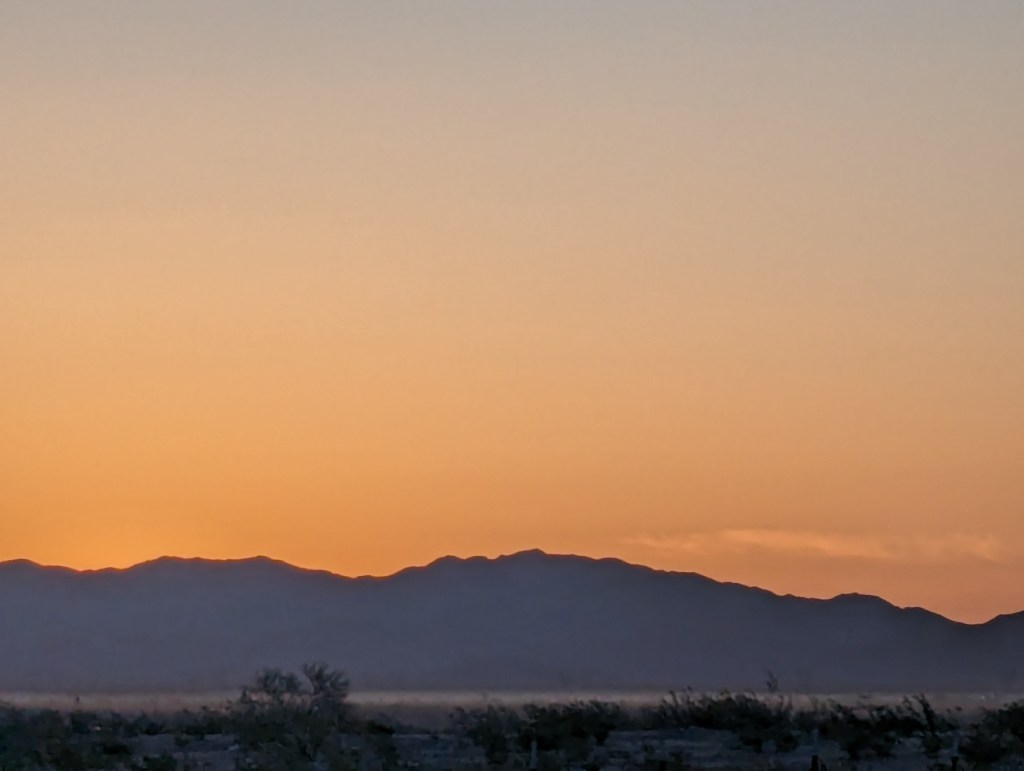
Anyway, my trip, although very different from how it was planned, was totally excellent! Just a short distance from the turnoff for the southbound San Diego Freeway towards my primary destination in Los Angeles, I was diverted to my secondary destination northwest of Phoenix. I missed the desert scenery as I drove all night to arrive shortly before four in the morning, and began my vacation exhausted. Although I missed out on some of my plans in Los Angeles, I got more time in Arizona. The weather was weirdly excellent, with a weirdly torrential thunderstorm right in the middle of it. It was too early in the year to collect the seed that I wanted, but I really was not expecting to find any anyway. I did happen to procure a hedgehog cactus of some sort. I decided that, since my return was already delayed by a day, that I may as well delay it for two days. (I had brought some of my work with me, so was able to tend to it prior to my return rather than after.) Therefore, I came to my original primary destination in Los Angeles secondarily, stayed to help Brent with the View Park Garden Tour on Sunday, and returned home on Monday.
Old fashioned New Zealand flax, Phormium tenax, is becoming increasingly uncommon. It is simply too big for compact modern gardens. Even without upright stems, its vertical and olive drab leaves can reach ten feet tall. They can flare outwardly as wide as fifteen feet. One cultivar is bronzed. Another is variegated. Both are somewhat more compact.
Most modern cultivars are either Phormium colensoi or hybrids of the two species. They are more compact and more colorful. ‘Jack Spratt’ grows only about a foot and a half tall, with chocolaty bronze foliage. ‘Yellow Wave’ gets about three or four feet tall with arching foliage with yellow stripes. Others are bronzed or striped with yellow, brown, red or pink.
New Zealand flax is remarkably resilient. The evergreen foliage is so very fibrous that it can be difficult to cut. Tough rhizomes that migrate where they are not wanted propagate easily by division. Some cultivars can revert by generating less colorful mutant growth. Since it is greener, such growth is more vigorous. It can overwhelm and displace more colorful foliage.
“Mediterranean” translates from Latin to “middle of land”. The Mediterranean Sea is in the middle of the land of those who named it. Other regions were either unimportant or unknown to them until the Sixteenth Century. Nowadays, most people of the World are aware of many other regions. A few of such regions also enjoy a Mediterranean climate.
Such climates are obviously not confined to the regions of the Mediterranean Sea. They merely resemble such climates. Some extend eastward into Western Asia. Others are in eastern and southern Africa, southwestern South America and Columbia. Larger regions of such climate are in southern Australia. The closest are here in western North America.
Even these limiting regional designations are debatable. Many horticulturists consider climates of New Zealand to be typical Mediterranean. Such climates are mostly between thirty and forty five degrees north and south. However, some might exist within northern India and southern China. Ultimately, climate is meteorological rather than geographical.
Mediterranean climates receive almost all of their rain during winter. Rain is very minimal through summer. Even if it is twice as abundant in other similar climates, it conforms to a similar schedule. Although winter chill is adequate for many species that need it, frost is mostly minor. Locally, summer weather does not often become too uncomfortably warm.
Native species know what to expect from local climate. So do exotic species from similar climates. Some may prefer more or less winter rain, summer heat or winter chill. Almost all can tolerate warm summers without rain, though. Such weather conditions are normal for them. Therefore, the most adaptable exotic species locally are from similar climates.
This includes species of Eucalyptus, Pittosporum and Callistemon from Australia. Aloe, Agapanthus and Morea are from South Africa. Phormium and Leptospermum are from New Zealand. Oleander and the various species of Lavandula are truly Mediterranean. In the past, a few exotic species adapted too efficiently to become invasively naturalized. Horticulturists are now careful to not import such potentially aggressive species.
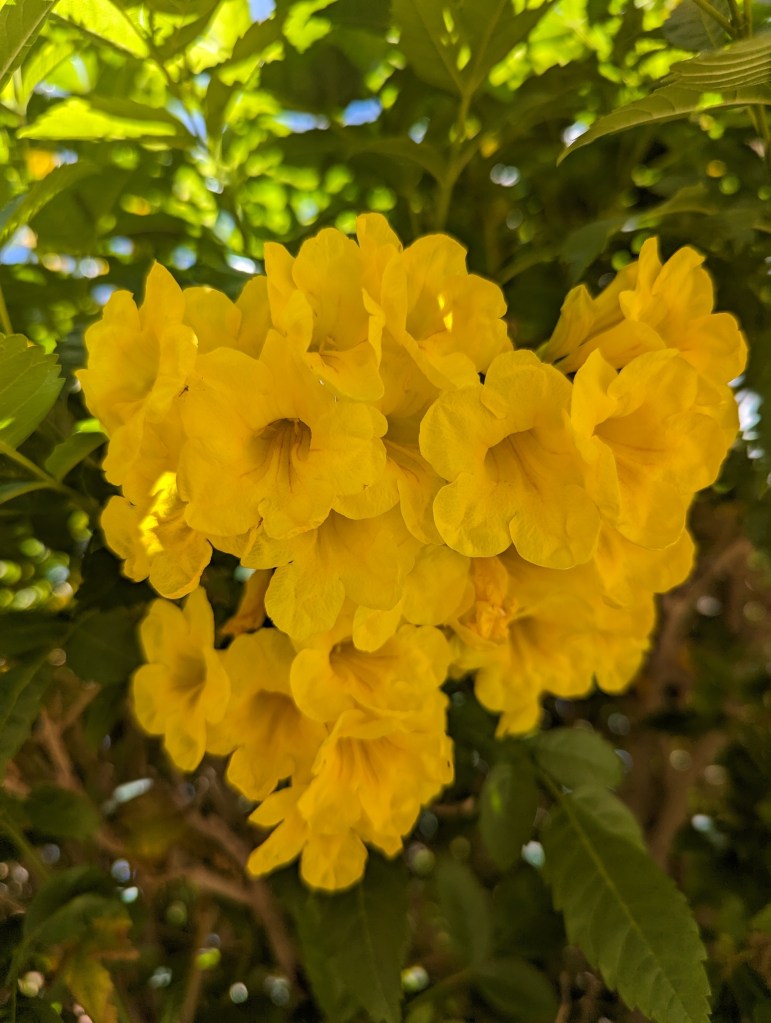
Tecoma stans is somewhat popular within the neighborhood where I stayed while in Arizona. It is available in nurseries also. I suppose that I could have purchased one or more for my garden. I had wanted to grow it for a long time. I refrained. I can explain.
The Tecoma stans that I can get from nurseries is an improved cultivar, or actually, about three cultivars. They are not the simple species, as it would be found growing wild. I realize that improved cultivars are known as ‘improved’ for a reason, but ultimately, I want to grow the simple species.
Crazy Green Thumbs sent me the seed for the simple species of Tecoma stans that I want to grow. That is all I need. Other colleagues have sent me seed, seedlings or cuttings for simple species of American beautyberry, American holly, American persimmon, pawpaw, red mulberry, red elderberry and perhaps too many other species to list briefly. In the future, I suppose that I could try cultivars of some of these species. I would like to get acquainted with them first though.
For most species, I suppose that I prefer cultivars. I want to grow the same ‘Moorpark’ and ‘Blenheim’ apricots that I grew up with. Eventually, I want to grow ‘John F. Kennedy’ rose. Cultivars serve a purpose also.
There are a few reasons why I want simple species rather than cultivars of some species. For American beautyberry, American holly and red elderberry, I want to grow what most other garden enthusiasts within the native ranges of these species grow merely because such species appear uninvited in their gardens. For American persimmon, pawpaw and red mulberry, I want to grow a few of the fruits that people enjoyed for culinary application prior to the development of relatively modern cultivars.
Giant redwood, Sequoiadendron giganteum, is famously the largest tree in the World. Although not quite as tall as the coastal redwood, Sequoiadendron sempervirens, it is bulkier. It grows taller than three hundred feet, with trunks wider than thirty feet, to weigh more than six hundred thirty tons.
Yet, like many species, it has at least one cultivar. ‘Pendulum’, which is the weeping giant redwood, is nothing like the simple species. It might grow forty feet tall, if it is able to support itself at such a height. It’s canopy might grow a few feet wide, but it really cascades more than it reaches outward. It really is weird. It looks more like a relative of Mr. Snuffleupagus of Sesame Street than like a relative of giant redwood.
Of course, its weirdness is what makes it so appealing. It is sculptural. It is bold. It really makes one wonder what planet it is from.
I got this picture in Kitsap County in Washington, hundreds of miles from the native range of the simple species within the Sierra Nevada. Actually, I see more of this cultivar in the Pacific Northwest than here. It likely performs better there because of the colder winter weather. Furthermore, this weird cultivar is more popular than the simple species, partly because it is so distinctive, and partly because it is more proportionate to home gardens. Simple giant redwoods only fit into very spacious landscapes.
Weeping giant redwood may not be good for anything more than its weirdness, but at least it excels at that. Otherwise, it provides no significant shade. It does not bloom conspicuously. It provides no fruit. It does not even make good firewood. Fortunately, weirdness has certain appeal. Within our home gardens, we can grow what we like, even if merely for its weirdness.
Arizona will be in the rear view mirror shortly after this episode of Six on Saturday posts at midnight on Saturday morning. I got a few pictures this time though. They are not too colorful only because I found the diverse cacti to be more compelling than the abundant desert bloom. Palo verde, esperanza, ocotillo, caliandra, oleander, bougainvillea, lantana and a few other flowers that I did not identify were all in bloom. A few others will bloom soon. We should be in Los Angeles by about noon, and at the View Park Garden Tour on Sunday. This is not how I planned this excursion, but it is working out rather splendidly.
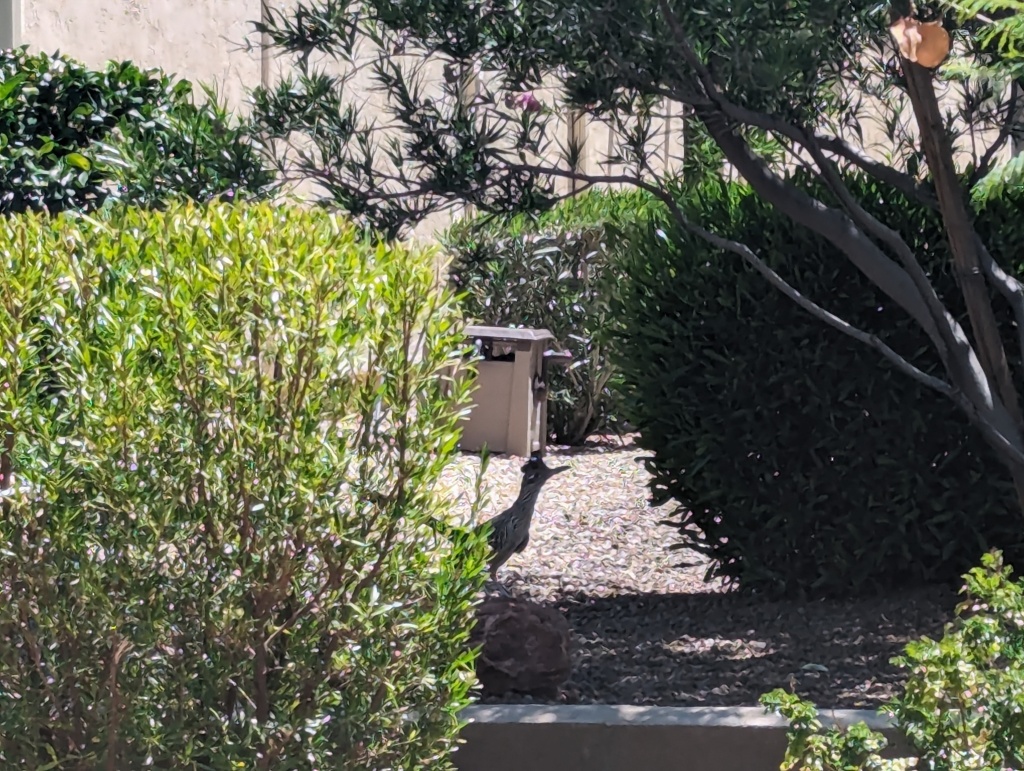
1. Wile E. Coyote, of whom I posted a picture last week, may have been requesting a ride to visit his old colleague, the Road Runner, here in Arizona. I neglected to consider that.
2. Cacti are obviously popular in Arizona, likely because they perform so reliably and are so striking. This and the next two are field grown nursery stock. I can not identify them.
3. This cactus developed a rather wide colony. Many impressively big cacti get relocated. However, I doubt that this entire colony can be relocated intact. It will likely be divided.
4. This unidentified lumpy cactus seems to be quite tame. The few that I have noticed in my neighborhood grow less than three feet high. They grow almost twenty feet tall here.
5. Hesperaloe parviflora, red yucca is difficult to get a good picture of. Its grassy texture and grayish color can look shabby. Its pink bloom is nice against a clear blue sky though.
6. Carnegiea gigantea, saguaro is the State Flower of Arizona, and what tourists like me expect to see in Arizona. I pulled over outside of town to take this picture from the road.
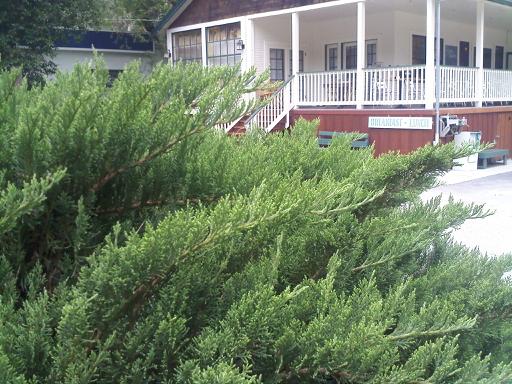
As much as I like junipers, even I have my limits. The tamarix juniper or tam, Juniperus sabina ‘Tamariscifolia’, is the juniper that gave junipers a bad name decades ago by being too common in too many of the wrong situations, and remains one of the most commonly planted junipers. What I do not like about it is that it is classified as a ‘ground cover’ juniper and can sprawl more than eight feet wide, but actually piles up more than two feet deep! However, I have noticed that it can be practical for certain situations as a ‘sprawling shrub’ instead.
Even without the foliar color or sculptural branch structure of other shrubby junipers, the dense dark green foliage and compact branch structure give the tam its own appeal and practicality. It can be shorn into low informal hedges as frequently as annually. It readily recovers its feathery texture if shorn as the weather starts to get warm in spring. All it wants is sunlight and infrequent but deep watering in summer.
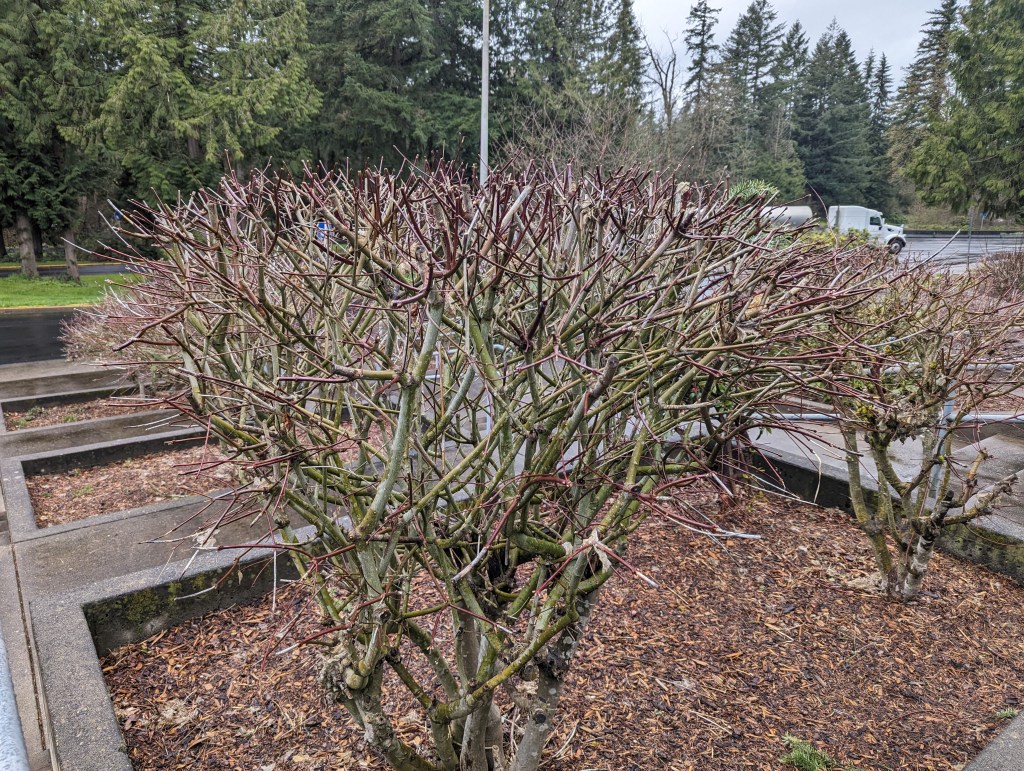
Vine maples should be small trees, not . . . this.
In the short time it took me to run to the back yard to get some big stakes and something to pound them into the ground with, the unfortunate deed had been done. I had come home to find that one of my neighbor’s new Canary Island pine trees had blown down. I also noticed that the gardeners were there; so I wanted to get the tree staked properly before the gardeners got to it. Sadly, as I returned with stakes, ties and a mallet, I found that the gardeners were faster. Instead of standing the small tree up and staking it, they had already shorn the formerly well structured canopy into a globular mound that was about the same size and shape as most other items throughout the landscape, for no other reason than it was within their reach.
This same landscape had egg shaped African iris ‘bushes’ that only rarely bloomed if they happened to get an errant flower stalk out between shearings, and short, round trumpet vine ‘bushes’ in front of hefty but bare trellises that they were never allowed to climb. Everything that was within reach was shorn, even the underside of an elegant Chinese elm that really should have been pruned properly by an arborist. The landscape was actually well designed, but could not perform as planned because of the shear abuse.
I really do not mind proper shearing of particular shrubbery that is intended to be shorn. I actually like old fashioned privet or boxwood hedges. However, even hedges need to be shorn properly; and realistically, not much else should be shorn as often. If it needs to be shorn regularly, but is not a hedge, it is probably not the right plant material for the job.
Properly selected plant material is proportionate to its particular application. This certainly does not mean that it does not need to be pruned. Most deciduous fruit trees and roses need to be pruned aggressively every winter, and almost all plant material needs to be pruned in some manner at one time or another. The difference is that shearing is indiscriminate pruning of outer growth without regard for foliage, bloom or branch structure. This is fine for hedges, but disfigures many other plants, and deprives them of their blooms and natural foliar textures that they were planted for.
For example, wisteria is an abundantly blooming robust vine that becomes a gnarled shrub that cannot bloom if shorn. Heavenly bamboo (nandina) is grown for its graceful and colorful foliage, but becomes a grungy rigid thicket of tattered leaves and stems with shearing. Although some shrubby junipers can make nice low hedges, frequent shearing deprives them of their feathery texture.
This is why it is so important to know what the various plants in the garden need. They can only perform as intended with the proper care and maintenance, which includes proper pruning. Hedges may only need to be properly shorn, but almost everything else needs to be selectively pruned, thinned, elevated (raised), divided, groomed, trimmed, trained or even cut back.
These coastal redwoods are very distinct from giant redwoods.
“Hidden giants: how the UK’s 500,000 redwoods put California in the shade” was published in the Guardian more than a month ago. It was amended to specify that it is about giant redwoods rather than all redwoods, as if that is a distinction that is easily omitted. Incidentally, it later mentions that, “For millions of years, the world’s tallest trees have graced California peaks and coastlines,” which is a reference to coastal redwoods, which are a different genus from giant redwoods.
What is worse is the claim that, “Researchers found that the Victorians brought so many seeds and saplings to Britain that experts say the giant redwoods now outnumber those in their US homeland.” More specifically, it continues to explain that, “The Victorians were so impressed that they brought seeds and seedlings from the US in such large numbers that there are now approximately 500,000 in Britain, according to a Forestry Commission estimate that includes coastal redwoods and dawn redwoods (a separate Chinese species) as well as the giant redwoods. Experts at Kew think most of the UK trees are giant sequoias, the official name for giant redwoods. California has about 80,000 giant redwoods, as well as also having coastal redwoods and a few ornamental dawn redwoods imported from China.”
Essentially, the article claims that this data demonstrates that there are more redwoods in the United Kingdom than there are here. Apparently, approximately half a million redwoods live there, and “experts” “think” that most are giant redwoods. Also apparently, only about eighty thousand giant redwoods live here.
Response to this is no easy task. It is a comparison of all redwoods in the United Kingdom to a very slim minority of redwoods here. About eighty thousand mature specimens of giant redwood live in the wild alone. Countless more immature specimens, including abundant seedlings that are only a few years old, live with them. Countless more giant redwoods have been installed into landscapes throughout areas of California that are collectively almost as large as all of Britain. Such trees have been getting planted here at least as long as they have been getting planted there. It is impossible to estimate how many giant redwoods are here, but there are many more than merely half a million. Furthermore, regardless of how the article was revised, the half a million redwoods of the United Kingdom includes coastal redwoods and dawn redwoods. There may be as many dawn redwoods here as there are there. More importantly, there are more than two million acres of wild coastal redwood forest here. In other words, for every redwood of any species there, there are at least four acres of wild coastal redwoods here. Many redwoods inhabit each acre of redwood forest. Also, many millions of coastal redwoods are planted into landscapes here.
Incidentally, the three species of redwood are actually three distinct genera, and the official name of giant redwood really is giant redwood. It is Sequoidendron, not Sequoia.
The article continues to say with complicated grammar, “Spurred by the climate crisis, devastating droughts and scorching temperatures have added new stressors for the redwood, particularly the famous giant sequoias, which now struggle to bounce back after big wildfires.” However, there is no climate crisis with devastating droughts or scorching temperatures here. Summers here are naturally dry and warm. That is simply how the climate here is. Most forests here burn at least every century or so. Therefore, redwoods that are thousands of years old have survived many fires. Now that some forests are allowed to burn as they naturally should, fires will not likely be so unusually lethal to younger redwoods in the future. Another claim that, “Vulnerable trees are also increasingly under attack from native bark beetles, insects that feed on their spongy red trunks until they topple.” is likewise inaccurate. Bark beetles rarely damage redwoods, and are no more likely to damage them now that they ever had been.
Of the few unrelated species of dusty miller, the most common here is Senecio cineraria. Like other dusty miller species, its foliage is remarkably silvery white. Its foliar tomentum can be so thick that it resembles fine felt. Individual leaves exhibit intricately deep lobes. They are about two to five inches long, but are smaller and simpler on upper floral stems.
Dusty miller blooms with floppy clusters of tiny but bright yellow daisy flowers. However, because the colorful foliage is more appealing, bloom might not be a priority. Removal of floral stems prior to bloom promotes denser and neater foliar texture. Within more severe climates, dusty miller is a warm season annual. It is a resilient shrubby perennial locally.
Mature specimens of dusty miller can get a bit taller than three feet with bloom. They are shorter with grooming and pruning to maintain compact form without bloom. If necessary, they are conducive to pruning to limit their height to about a foot and a half. This species tolerates a bit more partial shade than other dusty miller. Ideally, it prefers sunny warmth.







 Tony Tomeo