Hall’s Honeysuckle

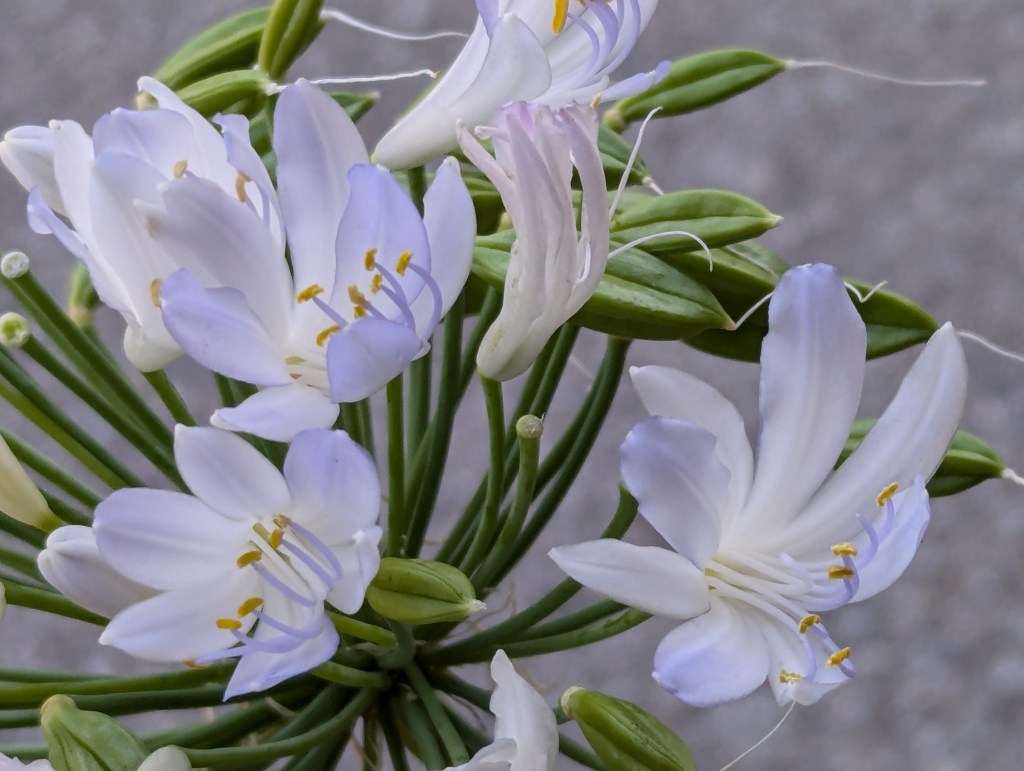
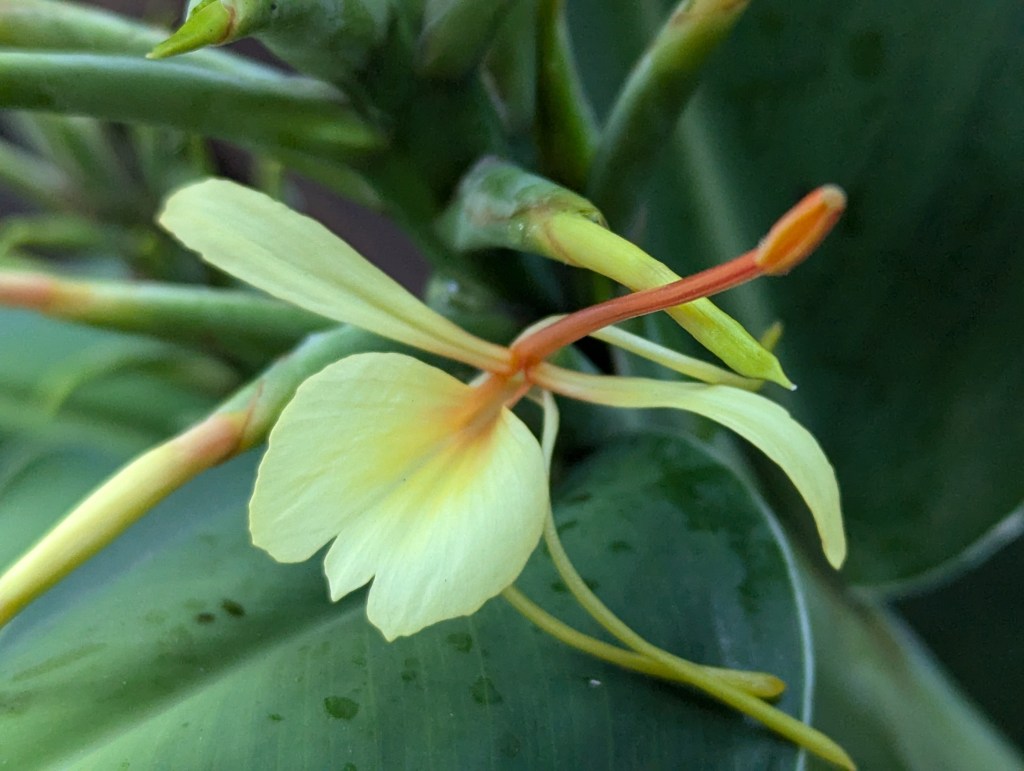
Hall’s honeysuckle climbs aggressively by twining.

The unrefined twining vines of good old fashioned Hall’s (Japanese) honeysuckle, Lonicera japonica ‘Halliana’, seem to fit in so naturally with lilacs, hydrangeas and bearded iris; the sort of plants that grow in grandma’s garden. Grandma may need help controlling it though, since it can climb more than twenty five feet, and get overgrown and invasive. It is best pruned back to main canes or to the ground annually at the end of winter. Even though it is evergreen, it drops some of its foliage and looks rather tired by the end of winter anyway.

Just as the fragrance of the earlier spring blooming flowers gets depleted, Hall’s honeysuckle begins to bloom with its own distinct sweet fragrance, attracting bees and hummingbirds. Bloom is typically most abundant in spring, and followed by sporadic bloom until autumn. Fluctuations of weather or watering can cause subsequent phases of abundant bloom during summer. The pale white tubular (and bisymmetrical) flowers fade to pale yellow that is perhaps the color of French vanilla ice cream. The simple light green leaves are about two inches long. A few leaves on the most vigorous vines may be lobed.

Every Species Of Vine Is Distinct

Bougainvillea does not cling to its support. It merely leans on it, or must be tied.

Harvesting grapes from a pear tree last summer reminded me why it is so important to control the grape vines this year. Without proper confinement to the fence below, the grape vines had climbed into and overwhelmed the pear tree above. My neighbor who witnessed the consequences of my lack of diligence in the garden, and helped me with the harvest, mentioned that the ‘grape tree’ was more productive than the vines had been when properly maintained during the previous year. I was embarrassed about my transgression nonetheless.

My colleague in Southern California has no problem grooming the many different kinds of vines that adorn arbors, trellises, walls, fences and railings in his garden. I certainly could not let him find out that I was vanquished by my single grapevine, which he refers to as ‘Dago wisteria’. I probably remind him of how important it is to control his vines more often than I am offended by racial slurs.

The trick is to select vines that are appropriate to each particular application. Vines for small, light trellises must be relatively complaisant, like lilac vine, pink jasmine, Carolina jessamine or clematis. Aggressive vines like wisteria, grape (the ‘other’ wisteria) and the larger trumpet vines need hefty trellises or arbors. Brambles and scrambling plants like bougainvillea and climbing roses do not actively climb, so need to be tied or ‘tucked’ into their supports.

Some of the seemingly innocent vines can actually become somewhat aggressive. Mandevillea, potato vine and star jasmine have wiry stems that seem harmless enough, but can eventually tear apart lattice or light trellises. Perennial morning glory and passion vine are potentially invasive. Trailing nasturtiums and annual morning glory really are as innocent as they look, so are nice small annual vines where space is limited. I prefer pole beans though.

Vines like Boston ivy, Virginia creeper and creeping fig that attach to their supports with roots or discs (modified tendrils) are too destructive for most applications in home gardens. They are fine on unpainted reinforced concrete buildings and concrete walls, such as the retaining walls and sound walls of freeways, but will ruin paint, siding, stucco and shingles. Unlike the other vines, these lack colorful bloom. Boston ivy and Virginia creeper produce remarkable fall color though, but then defoliate revealing bare stems through winter.

Algerian and the various English ivies are good ground cover plants that will become climbing foliar (without showy blooms) vines if they reach support. Unfortunately, they root into their support like creeping fig does, so have limited practicality. Honeysuckle is an aggressive vine that can also double as a ground cover.

Horridculture – Graffiti

Is this some sort of abstract art?!

This picture is all sorts of wrong! Brent sent it to me from Los Angeles. He has a habit of sending obnoxious pictures such as this.

Firstly, why would anyone install Italian cypress in such pointless situations?! The specimen to the left is centered on a prominent window. It is an unsightly obstruction to the window, and would be just as unsightly and obstructive to the window above if only it had not been so severely disfigured. Although the larger specimen is a bit farther from the window, it is just as unsightly, obstructive and pointless.

Secondly, why would anyone disfigure Italian cypress by topping them like this?! It would be more practical to remove them if their naturally upright form is undesirable for this particular situation. Then, some other preferable vegetation could be installed instead, or perhaps nothing at all.

Thirdly, why would anyone maintain these already disfigured Italian cypress like this?! Just remove them already! They are unsightly! Seriously, someone obviously puts quite a bit of effort into shearing them so systematically. Are they that important?! Does someone actually like these pathetic trees in this pathetic condition?! Am I missing something here?!

Finally, or fourthly, how could someone make this situation any worse by defacing the larger of these two Italian cypress with graffiti?! Seriously, that takes a bit of effort also. Cut the trees down already! Why do these trees not simply die of embarrassment?! Is this supposed to be some sort of conceptual or abstract art?! Is this here merely to see what sorts of reactions it gets?! Can anyone even read what that graffiti says?! Perhaps it translates to “PLEASE CUT THESE TREES DOWN!” This picture leaves me with way too many unanswered questions. Well, if nothing else, these sad Italian cypress were strangely entertaining.

Carob

Carob eventually develops gnarly branch structure.

John the Baptist survived in the Wilderness of Judah by eating locusts and honey. These locusts could have been large orthopteran insects, such as grasshoppers. However, they were more likely fruits of locust trees, such as carob, Ceratonia siliqua. Both possibilities are both nutritious and kosher. The insects got their name from resemblance to the fruit.

That was almost two millennia ago, and more than seven thousand miles away. Carob is much more popular than grasshoppers here and now. Unfortunately though, within home gardens, the fruit is more of a mess than an asset. Male trees are not messy like females, but produce objectionable floral fragrance. Monoecious trees are both messy and stinky.

Mature trees develop broad canopies that are generally less than thirty feet high. Trunks and main limbs eventually become sculpturally gnarly. Densely evergreen foliage is very shady. Pinnately compound leaves are olive drab, glossy and four to seven inches long. Female orchard cultivars should be fruitless without a pollinator, but are rarely available. Besides, it is impossible to know if a male tree is within pollination range.

Microclimates Are Distinct From Climates

Larger buildings inevitably produce larger microclimates.

Climates and geology are why cinema and television industries are so established here. Cinema evolved in Niles before relocating, with the evolution of television, to Hollywood. The diversity of local climates, geology and associated scenery was the primary appeal. Farmers of all sorts had already been exploiting such climates as well as microclimates.

Climate is a regionally prevalent pattern of weather. Mediterranean or chaparral climates are prominent locally. Coastal, desert and alpine climates occupy other relatively nearby regions of California. Variations of geology influence weather, which determines climate. This comprises mountains, valleys, various altitudes and proximity to the Pacific Ocean.

Microclimates, as their designation suggests, are small climates within big climates. With such a mix of climates here, microclimates might be difficult to distinguish. Some climate zones of steep coastal hillsides are very narrow, for example. Yet, if they are distinct from those for higher and lower elevations, they are climates. Microclimates are even smaller.

For microclimates, exposure is as relevant as endemic climates. Such exposure can not change climate, but modifies its influence. For example, large eaves and warm walls can provide localized shelter from frost. Southern slopes of hilly terrain are likely a bit sunnier and warmer than northern slopes. Buildings and fences shade garden area to their north.

Many microclimates, such as those that involve terrain or forest shade, are natural. They are generally less dynamic than unnatural microclimates. Forest shade changes only as fast as associated trees grow or die. Only major disruption, such as fire or timber harvest, accelerates such slow change. Terrain may not change significantly for millions of years.

Unnatural microclimates are more dynamic and unpredictable. Taller modern homes and fences shade more within adjacent gardens. Skyscrapers can extend their shadows into gardens a few blocks away. Conversely, some can reflect sunlight to adversely increase heat and glare. Expansive and unshaded pavement likewise increases ambient warmth.

No Shame

Nature still does what it wants to.

Squirrels are annoying. I do not care that gray squirrels are native, or that their ancestors were here before mine. They are still annoying. They ruin bulbs, seedlings, fruits, nuts and vegetables. Although I do nothing to exclude them from my garden, I do not want them there.

Some native vegetation is also annoying. It grows like weeds where I want other vegetation to grow. Like for squirrels, I do not care if it is native. It is still annoying, and I do not want it trying to infest my garden where I grow vegetation that I want to grow.

I have been told that native species can not be invasive merely because it was here before I was. That is completely false. If it aggressively invades my garden, then it is invasive. Claiming otherwise is comparable to claiming that I can move into any home here that I choose simply because I am native.

Everyone who lives here inhabits space that was formerly occupied by native flora and fauna. So does all the infrastructure. Anyone who disapproves should leave, and relocate to where they do not occupy space that was formerly occupied by native species. I do not know where that is, but perhaps they do.

Realistically, I do my part. I live very simply, in compact and minimally consumptive homes. Although I enjoy gardening, I do not use much more space than is necessary to sustain my simple lifestyle. I do not live so simply because I would feel guilty about living more lavishly. I do so because it appeals to me, and allows me to feel less sheltered from the same sort of nature that some might accuse me of being inadequately protective of. Ultimately, nature does what it wants to here, with or without my assistance.

Six on Saturday: Mostly Flowers

Simply, these are six varieties of flowers. All but one bloomed last week. Half are hybrid cultivars of the same genus with two in the same picture. Six pictures of flowers with two varieties in one picture should include seven varieties of flowers. But of course, “mostly” indicates something that is not exclusive. Anyway, I should have gotten more pictures at work, since it was a rather fun week. Irrigation is getting more demanding, though, now that the weather is getting warmer. Because we need to delay renovation of a prominent landscape, we installed potted Canna onto the site. They are potted to facilitate removal when renovation resumes, but will be rad!

1. Lantana camara, which is known here simply as ‘lantana’, is too colorful to not share. Actually though, it is from three weeks ago, and west of Phoenix. Ours is more yellowish.

2. Rosa ‘Iceberg’ and ‘Burgundy Iceberg’ are grafted together on two old rose trees in the rose garden. I find multiple grafts to be annoying, but guests find them to be intriguing.

3. Rosa of an unidentified cultivar blooms better with better exposure, and also without the other cultivar that it was originally grafted with, but that was crowded out years ago.

4. Alstroemeria peruviana, Peruvian lily will not die. We removed large colonies at least twice from this location, but some always survive. They are yellow, orange, pink and red.

5. Lilium, which seems to be some sort of fancy Asiatic lily, was a gift from a neighbor. I did not expect them to perform so well, but after only four years, they should be divided.

6. Rhody is the only one of these six who is not a flower, although another type of flower is named after him. Morgan, his F250 who identifies as a Mercury, wants to get washed.

This is the link for Six on Saturday, for anyone else who would like to participate: https://thepropagatorblog.wordpress.com/2017/09/18/six-on-saturday-a-participant-guide/

Spanish Lavender

Spanish lavender blooms with bows on top.

It is neither as variable as the many varieties of English lavender, nor as traditional as French lavender, but Spanish lavender, Lavandula stoechas, has the most unusual flower spikes. These short plump spikes are less than two inches long, but are topped with one or two pairs of distended terminal bracts that are almost as long; like simple little packages with big ornate bows. The flower spikes get their color from densely set bracts that surround the minute flowers, and can be various shades of purple or purplish pink or even grayish white. The large terminal bracts are lighter shades of the same colors.

Bloom begins during warm spring weather and continues into summer. Flower may stay close to foliage on stems less than two inches long, or may stand more than six inches above the foliage. The aromatic grayish leaves are narrow and about an inch long.

Mature plants may be three feet wide, and nearly as tall. Aggressive shearing after bloom promotes secondary bloom later, and keeps plants compact. Without pruning, old plants eventually die out in the center.

All lavenders want good drainage and good exposure, but do not want mulch or fertilizer. Inadequate drainage, crowding or mulch can promote rot. Fertilizer can inhibit bloom. Once established, lavenders do not need much water. 

Aromatic Foliage Is An Acquired Taste

Foliar aromas and flavors that are useful for culinary application deters many grazing animals.

The infinite variety of colors, fragrances, flavors and even textures that plants use to solicit the help of wildlife is amazing. Flower color, fragrance and sometimes texture are customized to attract very specific pollinators, and guide them to where they are needed. Many flowers direct and reward their pollinators with flavorful nectar. Fruit color, flavor and aroma attract specific animals to take the fruit, and disperse the seeds within. There is no end to what plants will do for their friends. We are merely secondary beneficiaries.

It is ironic that we also enjoy aromas and flavors that are instead designed to be objectionable to plundering herbivores. For example, the appealingly pungent foliage of most herbs is actually intended to repel grazing animals or feeding insects. We not only exploit these herbs for culinary purposes, but also to add their aromas to our gardens.

Lavender, mint, rosemary and the various thymes and sages are the most popular herbs that are attractive both aromatically and visually, whether or not we actually use them in the kitchen. Rosemary is actually a common and practical ground cover for large areas. Thyme is a good ground cover for smaller areas, and stays low enough to be grown around stepping stones where it becomes even more aromatic if stepped on.

Grecian or sweet bay is another herb that actually grows into a sizeable but practical evergreen tree. The native bay laurel is a bit too large to be as practical where space is limited, but is even more pungent. Although generally not useful as herbs, the various cypresses, pines, cedars and eucalypti are appreciated for their aromatic foliage as well. Incense cedar is particularly pungent.

Two of my favorite types of plants, junipers and geraniums, are among the more common aromatic shrubbery. Although actually considered to be perennials, zonal, ivy and of course, scented geraniums, can be used as small shrubbery or small scale ground cover. Junipers of course, range from ground covers to shrubbery to small trees.

Rockrose, breath of Heaven (Coleonema spp.) and myrtle are all quite aromatic. The old fashioned myrtle that gets considerably larger than the modern compact variety is even more aromatic. Lantana is an aromatic ground cover or low mounding shrubbery.

The aromas of aromatic foliage are strongest as fresh new foliage emerges in spring, and particularly after spring rain. Some people like to put aromatic plants where they will be slightly in the way, since foliage relinquishes its aroma more readily when slapped with a gate, bumped, or otherwise disturbed.