Horticultural industries are innately hazardous. Most horticultural professionals work outside in all sorts of weather, regardless of what that weather might be; stormy, cold hot and so on. Some of us who grow horticultural commodities might occasionally work with hazardous chemicals, and many of us work exhaustingly long hours, and sometimes in the dark of night. Those who work with landscapes might also work with the same chemicals, as well as potentially hazardous motorized tools. Arborists work with the most hazardous machinery, as well as dangerously heavy debris falling from great heights, and those who climb do their work dangerously high above the ground. Then there is this, which sounds much worse than its bad punctuation. “!PLEASE DO NOT! SIT (I WAS HIT BY A STRAY METEOR)” It sounds like all sorts of bad! I do not know what is worse, sitting or a stray meteor. It is not actually a horticultural concern, but the implication is that whatever happened, it happened on this now broken bench that was formerly located within one of the landscapes that we work in. I suspect that the bench merely broke because it was deteriorated by the weather, which is a concern of meteorology.
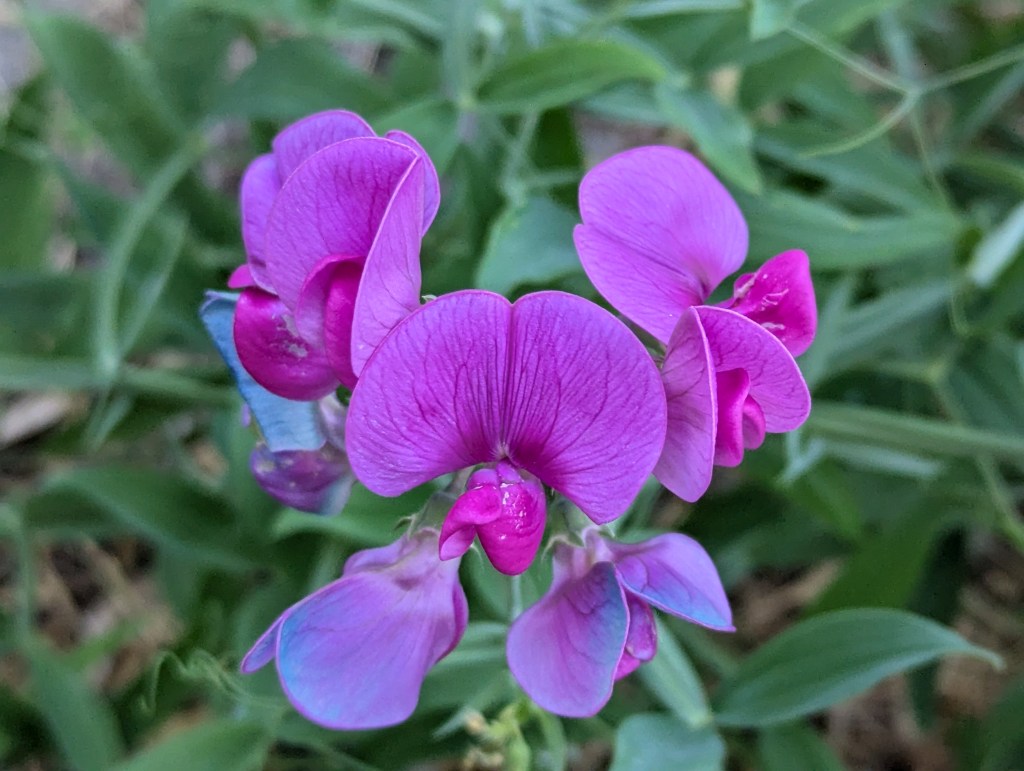
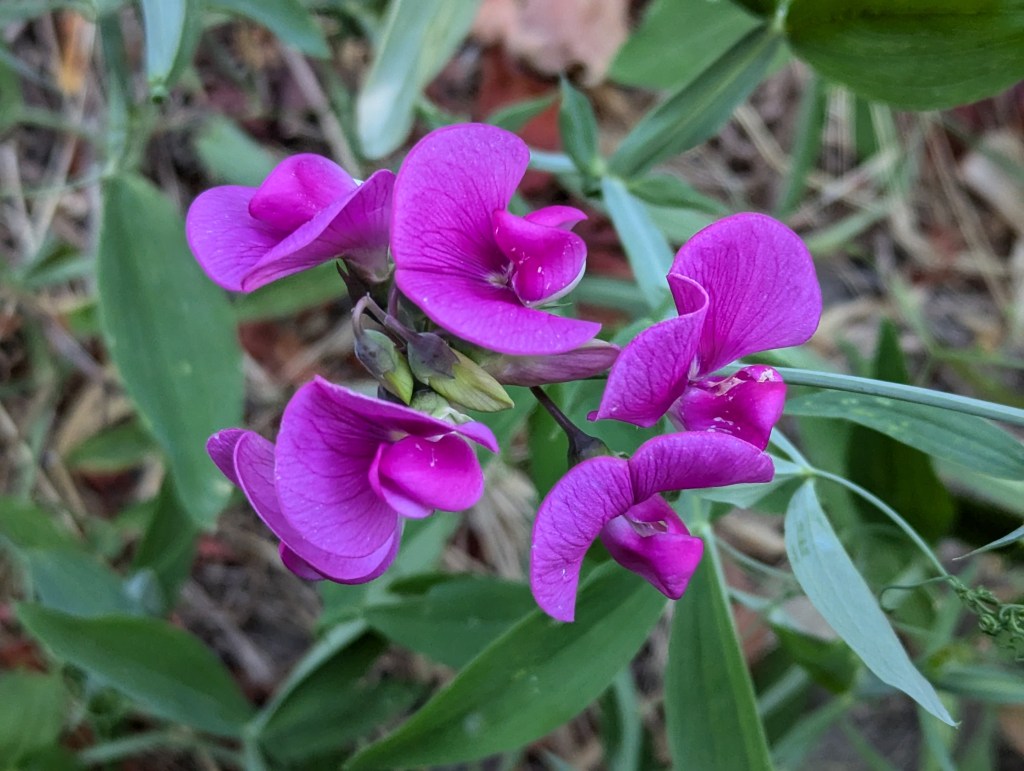
P was about a white blooming perennial pea, Lathyrus latifolius, that I recently found to replace what I inadvertently lost earlier. P II was irrelevant to both that and this, but did happen to get a title that incorrectly designates it as a sequel to P, and prevents me from using that title for this Six on Saturday post with three variants of perennial pea and the more typical sort. Perhaps I should not have expended such effort for such a weed. What is worse is that I canned and am now growing copies of the three variants as well as the favored white blooming variant.
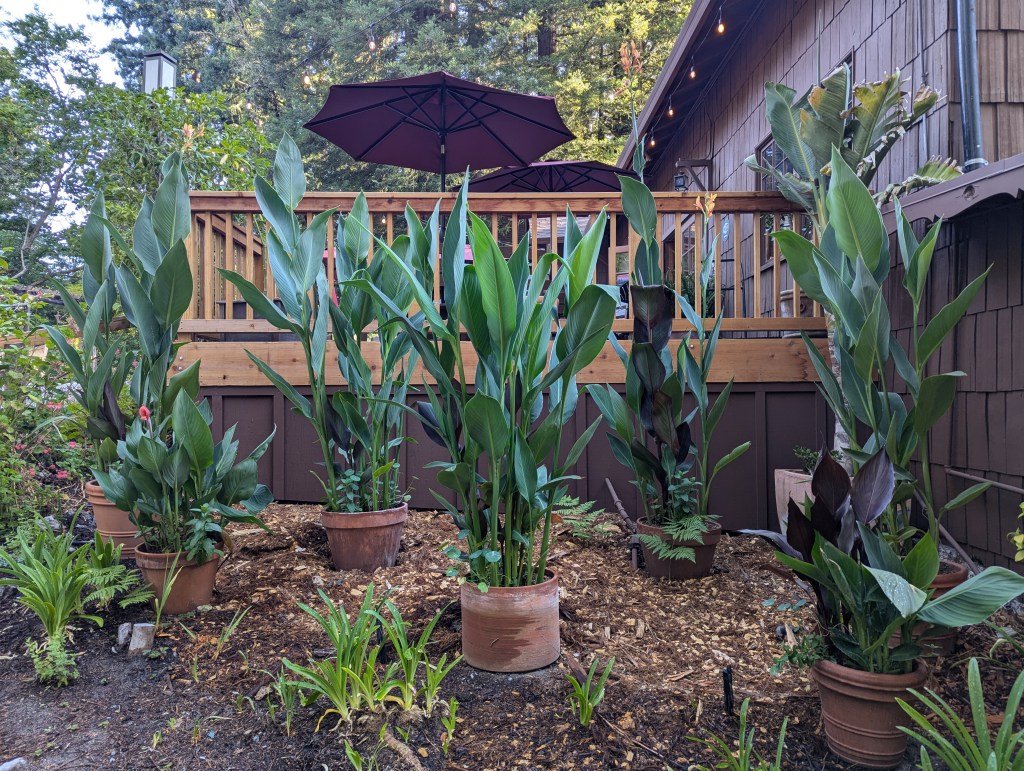
1. Canna are irrelevant to the primary topic, but are too cool to not mention. These were placed here temporarily in random pots until a new landscape gets installed next winter.
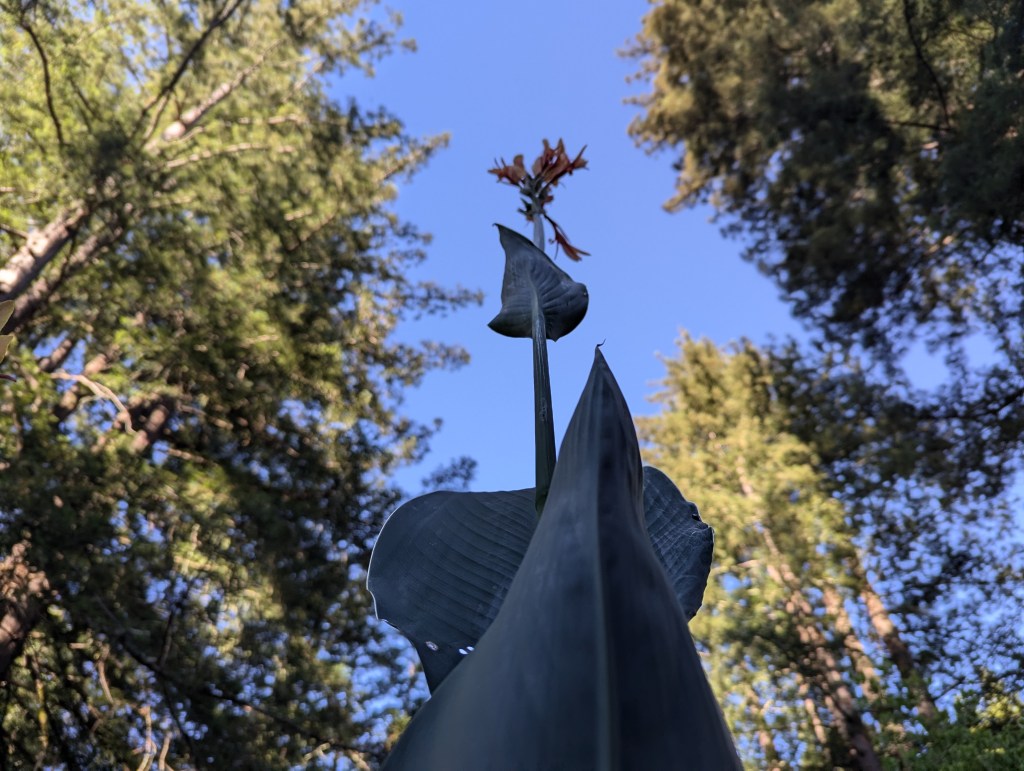
2. Canna musifolia dominates, which is why there is not much bloom. This one stands a bit more than eight feet high in its pot. It might be ‘Omega’ like the compact Oldsmobile.
3. Lathyrus latifolius, perennial pea is the primary topic because I found three variants. This one blooms with swirled pink flowers. It is about as rare as those that bloom white.
4. This looks white in this picture but is actually blushed very slightly with pink. I should have gotten a better picture. I dug and canned a copy because I had never seen it before.
5. This is the typical floral color of the species. To me, it looks purplish pink. I am not so proficient with color. Others say it is pinkish purple. It justifies my preference for white.
6. Like the picture of the very slightly blushed white flowers, this is not a good picture of flowers that seem to be slightly richer purple than the typical purplish pink. I got a copy.
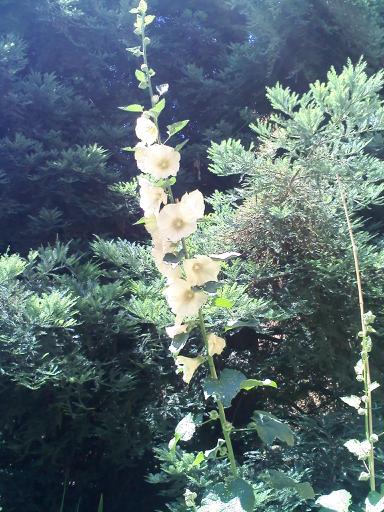
Hollyhock was more popular within Victorian gardens.
Old fashioned hollyhock, Alcea rosea, can be a bit too imposing for small gardens, since their spire like flower stalks can get taller than eight feet. Modern varieties are more proportionate, standing about five or six feet tall. Some are only about two and a half feet tall. Many modern varieties also have fluffier semi-double or double flowers. Those with smaller flowers have denser flower set than old varieties (Flowers are closer together on the stem.).
The three to five inch wide flowers bloom through summer in shades of pink, red, purple, pale yellow, pale orange and white. Removal of spent flower stalks may promote shorter autumn blooms, but also prevents self sowing. Seed can be sown at the end of summer for blooms next year. The coarsely textured and variably lobed basal foliage does not get much wider than two feet. Snails and rust can be problematic.
(This article is several years old, so some of the information within is likely outdated.)
Those who witnessed the event know that it actually happened. During citrus season a few years ago, a crew of volunteers descended upon, or should I say, ascended ladders into the legendary and monstrously large King Grapefruit Tree in a gallant but hopeless attempt to harvest the fruit. Our caravan of an assortment of smaller pickups and my full sized Ford that we drove out to confront this aberration of nature where it resided was completely full by the time we had harvested only about a third of the fruit. We left happy with our plunder, but unexpectedly defeated by the abundance left behind. I have seen many fruit trees throughout my career, but have never seen so much fruit in a single tree!
It may have watched us leave exasperated with our mud-flaps dragging, but the King Grapefruit Tree was not solely victorious. We Village Harvest volunteers and the many beneficiaries of Village Harvest enjoyed its fruit for weeks! Village Harvest arranges for community fruit harvesting events to collect fruit that might otherwise go to waste so that it can instead be distributed to people in the community who can use it. The fruit of the King Grapefruit Tree was donated, and more was harvested later, so that it would not become an unwanted mess for the residents of the nearby home.
This is just one of many examples of how Village Harvest community fruit harvesting events benefit everyone involved. Those who donate their surplus fruit get it harvested and taken away before it becomes messy. Village Harvest volunteers get to take a bag or so of the fruit that gets harvested during the event. The clientele of the local food agencies that distribute the produce get fresh home grown fruit from the Santa Clara Valley; which is, as we all know, the best in the world.
Although citrus season is still several months away, five community fruit harvesting events are scheduled to collect summer fruit through July. On July 18 and again on August 1, two Mountain View community harvesting events will be from 9:00 a.m. to 12:30 p.m.. Two Central San Jose community harvesting events will be from 8:30 a.m. to 12:30 p.m. on both July 20 and July 27. The Sunnyvale community harvesting event will be from 8:00 a.m. to noon on July 26. Locations to meet for each event can be determined when making reservations.
Information about volunteering for any of these and other events, or how to arrange for donation of fruit, can be found at the website, www.villageharvest.org, or by telephoning 888 – 378 4841. Because admission is limited, it is advisable to make reservations for any event early, either online or by telephone. (It may be too late for the July 18 event.) Parking is also limited, so participants should carpool if possible. Pickups and station wagons to help transport fruit are very helpful. So is a grocery bag to share in the harvest afterward. Covered shoes (not sandals) are important. Layered clothing is more comfortable for cool mornings that get warmer closer to noon.
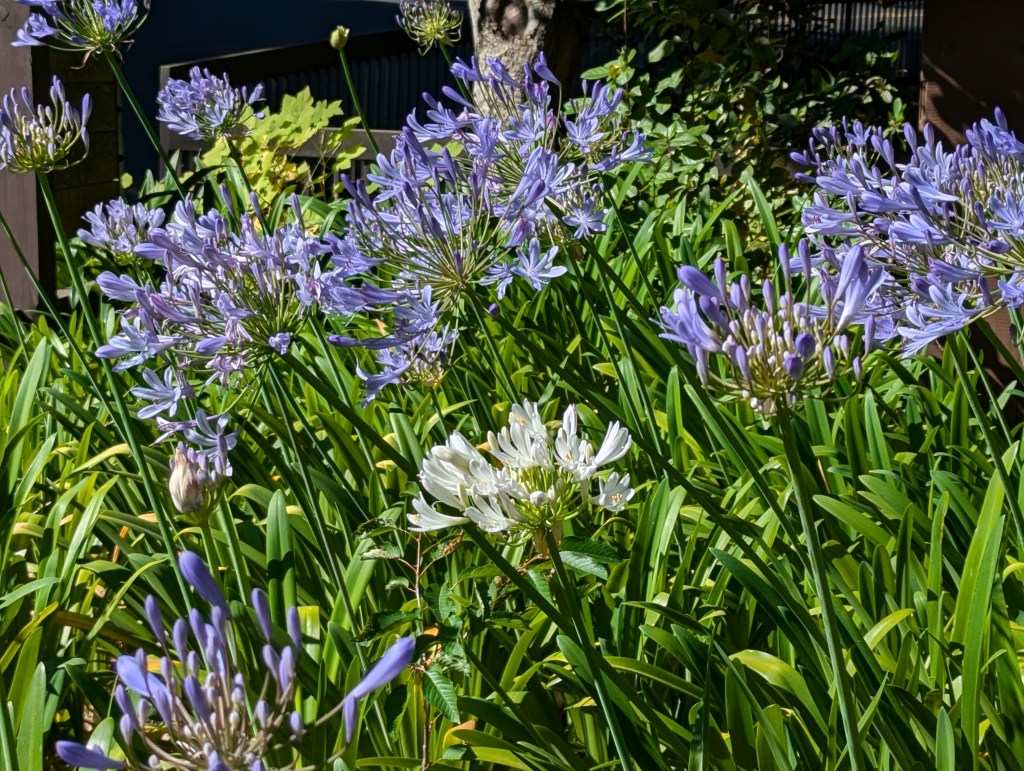
This white lily of the Nile appeared this summer within this exclusively blue colony.
Horticulturally, a sport is a genetically variant growth. Although it is more common among extensively bred or genetically aberrative cultivars than simple species, the most basic of lily of the Nile can, on rare occasion, change floral color from blue to white or from white to blue, as I mentioned on the sixth of July. Unvariegated or ‘green’ sports are a more common annoyance among some cultivars with variegated foliage, such as popular cultivars of Euonymus japonica, since they grow faster with more chlorophyll, and can overwhelm the original and more desirable variegated growth. The yellow hybrid gladiola that I posted a picture of for Six on Saturday on the twenty-ninth of June could be a sport of an adjacent orange and yellow hybrid gladiola. I did not give it much consideration because I assumed it to be the first bloom that I noticed from one of a few bulbs that somehow survived for a few years longer than expected. Until last summer, the only hybrid gladiolas to survive from a mixed batch planted years earlier had been either purple or the aforementioned orange and yellow. However, now that the yellow bloom is gone, an equally unfamiliar orangish red bloom emerged from the same small colony of bulbs that had bloomed only orange and yellow. As their common name suggests, hybrid gladiolas are hybrids, so are innately genetically unpredictable, and therefore have potential to generate sports as they multiply. Although I do not know for certain that this new orangish red hybrid gladiola did not survive without blooming for the past few years, I sort of suspect that it and the new yellow hybrid gladiola are more recently developed sports of the original orange and yellow hybrid gladiola. I hope that both are as reliably perennial as the original.
This orangish red hybrid gladiola seems to be a sport of the orange and yellow hybrid gladiola.
Mundane floral color and a lack of floral fragrance are no problems. Smokebush, Cotinus coggygria, compensates. Its uninteresting bloom reveals strikingly fluffy floral trusses for summer. These trusses eventually deteriorate to reveal exquisitely vibrant foliar color for autumn. This foliar color eventually deteriorates to reveal sculptural trunk form for winter.
Foliar color through spring and summer is likely the most striking attribute of smokebush. Most are boldly rich purplish bronze. Some are strikingly vivid yellowish chartreuse. The two extremes contrast splendidly. Old fashioned olive drab is now rare. Foliar color does not fade much. However, it suddenly transitions to fiery orange and red color for autumn.
Old fashioned olive drab smokebush can grow a bit more than fifteen feet high and wide. Because it does not grow fast, only old specimens are so large. Most bronze cultivars do not get much higher than first floor eaves here. Chartreuse cultivars are likely to stay a bit shorter. Healthy young specimens might get wobbly if their canopies outgrow their roots. Aggressive pruning improves form and stability, and can also enhance foliar color.
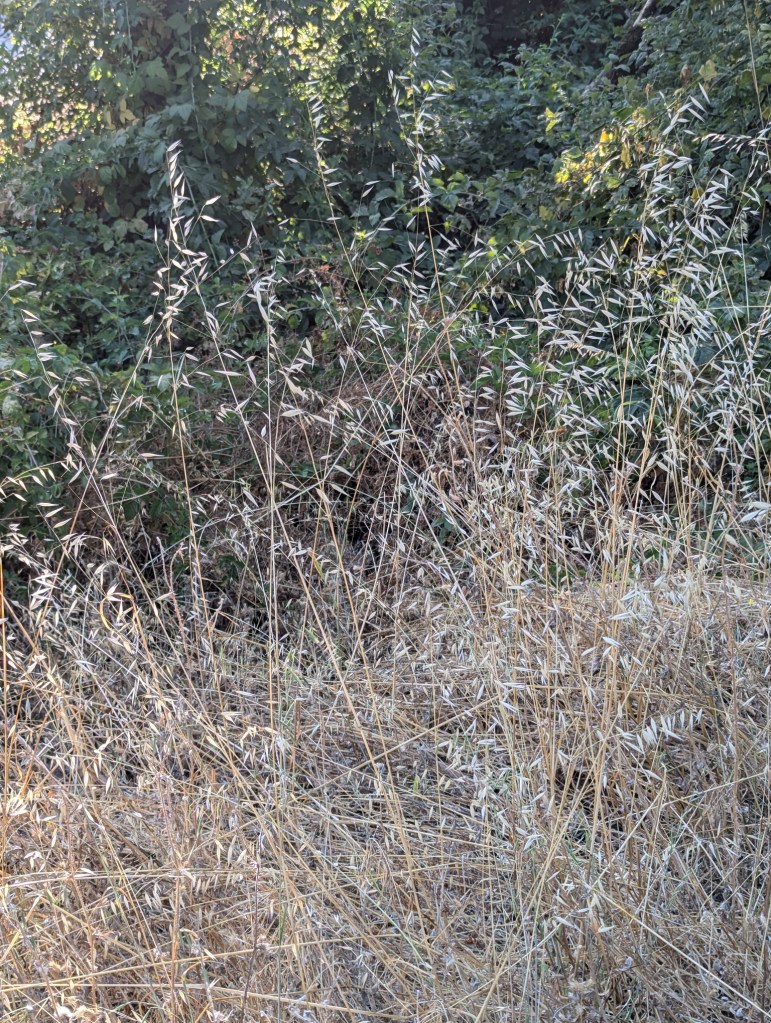
Gardening involves weeds. Gardening outside of refined gardens involves more weeds. A few of such weeds are native species which grow where they are undesirable. Most of the most aggressive are naturalized exotic species. Collectively, they are an unpleasant consequence of unmanageable external biodiversity. They necessitate weed abatement.
Weed abatement is a standard procedure within refined gardens. Most know it simply as weeding. Ideally, it is harmless to desirable vegetation. It may be a relatively simple task where desirable vegetation excludes weeds. Also, weeds are less abundant where they lack sources of seed to regenerate. Timely weeding should eliminate much of their seed.
Unfortunately, no garden is isolated from external influences. Weed seed sneaks in from uncultivated spaces, adjacent gardens or beyond. Suburban and rural gardens might be close to wildlands or forests. Many of such weed seed sources are beyond the control of their victims. Some are merely easy to ignore because they are out of view or not in use.
For some unused or unseen areas, weed whacking can be more practical than weeding. It entails cutting undesirable vegetation almost to grade with a motorized weed whacker. Manual weed whackers, although rare, are not extinct. Weed whackers are not selective. They can sever desirable annuals or perennials that mingle with undesirable vegetation.
The primary advantage of weed whacking is that it is fast and efficient. With good timing, it eliminates bloom or developing seed prior to dispersion of seed. Diminishment of seed inhibits subsequent proliferation, and is much safer for pets. Foxtail seed are notoriously hazardous. Besides, overgrown weed vegetation becomes a fire hazard as it desiccates.
Viable basal stems and roots that remain after weed whacking are not much of an asset. Many types of perennial and biennial weeds regenerate from such growth. However, to a very minor degree, such vegetation may contribute to healthy biodiversity. It may sustain some beneficial insects and soil microorganisms. Also, it can inhibit surface soil erosion.
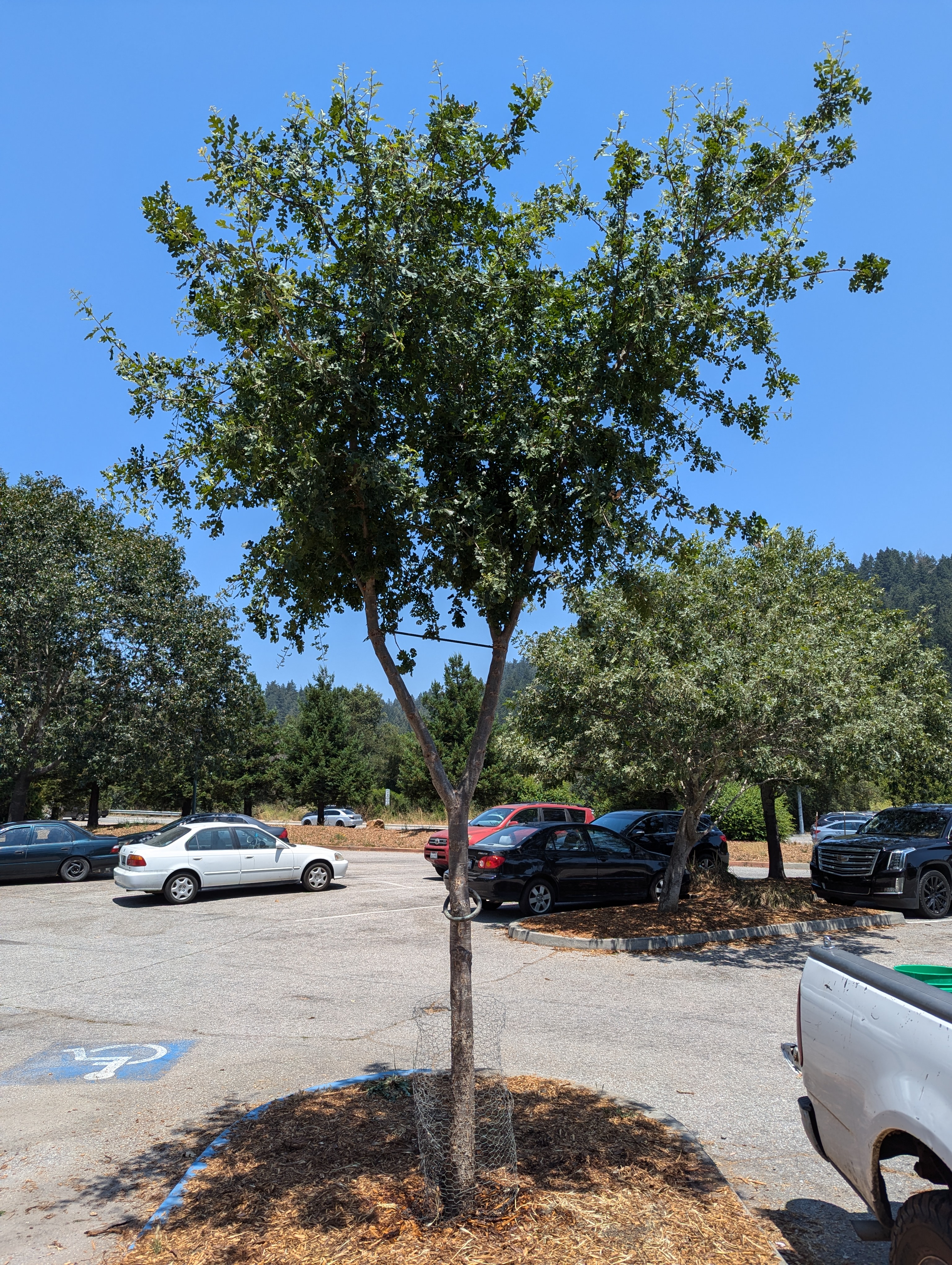
The Memorial Tree is becoming a productive member of its ecosystem!
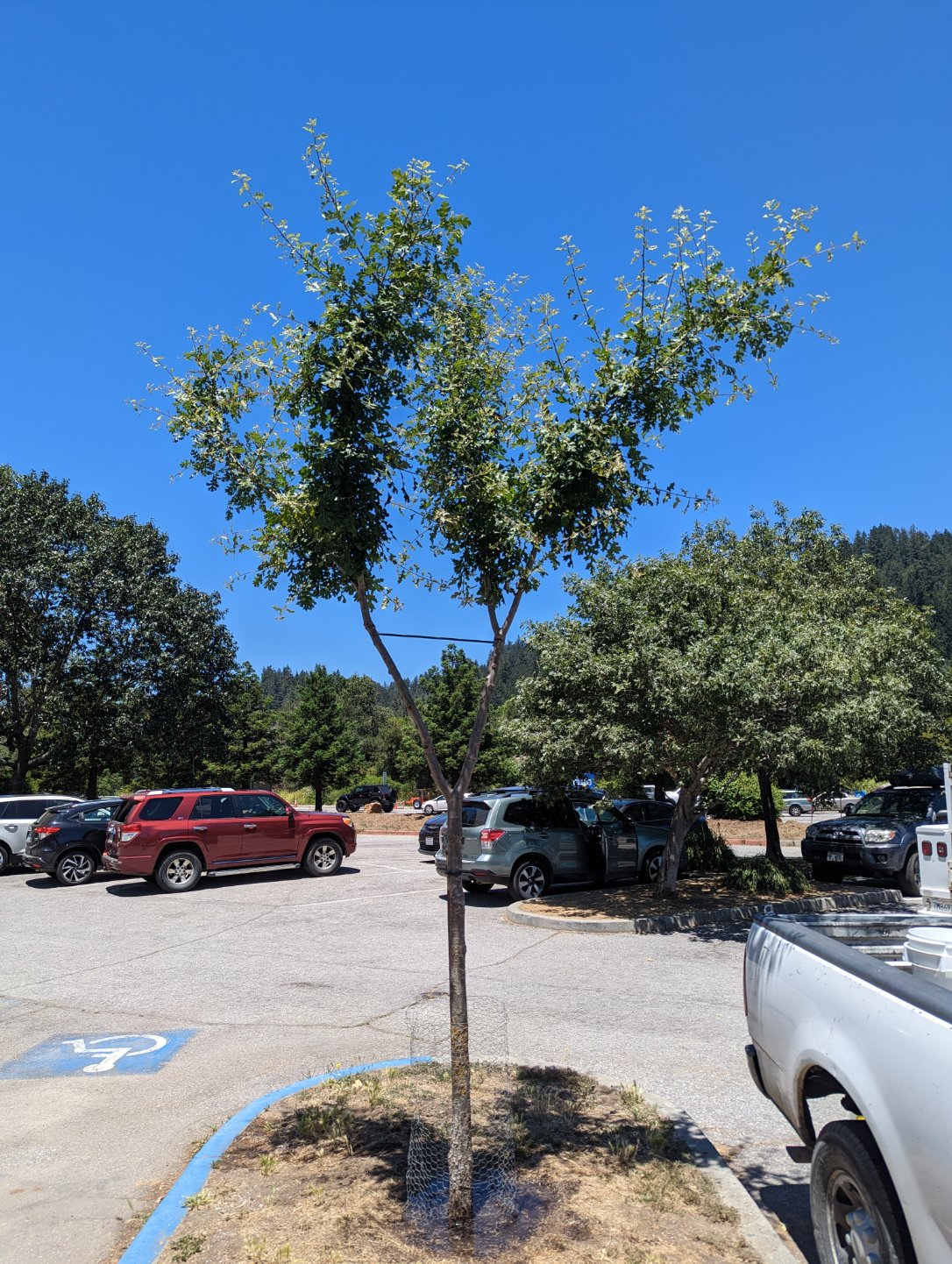
Every year, there is less to write about regarding the Memorial Tree in Felton Covered Bridge Park. That is because every year, it becomes more independent. It no longer needs structure pruning for clearance above the surrounding parking lot. It no longer benefits from supplemental irrigation. The mesh around the base of the trunk really should be removed. So should the truss between the two lowest main limbs. The stake remains merely as a precaution for strong winds, but is likely completely unnecessary. It can be removed after defoliation next winter. The trunk is quite sturdy. Growth is quite vigorous. The branch structure seems to be rather awkward, but such structure is normal for such young specimens of this particular species, and is very unlikely to compromise structural integrity as the tree matures. The canopy is slightly asymmetrical, but not problematically so. The crew who maintains the park replenishes the mulch within the parking lot island around the tree more regularly than they had in the past, and cuts weeds when necessary. They are very protective of this tree, so pull weeds between the trunk and the surrounding mesh rather than get too close to the trunk with their weed whackers. Recently, a neighbor pulled weeds before weed whacking became necessary. Although oaks can technically bloom and produce acorns after only about five years, almost all delay bloom until they are about twenty years old, and some wait until they are twice as old. A lack of bloom this early is therefore normal. The development of two oak apples was a surprise though. Apparently, an oak apple gall moth considers this tree to be mature enough to sustain its eggs. It is as if this little Memorial Tree is already growing up to become a productive member of its ecosystem!
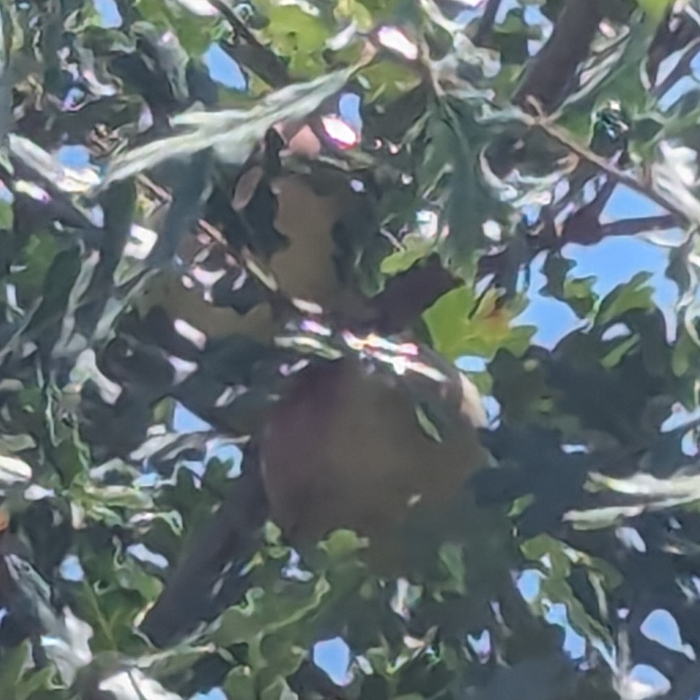
From the ground, I could not get a good picture of these first oak apples.
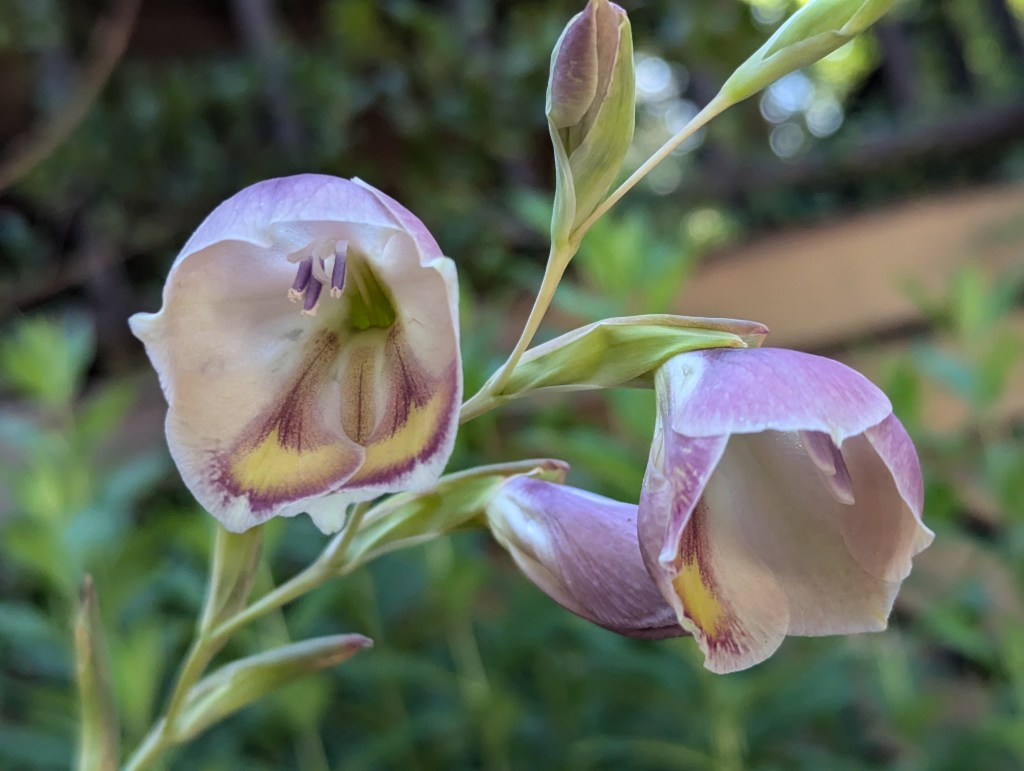
Gladiolus papilio, butterfly gladiolus has been performing very well, and, unlike the more common fancy hybrid gladiolus, it has been very reliably perennial. It multiplies and migrates like a wildflower. I know that I brag about it more than I should, and I just posted a picture of it for Six on Saturday last Saturday, but it happens to be one of my favorite perennials now. It was a gift from Tangly Cottage Gardening in the autumn of 2018, almost six years ago. Prior to that, I had been wanting to grow perennial gladiolus for quite a while, although I was not familiar with such species. I was only familiar with the common fancy hybrid sorts, which are generally not reliably perennial. Gladiolus murielae, Abyssinian gladiolus that arrived a few years ago as a gift from a neighbor may eventually inhabit a different portion of the same landscape that the butterfly gladiolus inhabits. It neither multiplies nor migrates as much as the butterfly gladiolus, and is a bit more garish in bloom, but is both reliably perennial and compatible with wildflowers, and technically, is probably more appropriate to that particular refined landscape. Various cultivars of Watsonia, bugle lily, most of which also came from Tangly Cottage Gardening, could also inhabit the same landscape. There is no rush to decide anytime soon, and the refined landscapes at work are constantly evolving. Within my home garden, I can be less concerned with how visually compatible some of such species and cultivars are, and be more concerned with growing what I enjoy. After all, that is how I acquire so many odd species and cultivars with so much history and from so many important gardens, and even from so many natural ecosystems. It is what makes my home garden so important to me.
‘Variegata’ is a common designation for the first variegated cultivar of a species. Fancier or later distinct cultivars get fancier cultivar designations. The first three of these six are variegated, but lack a cultivar designation as if variegation is normal for the species. The fourth seems to have a few cultivars with the same designation. The last two could be the only variegated cultivars of their respective species. I can not remember ever seeing any of the first four without variegation. The fifth is still rare. The sixth is now more popular than unvariegated.
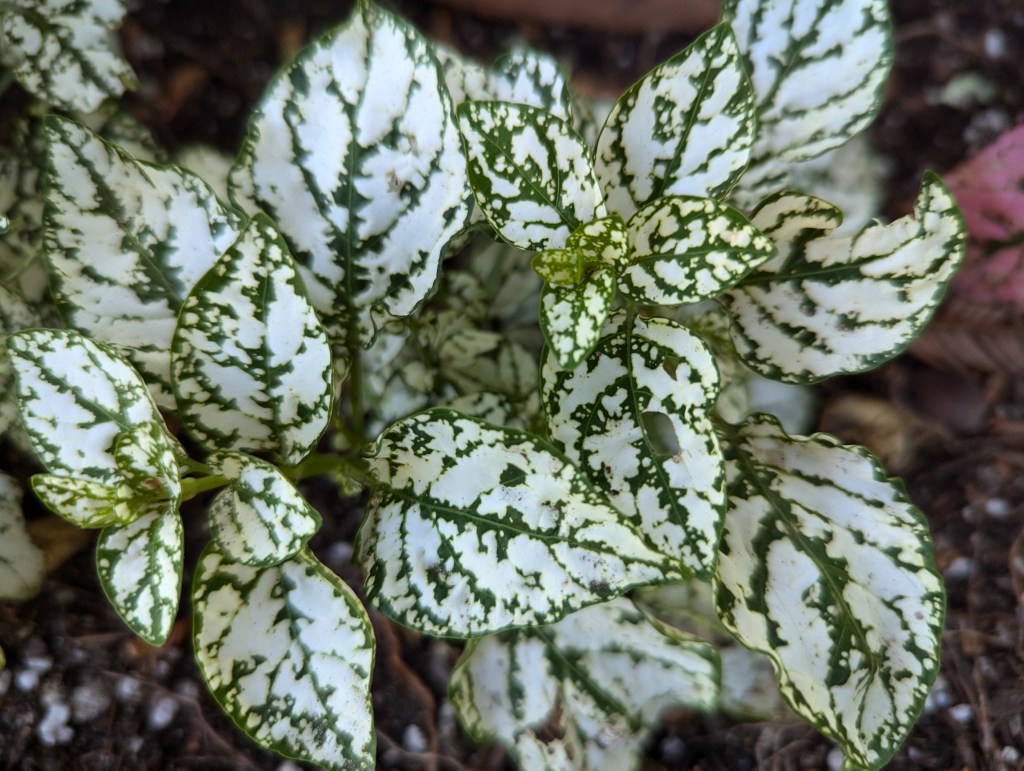
1. Hypoestes phyllostachya, polka dot plant lacks cultivar designation. This was labeled merely as white. Variation of foliar variegation indicate that they were grown from seed.
2. Hypoestes phyllostachya, polka dot plant is also pink, which is exactly how this other half of them was labeled, likewise without cultivar designation. ‘Variegata’ would suit it.
3. Hypoestes phyllostachya, polka dot plant variegation is variable. Some specimens are more green than others. At least two of the pink sort are variegated with red such as this.
4. Aucuba japonica ‘Variegata’, gold dust plant is about as variable as polka dot plant is, but is known by the same cultivar name. Of course, modern cultivars have other names.
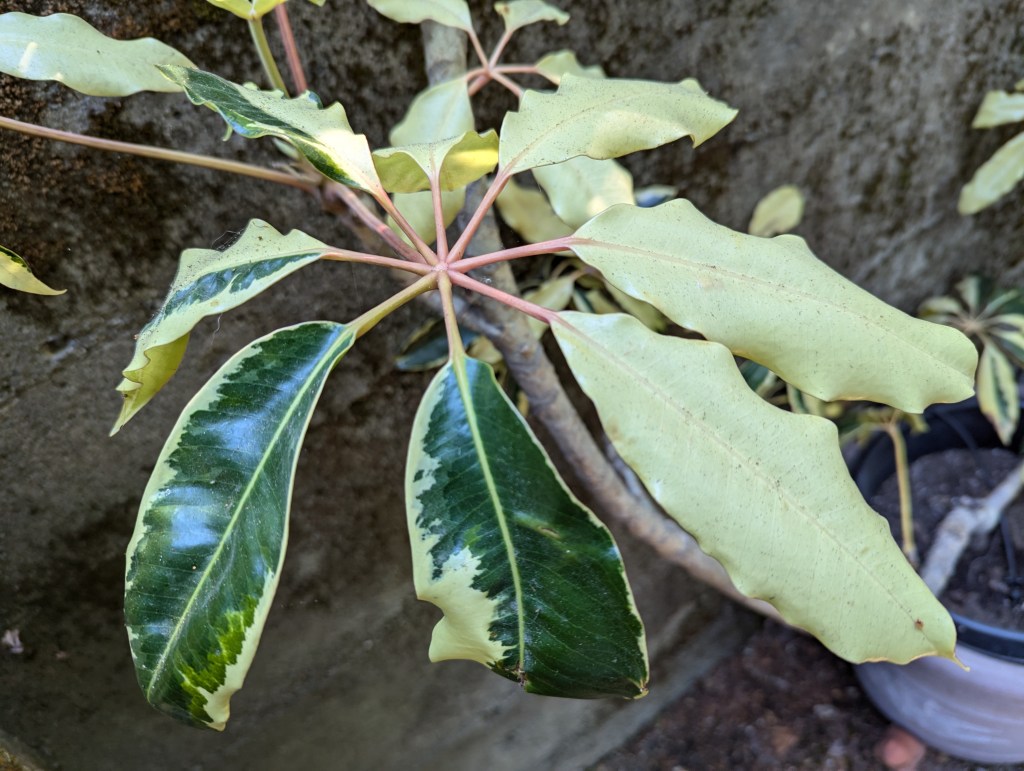
5. Tupidanthus calyptratus ‘Variegata’, mallet flower was not planned. I have wanted to grow the typical unvariegated type since I met it in 1986. Brent sent me this raggedy old but rare variegated specimen so that I would grow more for him. I am learning to like it.
6. Solandra maxima ‘Variegata’, cup of gold vine was also unplanned. I grew the typical unvariegated type to the left first. Then, Brent got me the variegated cultivar to the right. I am getting to like it because it is more docile. The unvariegated sort grows like a weed!