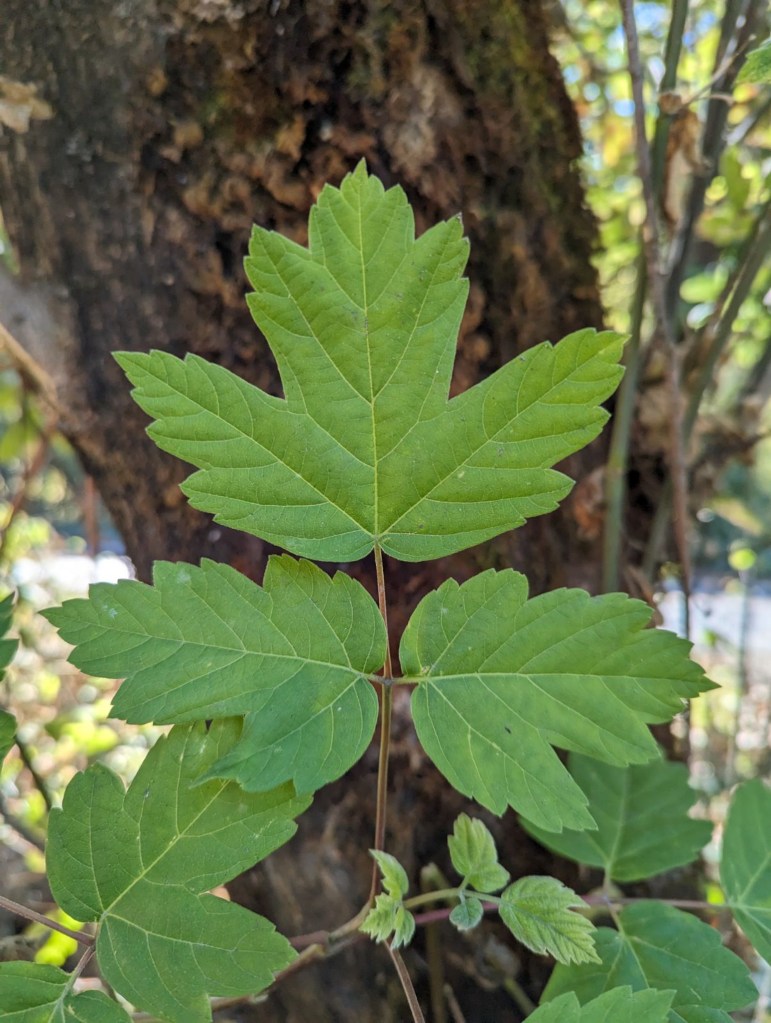
Leaves of three, leave it be, unless one can see that it is a box elder tree, Acer negundo. This is the most common of the North American maples. It is native to all American states except for only Alaska and Hawaii. Yet, it is also unique as the only maple with pinnately compound leaves. Typical leaves have three leaflets, but might have as many as seven. A few rare maples have palmately compound leaves.
Although common in the wild, box elder is rare within refined landscapes. It grows fast to about forty feet tall, but does not live for much more than fifty years. It typically develops a few plump trunks with casually irregular form. Unfortunately though, such form becomes structurally deficient with age. Autumn foliar color is unremarkable yellow or brown here.
However, a few garden cultivars display distinctly colorful foliage for spring. ‘Flamingo’ is the most popular cultivar. Pink variegation of new spring growth fades to white. ‘Auratum’ displays bright yellow new growth. ‘Violaceum’ displays smoky blushed new foliage with purplish red floral tassels. After pollarding, such cultivars are more compact and colorful, but lack floral tassels.
Autumn foliar color eventually gets messy. Actually, any deciduous foliage can become messy during its autumn defoliation. Color is not a prerequisite. Some deciduous foliage remains green through the process. Furthermore, some evergreen foliage contributes to the mess. A few evergreen species shed a bit more as the weather becomes more wintry.
Contrary to popular belief, deciduous vegetation is neater than evergreen vegetation. It only seems to be messier because it defoliates completely at once. Also, such complete defoliation exposes bare stems. Evergreen vegetation sheds slower throughout the year. As it replaces old foliage with new, it sheds more in seasonal phases, but incompletely.
Deciduous leaves also seem to be messier because they are generally bigger. They do not disintegrate into landscapes as efficiently as tiny evergreen leaves do. They require raking from lawns, as well as groundcover that can absorb smaller leaves. So, they fall most abundantly, and dissipate least efficiently. That is why defoliation is so very messy.
Defoliation of deciduous foliage occurs at both the best and worst time of year. It allows more warming sunlight into homes and gardens while the weather is cooling. It leaves deciduous trees more resilient to eventual windy wintry weather. However, it gets messy while the weather begins to get less conducive to gardening. Summer is about finished.
It truly is ironic. Rain and wind will eventually dislodge the last deciduous foliage during winter. Rain is also why this same foliar debris must not clog eavestroughs and gutters. Yet, it is why removal of such debris can be such an unpleasant chore. Removal of foliar debris from hardscapes is also important. It stains and gets slippery if dampened by rain.
While defoliation decreases shade above, it can increase shade below. Accumulation of foliar debris can detrimentally overwhelm turf and groundcover. Some large leaves can do the same on top of dense shrubbery. Fungal pathogens proliferate within the dark and stagnant dampness below such debris. Shade from such debris inhibits photosynthesis.
This particular situation is both too compact and too shady for these items.
Yellow and purple ‘Karma’ iris did not work out so well. To be brief, Brent and I ‘borrowed’ rhizomes of pink bearded iris after their bloom, and prior to their removal and disposal, but they bloomed yellow and purple for the following spring. Apparently, we ‘borrowed’ the wrong rhizomes, and were victims of ‘karma’ that was appropriate for the manner in which we ‘borrowed’ them.
Of course, that experience has never dissuaded me from ‘borrowing’ what I want to grow in my own garden. I am a horticulturist. I can grow just about anything that will grow here from seed, cutting or other sources of propagation material. Some is from situations from which it must be removed anyway. Some is from greenwaste piles. Some is from seed or cuttings that I find while out and about. I purchase almost nothing from nurseries.
Much of what we grow for the landscapes at work is recycled from other landscapes at work. This particular portion of a landscape is in front of a residential staff cabin. The Australian tree fern and elephant ears were installed here by a former resident who no longer resides here. Unfortunately, this situation is both too confined and too shady for them. Not only do the leaves extend over the adjacent walkway and steps, but, in response to the shade, they also grow larger and therefore more obtrusive than they otherwise would be. Because it would be impractical for them to remain within this landscape, I am not at all hesitant about recycling them into other landscapes. I am merely waiting for cooler and rainier winter weather, when they will be more conducive to relocation. The elephant ears should be dormant. I know which landscape the fern will relocate to. The elephant ears may remain canned for propagation.
Monocarpic species bloom only once. They die afterward. Many annuals are monocarpic by default. After bloom and production of seed, they have served their purpose of perpetuating the next generation. Some may bloom more than once within their respective season, but realistically, do not expect to live for long after doing so.
Agaves are monocarpic. Unlike annuals, some grow for many years before maturing enough to bloom. In fact, the century plant is known as such because, in the wild, it supposedly takes a century to mature enough to bloom and finally die. Of course, they do not take nearly so long to bloom within cultivation.
That could be either an advantage or a disadvantage. Their bloom is awesome, but their death is ugly. Removal of their deteriorating but wickedly thorny foliage is a horrid chore. The sap from their foliage causes a rash that can be comparable to the allergic reaction from poison oak. What is worse is that they are not really monocarpic!
Again, that can be either an advantage or a disadvantage. They provide more than enough pups to replace their deteriorating carcass. However, these prolific pups must be divided from each other and the deteriorating carcass of their parent. They are too numerous to accommodate within the same garden or share with neighbors who likely do not want them. Furthermore, they continue to generate pups long after the parent and first litter of pups is gone. Without intervention, they seem to never die completely. Even with diligent intervention, they can linger for many years.
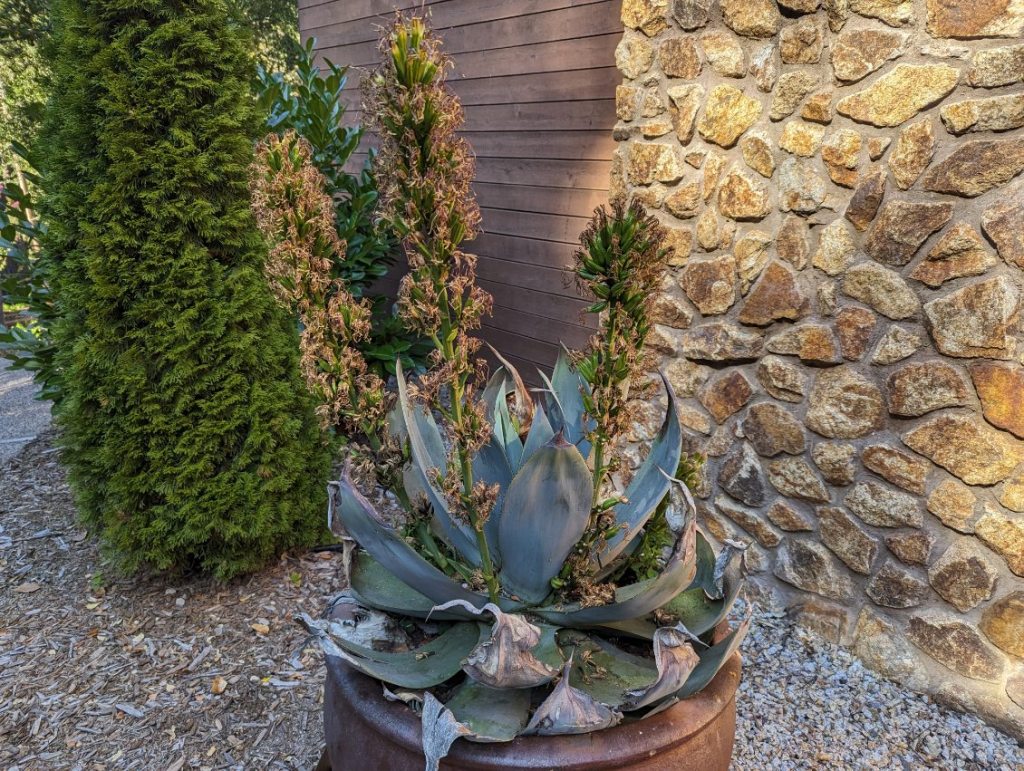
This particular agave should have remained vegetative for many years, but bloomed after only two or three years. The first litter of pups bloomed immediately afterward, as this picture demonstrates. Ultimately, we would like only a single pup to replace the parent.
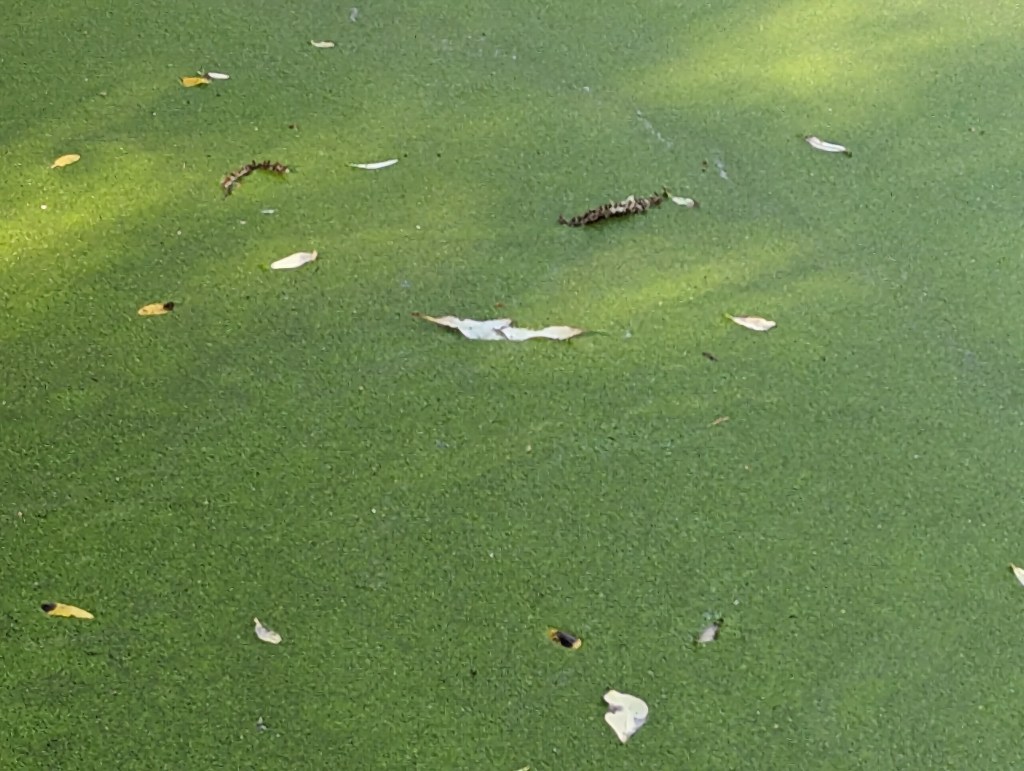
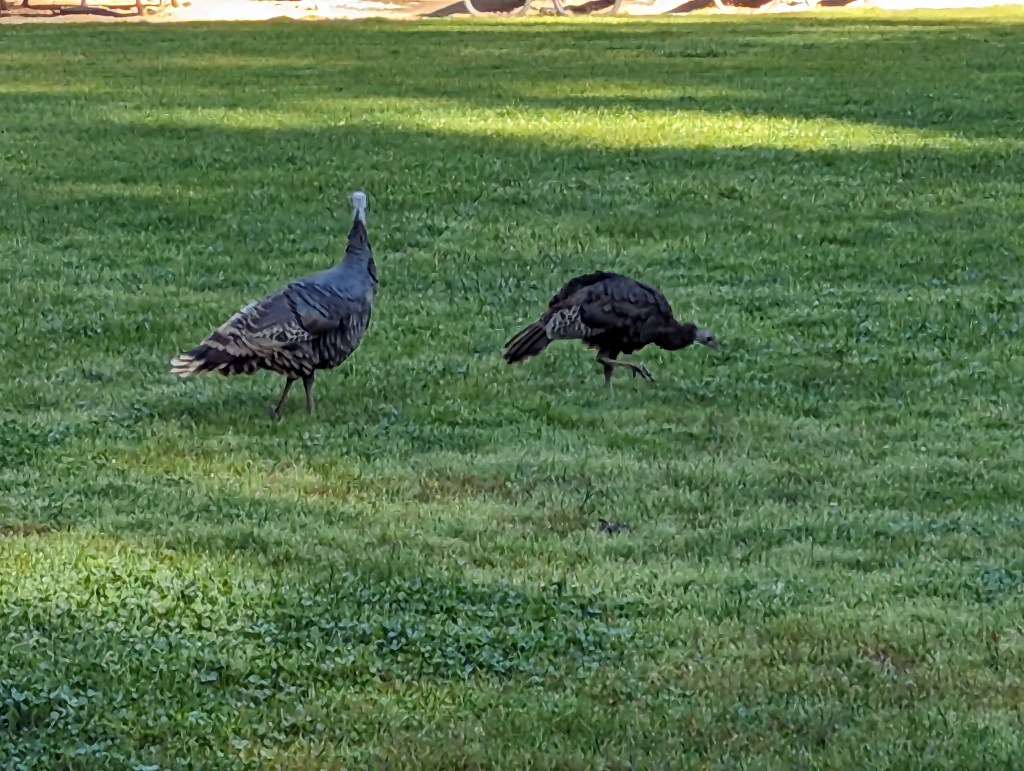
Wildlife is fortunately not too much of a problem within the landscapes here. Deer have complete access but strangely avoid refined landscapes, which includes roses. We would be unable to defend the landscapes otherwise. With so many people in the area, hunting is not possible. Even if it were, I do not like the local options much. Turkeys must know, which is why they are so blatant with their minor but annoying transgressions. Ducks at least try to be helpful by eating snails and the overwhelmingly prolific duckweed in their pond. Actually, I would not mind if they invited some of their friends over to help, since the pond looks more like a lush green lawn than water. Increasingly cooler weather may change that somewhat soon.
1. Single white angel’s trumpet is irrelevant to wildlife, but is blooming too splendidly to ignore. It was #6 last week, while beginning to bloom. It grew from a cutting last spring.
2. Ducks enjoy the pond without becoming too annoyingly numerous. Only this nice pair seems to be permanent residents. Another pair occasionally stops by but lives elsewhere.
3. Duckweed might otherwise be less bothersome if only they invited their friends over a bit more often. Even in this small pond, a single pair of ducks can not control duckweed.
4. Turkeys are the opposite. They are annoyingly numerous, but do not help much. They glean insects, but also thrash colorful flowers and berries, whether they eat them or not.
5. Pyracantha berries should remain colorful while small birds eat them through winter. Instead, turkeys shake most of them from their branches, and leave them on the ground.
6. Rhody is a terrier of some sort. His ancestors pursued burrowing animals who lived in the ground, or ‘terra’. Fortunately, he is uninterested, and is even less interested in fowl.
Blood red trumpet vine provides more lush foliage than bloom.
Abundant lush foliage is actually the main asset of blood-red trumpet vine, Distictis buccinatoria, with the sporadic clusters of three inch long tubular flowers blooming as an added benefit during warm weather. Bloom can certainly be impressive when least expected though; and has a sneaky way of getting a late blast of color out during Indian summer weather patterns, when the weather gets warm after a cool phase in autumn. Contrary to the name, the flowers are more ruddy orange with yellow throats than blood red. The rich green leaves are compound, with a pair of three inch long leaflets and a three fingered tendril reaching out from between.
The vines are somewhat aggressive and can climb more than twenty feet, so need adequate support. They should not be allowed to overwhelm smaller or slower plants, or escape out of reach into adjacent trees. The tendrils can grab onto and damage shingles and light fences, but are an advantage for covering chain link fences. Given the opportunity, blood-red trumpet vine can even climb rough cinder block or stucco walls.
Hyacinth will not bloom for a few months, but goes into the garden about now.
Some of the most familiar flowers to bloom in the earliest of spring get planted now as bulbs. They sit and wait in the garden to finish their dormancy, perhaps get a bit of a chill through winter, and get an early start to their bloom cycles as soon as weather permits. Because winters are so mild here in the Santa Clara Valley, some do not even bother to wait for spring, but are instead happy to start bloom before winter ends.
Bulbs become available in nurseries when they can be planted. Those that are not available yet will become available when it is time to plant them for later spring or summer bloom. The first to become available are generally the first to bloom; although bearded iris seem to know when they want to bloom, regardless of when they get planted.
As long as they do not get stored too long or get planted too late, bulbs do not need to be planted immediately, and actually extend their performance if planted in phases. The earliest phases to get planted will bloom earliest. Phases of the same bulbs planted a few or many days later should bloom about the same amount of time later.
With proper planning, later phases bloom as earlier phases finish. For example, because crocus flowers do not last very long, different phases of bulbs can be planted only a few days or a week apart, so that more flowers start to bloom in time for earlier flowers to fade. Freesia flowers last a bit longer, so different phases can be planted two weeks or so apart.
Narcissus and daffodil bulbs are not so discriminating about how deeply they get planted, so various phases can be put in the same spots. As long as they do not get planted too deep, the earliest phases can be planted deep and covered with only a bit of soil, so that later phases can be planted above. If similarly covered with only a shallow bit of soil, later phases of the same bulbs can be stacked, as long as the last and shallowest phase still gets planted deep enough.
Not many bulbs are actually real bulbs. Most are corms, tubers, rhizomes or tuberous roots. They all do the same thing though; store resources through dormancy to sustain quick bloom as weather allows. Although many bloom reliably only once in their first season, some naturalize to bloom at about the same time each year. Tulips are capable of naturalizing, but rarely get enough chill in winter to bloom after their first season.
Anemone (windflower), hyacinth, lily, rananculus, tulip and small colorful callas are the less reliable of spring bulbs after their first year. Crocus, freesia, hymenocallis and harlequin flower can be more reliable if they get what they want. Grape hyacinth, narcissus, daffodil, watsonia, bearded iris and the old fashioned white callas are the most reliable of bulbs that get planted about now.
Well, I did not exactly do it myself. One of three specimens of ‘Proud Land’ hybrid tea rose that I installed into the rose garden in about 1984 did all the work. I was quite pompous when I found it though. After all, I maintain this particular specimen in a can here until it relocates into another rose garden.
I certainly did not expect such a bloom only a week before November. Although roses can bloom until winter dormancy, the latest are generally on short stems. Increasingly cool weather decelerates formerly vigorous growth.
This particular rose bloomed on a stem that was more than three feet long! It would have been ideal for Miss Piggy of the Muppet Show! Goodness, it could have been too good for Miss Piggy!
‘Proud Land’ hybrid tea rose
The flower might have lacked perfect form, and the foliage might have been slightly blemished, but with such an awesome stem, they were inconsequential. Perhaps I should have stripped the foliage and cut the flower off, in order to most effectively display the near perfection of this most astounding stem!
After cutting it, I removed the thorns and lower foliage, and put it in water outside the lounge at work. According to tradition, unless someone else is presently experiencing marital tension of some sort, the first of the gentlemen with whom I work to find roses there takes them to his wife. This was only a single rose, but was very special. It was gratifying to know that someone with whom I work was about to experience a very special evening, although I gave it no more thought than that.
Then, the gentleman who claimed it mentioned that it was too long, and before I could protest, he cut the stem in half.
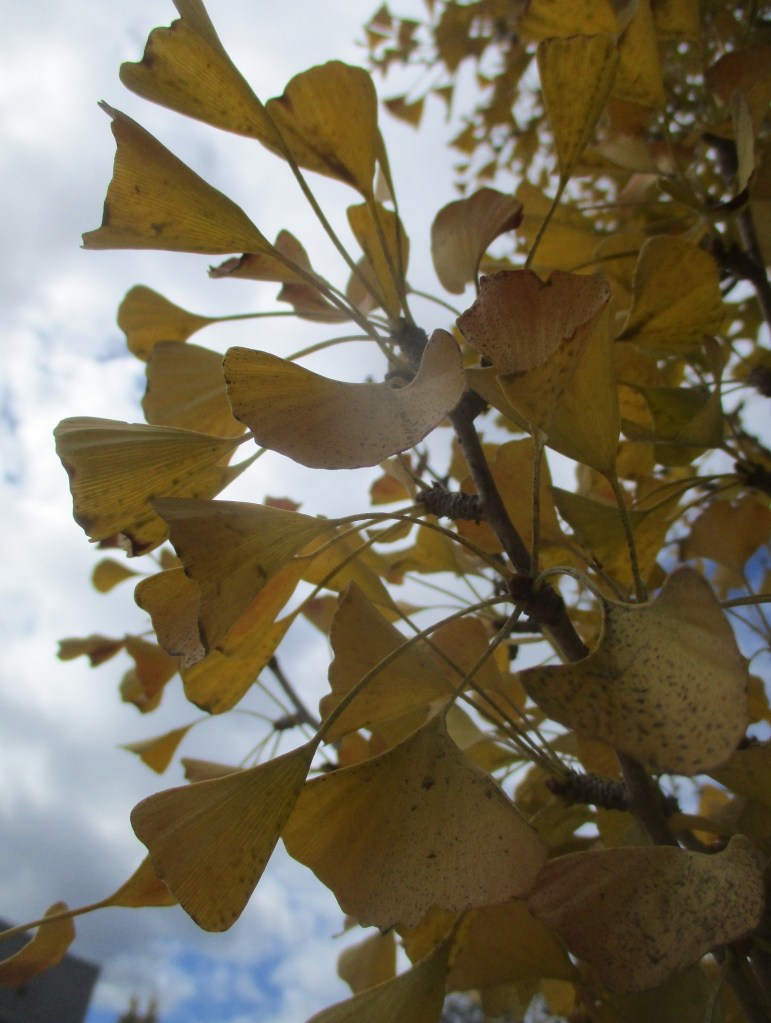
Minimal chill is sufficient for ginkgo, Ginkgo biloba, to develop brilliant yellow foliar color. Mild weather actually enhances retention of foliage after it colors. Colder weather or frost accelerates efficient defoliation. Although less messy, it ruins the spectacular display too soon. Autumn foliar color is monochromatically yellow, but is the best yellow of autumn.
Some old ginkgo trees produce messy fruit with objectionable aroma. This characteristic limited their practicality and popularity. Modern cultivars, though, are male and therefore fruitless. Female cultivars are very rarely available, and mostly only by online purchase. Their fruit and the nuts within are edible. However, only mature trees can be productive.
Ginkgo trees grow somewhat slowly, but can eventually get taller than fifty feet. Modern cultivars are rather slender and perhaps lanky while young. They retain their elegantly irregular structure as they broaden with maturity. Leaves are about two or three inches long. Their venation radiates outward from their petioles, like fishtails, with paired lobes.
Indian Summer complicates autumn. It is an imposition of pleasant weather that delays inevitable chill. Gardening is a bit more enjoyable while the weather remains summery. However, late warmth confuses a few species that should decelerate growth for autumn. Deciduous species delay dormancy. This delays the development of autumn foliar color.
Consequently, autumn foliar color is somewhat late this autumn. It is only beginning to develop. Some species that eventually become spectacularly colorful remain very green. Only the most sensitive species, such as Boston ivy, are beginning to exhibit their color. Unfortunately, because of this delay, some may defoliate unusually soon after coloring.
Autumn foliar color is underrated here, for various reasons. It is less common in the wild than in other regions. The color range of native deciduous species is almost exclusively simple yellow. Orange or red are uncommon. This is not much incentive for incorporation of such species within home gardens. Nor does it promote more colorful exotic species.
Besides, deciduous trees are innately less popular here than within other regions. Local culture seems to promote a preponderance of broadleaf evergreen species. Penetration of warming sunlight through defoliated trees is not such a priority. Winter weather does not get very cold here. Concealment of undesirable suburban scenery is more important.
Also, the misbelief that chill is inadequate here for much autumn foliar color is common. Technically, many of the most colorful species of cooler climates lack such color locally. This unfortunately includes famously colorful North American maples. Several species, however, do not need much chill for spectacular color. They compensate for what lacks.
Sweetgum develops the most vivid autumn foliar color, including yellow, orange and red. It defoliates slowly to retain its color until winter. PIstache is about as colorful, although it defoliates a bit earlier. Flowering pear provides more orange, red and dark burgundy red. Crape myrtle is a smaller tree with comparable foliar color. Ginkgo becomes vivid yellow. Of course, physical traits of each species are also important.








 Tony Tomeo