Even after mentioning several times that I must discontinue blogging and reblogging, I feel terribly guilty about not posting anything for today. However, for the first time, there is nothing more than a few of the most recent articles to reblog, and nothing new to post. So, here is one of the recent aticles.
Gaura

Although not native, gaura, Oenothera lindheimeri, can almost naturalize as if it were. All it needs is occasional watering through summer. It performs better with regular watering. Individual specimens live for only about four years. Some may last for only a single year. However, their abundant progeny are likely to replace and perhaps overwhelm them first.
Gaura prefers sunny and warm exposure. Shade causes sloppy form. Naturalized gaura has potential to become weedy or invade other vegetation. Seedlings relocate efficiently. Cutting back old growth as it deteriorates through winter promotes vibrant spring growth. Concurrent removal of the shabbiest old specimens favors vigorous younger specimens.
Collective growth is mostly less than five feet deep, with wispy and lightly foliated stems. Basal leaves are bigger than tiny upper leaves. Airy flowers are only about an inch wide. Floral color is mostly pale pink. Seedlings of cultivars with white or richer pink bloom are not necessarily true to type. Neither are seedlings of cultivars with richly bronzed foliage. Bloom continues from very early spring until cooler wintry weather.
Irrigation Technology Can Get Complicated
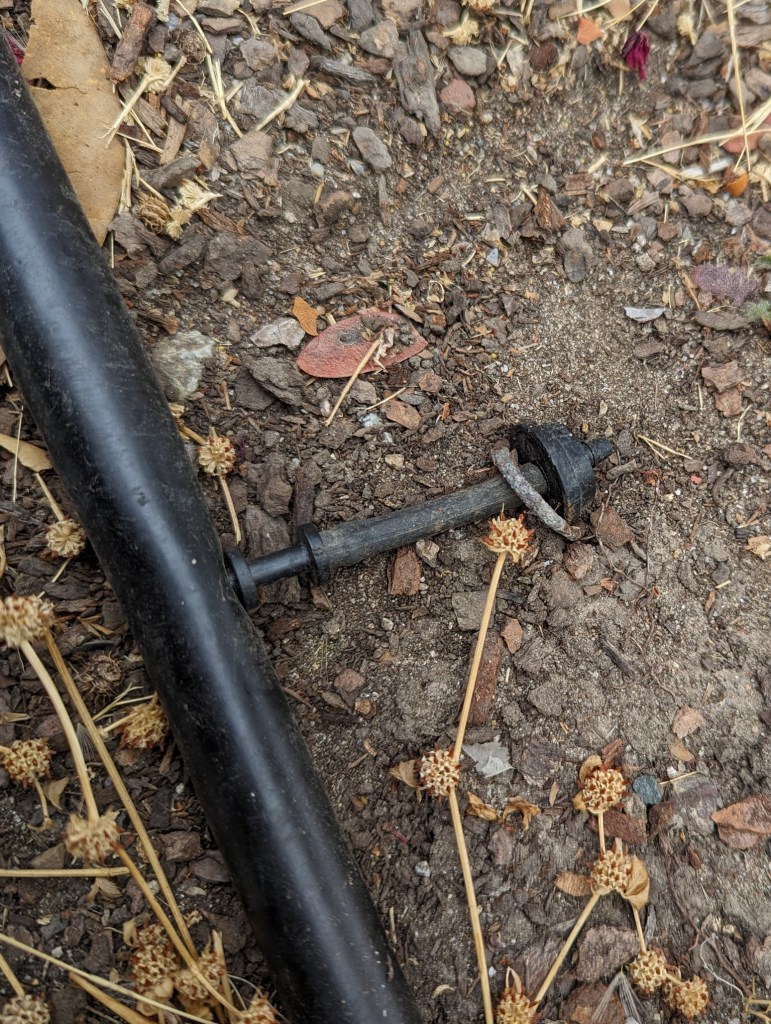
Old fashioned irrigation systems were quite thorough, and technically sustainable. They broadcast generous volumes of water over any vegetation that required it. Their systems were too simple to need much adjustment. Their metallic composition was very resilient. That is why so many old systems were in service for so long. Some continue to function.
However, such old fashioned irrigation systems were not perfect. Their consumption was not as sustainable as their plumbing. They wasted water on vegetation that needed less, and pavement. Some of the broadcast water evaporated before reaching any vegetation. Without automation, old irrigation systems operated when convenient for their operators.
Modern irrigation systems are typically more efficient. Automation allows them to operate prior to sunrise to limit evaporation. Most modern systems apply water directly to the soil. This leaves no irrigation water to evaporate from foliar or other surfaces. Also, it prevents evaporation from airborne broadcast irrigation water. Evaporation innately wastes water.
Of course, modern irrigation systems are no more perfect than old systems. Groundcover and lawns still rely on broadcast irrigation. Such systems still waste water on pavement. Automation can actually waste water if not adjusted manually for rain and other weather. Only the most modern automation adapts to weather. No system responds to vegetation.
Consequently, irrigation can become either deficient or excessive as vegetation matures. Many native species need regular irrigation only as they disperse roots after installation. They are likely to rot with the same irrigation as they mature. Many tropical species need more water as they grow. Some vegetation, as it grows, can obstruct broadcast irrigation.
The complexity of modern irrigation systems complicates their maintenance. Automation is merely one component of the infrastructure. Emitters of drip irrigation sometimes need relocation or replacement. They are sometimes difficult to find below healthy vegetation. Because components are plastic, they are not as durable as old fashioned components.
Hurricane Hillary
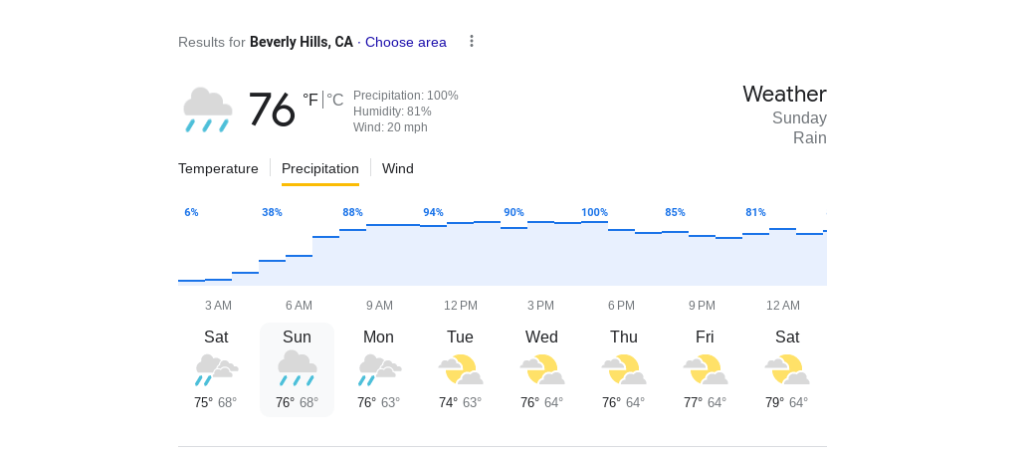
California is so big that, from here, it extends about four hundred miles to the north and four hundred and fifty miles to the south. That is where San Diego County is, in the southwestern corner of California. It is so far away that the weather there can be very different from here, as it is now that Hurricane Hillary is coming up from the coast of Baja California. While a tropical storm warning is in effect there, typical summer weather is expected here.
Typical summer weather here is dry. Not much rain happens after early spring. Not much happens prior to late autumn. Every few years, a single odd and brief thunderstorm goes through in the middle of summer, leaving no evidence of its downpours two days later. If it were to happen this year, it should happen about now, like it is in Southern California.
Forecasts for the weather in Southern California are quite unpleasant. A friend in Palm Springs was filling sandbags today. Floods and mudslides are expected through a huge area. This is the first tropical storm in California since 1939, and the first ever tropical storm warning. Yet, we will miss it completely here.
I try to remind myself that the historically torrential rain of last winter was no fun. Flooding was a mess, and caused significant damage even in this neighborhood. Nonetheless, even native Californians can start to miss rain late in summer.
Brent will likely telephone at about seven in the morning. It might be raining by that time. It should finish by noon on Monday. Realistically, it will not rain for long. The problem is that rain will be torrential, especially at high elevations out in the deserts, which do not absorb much water. It will be interesting to see what transpires.
Is Phlox A Weed?

When it first appeared within one of the landscapes at work four years or so ago, I was not sure of its identity. I guessed that it was some sort of phlox only because it resembled phlox that I had seen in mail order catalogs many years earlier. No one knows where it came from or how it got there. Some sort of Campanula arrived within the same garden only a year or so earlier, and worked out nicely. Therefore, we decided to give what we thought was phlox the same chance to perform.
It performed splendidly! It matured rather quickly, and happened to fill a prominently bare spot. Its bloom is pure white and delightfully fragrant. After getting cut back for winter, it regenerated for spring.
Then, we started noticing that it had seeded while no one noticed. A few seedlings were appearing nearby. At first, we were pleased, but also concerned that it could become invasive. I pulled a few seedlings up from where I did not want them to grow, and was able to relocate them to better situations, but was not sure if I should have done so.
Fortunately, like the campanula, this new plox seemed to want to cooperate. After getting established, it did not seem to be invasive.
Now, it is one of my two favorite perennials within its particular landscape, along with Gladiolus papilio. I am confident that we can allow it to bloom fully without dispersing too many seed afterward. I am very fond of the strikingly bright white bloom and its rich fragrance. It would be great if more feral species developed as assets to their gardens instead of as weeds. I am pleased that we gave this phlox its chance to perform, and will likely relocate more to other landscapes.
Six on Saturday: A Series Of Unfortunate Events
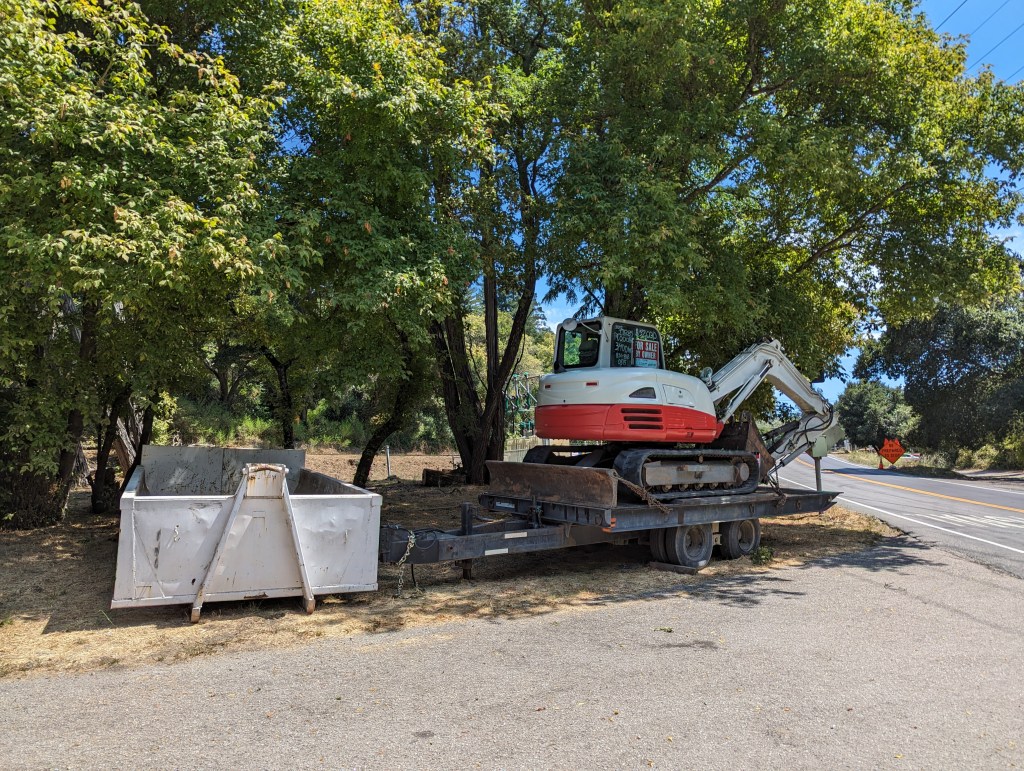
Horticulture can be so challenging. Some challenges are very frustrating. Some are quite infuriating. Some of the worst would be likewise if they were not so weirdly silly. Really, plants naturally present certain innate challenges. So do their pathogens. People though, are special. Their behavior is not completely innate. They should know better than to do so much of what they do. So many of their mistakes are so creatively inane. Yet, some of the most egregiously silly are not even mistakes according to their personal perceptions. Goodness, merely attempting to explain these unfortunate events becomes challenging! Realistically, it is not as bad as it seems. I swatted lily of the Nile buds when I was a kid. The neighbor with the ‘machine’ is unaware of the naked ladies, and will remain as such.
1. Lagerstroemia indica, crepe myrtle is susceptible to powdery mildew. These new specimens of a modern cultivar are more resistant than most but apparently not enough.

2. Hydrangea macrophylla, bigleaf hydrangea changes floral color according to soil pH. However, white is always white. We relocated this white specimen to the White Garden.

3. Canna ‘Cleopatra’ is the strangest Canna here, with mixed red and yellow bloom, and mixed green and bronze foliage. Unfortunately, it shared its virus with the other Canna.

4. Agapanthus orientalis, lily of the Nile is a reliably resilient and neat perennial for the edges of walkways, where kids unfortunately enjoy swatting their floral buds with sticks.

5. Agave americana, century plant is so prolific with pups that they are sneaking out the drainage holes! We can them to give them away, but no one wants them. They are nasty!
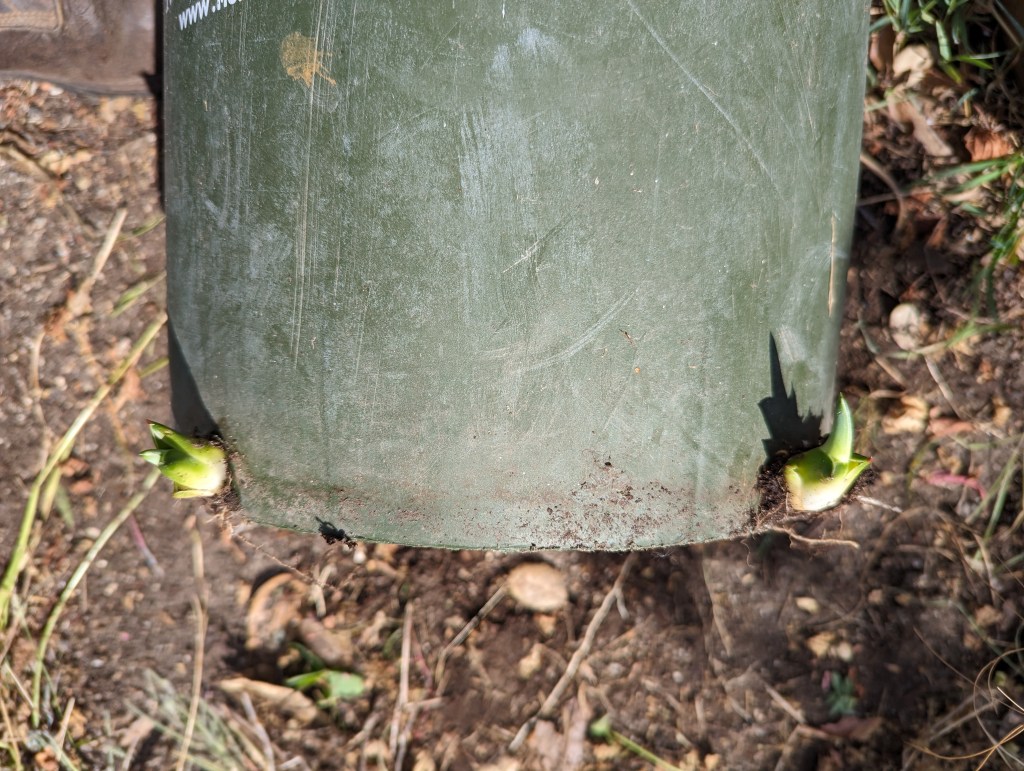
6. Amaryllis belladonna, naked lady was about to bloom as profusely as it does annually when this was maneuvered into position, back and forth, back and forth, back and forth.
This is the link for Six on Saturday, for anyone else who would like to participate: https://thepropagatorblog.wordpress.com/2017/09/18/six-on-saturday-a-participant-guide/
Hydrangea

Things were simpler decades ago when hydrangeas, Hydrangea macrophylla, were either white or not white. Those that were not white were mostly pink locally because of the alkaline soil of the Santa Clara Valley. Blue hydrangeas where seen where the soil is acidic in the Santa Cruz Mountains, or where the soil was amended to be acidic. (Acidity causes flowers to be blue. Alkalinity causes flowers to be pink.)
Now there are more than five hundred cultivars of hydrangea! Although bloom color is really determined by pH, many cultivars make better blue shades, and many others make better pink shades. Purple and red have been added to the mix, while white has become less common. After getting pruned low while dormant through winter, most hydrangeas grow about three or four feet tall and broad through summer. Some can get twice as large, while many stay low and compact.
Most hydrangeas have ‘mophead’ blooms, which are large, round ‘panicles’ (clusters) of smaller sterile flowers. ‘Lacecap’ blooms are flat topped panicles with narrow borders of the same small sterile flowers surrounding lacy centers of minute fertile flowers. Hydrangeas bloom from early spring late into autumn.
Hydrangeas Perform Better With Proper Pruning

After decades of breeding, most modern cultivars of hydrangea are much more compact and a bit stockier than old fashioned hydrangeas that had long, limber stems that could bend downward from the weight of their own blooms. They stand up to proudly display their modern, vibrant color, even when their billowy blooms get heavy with rain. Yet, even with all their genetic improvements, they should still be pruned properly and annually to promote continued bloom. Without pruning, even modern cultivars can get floppy and lanky.
Because most hydrangeas bloom on stems that developed during the previous year, they should not be pruned too much while dormant through winter. Instead, solitary (generally unbranched) stems that grew from the base last year and bloomed this year should be pruned back to a pair of buds about a foot high as their blooms deteriorate. Even though some blooms continue to develop late into autumn, most are finishing about now. Therefore, pruning stems back while also removing spent blooms gets the pruning done early enough for the side buds to start to grow into secondary stems.
These secondary stems should not get pruned again, even when they go dormant through winter. They do not grow much before winter, but should be mature enough to bloom during the following spring. Thinning these branched stems through winter by cutting some of the smaller stems to the ground should produce fewer but significantly larger blooms, as well as prolong the blooming season. (However, many modern cultivars naturally bloom sporadically after their primary bloom phase until autumn anyway.)
New canes that develop from the ground to replace older branched stems may not bloom their first year, but can be left unpruned through winter to bloom early the next spring, which starts the process over again. Old stems should be cut to the ground after their third year (second bloom season). Leaving a few spent blooms on the plants long enough to dry (as dried flowers) should not interfere too much with proper pruning.
Horridculture – Too Busy To Write

It will be a while before I resume blogging as I formerly did, if I resume. I may just continue to share my gardening column here. The situation is too complicated to explain, and too irrelevant to bother with.
So, if I do resume, I hope to write more about my own home garden. I have been negligent in that regard for a few reasons. Firstly, my home garden is not very interesting. I am a nurseryman, so am in the habit of giving away anything in the garden as it becomes appealing. Secondly, my uninteresting home garden has been neglected for too long. I have been too busy with several other obligations that I still can not keep up with. Thirdly, the landscapes where I work part time are far more interesting than what I would grow in my own uninteresting and neglected home garden if it were not so uninteresting and neglected.
In the future, I hope to renovate my home garden and make it more interesting. Seriously, all those interesting species that I bring back but do not give away from Southern California, the Pacific Northwest and even the Phoenix region deserve a comfortable garden in which they can perform as they should. Seven cultivars of banana grow fast! It would be unhealthy for them to remain canned much longer.
Because I know nothing about landscape design, I do not know how to renovate my home garden, but can figure it out as I proceed, even if most of it is as simple and utilitarian as it had formerly been. Palms do not conform to a simply utilitarian garden, so do not leave me much choice about incorporating them as aesthetic elements. It should be fun. At least that is what I continually try to remind myself.
Norway Maple
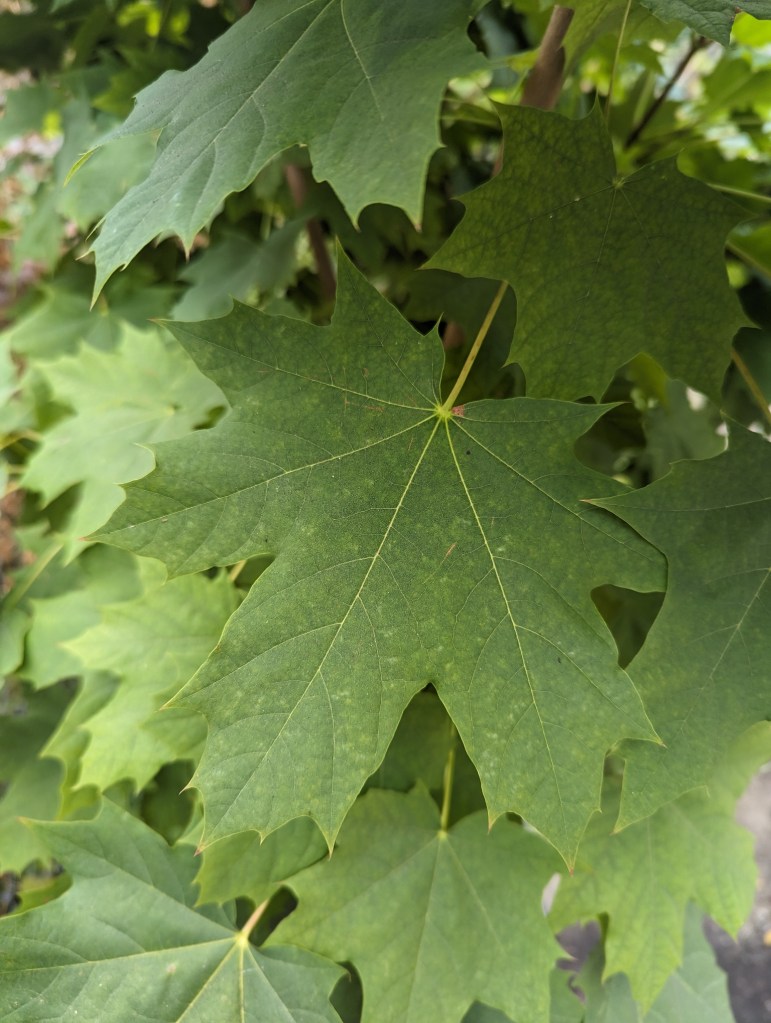
The botanical name of Norway maple, Acer platanoides, means ‘maple like a sycamore’. It resembles Platanus X acerifolia, which means ‘sycamore with maple foliage’. Platanus X acerifolia is London plane (‘sycamore’), which serves similar purposes. Norway maple lacks the irritating foliar tomentum of London plane. It has more aggressive roots though.
Norway maple was likely never a fad, but was common as a street tree during the 1950s. It naturalized as in invasive exotic species in parts of the Pacific Northwest. It is not such a nuisance locally. Most domestic trees are sterile or almost sterile cultivars. If their roots were more complaisant, they could have been ideal street trees. Their shade is splendid.
‘Schwedleri’, with bronzed foliage, was likely the most popular cultivar originally. Modern cultivars are darker bronze, golden, variegated or simple green. Their deciduous foliage is not so impressive for autumn though. It turns somewhat brownish yellow. The palmate leaves are about five to nine inches wide. Defoliation is efficient. Refoliation is quite late. Not many Norway maples get more than forty feet tall within the mild climates here.
 Tony Tomeo