GREEN

P71112

GREEN – Greening Residential Environments Empowering Neighborhoods – allocates resources, procured from both municipal funding and private donations, to the installation, maintenance and protection of trees in public spaces within the collective urban forest of Los Angeles, and to the enforcement of environmental justice.

How is that for a mission statement?

It is no coincidence that GREEN is also Brent’s last name. He is quite vain. Really though, it works.

Brent has been planting street trees since we were in school in the 1980s, and did his first big project of thirty trees in the median of San Vicente Boulevard on his thirtieth birthday in 1998. This January, twenty years later, he will be planting fifty more trees.

Here and there, I will be writing more articles about these projects. They are too involved to write just one article about. For now, I would like to mention the Facebook page for GREEN, at https://www.facebook.com/GREEN-1518459741733375/. I am sorry that I can not devote more attention to it. I really should be writing more articles about what GREEN does.

There is more to it than just planting. Trees also require staking. Street trees need pruning for clearance above the roadways that they shade. Some trees needed to be injected with systemic insecticide for homopteran insect infestation. When mature Canary Island date palms were being stolen from the embankment of the Santa Monica Freeway and sold into other neighborhoods, GREEN was there to stop it, and to get at least one of the trees returned (although the neighborhood is still waiting for other reparations). GREEN has organized neighborhood clean-ups and graffiti abatement.

GREEN is in Los Angeles, but could be duplicated in other municipalities that could use more trees, or that already have trees that need maintenance. So many trees in America have tree preservation ordinances, but some of the biggest cities need to enforce their ordinances more diligently.

If you continue to read my blog, you will be reading more about GREEN. Again, the Facebook page is at https://www.facebook.com/GREEN-1518459741733375/

Trees Do Not Like Chimneys

P71027There are many reasons why fireplaces and their chimneys are not such a safety concern like they were decades ago. Only a few modern homes are even equipped with them. Installation of a new fireplace is outlawed in many municipalities, even if a fireplace gets damaged by an earthquake, and should be replaced. Urban sprawl has replaced almost all of the orchards and woods that once supplied affordable fuel.
Most of the few fireplaces and wood stoves that still get used are safer because their chimneys are outfitted with spark arrestors. Also, most combustible cedar roofs have been replaced by non-combustible roofing material. Nonetheless, chimneys can sometimes get overwhelmed by potentially combustible vegetation. Trees, large shrubbery and vines might need to be pruned for adequate clearance from the heat.

Vines like ivy, Boston ivy and creeping fig are sometimes allowed to climb chimneys because they do not damage bricks as easily as they damage painted surfaces. However, they can easily grow over the top of a chimney. Aggressive vines generate significant volumes of vegetation, and can accumulate even more from nearby trees. Because they are directly over chimney exhaust, they ignite as soon as a fir is lit below.

Trees that reach over chimneys take a bit more time to burn because heat dissipates somewhat in the space between the top of the chimney and the higher vegetation. Cypress, pine, eucalyptus, cedar and big junipers are very combustible. If they get close enough, ungroomed palms and yuccas can be even worse! Deciduous trees are mostly defoliated, and less combustible while it Is cool enough to use a fireplace.

Regardless, all chimneys need adequate clearance from vegetation. Trees and vines that were allowed to get too close while fireplaces were unused through summer will need to be pruned back before the first fire is lit to take the chill out of cooling autumn weather. Debris that collects behind (upslope from) chimneys should also be removed. It can be combustible while dry, and once dampened by rain, it can cause rot.

This is also a good time to start cleaning eaves-troughs (gutters) and downspouts. Yes, it may need to be done more than once if enough deciduous foliage continues to fall through autumn. Debris is easiest to clean out while dry (before it needs to be cleaned out), but unfortunately becomes messier with rain.

Arborists Are Physicians For Trees

71108thumbBefore the storms of winter get here, it might be a good time to make arrangements to get some help for big trees that need it. Smaller trees that can be reached from the ground may not need anything that we can not do ourselves. It is the big trees that have grown beyond our reach that may need professional help if they have problems. They are unsafe for us DIY garden enthusiasts.

Once late autumn and winter weather patterns start, storms can break limbs and destabilize trees. Identifying problems and executing necessary remedies can limit such damages before they happens. Disproportionately heavy or structurally deficient limbs can be pruned to reduce weight and wind resistance. Obtrusive limbs can be pruned for clearance from roofs and anything else.

Trees are the most significant and influential features of our gardens. They shade and extend their limbs over our homes and gardens. Not only can they cause serious damage by dropping limbs or falling, but they can also change how our home and garden are affected by their shade. They are worthy of proper maintenance, even when it is necessary to procure the services of an arborist.

An arborist is a horticulturist who specializes in arboriculture, which is the horticulture of trees. Arborists are essentially tree physicians, who evaluate the health, stability and structural integrity of trees, and make recommendations for maintenance, or to repair problems. Most municipalities require an ISA Certified Arborist report in order to issue a permit to remove an unsalvageable tree.

The ISA is the International Society of Arboriculture. Certified Arborists have passed an examination of their arboricultural expertise, and maintain their credentials by continued involvement with ISA educational seminars, classes and workshops. More information about the International Society of Arboriculture and local certified arborists can be found at the website, www.isa-arbor.com.

Arboriculture is not the sort of thing that gardeners should be expected to perform. It is completely different from the sort of mowing, shearing and pruning that they do. Sadly, much of the damage that arborists find in trees was caused by improper arboricultural procedures. Arboriculture also has the potential to be very dangerous to someone who lacks adequate training and equipment.

Small Tree In A Big Park

P71006How did the Featherstone Tree survive? (See: https://tonytomeo.wordpress.com/2017/10/05/big-tree-in-a-small-town/.) It was planted on the edge of a busy highway where heavy loads of lumber were driven by oxen, at a time when society was more interested in harvesting trees than preserving them. Yet, after more than a century, it is still here.
The Scofield Tree is a very small valley oak in an island of a parking lot at Felton Covered Bridge Park, just across the San Lorenzo River from the Featherstone Tree. In a few centuries, it might be comparable to the big valley oak that was recently cut down across the road (See https://tonytomeo.wordpress.com/2017/09/11/goodbye-to-an-old-friend/.) It is a good choice for this location because it develops a remarkably complaisant root system for such a large tree, and it is a native, so does not need to be watered.

However, it is the fourth tree to be planted here. The original California black oak that was planted when volunteers from the Community built the park years ago did not last long before getting run over by a car. It was not replaced until a small Eastern redcedar was planted on New Year’s Day of 2013. That tree was dead and crispy by summer. A bigleaf maple was planted the following winter, and sort of survived through the year, only to die the following winter. It was too late in winter to plant anything new that year, so the tiny valley oak was planted late in 2015.

Although tiny, it had a nice root system, which was more than the two bare-root trees before it had. The hope was that if it could survive getting peed on by dogs long enough to disperse roots, it would be fine. It started to foliate the following spring, only to get much of the bark gouged away by a ‘gardener’ with a weed whacker. The poor tree nearly died, but somehow survived and started to recover. However, it did not recover fast enough to get ahead of the dog pee. It really seemed to be struggling through this year, and is now getting ready to defoliate for autumn. It really needs to get some height next year. Small trees are just too vulnerable to all that goes on in a park.

Each of the redwood trees around the perimeter of Felton Covered Bridge Park is a memorial tree, sponsored by friends or family of the deceased. An additional sweetgum tree is a memorial tree for a French bulldog. Some of the trees are outfitted with memorial plaques. The tiny valley is named the Scofield Tree for an old friend of the Community, Jeff Scofield, who passed away in the spring after the tree was planted; but it is really a memorial tree for a few people who passed away within a few years of that time. The Scofield Tree was sponsored and planted for the deceased by Felton League, an informal group of displaced and socially disadvantaged people of Felton, and their friends. Their Facebook page can be found at https://www.facebook.com/Felton-League-520645548069493/.

Perhaps what is written now about the Scofield Tree will eventually become part of the history of Felton, and be summarized on a plaque like the one on the Featherstone Tree. It would be excellent enough if the Scofield Tree simply does what good treed do in a park for a few more centuries.

Big Tree In A Small Town

P71005Trees get planted all the time. Apparently, nature does not do the job adequately. Trees get put into specific locations to provide shade, produce fruit, enhance a landscape, obscure a view, or for any of a vast number of reasons. It is amazing that they are as accommodating as they are. It is rather presumptuous for us to think that they actually want to live with us in our synthetic environments as much as we want to live with them.
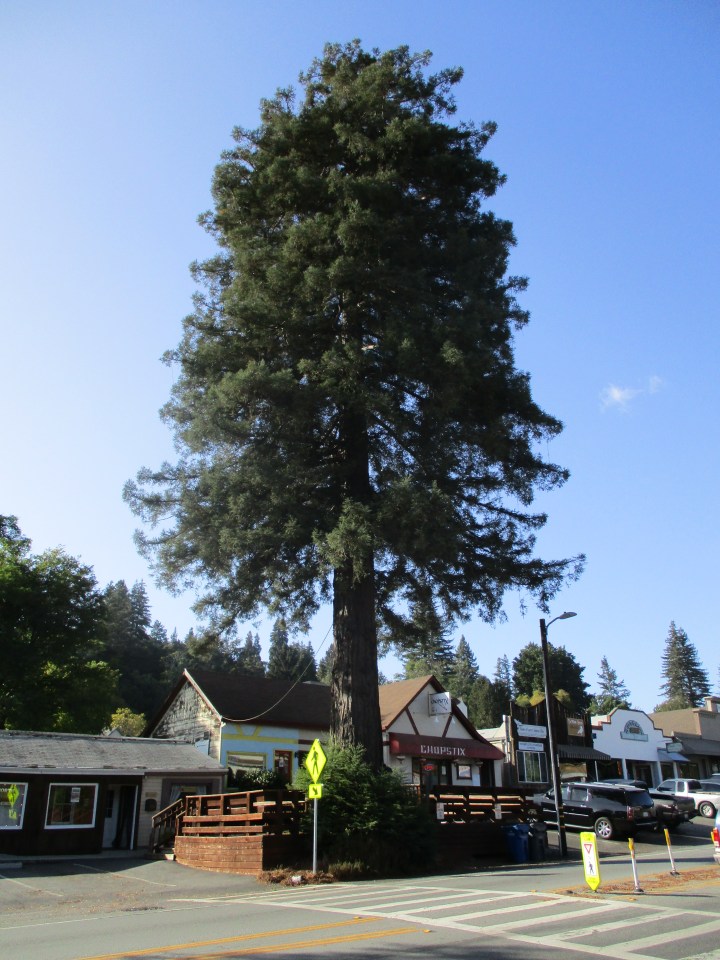
The coastal redwood is the tallest tree in the world. It can live for thousands of years. An individual tree can produce enough lumber to build a small house. It is no wonder that they are so impressive to anyone who sees one for the first time.

Many towns within the natural range of the coastal redwood were established for the redwood lumber industry. Felton, in the Santa Cruz Mountains, is one of those towns. George Featherstone of Ottawa came to Felton in 1888, and was so impressed with the coastal redwood trees, that he planted one in the middle of town only a few years after his arrival. This tree was only a teenager when redwood harvesting increased to supply lumber to rebuild San Francisco after the Great Earthquake and Fire of 1906, and then to develop the rest of the San Francisco Bay Area.

More than a century later, the Featherstone Tree is still here, and is the biggest thing in the small downtown. The Community Deck was built around it by volunteers from the Community many years ago. It is not as tall as trees in the forest are, but only because it does not need to compete with them. It is shorter and stouter, and really seems to enjoy being the center of town. It is quite the celebrity.

Mr. Featherstone had no idea of how important the tree he planted would become. It would be nice if we all could do such nice things for our communities, but then the world would be much too shady.

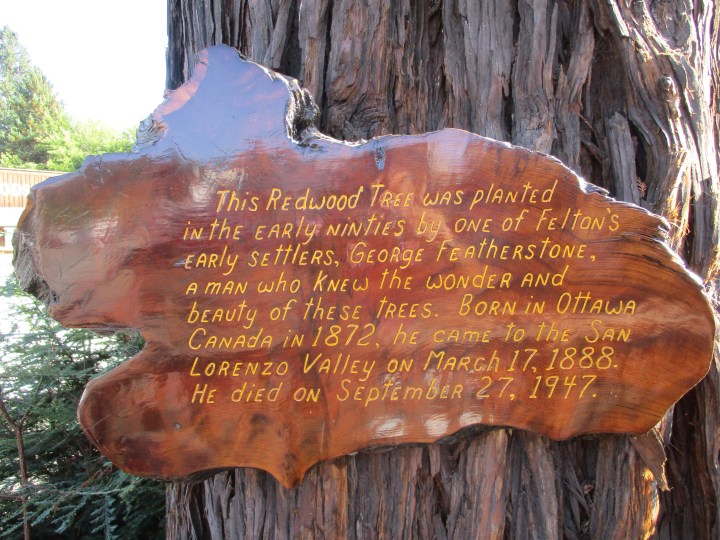
P71005+(‘ninties’ means the 1890s.) This Redwood Tree was planted in the early ninties by one of Felton’s early settlers, George Featherstone, a man who knew the wonder and beauty of these trees. Born in Ottawa, Canada in 1872, he came to the San Lorenzo Valley on March 17, 1888. He died on September 27, 1947.
No Respect

IMG_0417Horticultural industries are full of them; those who changed their respective careers half way through to do something ‘green’. We hear it all the time. “I used to be a ______ (Fill in the blank.), but I got so tired of ______ (Fill in the blank again.) and decided to get into landscaping.” Really?!? That is what you think of the landscape industry? Anyone who flunks out in your industry can ‘easily’ make it in landscaping?
While driving the delivery truck (because we could not hire a frustrated brain surgeon to do it for us), I had to deliver truckloads of rhododendrons to a ‘landscaper’ who did several jobs in Alameda and Contra Costa Counties. This ‘landscaper’ would walk through the nursery and tag whatever looked good at the time, and then assemble the landscape when the selected material arrived on site. Of course, he selected material that was in full bloom at the time, so the flowers were deteriorating by the time they arrived. His ‘landscapes’ were atrocious! The material was just tossed together so randomly, with plants that needed shade out in full sun, and full sun plants in the shade of big trees that were not pruned before the landscape was installed.

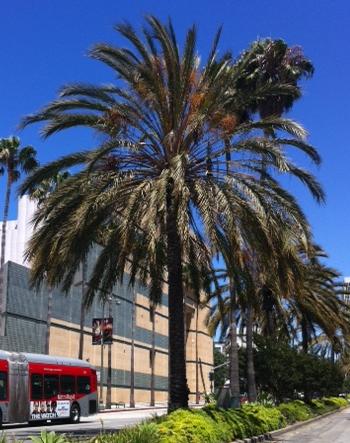
I can distinctly remember a job in the Oakland Hills that had two big Canary Island date palms that had not been groomed for many years. Decaying fronds were sagging low enough to mingle with the carcasses of agave blooms that were still sort of standing (or not) around the perimeter of the yard. Below these two palms (and I mean ‘below’, and within only a few feet of the trunks), the ‘landscaper’ had installed a few Colorado blue spruces, even more saucer magnolias, and about as many Japanese maples. These poor trees were literally pressed up against each other, and the rhododendrons that were getting delivered still needed to be stuffed in with them! Well, I could go on about how bad the ‘landscape’ was, but you probably get the point. Really, agaves and rhododendrons.

While unloading, the ‘landscaper’ explained to me, using the classic line mentioned above, “I used to be a chiropractor, but I got tired of all the stress and decided to get into landscaping.” He then continued to explain to me what made his career so stressful. After unloading the truck, I explained how frustrating it is to not be able to hire anyone to drive the truck or do the hard work at the farm. I hate working the irrigation through the middle of the night when summer gets hot. I am tired of the mud and rain in winter. Perhaps I should become a chiropractor!

Well, he did not like that much. He said that the two industries are completely different. Okay, I get that. He had to go to school for many years to earn his degree. Okay, I get that too. He had to work long hard hours for his career. Okay, I am still following here. It is a very stressful job that is not for everyone. Okay, have you worked out in the summer heat and dust, or winter cold and mud, until the sun went down, and sometimes into the night? Can you drive a tired old tractor or operate a chain saw? Do you even know how a shovel works?

The more he tried to explain to me that a chiropractor can become a horticultural professional, but a horticultural professional can not become a chiropractor, the more I realized how qualified I was for his former job. Yet, the horticultural industries are crowded with those who should be in other industries, or who simply do not take their work as seriously as it should be.

Goodbye To An Old Friend

image(16)

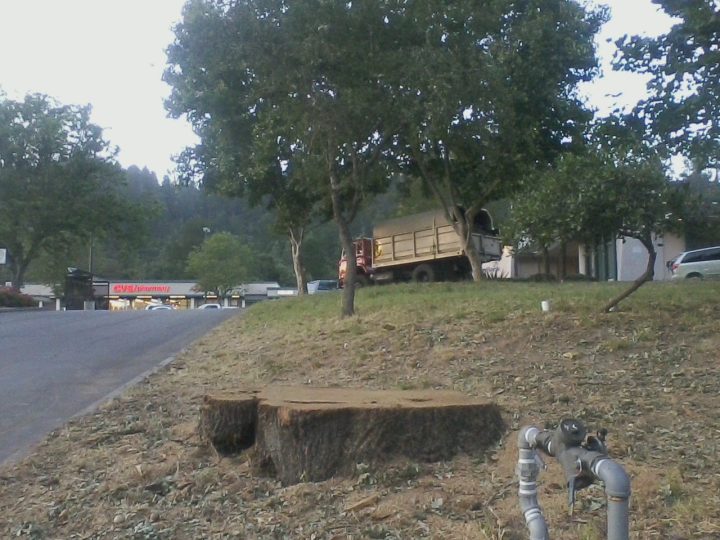
After decades of deteriorating structural integrity, Quercus lobata of Felton finally succumbed to a need to prioritize public safety, and passed away at home in Felton Fair on June 20, 2017. His age is unknown, but may have been about three centuries. He was born in Felton before Felton was, and lived his entire life here. In the idyllic alluvial meadow between Zayante Creek and the San Lorenzo River, he was a simple forest tree for most of his career, and only became a distinguished shade tree when Graham Hill Road was built. Instead of retiring later in life, he became the most prominent tree in the parking lot when Felton Fair was constructed. In his spare time, he enjoyed feeding neighborhood squirrels. A tree of few words, or really none at all, Quercus lobata never complained about anything, even when cars crashed into his bulky trunk, and stripped away large portions of bark where decayed cavities later developed. His remains will be scattered as mulch,and used to warm homes throughout the region. Ashes will be scattered as stoves and fireplaces are cleaned. Rings will be counted privately. Quercus lobata is survived by an unknown number of children, countless squirrels, and countless admirers of various specie throughout Felton.

The obituary above was serious business when it was written. What it does not mention is that the deceased did not fall down or die completely of natural causes. It was cut down after dropping a very large limb onto a roadway, demonstrating how dangerous it could be. It would have gotten more dangerous if it aged and deteriorated more. No one wanted it to be cut down. It was just too necessary.

This is the part of the job of arborists that non-arborists do not seem to understand. We arborists love our work, and we love trees. However, that does not mean that we object to the removal of each and every tree. The people who live with trees are more important. Any tree that blatantly endangers people or property must be removed or made safe.

Unfortunately, valley oaks deteriorate and fall apart for many decades before they finally die. This particular tree might have survived for quite a while if it had not been cut down. It also would have continued to drop limbs.

Distinguished old trees are always the most difficult to condemn. No one is old enough to remember when they were not here. They witnessed more changes to their little part of the world than anyone. Without going anywhere, some of them here in California visited three different countries; Spain, Mexico and the United States of America.

In the end though, death is perfectly natural. The tree had spent centuries doing what it was put here to do. It was time for it to go. Behind the stump in the picture, one of its babies is already becoming a nice young tree. Another one is just to the east, just beyond the left edge of the picture. They might shade the road and driveway for a few more centuries. What history will they see during that time?


Street Wise About Street Trees

70913thumb

There is no such thing as a perfect tree. All trees have foliage that one way or another, eventually falls to the ground. All trees have roots that might try to displace something that gets in their way. Many trees are messy in bloom. Some make messy fruit. Except for palms, all trees have branches that can be broken by wind. Just about any tree can be blown over if the wind is strong enough.

This is why the selection of trees that are appropriate to each particular application is so important. Finding trees that provide enough shade, obscure an unwanted view, or perform any specific function is one thing. Finding trees that behave while performing their assigned tasks is something else. There are always compromises. A certain degree of bad behavior will likely be tolerated.

Street trees for a parkstrip between the curb and sidewalk can be the most challenging trees to select. There are so many variables to consider. Many neighborhoods have saved us the trouble of selection by prescribing a specific tree, or maybe limiting the choices to only a few species, whether or not they are actually appropriate. Otherwise, we are on our own, to select whatever we like.

Microtrees might seem like good choices. They do not get big enough to damage a sidewalk, or make much mess. These are trees like crape myrtle, purple leaf plum and photinia (in tree form). These trees can be proportionate to narrow streets, but really do not shade much more than a single parking space. Because they are so low, they need serious pruning for adequate clearance.

Mid-sized and bigger trees like Chinese pistache, honeylocust maidenhair tree and some of the modern hybrid elms certainly cause more problems, but might be worth the bother. They shade curbside parking and part of the front yard nicely. Like small trees, they need to be pruned for clearance, especially over the roadway, but they eventually grow up high enough to be out of the way.

It seems that trees that exhibit some of the better characteristics for street trees are deficient in other ways. Australian willow has very complaisant roots, and is very resilient, but also branches low, and is not much to look at. Fern pine and several oaks are excellent street trees for decades, but eventually get big. Root barriers will delay, but not prevent roots from damaging sidewalks.

Timing Is Everything For Pruning

70906thumbThere are certain disadvantages to gardening in such a perfect climate. We can not grow things that require significant chilling in winter. Nor can we grow things that require prolonged heat in summer. Seasons change so gently that it is easy to get behind schedule. It is already late summer, whether it seems like it or not. What we do not do in the garden is as important as what we do.
Plants know what time it is. Almost all are slowing down significantly. Many natives do almost all of their growth in spring, and then spend the later half of summer just getting ready for autumn. By now, the buds of deciduous trees like sycamore, oak and willow are already getting plump, even though they will not do anything until the end of winter. Non native plants will not be too far behind.
Evergreen plants that get pruned or shorn a few times through summer might need to be pruned or shorn one last time. If not done now, it probably should not be done any later. They need a bit of time to recover and regenerate a little bit of new growth prior to autumn. Otherwise, the exposed inner growth will stay exposed, and get worn by the weather as summer progresses into autumn.
Some plants need a bit more time to for new growth to mature than others do. Privet hedges for example, are quite tough, and do not seem to mind getting shorn at any time. New growth of holly, pittosporum and photinia gets stunted and discolored if still trying to grow as the weather gets too cool for it to continue. With enough time, new growth starts, and then ‘hardens off’ before autumn.
Like pruning, fertilizer promotes new growth, so should likewise not be applied too late. One last application of fertilizer can improve the color of citrus foliage before winter. Greener lemon and lime foliage tends to be more resilient to frost. Iron is particularly helpful for foliage, and is less likely than complete fertilizers are to stimulate new growth that will be sensitive to frost later in winter.