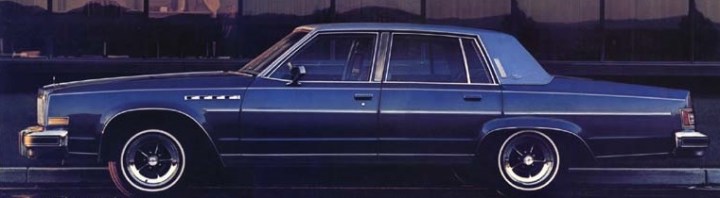
 That is a myth. They do not hate all cars. They just hate particular cars.
I did an internship with arborists in the summer of 1988, and have never been able to get away from arboriculture. Even as a nurseryman, I still sometimes work for arborists, and inspect trees that they are concerned with. I have seen many of their subject trees that have fallen onto parked cars, homes and whatever trees fall onto. I have noticed particular patterns.
Trees are more careful with Buick, Oldsmobile, Pontiac, Chrysler, Volkswagen, Mercedes Benz, and Datsun or Nissan. I have seen them put considerable effort into avoiding these cars when dropping limbs or falling over. When I was in school in San Luis Obispo, I drove my neighbor’s 1969 Oldsmobile Cutlass out from under his Chinese elm that fell over it. The tree held itself up on limbs that landed on the opposite side of the driveway so that the car came out from under it completely unharmed. When I lived in town in Los Gatos, a massive coast live oak two doors down fell harmlessly into the front yard next door. The roots pulled up in front of and behind a Volkswagen GTI that was parked at the curb, and barely tossed an ounce or two of mud onto the hood. A few big olive trees did the same at a large condominium complex in San Jose during a windy storm, leaving nothing more than a bunch of leaves and olives on top of a classic Mercedes Benz sedan and an old Datsun B210. These are certainly not the only examples. This seems to be a common theme for these particular cars.
I can not say the same for Mercury, Plymouth, Jeep, Cadillac, Mazda, Toyota, Lexus, Honda, Subaru, Infinity or Volvo. I have never seen trees damage or avoid damaging them.
Damage to Ford, Dodge, Audi, Isuzu and BMW did not see to be targeted. It was the sort of random damage that one would expect from a tree innocently falling onto parked cars.
Both of the only two cars that I know of that were squashed while being driven were Lincoln Navigators. That is not a good statistic at all. One was hit by a falling Canary Island pine in Fremont. The other was clobbered by a Coast live oak in Saratoga. No one was hurt; but the cars were killed.
I have seen only one Chevrolet damaged by a tree, but it was vicious! It was one of only three coastal redwood trees in a landscape situation that I had ever seen fall, although ‘fall’ does not adequately describe what this tree did. Without enough wind to damage adjacent and notoriously structurally deficient California pepper and Chinese elm trees, this redwood seemed to jump out of the ground to land on top of an Astro Van about twenty feet away! I do not think the tree was targeting it because it was a Chevrolet. The tree obviously hated this specific Astro Van VERY much.
Acura seems to be the second most hated sort of car among trees. They are less common than Honda, but I have never seen a Honda damaged by a tree that it did not run into first. Yet, I have seen at least three Acuras destroyed by a coast live oak, a blue gum eucalyptus and a Monterey pine. That is an inordinate number!
The car that trees seem to hate most is Porsche! They are uncommon cars, and are probably less common than any other car that I have ever seen damaged or destroyed by trees. Yet, I have probably seen more of them destroyed than Acuras, including one that was attacked as blatantly as the Astro Van was attacked by the small redwood. The ONLY blue spruce that I have ever seen fall landed squarely down the middle of a new Cayenne, back when they were the first SUV that Porsche made. The densely foliated canopy enveloped the car so thoroughly that only the middle of the tailgate was visible.
It would be interesting to know if insurance companies have determined if any particular types of cars are more likely to be damaged or destroyed by trees than any other. I would think that if the trends that I have noticed are accurate, that insurance companies would be aware of them as well. I am also curious to know if other arborists have noticed similar trends.
KinderGarden
By modern standards, the public schools that I attended in the early 1970s would be considered to be bleak and primitive. The building were utilitarian and simple, from about twenty years earlier. The landscaping was comparably simple, with a big lawn and proportionately big shade trees. A screen of alternating Monterey pine and Monterey cypress was hedged on the southern half of the eastern boundary of the schoolyard. The only deviants to the simplicity were a few significantly older trees on the northern half of the eastern boundary of the school yard. There were two coastal redwoods, a Canary Island date palm, a cedar, and a spruce of some sort. They were all quite mature, and were likely remnants from an old farmhouse that was there before. Perhaps they wanted us to be aware that everything changes.
On the way to kindergarten, back when children were allowed to walk to school, I weaseled my way underneath the first Monterey pine and Monterey cypress on the southern end of the fence line, and fell asleep. I do not remember how long I stayed there, but it was long enough to get in serious trouble with my very worried kindergarten teacher. After that, I could only visit those two trees in passing, and perhaps stop only briefly to smell the foliage or shake some of the rain away.
Nearly four decades later, but only a few years ago, I was assigned the grim task of composing the arborist report that would justify the issuance of a permit to remove that same Monterey pine, which was the last that remained of the hedged trees that I remember. I did not know that when I went to the site. I was just told that it was a ‘pine’.
Visiting the old school was not a pleasant experience. The entire site was surrounded with a prison like fence and saran screens to obscure the view inside and out. There were no open gates. I needed to be escorted to the tree by a professional chaperone. Much of the schoolyard had been very synthetically landscaped with microtrees and pretty flowering shrubbery that was intended to impress parents rather than appeal to children. It is bad enough that there are no orchards or open spaces remaining in the region, but it is worse that children are deprived of the open lawns and trees and natural spaces that my generation had taken for granted on the grounds of our school. Are children even allowed to climb trees anymore? Do they know what dirt is? Can they observe a chrysalis split open to reveal a new butterfly before the gardeners shear the shrubbery and take the learning experience away? It was saddening.
Once I realized that the tree that I was expected to condemn was my old friend, I asked the chaperone, who seemed to know a bit about facilities at the site, why anyone would want the now mature tree to be removed. I knew that it had been mutilated while young, but was impressed with how it somehow recovered and developed a well structured trunk. I thought that perhaps someone noticed something that I was missing in my inspection. People who are not arborists are sometimes alarmed by something that is perfectly normal for a tree, such as furrowed bark, or slight seasonal foliar discoloration.
The chaperone explained that the tree needed to be removed simply because it did not conform to the style of the rest of the landscape. I waited for the rest of the answer, but that was it. The tree did not conform.
Nothing gave me more pleasure than to explain that after my evaluation of the health, stability and structural integrity of the subject, I could find no justification for removal.
I was dismissed.
Yes, it was worth it.
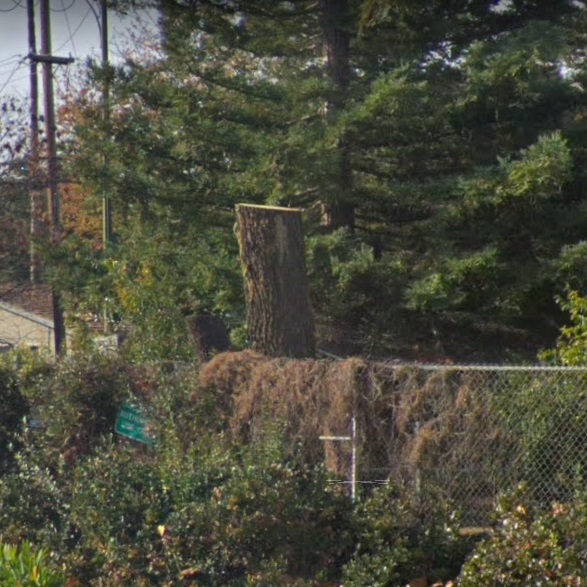
However, I knew that for the right price, another arborist would be pleased to condemn the tree. The picture of what remains suggests that the arborist who did so was not even professional enough to get his crew to finish the job. How does this dead stump conform to the rest of the landscape?
Those old trees, the redwoods, palm, cedar and spruce, were right. Everything changes.
The Monterey pine that would not conform is gone now, but it was right too.
Horridculture – Arborists Are . . . Unique.
 There are many different types of horticulturists. We are all unique, both individually as well as collectively within our respective professional group classifications. For some of us, individuality interferes with conformity to the collective generalizations that are so commonly associated with our collective groups. For some of us, the stereotypes are a perfect fit.
‘Primarily’, I am a nurseryman. We are the intellectual ones. Well, at least we get most of the credit for being the intellectual ones. Most of us really are quite intellectual. Most of us are rather humble about it.
My excuse for nonconformity to the latter is that I am ‘secondarily’ an arborist. Arboriculture is something that I have never been able to get away from. I did an internship with the most excellent arborists in the entire universe in the summer of 1988. After all these years of mostly growing horticultural commodities, I still sometimes conduct inspections and compile reports for trees that other arborists and their clients are concerned about.
You see, arborists are the passionate ones. One might say that we are enthusiastic, fanatical and zealous. Nurseryman might say that we lack restraint and cultural refinement. It is not such a simple task to distinguish between exuberant dedication and primitive efficiency. Regardless, most arborists do not like to write reports. It is easier to get a nurseryman to do it.
In fact, arborists do not like to write much of anything. There are several elaborate blogs that are written by nurserymen; but blogs written by arborists are rare, with brief and infrequently posted articles.
The irony of this is that it is more important for arborists to express professionalism with clients than it is for nurserymen. Arborists are out in the real world, working directly with clients. Nurserymen work on the farm, isolated from those who purchase the horticultural commodities that are grown there.
Arborists are horticulturists who specialize in the horticulture of trees. The best are just as educated and experienced as nurserymen are. In fact, much of my education was derived from arborists. Yet, arborists are so often regarded as mere gardeners who go up trees.
That is where I get offended. Yes, I am aware that there are hackers out there. I am also aware of what clearance pruning of utility cables entails. I also know how serious my arborist colleagues are about their profession. They are not to be compared to gardeners.
There are many gardeners who are just as educated, experienced and proficient with horticulture as arborists and nurserymen. However, the majority of gardeners are not. I will not elaborate on this presently. It will be the subject of other rants. I have written articles about my professional experience with gardeners already, and none of them go well. (I lack experience with good gardeners simply because they have no need for my expertise.)
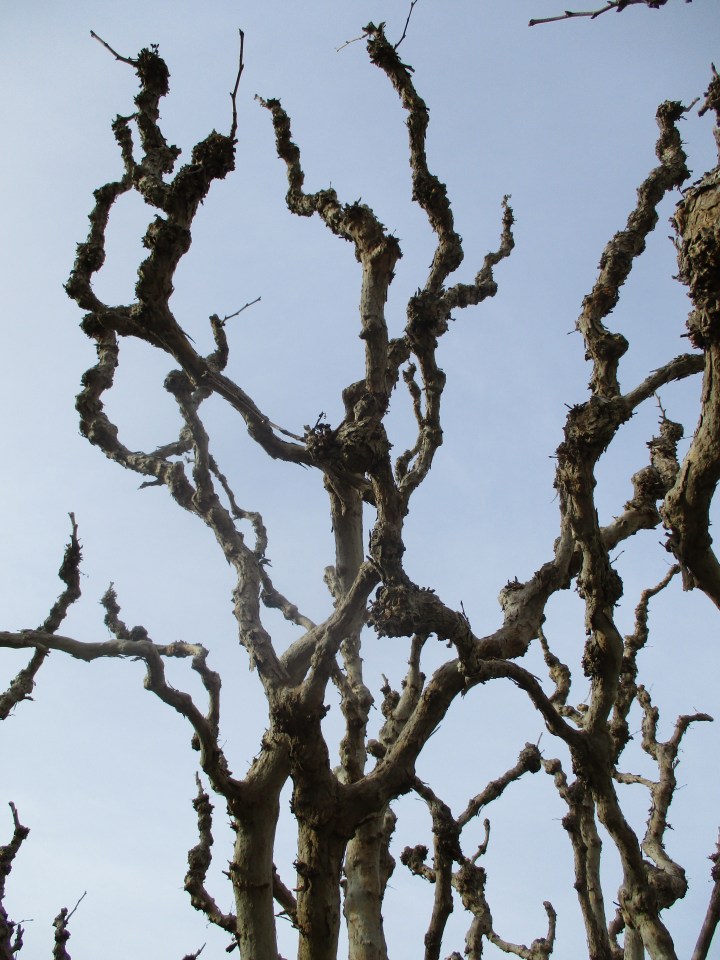
The picture above is an example of a sycamore that is pollarded in the traditional English style. The work is exemplary, and is repeated annually every winter. It is no simple task. I certainly would not want to do it. I can not think of any other nurseryman who would know how to do it properly. It is the work of a very skilled and very experienced arborist.
Horridculture – Lessons From Motivational Posters
 I work for the best. I do not intend to be too terribly pompous about it. I am just being honest.
This is not first time I have worked for the best. I have worked for at least three of the best arborists in the Santa Clara Valley, and two legendary horticulturists. I intend to eventually return to work for one of those legendary horticulturists back on the farm.
The main work I do now is part time and temporary. That means that I work less than four days each week, and will not be working there forever. I try to not think about leaving because it is saddening. I enjoy those whom I work for so much.
I work for only one other horticulturist, and one who is studying to be an arborist. Neither of them grow any significant quantity of nursery stock like I intend to spend the rest of my career doing. They maintain landscapes and facilities. The others of our elite group are very specialized professionals who work with everything else that is not relevant to horticulture. One is a carpenter. One is an electrician. One is a plumber; and so on. Although impeccably specialized, any one of us would do what he must to accomplish whatever needs to be done, even if it is beyond his respective specialty. Collectively, we are the ‘maintenance staff’.
How is this relevant to horticulture? I suppose it is not very relevant. However, everyone else on the maintenance staff respects what the other horticulturist, the other arborist, and I do. Anyone who needs vegetation pruned for clearance from a project contacts us to get it done properly. Anyone who sees obvious problems in the landscape informs us about them. Everyone on the maintenance staff respects everyone else and their respective professions.
To describe what makes the maintenance staff the best, I could use any combination of those inspirational words that are so ungraciously followed by an overly simplified dictionary definition on those insultingly inane motivational posters that so many other employers display prominently in the workplace. They are all relevant. However, we have nothing to prove.
Besides, this is not about the best. It is Wednesday, when I write within the context of my ‘Horridculture’ theme.
I have also worked for the worst. One of these worst was portrayed to be a very professional landscape maintenance company. We had a much larger staff, spread out over nine counties. We had a good variety of those motivational posters in our main office. Unfortunately, I did not realize when I went to work there, that those posters merely defined what we lacked.
Integrity – Dedication – Perseverance – Discipline – Teamwork – Excellence – Strength – Endurance – Accountability – We had none of that. I was the only horticulturist in the big staff of a big landscape maintenance company that simply did not care. I do not know how to describe it more accurately. We simply did not care. We were there to make a buck any way we could. We swindled, cheated and lied. I was only there as their token horticulturist and arborist, to help them get away with more of their illicit activity, and to make a good impression for their victims.
It is so backward. The big and seemingly reputable landscape maintenance company has less regard for horticulture than a maintenance staff who has other completely different priorities.
Horridculture – Ignoring Arboriculture
 There are too many different types of horticultural professionals to count. There are nurserymen who grow horticultural commodities. There are landscape architects and landscape designers who design the landscapes into which some of these horticultural commodities will go. There are landscapers who install such landscapes. Of course, there are gardeners who maintain the landscapes after they are installed. These are just a few of the more familiar horticultural professionals.
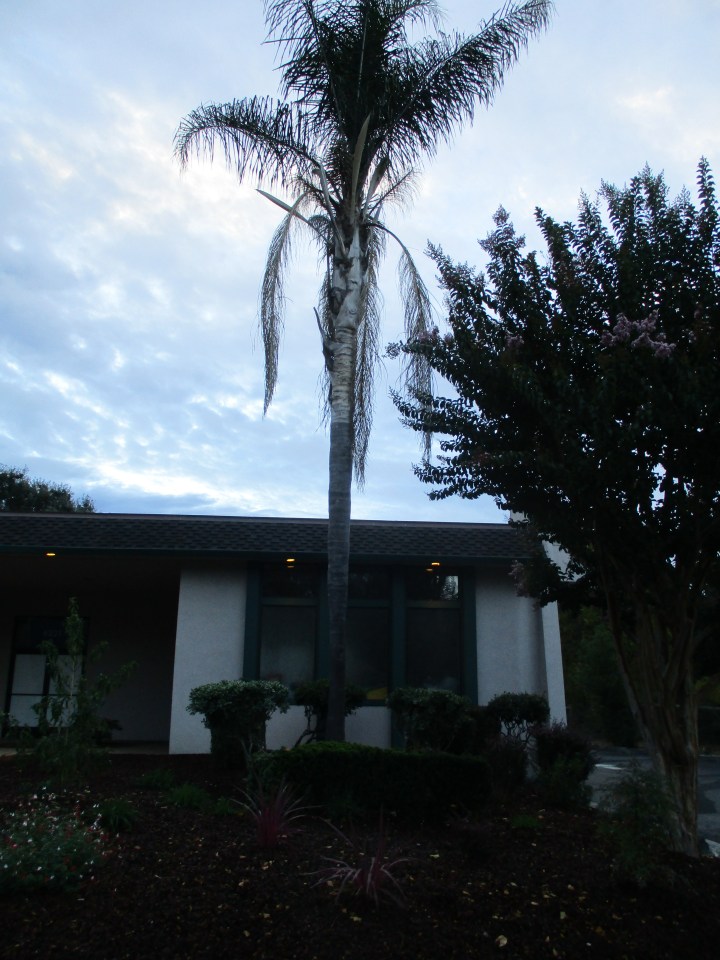
I will refrain from my typical ranting about the extreme lack of professionalism among almost all horticultural professionals who are not nurserymen or arborists (okay, and one landscape designer), but must point out something in the picture above. Do you see it?
It is not the fact that this once very well designed landscape was dismantled and mostly replaced with a cheap slapped together assemblage of cliché plants by someone who just needed work.
Nor is it the pointlessly disfigured shrubbery from the original landscape that was salvaged while the best features that could have been salvaged were removed.
Nor is it the fact that this process has been repeated a few times since the building was originally landscaped back in the 1980s, leaving a nicely maturing but weirdly non conforming crape myrtle in front of the queen palm that should be the focal point, as well as a new dogwood that will compete with both focal points.
It is the fact that despite all the effort that went into the installation of this garage sale style landscape, no one bothered to procure the services of an arborist to groom the queen palm. Do you see it now; all those dead fronds hanging from the canopy of the queen palm? It is like taking a pick up through a car wash while it is loaded with garbage.
General Sherman Tree

The biggest, tallest and oldest trees in the World are all native to California. The biggest trees are the giant redwood, Sequoiadendron giganteum. The tallest trees are the coastal redwood, Sequoia sempervirens. The oldest trees are the bristlecone pines, Pinus longaeva. The biggest and the tallest are two of only three specie of redwood in the World, and except for a few coastal redwood that live barely north of the Oregon border, both are endemic only to California. Most of us know that the coastal redwood is the state tree of California. However, some believe that California is the only state with two state trees, which are the two native specie of redwood.
This gives arborists from California serious bragging rights.
Most of the arborists whom I work with are very familiar with the coastal redwood. Not only is it the most prominent tree in the Santa Cruz Mountains, but it is also a common tree in landscapes of the Santa Clara Valley.
The other two specie are not nearly so common. Neither perform well in landscape situations, and certainly not locally. Even if they did, the giant redwood gets much too bulky to fit into urban landscapes, and the bristlecone pine is a bit too irregular for refined landscapes. Because they both live in somewhat remote regions within California, some very experienced arborists have never seen either of them in the wild. Of course, it is not something we talk about much.
I still have not seen bristlecone pine in the wild. The only specimens I have ever seen were bonsai stock that had not yet been cultivated as bonsai specimens.
In the late 1990s, I had not seen giant redwood in the wild either. I had only seen the unhappy specimens that were planted on the sides of roads between San Jose and nearby towns during the Victorian Period before the urban landscape had become so inhospitable to them. One of my respected colleagues who had seen many of the more interesting trees of California in his travels had not seen them either.
Fortunately, it was nothing that a good old fashioned road trip could not fix. Without much planning at all, we drove out to Sequoia National Park and met with the General Sherman Tree. There was too much snow to get very far, so we did not get similarly acquainted with the General Grant Tree farther up the road. It was one of the most compelling horticultural trips of my lifetime, right up there with going to see the native California fan palm, Washingtonia filifera, outside of Palm Springs, or the Joshua tree, Yucca brevifolia, outside of Palmdale. I know that the picture above is not a good picture of my colleague with the General Sherman Tree. It is from a time when cameras still used film. Getting pictures transferred to a compact disc was merely an option back then. The sepia toned picture below is even older, but it is not mine.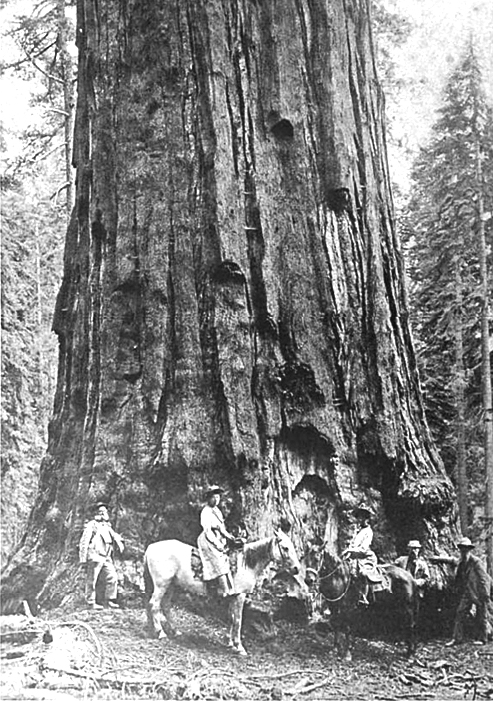
Horridculture – Reputation

I earned it. For several years, back when newspapers were composed of a rather ingenious combination of both news and paper, I was a respected garden columnist, as well as a respected horticulturist and arborist. Of course, I was an a horticulturist and arborist first. I later started writing my garden column because I wanted to do better than what the professional columnists who lacked practical experience with horticulture were doing.
For someone who would have preferred to simply grow horticultural commodities back on the farm, the notoriety was an odd fit. I was often asked to be a guest speaker for all sorts of garden clubs, and to write about their events. For a few years, I was a guest of honor and staffed a gardening question booth at Spring In Guadalupe Gardens in San Jose. It was awkward to walk from where I parked to the booth, past a dozen or so posters with my picture and various quotes on them.
People read my gardening column because they wanted accurate and relevant information. Although I was not proficient at writing, I managed to maintain my integrity as a horticulturist and arborist. My expertise was respected.
Then, a ‘colleague’ who wanted to capitalize on my notoriety convinced me to work for him while he established a website for me. I agreed, along with the stipulation that the website conform to my discriminating standards.
That stipulation was ignored. The website was embarrassingly flashy, with pictures of tropical plants that would not survive as more than houseplants in California. The grammar and spelling were deplorable. Articles were modified to be relevant in any season, just in case, for example, someone was worried about frost in the middle of summer. My ‘manager’ was not at all concerned with horticulture, but was instead more interested in installing advertisement for his products into the website.
About that time, I was invited to install a landscape into the 2009 San Francisco Flower and Garden Show. I would have declined, but was encouraged to compose a landscape to promote the new website. The landscape was ‘adequate’, and did happen to feature an excellent reproduction of an old windmill that my ‘manager’ happened to procure. However, the real priority was showcasing the products that my ‘manager’ was marketing, including a rainwater harvesting system. Within our limited space, we had a big black vinyl water tank! Instead of getting a vendor booth at the show, he used the landscape to pimp his products and services! It was mortifying! The fact that my modified design won awards seemed to make it even worse, as if to justify out extreme gaucheness!
It took a few years and the assistance of an attorney to get the ‘manager’ to close down and delete what was supposed to be my website, but was merely a collection of links back to websites and advertisements for what the ‘manager’ wanted to sell. Otherwise, anyone searching for me online would still be directed to products and services that I want nothing to do with, but seemingly endorse. Even now, these two images above and below would be at the top of the list of a search for images of Tony Tomeo on Google. They are from the 2009 San Francisco Flower and Garden Show, and are now associated with a website with which I have absolutely no affiliation. I want nothing to do with such unethical standards.
The picture above was taken within the landscape just before the Show opened to the public. The black vinyl tank is visible in the background. The picture below was taken during the assembly of the landscape, before I had shaven and gotten appropriately dressed.

Spontaneous Limb Failure
 It is as scary as it sounds. Well foliated limbs or entire trees really do fall spontaneously during the calmest of warm weather. It never fails to frighten anyone who witnesses it. Those who witness it always express the same difficulty with trying to explain it to those who did not witness it, as if they know that no one will believe them.
Several people heard this cottonwood limb fall onto a bridle path in Felton Covered Bridge Park. It is not a particularly large limb. The diameter about a foot above the flared union is only about seven inches.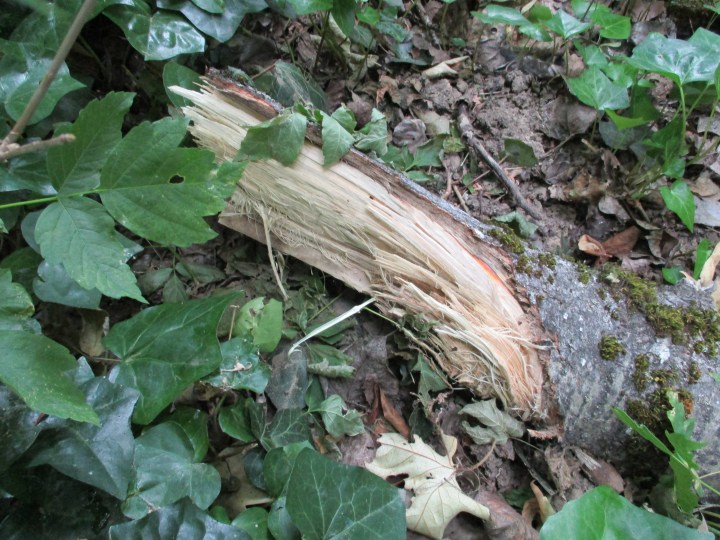
Yet, even this relatively small limb is seriously dangerous when it falls from above, and from such a height.
A much larger sycamore limb that was almost two feet in diameter fell nearby a few years ago. It was like a full sized tree falling from the sky!
What makes it so frightening is the spontaneity. We expect limbs to break when the wind is blowing. Trees are more likely to fall when the soil is saturated from an abundance of rain. Dynamic weather like wind, rain and snow are expected to be the cause of limb or tree failure. Passive weather like warmth and humidity seem like they should be innocent of causing such damage. Not so.
Warmth accelerates vascular activity, which increases the weight of healthy foliage.
Humidity inhibits evapotranspiration (evaporation from foliar surfaces) that would otherwise decrease the increasing foliar weight.
Breezes that are normally thought of as a cause of limb failure would actually enhance evapotranspiration. Therefore, a lack of any breeze actually increases the potential for spontaneous limb failure.
So, while the weather is warm, humid and still, just when you least expect it, spontaneous limb failure is most likely to happen.
Real Deal
 Stereotypes can be such a bother. For the past almost twenty years that I have been writing my gardening column, many of those who read the column have been making assumptions about who I am and how I behave. I actually find much of the behavior that I should conform to be rather objectionable. Even the lingo would be awkward for me. I am a horticulturist, and if you must know, an arborist as well. It is my profession. I did not take an interest in horticulture because I retired or got bored with my primary career. Nor did I flunk out at everything else. I am not a garden guru, flower floozy or hortisexual. I do not crowd my garden with garden fairies, repurposed junk or rare and unusual plants. There is nothing eclectic or quaint. There is no whimsy or magic, and most certainly NO riot of color! Brent does not even flinch at my offensive racial comments.
Does anyone remember the yellow clivia fad? Everyone wanted yellow clivias in their own gardens because they were so rare, and so different from the typical orange. Does anyone even know what ‘rare’ means? When we all get them growing in our own garden, they are NOT rare! Has anyone tried to find an orange clivia lately? Yellow clivias had been rare back when orange was the more popular color, but only because orange clivias were the previous fad, and nurseries did not bother to grow the undesirable yellow clivias. Both yellow and orange are nice, but only if they happen to be the right perennial for a particular situation. They work nicely in spots that are too shady for other plants, and the bright colors are striking against the richly dark green foliage. However, they are not better than lily-of- the-Nile for sunny spots. I have grown more lily-of-the-Nile than I can write about, but have grown only one orange clivia.
The same goes for dawn redwood, or like landscapers with something to prove say, ‘Metasequoia glyptroboides’. They are nice trees in the right situation, particularly where redwoods would be nice, but a bit of sunlight is preferred through winter. However, that certainly does not make the right tree for every situation. I have worked with a few, but have never grown one in my own garden.
I loath Japanese maples! I do not mind growing them in the nursery, but I do not want to waste garden space on something so trendy. There are plenty of other more useful or prettier trees and shrubs. When I say that maples are some of my favorite trees, I mean ‘real’ maples, such as sugar maples and red maples. I know that silver and bigleaf maples are not very desirable trees, but they happen to be two of my favorites.
Being a good horticulturist is about knowing the many plant specie that we work with. Although silver maple happens to be one of my favorites, I have only been able to recommend it for just one application in my entire career. Just because it would be nice in my home garden, and I am willing to deal with the problems, does not mean that I can recommend it for other landscapes where others would need to contend with the problems. As much as I dislike Japanese maples, I have recommended them a few times for small spaces like atriums, particularly for clients who happen to like them. Unfortunately, they are more useful than silver maple. It is all a matter of knowing what specie are most appropriate for every application.
High Fashion
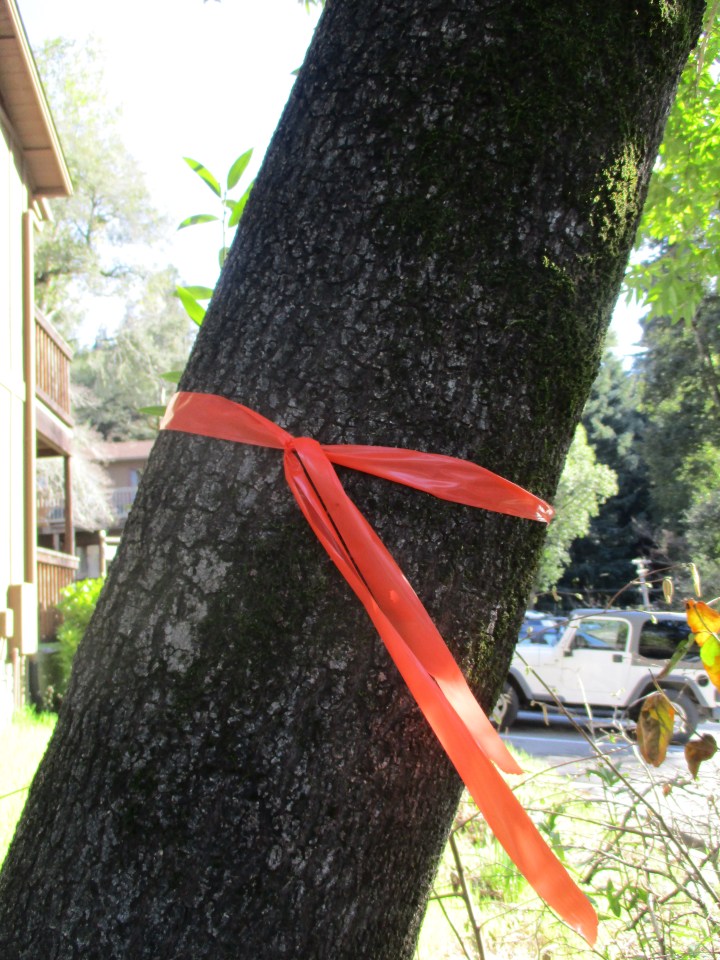 This exquisite yet elegantly simple persimmon orange cravat is to die for! See how distinguishing it is for the Umbellularia californica sporting it! The brilliant color is so appropriate for a tree that needs to stand out in a crowd! How else would the arborists coming to cut it down find it? Yes, it is to die for!
This sort of high fashion is not normally so high. Trees that are tagged by surveyors are typically more discretely tagged with spray paint down near the ground. We just used this orange tape because we were only hastily marking a few or our own trees for removal, and nothing else.
The problem with tape in other situations is that it can be removed and applied to another tree. One of my colleagues sent his crew to cut down a street tree downtown that had been marked with orange tape, only to find later that the wrong tree had been cut down. The client had procured a permit for the tree that the arborist had tied the tape onto, but not another tree next to it that he wanted removed also. After the arborist marked the tree to be removed with tape and left, the client removed the tape, and tied it onto the tree that was to be preserved. Of course, the crew cut down the tree with the orange tape. The sleazy client did not want to pay for the removal because the wrong tree had been cut down, and then hired another tree service to legally remove the tree for which the removal permit had been issued, while leaving the first arborist liable for cutting down a protected tree without a permit. Fortunately, a neighboring merchant knew what the client was up to, saw him move the tape, and reported the incident to the responding code enforcement agents. The arborist got paid. The client got two huge fines; one for removing the tree without a permit, and one for the value of the rather valuable tree.
Tape works fine in the nursery because there is no one there to do anything sleazy. Besides, paint would be messy. Many years ago, we used red tape for stock that needed to be disposed of, orange tape for stock that needed to be shifted into the next larger size, and blue tape for stock that was sold and needed to be moved to a holding corral or loaded onto a delivery truck. Of course, different nurseries might use different colors and a different code.
For the sort of tree work that I was involved with, orange or red paint was used only on trees that were to be removed. It would not have been appropriate to tag good trees with paint! We usually marked trees for removal with a circled ‘X’ or just an ‘X’, in a very visible manner.
Surveyors use paint in a more discrete fashion, with single dots or other small markings of paint down near the ground. They use a variety of colors and a standardized code system. The paint is not permanent, and weathers away after a year or so. Some trees get tagged for pruning for clearance from utility cables. Some get tagged for clearance above roadways and sidewalks. A few that are hazardous or in need of such severe pruning that they will be ruined in the process get tagged for removal. Each color of paint means something different. Each specific tag is a message to whomever is responsible for the prescribed procedure. Some who are responsive to the coded messages work for the respective municipality. Others work for a utility company of some sort. They may not know what all the tagging means, but they recognize the meaning of the tags that are addressed to them.
That is why, when a client asks me what a particular tag on a tree means, I can only say that I do not know. I know what tags my associates use, and I can guess what a prominent circled ‘X’ or an ‘X’ means because I know of so many arborists who use that tag. I do happen to know what the bright orange tape around the bay tree above means because my associate put it there. However, I do not know what a blue dot, green dot, yellow dot, orange vertical line or red horizontal line mean.
 Tony Tomeo