Shady

P80310+++++Shady applies to more than trees. It applies to many of those who are hired to maintain trees and landscapes. In my career, I have worked for some of the best arborists, nurserymen and other horticulturists. In fact, some of my colleagues, particularly a landscape designer, two nurserymen and at least three arborists, happen to be legendary. I would say that I don’t mean to brag, but that would be inaccurate. I will write about some of them sometime. This here is not about them.

Sadly, I have had the misfortune to work with some really shady characters and businesses. They may seem to be more professional than the real professionals who take their professions very seriously, but it is all for show. I can tell you all about the brochures, and use all the buzz words, but it is all a lie. From sustainability and planting natives to save water, to diagnosing problems before they become serious, they are all lies. Their objective is to take money; as much money as possible, for as little effort as possible.

Even their contracts were not considered to be sustainable. I once informed an operations manager that the oleanders that were planted below a sign were not the dwarf oleanders that they were supposed to be, and that in order to prevent them from obscuring the sign, they would need to be pruned and deprived of bloom. He was not concerned, and told me that we have no idea who will be taking care of the landscape by the time that happens.

Sure, they would plant garden varieties of native ceanothus, supposedly to save water, but then water them so much that they would rot and die. In fact, they would put so much water on lawns that many established trees would rot and die. They would then charge a lot of money to remove the dead trees, and then charge more money to plant new ones, even though they were responsible for killing the originals.

I was once instructed to go look at a ‘Marina’ madrone that was a street tree in what had been the old Fort Ord, where some of the old homes, buildings and landscapes were in the process of being salvaged or renovated. I was only informed that the tree was in bad condition. Upon arrival, I found the single madrone in a well matched row of others, on a curving street. I was quite annoyed that the tree was so distressed from severe aphid infestation that it could not be salvaged. The subject looked as if it had been healthy for many years, but only recently became infested with aphid within the previous two years. The other ‘horticultural professionals’ at the site should have noticed the problem before the tree had deteriorated as much as it had. Now, removing the tree was going to compromise the conformity of the evenly spaced and well matched row of street trees. I wrote the report prescribing removal.

I needed to visit the site for another problem a few weeks later, and when I drove by where the tree should have been removed, I noticed that it was still there, and very dead. Interestingly, a tree next to it was missing. That made me wonder. I radioed in, and was informed that the tree had been cut down. You can guess where this is going. They had cut down the wrong tree; a perfectly healthy ‘Marina’ madrone. Why didn’t the crew removing the healthy tree question the removal of such a healthy tree next to a dead tree? Who knows. I wrote another report prescribing the removal of the dead tree, which was removed the second time around.

The client was charged for the removal and replacement of BOTH trees, the dead tree, and the healthy tree that was removed by ‘mistake’! The replacement trees were large boxed trees that better matched those that were removed!

For those who do not know, madrones should be planted while young, and will rather efficiently grow to match the others. Boxed trees get too distressed from the transition to recover right away, and wait around for years before they resume growth. By the time a big boxed tree starts to grow, a smaller tree would have already gotten established and grown larger. Boxed madrones are really for those who want to charge more money than they could get for smaller trees that cost much less.

So, the landscape company charged a lot of money to maintain the landscape, so that trees would not die from negligence. Then, they charged not only for the removal and replacement of a tree that died as a result of their negligence, but also a tree that was killed by their stupidity. As if that were not enough, they charged for the the most expensive replacement trees available. They were shadier than the trees that they killed.

Big Trees Really Need Arborists

41203thumbStormy winter weather always reminds some of us that our trees need some attention. Wind can break limbs. If the weather gets really nasty, trees can be destabilized by strong wind, particularly if the soil is moistened by rain. However, the truth is that arboriculture, which is the horticulture of trees, is important throughout the year. We just become more aware of it when weather threatens.
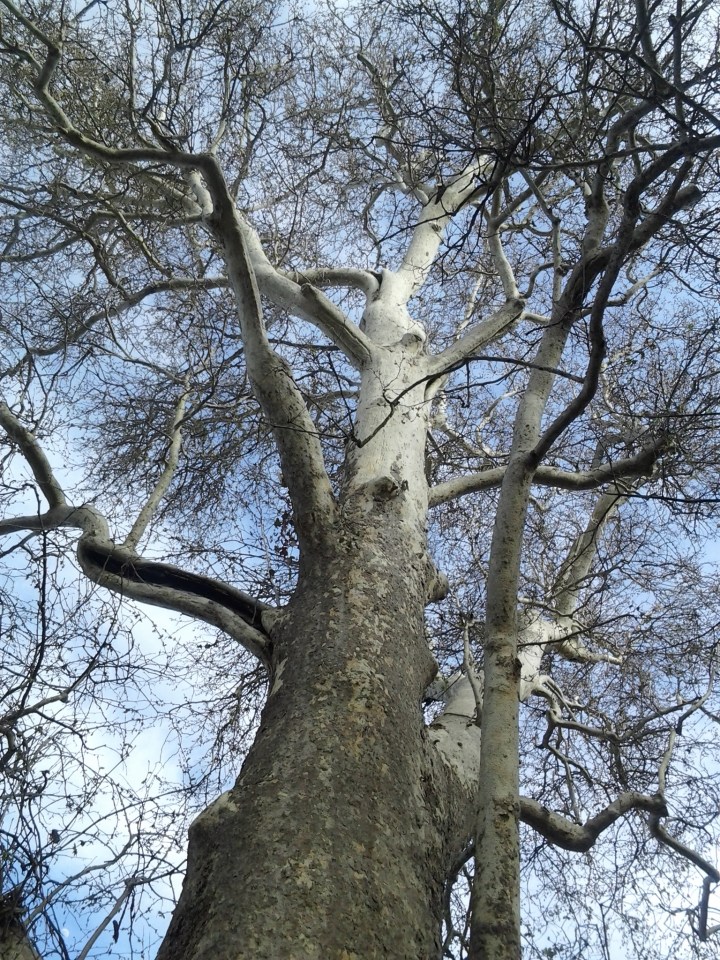
Not only is arboriculture important throughout the year, but it is also the most important aspect of horticulture in most gardens that are outfitted with trees. After all, trees are the most significant features of such landscapes. Their shade affects the homes and garden spaces around them. If they drop limbs or fall, they can cause significant damage. Many get far too big for us to maintain.

This is why we need arborists, the horticulturists who specialize in trees. Arborists can evaluate the health, stability and structural integrity of trees, and prescribe any necessary arboricultural procedures. In order to issue a permit to remove a tree, most municipalities require an inspection and report from an arborist who is certified by the International Society of Arboriculture, or ISA.

ISA Certified Arborists have passed an examination of their arboricultural expertise, and maintain their certification by continued involvement with ISA educational seminars, workshops and classes. The ISA is the standardizing resource for the promotion of the most important arboricultural technology, and maintains discriminating standards. ISA certification is quite a commitment.

www.isa-arbor.com, the website of the ISA, is an excellent resource for anyone in need of the services of a certified arborist. The registry of arborists can identify and find an arborist directly by name, or regionally by city or ZIP code. The site is also useful for information about proper arboriculture and trees, for those of us who maintain our own small trees, or want to select new trees.

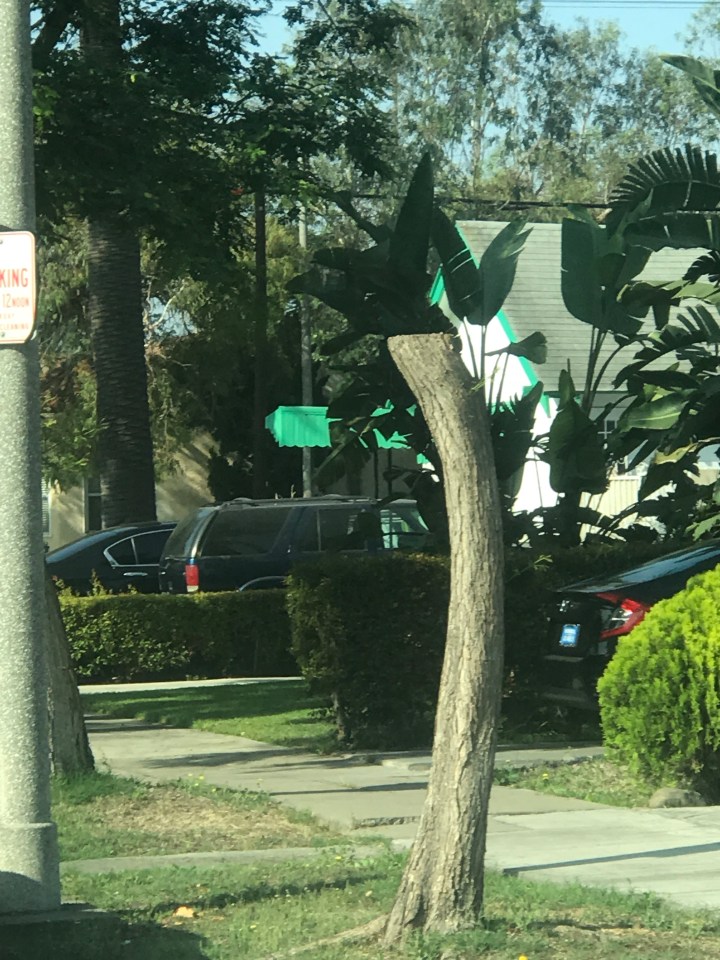
Trusting the wrong professional to maintain trees can be very risky. Even gardeners who are proficient at mowing lawns and shearing hedges may not be adequately knowledgeable about proper arboriculture. Instead of correcting problems, improper pruning can disfigure trees and limbs, and actually compromise their structural integrity. Sadly, it is not uncommon for otherwise healthy, stable and well structured trees to be ruined by those hired to care for them.

Arboriculture: Deep Space Nine

P71231The “Poly” in Cal Poly is for “Polytechnic”, as in there are multiple schools within “California Polytechnic State University” at San Luis Obispo. There were seven school when I was there between 1985 and 1990. I was a student of the “School of Agriculture”. “Horticulture” was my “Major”, or major realm of study within this school. Within this major, I selected “Floriculture and Nursery Production” as my “Concentration” of study. That certainly is a lot of quotation marks.
While majoring in horticulture at Cal Poly, I studied with students whose concentrations of study were within “Landscaping” or “Floral Design”. Withing the School of Agriculture, we studied with students who majored in “Crop Science” or “Animal Science” and so on. Like horticulture, each of those other majors was divided into other concentrations.

Then there were all those students of the other six schools, which I will not even get into because I am wearing out the quotation mark key.

In the summer of 1988, while many of my colleagues were going to Australia, New Zealand or South Africa for their internships, I stayed right here in California, and took a job with a Lee’s Tree Surgeons in Saratoga. My colleagues thought that was a bad idea. Not only was that sort of internship for those in the landscaping concentration, but it was for the lowliest among them. They climbed trees and used chain saws and ropes and such. They were primitive. They were barbaric. They were not like us.

As it turned out, I was not like them. Fortunately, they did not mind. They took very good care of me, and trained me as best they could about arboriculture in the three months I was with them. They realized pretty quickly that I was not a good candidate for the job they gave me, but made accommodations for me. Although I was never proficient at climbing, and was not really good for much at all during that summer, I later went back to work for some of them, and eventually became a somewhat proficient groundsman; but that is another story for another time.

In my fourth year at Cal Poly, San Luis Obispo, after my internship with Lee’s Tree Surgeons, I relocated from my semi-rural home back into town, and lived in a big apartments with three roommates. We made a tradition of watching “Star Trek: the Next Generation” on television. One of the roommates, who is now a very respected professor at Cal Poly, made cornbread for the weekly event. Although I did not continue the tradition after we all graduated and went our separate ways, I did sometimes watch “Star Trek: Deep Space Nine” when it came out a few years later. I really need to stop with the quotation marks.

In Star Trek: Deep Space Nine, I liked the concept of so many different species living together in an society in which it was very necessary to make accommodations for those who are different. Everyone needed to respect everyone else. Some even learned to appreciate the differences. Even the bad guys had redeeming and very often likeable traits.

In my career, I am primarily a nurseryman. That means I grow things. Other horticultural professionals might compare my people to the Vulcans. They think that we are too uptight, efficient and plain to be much fun. Factory growers (who work for the big corporate growers) would be more like Romulans, and are therefore less dedicated to what is right and logical if it is to their disadvantage. Some of the better artistic landscape designers are likened to the Bajorans. Unscrupulous maintenance gardeners who will do what they must to make a buck are comparable to the Ferengi. Some of them work for the larger and imperialistic Cardassian landscape corporations.

Arborists are the most excellent of all; or perhaps the second most excellent after Vulcan nurseryman. They are like the Klingons; honorable, noble, independent, passionate and boisterous! I can understand why my colleagues think of them as barbaric and primitive, but I also believe that my colleagues should be more accommodating. When I consider what arborists must have though of me what I did my internship, I realize that it must not have been easy for them to accommodate me. Yet, they did, and in the most excellent way. They still respect that I have my own career in my own world, but to this day, thirty light years later, they are still pleased to invite me to their world.

Someone Got Payed For This?!

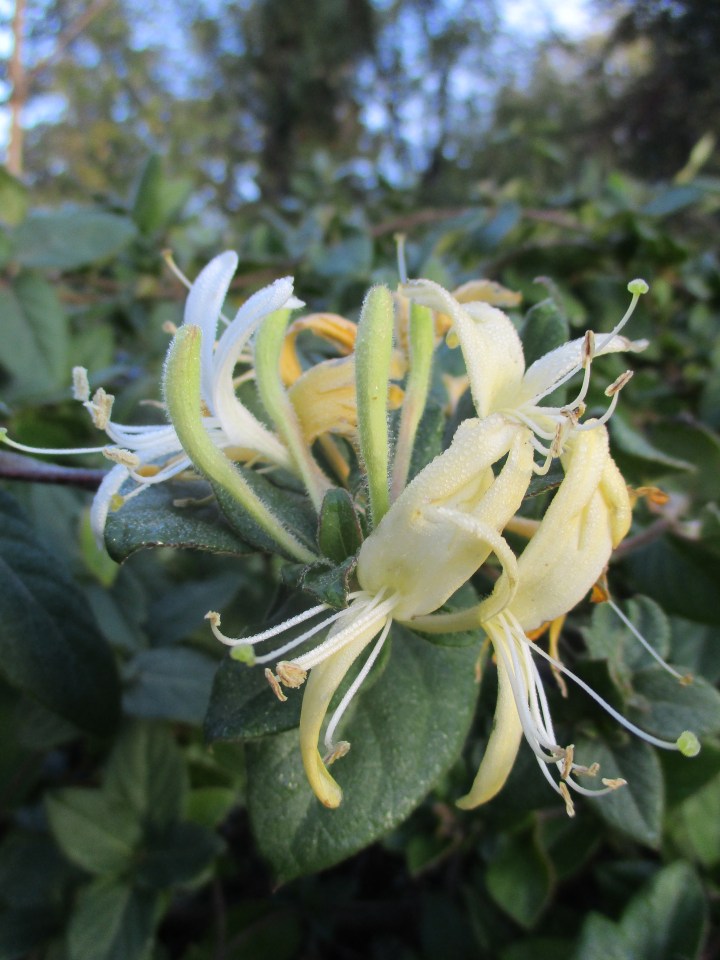
P71216See what happens when the plants in the garden are happy? They do pretty things. It is now halfway through December and this honeysuckle is still blooming nicely. The cool weather has inhibited bloom somewhat, but has not totally prevented it yet. By the end of winter, this honeysuckle will get pruned back so that it can regenerate new growth to bloom through next year.
This honeysuckle happens to be growing on a chain link fence behind a small group of apartments. Someone who lives in one of the apartments enjoys tending a few vegetables and flowers, but really does not put too much effort into the surrounding vines and shrubbery that obscure the view of the parking lot next door. That region of the garden gets only the maintenance that is required to keep it under control. The person who does it is no horticultural professional; merely someone who enjoys a bit of home gardening.

Horticultural professionals should know more about horticulture than someone who just enjoys growing a few vegetables and flowers after coming home from working at another profession. That is what they get payed for. That is why they are professionals. . . because it is their profession.

Right across Highway 9 from the homes with the honeysuckled fence is a pharmacy with a parking lot that is ‘maintained’ by ‘gardeners’. It looks like a parking lot. There are some nice young but shady elms that were recently pruned up for clearance by professional arborists who did a rather impressive job. Below the elms is a mixture of typical ‘low maintenance’ plants that are often found in parking lots, including lily-of-the-Nile, African iris, Oregon grape and Indian hawthorn, with a few dwarf Heavenly bamboo to add a slight bit of Japanese ethnic diversity into an otherwise African-American landscape.

Except for the elms and other young trees, none of the plants are exemplary. They are all tough plants that are resilient to the climate and abuse that they get in a pharmacy parking lot. Their main problem is the ‘maintenance’ performed by the ‘professional gardeners’. I could go on about this, but for now, I just want to describe what was done to the Heavenly bamboo.

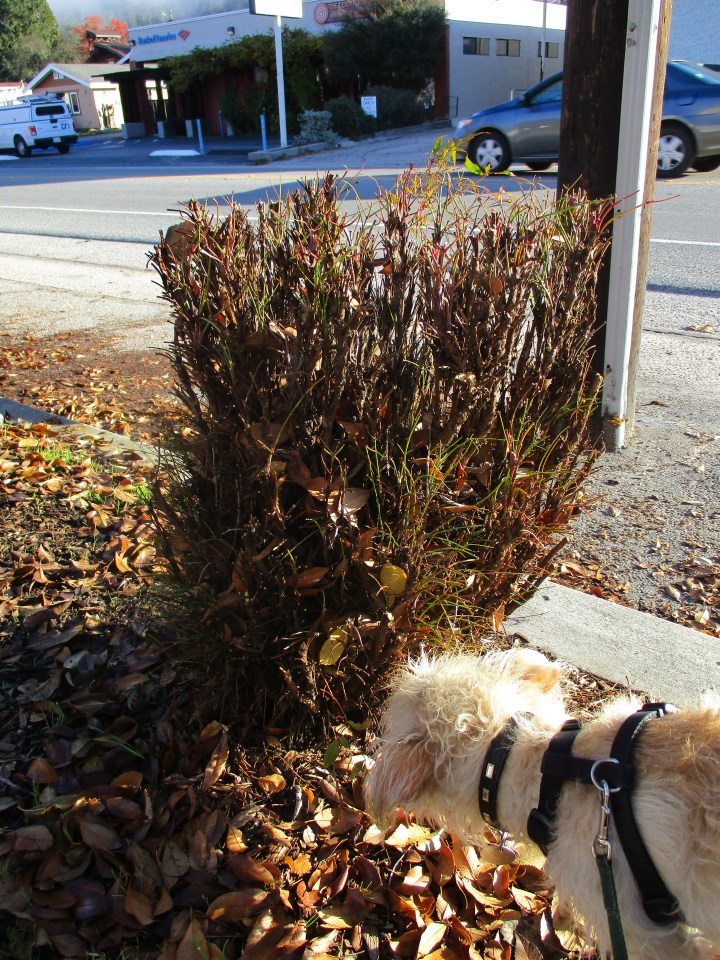
It never really looks that good. It does not get a chance to. At least this time of year, this particular cultivar of Heavenly bamboo gets some rather nice color on it. Even if the foliage is mutilated and crowed from a lack of ‘proper’ pruning and an excess of ‘improper’ pruning, the reddish or burgundy color is pretty from a distance. At least, it would have been.

The ‘gardeners’ cut all the foliage off, just as it was beginning to color. Yep. It is all gone. The canes were cut into these tightly shorn but somehow awkwardly asymmetrical cylinders with angular edges around the circular and flat tops. How does one put that much effort into shearing something so tightly, and perfecting the flat top, without getting it symmetrical? Why put that much effort into ruining something just before the performance that it waited all year for, and just prior to the longest time of year before the weather warms enough for it to recover?

Shear abuse – with shears.

Perhaps those are questions that Rhody is pondering in the picture. Perhaps he just wants to leave a ‘message’ for the ‘gardeners’.P71216+

Sculpture

P71206

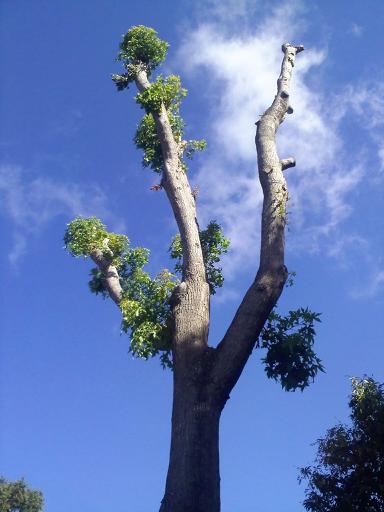
I use the term loosely. Okay, so maybe I use it mockingly in this context. This sort of thing really should have no connection to the works of Calder, Rodin or Brancusi. It might be worthy of a few fancy adjectives, such as ‘severe’, ‘unusual’, ‘dramatic’ and ‘bold’. Horticulturally though, we might be thinking more like ‘disgraceful’, ‘abhorrent’, ‘ridiculous’ or ‘just plain sad’.

There is nothing wrong with pollarding, that severe sort of pruning that almost all other arborists will tell you is wrong. It involves pruning trees back to the same distended terminal knuckles every winter. Only a few trees are adaptable to the technique, and technically, sweetgum happens to be one of those few trees.

The stipulation is that once pollarded, they MUST be cut back to the same knuckles EVERY winter. A small stub or maybe two can be left on knuckles to allow them to elongate a bit annually, but that is about all. Pollarding is severely disfiguring, and ruins structurally integrity for all growth after the first growing season. Without this annual and aggressive maintenance, pollarded trees are very likely to drop limbs and possibly disintegrate faster than they can recover.

Sweetgums are not often pollarded because they are usually grown for their autumn color. Secondary growth that develops in response to pollarding is too vigorous to color well. The foliage stays green well into winter, and then falls without much color at all. Pollarding sort of defeats the purpose of growing a sweetgum.

The real problem with this particular tree is that it was not pollarded correctly. For one, it was probably cut like this because someone thought that it was too big. It should have been cut much lower if someone was going to put the work into pollarding it at all. Now, the secondary growth that must be pruned away will be very high, and take much more work to prune away. It will also be more exposed to wind. Limbs that break away will fall from higher up, so will fall farther away, and with more inertia.

Secondly, the pruning technique really was ‘abhorrent’. Small stubs are acceptable on established knuckles in order to direct growth. Long stubs that are expected to develop into knuckles are also acceptable. The weird stubs on the trunks of this tree are both too short and too stout. Because they are too short, they will be too shaded to develop into knuckles. They are too stout to compartmentalize or ‘heal’ (if they do not form knuckles) so are likely to decay, and spread decay into the trunks.

Thirdly, this tree was pollarded in summer, which is why the secondary growth is so stunted and underdeveloped now that the tree should be going dormant for autumn. The stunting should not be much of problem, since new growth should develop in spring. The problem is that the lightly colored bark likely scaled when it suddenly became exposed to sunlight by the removal of all of the foliage in the middle of summer. The scalded areas will eventually decay and become open wounds, which will spread decay into the main trunks and limbs. Even if secondary growth is healthy, and the tree gets pollarded correctly every winter, the limbs will eventually become unable to support the weight of healthy foliage.

This is one of the many reasons it is so important to procure the services of a qualifies arborist. Someone payed a significant amount of money to get this valuable tree ruined, and will eventually need to pay more money to have it removed. It would have been much less expensive to pay a bit more to get the tree pruned properly, or to have it removed completely.

Arborists Are Physicians For Trees

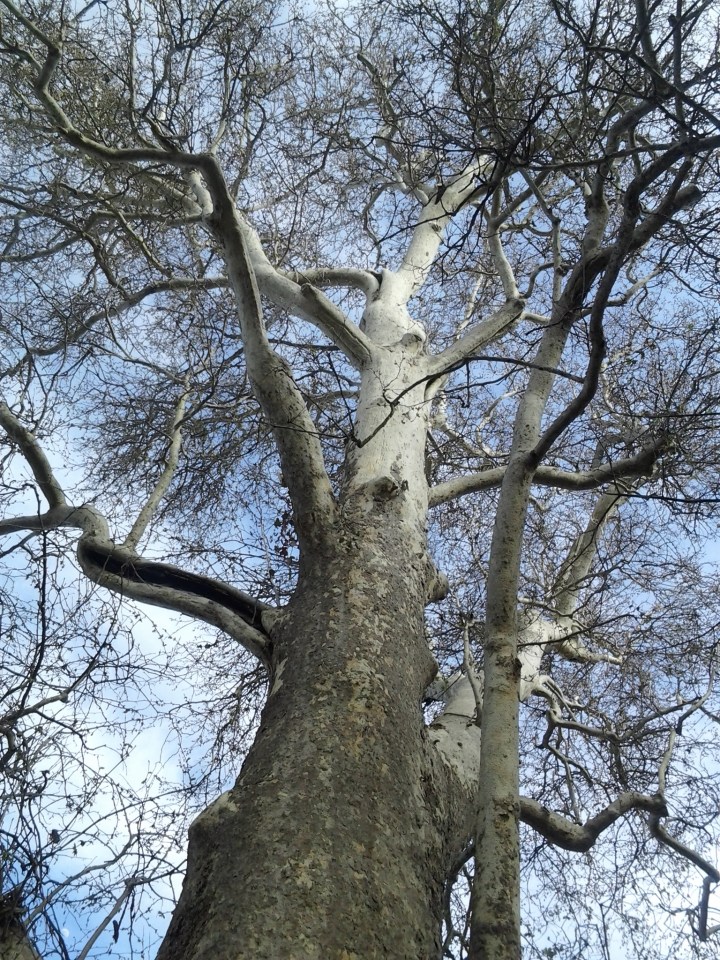
71108thumbBefore the storms of winter get here, it might be a good time to make arrangements to get some help for big trees that need it. Smaller trees that can be reached from the ground may not need anything that we can not do ourselves. It is the big trees that have grown beyond our reach that may need professional help if they have problems. They are unsafe for us DIY garden enthusiasts.
Once late autumn and winter weather patterns start, storms can break limbs and destabilize trees. Identifying problems and executing necessary remedies can limit such damages before they happens. Disproportionately heavy or structurally deficient limbs can be pruned to reduce weight and wind resistance. Obtrusive limbs can be pruned for clearance from roofs and anything else.

Trees are the most significant and influential features of our gardens. They shade and extend their limbs over our homes and gardens. Not only can they cause serious damage by dropping limbs or falling, but they can also change how our home and garden are affected by their shade. They are worthy of proper maintenance, even when it is necessary to procure the services of an arborist.

An arborist is a horticulturist who specializes in arboriculture, which is the horticulture of trees. Arborists are essentially tree physicians, who evaluate the health, stability and structural integrity of trees, and make recommendations for maintenance, or to repair problems. Most municipalities require an ISA Certified Arborist report in order to issue a permit to remove an unsalvageable tree.

The ISA is the International Society of Arboriculture. Certified Arborists have passed an examination of their arboricultural expertise, and maintain their credentials by continued involvement with ISA educational seminars, classes and workshops. More information about the International Society of Arboriculture and local certified arborists can be found at the website, www.isa-arbor.com.

Arboriculture is not the sort of thing that gardeners should be expected to perform. It is completely different from the sort of mowing, shearing and pruning that they do. Sadly, much of the damage that arborists find in trees was caused by improper arboricultural procedures. Arboriculture also has the potential to be very dangerous to someone who lacks adequate training and equipment.

No Respect

IMG_0417Horticultural industries are full of them; those who changed their respective careers half way through to do something ‘green’. We hear it all the time. “I used to be a ______ (Fill in the blank.), but I got so tired of ______ (Fill in the blank again.) and decided to get into landscaping.” Really?!? That is what you think of the landscape industry? Anyone who flunks out in your industry can ‘easily’ make it in landscaping?
While driving the delivery truck (because we could not hire a frustrated brain surgeon to do it for us), I had to deliver truckloads of rhododendrons to a ‘landscaper’ who did several jobs in Alameda and Contra Costa Counties. This ‘landscaper’ would walk through the nursery and tag whatever looked good at the time, and then assemble the landscape when the selected material arrived on site. Of course, he selected material that was in full bloom at the time, so the flowers were deteriorating by the time they arrived. His ‘landscapes’ were atrocious! The material was just tossed together so randomly, with plants that needed shade out in full sun, and full sun plants in the shade of big trees that were not pruned before the landscape was installed.

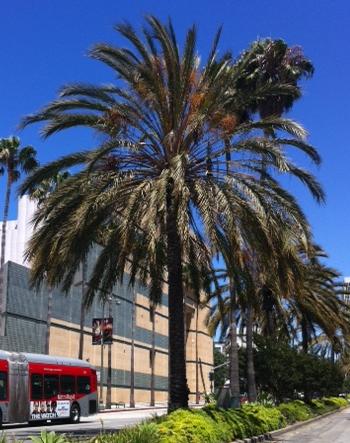
I can distinctly remember a job in the Oakland Hills that had two big Canary Island date palms that had not been groomed for many years. Decaying fronds were sagging low enough to mingle with the carcasses of agave blooms that were still sort of standing (or not) around the perimeter of the yard. Below these two palms (and I mean ‘below’, and within only a few feet of the trunks), the ‘landscaper’ had installed a few Colorado blue spruces, even more saucer magnolias, and about as many Japanese maples. These poor trees were literally pressed up against each other, and the rhododendrons that were getting delivered still needed to be stuffed in with them! Well, I could go on about how bad the ‘landscape’ was, but you probably get the point. Really, agaves and rhododendrons.

While unloading, the ‘landscaper’ explained to me, using the classic line mentioned above, “I used to be a chiropractor, but I got tired of all the stress and decided to get into landscaping.” He then continued to explain to me what made his career so stressful. After unloading the truck, I explained how frustrating it is to not be able to hire anyone to drive the truck or do the hard work at the farm. I hate working the irrigation through the middle of the night when summer gets hot. I am tired of the mud and rain in winter. Perhaps I should become a chiropractor!

Well, he did not like that much. He said that the two industries are completely different. Okay, I get that. He had to go to school for many years to earn his degree. Okay, I get that too. He had to work long hard hours for his career. Okay, I am still following here. It is a very stressful job that is not for everyone. Okay, have you worked out in the summer heat and dust, or winter cold and mud, until the sun went down, and sometimes into the night? Can you drive a tired old tractor or operate a chain saw? Do you even know how a shovel works?

The more he tried to explain to me that a chiropractor can become a horticultural professional, but a horticultural professional can not become a chiropractor, the more I realized how qualified I was for his former job. Yet, the horticultural industries are crowded with those who should be in other industries, or who simply do not take their work as seriously as it should be.

Goodbye To An Old Friend

image(16)

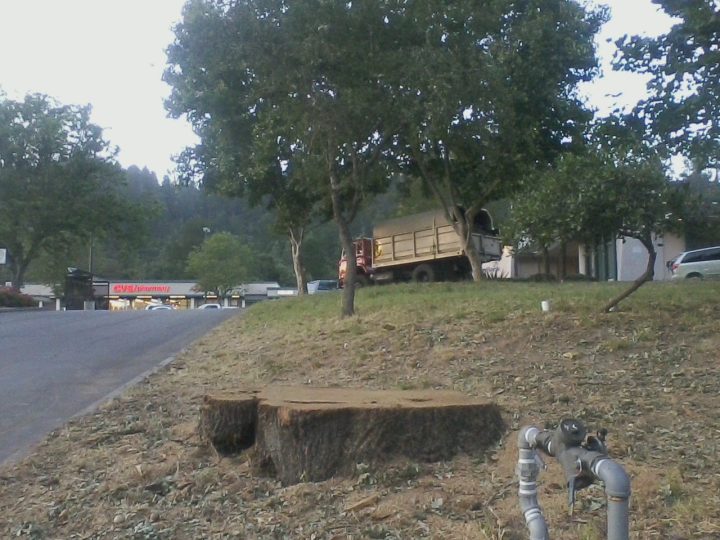
After decades of deteriorating structural integrity, Quercus lobata of Felton finally succumbed to a need to prioritize public safety, and passed away at home in Felton Fair on June 20, 2017. His age is unknown, but may have been about three centuries. He was born in Felton before Felton was, and lived his entire life here. In the idyllic alluvial meadow between Zayante Creek and the San Lorenzo River, he was a simple forest tree for most of his career, and only became a distinguished shade tree when Graham Hill Road was built. Instead of retiring later in life, he became the most prominent tree in the parking lot when Felton Fair was constructed. In his spare time, he enjoyed feeding neighborhood squirrels. A tree of few words, or really none at all, Quercus lobata never complained about anything, even when cars crashed into his bulky trunk, and stripped away large portions of bark where decayed cavities later developed. His remains will be scattered as mulch,and used to warm homes throughout the region. Ashes will be scattered as stoves and fireplaces are cleaned. Rings will be counted privately. Quercus lobata is survived by an unknown number of children, countless squirrels, and countless admirers of various specie throughout Felton.

The obituary above was serious business when it was written. What it does not mention is that the deceased did not fall down or die completely of natural causes. It was cut down after dropping a very large limb onto a roadway, demonstrating how dangerous it could be. It would have gotten more dangerous if it aged and deteriorated more. No one wanted it to be cut down. It was just too necessary.

This is the part of the job of arborists that non-arborists do not seem to understand. We arborists love our work, and we love trees. However, that does not mean that we object to the removal of each and every tree. The people who live with trees are more important. Any tree that blatantly endangers people or property must be removed or made safe.

Unfortunately, valley oaks deteriorate and fall apart for many decades before they finally die. This particular tree might have survived for quite a while if it had not been cut down. It also would have continued to drop limbs.

Distinguished old trees are always the most difficult to condemn. No one is old enough to remember when they were not here. They witnessed more changes to their little part of the world than anyone. Without going anywhere, some of them here in California visited three different countries; Spain, Mexico and the United States of America.

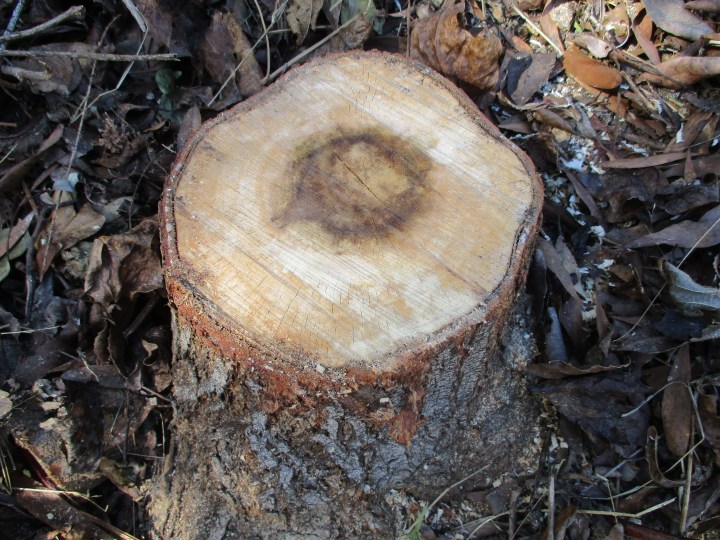
In the end though, death is perfectly natural. The tree had spent centuries doing what it was put here to do. It was time for it to go. Behind the stump in the picture, one of its babies is already becoming a nice young tree. Another one is just to the east, just beyond the left edge of the picture. They might shade the road and driveway for a few more centuries. What history will they see during that time?


Street Wise About Street Trees

70913thumb

There is no such thing as a perfect tree. All trees have foliage that one way or another, eventually falls to the ground. All trees have roots that might try to displace something that gets in their way. Many trees are messy in bloom. Some make messy fruit. Except for palms, all trees have branches that can be broken by wind. Just about any tree can be blown over if the wind is strong enough.

This is why the selection of trees that are appropriate to each particular application is so important. Finding trees that provide enough shade, obscure an unwanted view, or perform any specific function is one thing. Finding trees that behave while performing their assigned tasks is something else. There are always compromises. A certain degree of bad behavior will likely be tolerated.

Street trees for a parkstrip between the curb and sidewalk can be the most challenging trees to select. There are so many variables to consider. Many neighborhoods have saved us the trouble of selection by prescribing a specific tree, or maybe limiting the choices to only a few species, whether or not they are actually appropriate. Otherwise, we are on our own, to select whatever we like.

Microtrees might seem like good choices. They do not get big enough to damage a sidewalk, or make much mess. These are trees like crape myrtle, purple leaf plum and photinia (in tree form). These trees can be proportionate to narrow streets, but really do not shade much more than a single parking space. Because they are so low, they need serious pruning for adequate clearance.

Mid-sized and bigger trees like Chinese pistache, honeylocust maidenhair tree and some of the modern hybrid elms certainly cause more problems, but might be worth the bother. They shade curbside parking and part of the front yard nicely. Like small trees, they need to be pruned for clearance, especially over the roadway, but they eventually grow up high enough to be out of the way.

It seems that trees that exhibit some of the better characteristics for street trees are deficient in other ways. Australian willow has very complaisant roots, and is very resilient, but also branches low, and is not much to look at. Fern pine and several oaks are excellent street trees for decades, but eventually get big. Root barriers will delay, but not prevent roots from damaging sidewalks.