Sprawling ground cover forms of rosemary, Rosmarinus officinalis, that get only a foot or so deep are the most familiar. Taller upright types that can get to six feet tall can be quite sculptural. There are several shorter shrubby types in between that can be allowed to grow wild or shorn into tight hedges.
All rosemary is densely foliated with small narrow leaves not much more than an inch long. It is used as an herb because it is so aromatic and flavorful. Tiny flowers bloom in various shades of blue through winter and spring, and sometimes again in autumn. Stems that root where they touch the ground can be dug and moved as new plants.
Neither lavender nor cotton, but a member of the Compositae Family.
The name is somewhat of a mystery. It is related to neither lavender nor cotton, but Santolina chamaecyparissus is known as lavender cotton nonetheless. The small, silvery gray leaves have a finely wrinkly texture, and are remarkably aromatic, like lavender. Though, the small and round bright yellow flowers look like daisies with the outer petals plucked off.
Unlike lavender and most other similar evergreen semiherbaceous shrubs, lavender cotton is adaptable to shearing, and is actually a classic component of traditional ‘knot gardens’, usually with another species of Santolina with green foliage to provide contrasting color. (Knot gardens feature small hedges with various foliar colors shorn into geometric and sometimes intricate patterns.) If regularly shorn, it is appreciated for its strikingly gray evergreen foliage, since it will not bloom.
Unshorn plants get about two feet tall and a bit broader, and will eventually need seasonal light shearing to remove fading flowers after bloom. Annual pruning at the end of winter keeps plants compact and neat without depriving them of their bloom. They otherwise eventually get bald in the middle and sloppy around the edges. (Some of us know about that.)
Good warm exposure and well drained soil is best. After their first year, lavender cotton does not need much water.
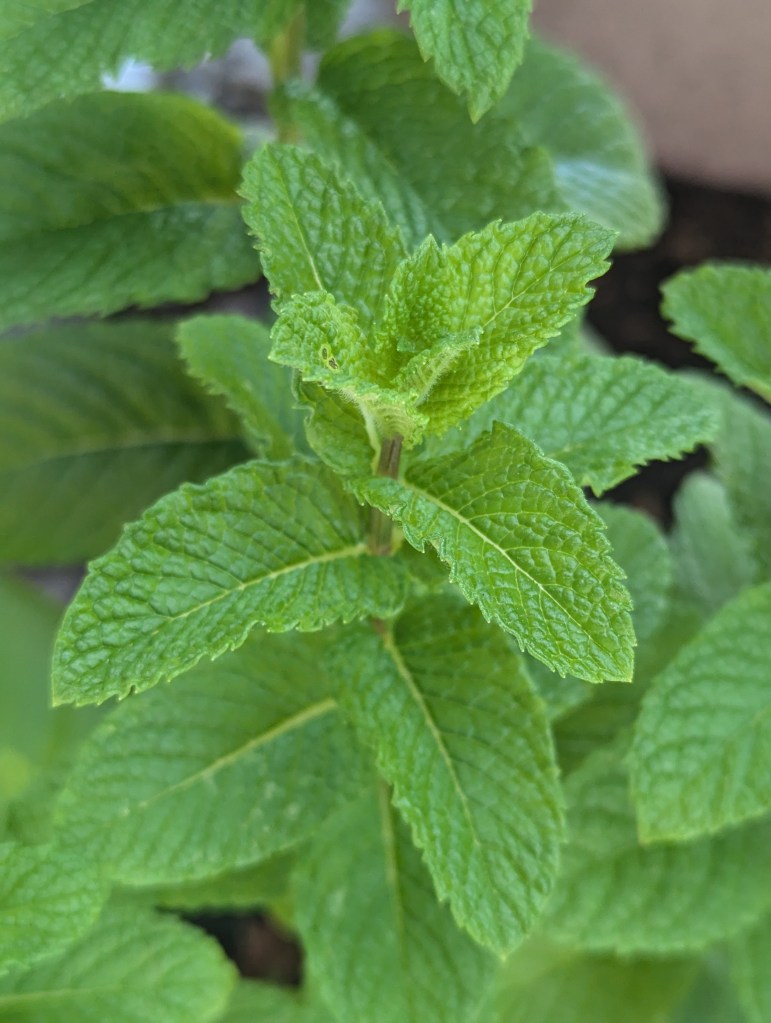
Propagation is not a problem for mint, Menthaspicata. It grows very easily from cuttings, even in water. Alternatively, it grows efficiently from division of its dense network of basal stolons. A more likely problem is its potential invasiveness. It spreads everywhere it finds water, even into other vegetation. Therefore, it is more popular in pots than in the ground.
Mint is as popular for its herbal or culinary application as for its aesthetic appeal. Various cultivars and hybrids provide various flavors and aromas of mint. It is handsome alone in pots, or can mingle nicely with annuals, perennials or herbs. It is a traditional component of mixed window boxes. With containment it can be a splendid small scale ground cover.
Mature growth is generally less than a foot high. It can sprawl almost three feet high onto low shrubbery, though. Occasional shearing, particularly after winter, maintains tidier and lower growth. Paired evergreen leaves are about two inches long, with serrated margins. Slender floral spikes of tiny white or pink flowers may get slightly shabby during summer if not shorn.
English lavender is likely the most common of this genus, with the most cultivars. French lavender is the primary culinary species. Spanish lavender, Lavandula stoechas, should likely be more popular than it is. All lavenders live for only a few years. Spanish lavender is more likely to self sow to replace itself, though. It can naturalize in favorable situations.
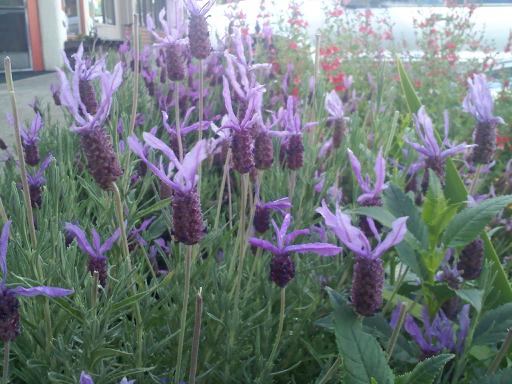
Spanish lavender is an evergreen shrub of irregular form, that grows as tall as three feet. Its finely textured foliage is grayish or drab green. Individual leaves are quite narrow and only about half an inch to an inch and a half long. Roots are not finicky about soil, but are likely to rot if irrigation is generous. Spanish lavender prefers warm and sunny exposure.
Bloom begins as soon as weather warms in spring and continues into summer. Sparsely sporadic bloom can continue until autumn. Dense floral spikes stand several inches over their foliage, on bare stems. They would not be very colorful if not for their few long upper bracts. Bloom is typically lavender, but may be bluish lavender, pink or very rarely white. It delights bees.
Floral fragrance attracts insect pollinators. Foliar aroma repels insect pathogens. It might repel other herbivores also. For organisms that lack olfactory perception, plants certainly make productive use of it. Fragrant flowers are as attractive in home gardens as they are to pollinators in the wild. However, aromatic foliage has the opposite of intended effects.
In other words, aromatic foliage is popular within home gardens because of its aroma. Its effort to be repulsive to some insects and herbivores makes it attractive to people. Some aromatic foliage has culinary or herbal application. Actually, almost all herbs are notably aromatic, with corresponding flavors. Mint, chive, thyme and sage are popular examples.
Window boxes became popular in ancient European towns because of aromatic foliage. Where garden space was scarce, they were convenient planter boxes for growing herbs. Also, prior to window screens, they sustained aromatic foliage that repelled mosquitoes. Trailing rosemary, ivy geranium and nasturtium are still very traditional accompaniments.
Rosemary has both culinary and aesthetic application. Culinary cultivars exhibit the best flavor. Landscape cultivars are either trailing or more densely shrubby. Some cultivars of fennel are similarly better for either culinary or landscape application. Bronze fennel has become popular for both. Varied lavenders are more popular as home garden shrubbery.
Native bay is very aromatic when its foliage is disturbed, but is not culinary bay. It is a big and obtrusive tree that is proportionate only to large landscapes. Culinary bay is another smaller species that is more proportionate to home gardens. Also, it has a distinct aroma. Incense cedar is another very aromatic native tree, but is quite rare within home gardens.
Most aromatic foliage can not exude its aroma like fragrant flowers exude their fragrance. Most does so only when disturbed. Some, such as that of many conifers and eucalypti, is beyond reach. It is therefore easy to dismiss within some landscapes. Lavender, lantana, diosma, rockrose and salvia stay within reach. Warmth and humidity amplify their aroma.
Its common name is both simple and descriptive. Little leaf sage is a literal translation of its botanical name, Salvia microphylla. However, several of its most popular cultivars are actually hybrids with other species. Also, they are more popularly but inaccurately known as Salvia greggii. Most lack their species name between their genus and cultivar names.
Little leaf sage is a small and generally evergreen shrubby perennial. Mature specimens are about three or perhaps four feet tall. They are a bit wider, and some can slowly widen by dispersing little rhizomes. Their little leaves are less than an inch long and delightfully aromatic when disturbed. Where winters are cooler, frost might initiate partial defoliation.
Bloom is most abundant for late spring or early summer, and again for autumn. Sporadic bloom can continue throughout most of the year. A few flowers may even bloom through winter. Floral color ranges through red, white and pink, as well as peachy and rosy pink. Coppicing old growth at the end of winter promotes replacement with new basal growth.
White sage is so aromatic that it may be be objectionable to some.
‘White’ is not often associated with ‘sage’, since so many sages are known for the rich shades of purple, blue and red of their flowers. Others have lavender, pale blue, pink, yellow or ‘almost’ orange flowers. Compared to these, the whorls of small, slightly blushed white flowers of white sage, Salvia apiana, are relatively unremarkable, even though they are held as high as a foot and a half above the shrubby foliage on elegantly slender flower spikes.
However, the evergreen silvery foliage of white sage is quite remarkable both visually and aromatically. It is so aromatic that some people may actually find it to be objectionable. Those who initially grow white sage as an herb or for use as incense later realize that it also becomes a prominent ornamental, particularly with dark green foliage, like junipers or arborvitaes, to contrast with its strikingly silvery color. Mature plants get taller and wider than three feet, with simple three inch long leaves. After spring bloom, flower spikes can be shorn off to promote fuller foliar density. I prefer to prune stems back more aggressively to promote more aromatic vigorous vegetative (non-blooming) growth. These vegetative stems become less aromatic as they too eventually bloom.
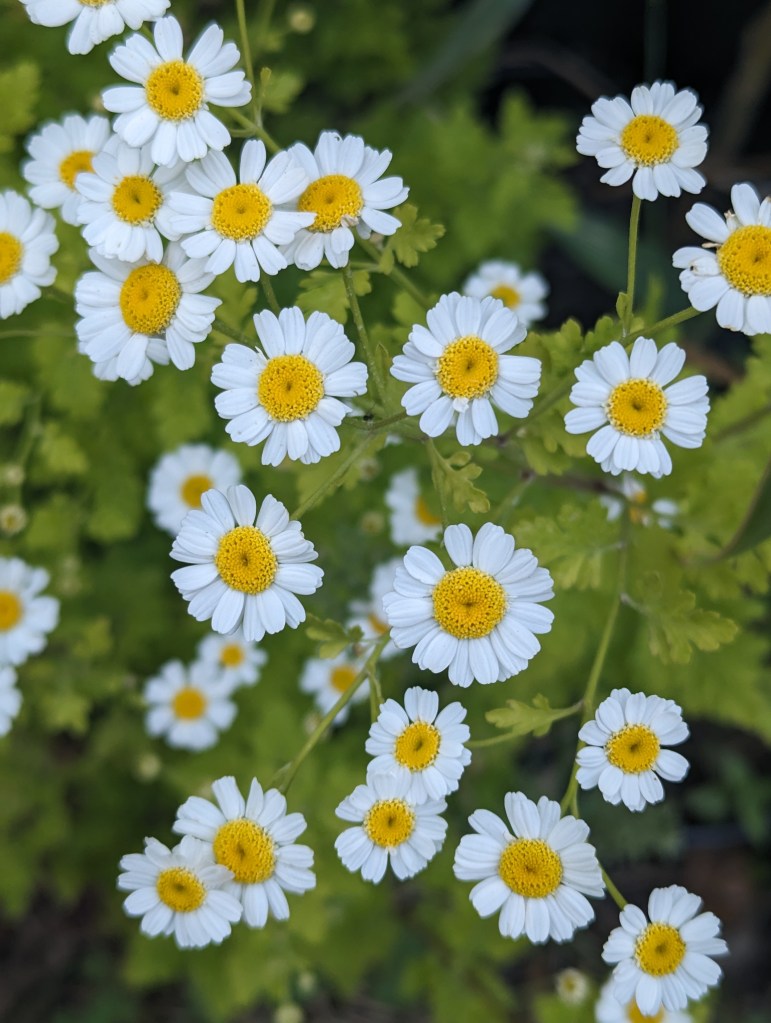
Historical herbal applications were the origin of its now silly name. Feverfew, Tanacetum parthenium, is a relative of chamomile. Its leaves are useful for herbal tea like floral buds of chamomile. Feverfew is delightfully aromatic, although some may disagree about how delightful it is. Some believe that it can repel unwanted insects, but may also repel bees.
Feverfew is likely more popular for its floral display than its aromatic foliage. Its abundant small composite blooms are very similar to those of chamomile. They are nearly as wide as three quarters of an inch. Their yellow centers are a bit flatter. Their ray florets (petals) are a bit wider. They bloom on open trusses that hover loosely above their basal foliage.
Feverfew has lime green foliage with a fine texture. It can stand almost two feet high with bloom standing a bit higher. It migrates slowly, but can slowly get where it should not be. Pruning scraps can root as cuttings. Feverfew prefers rich soil but does not need it. Good sun exposure and even watering are more important. ‘Aureum’ is bright greenish yellow.
It is neither as variable as the many varieties of English lavender, nor as traditional as French lavender, but Spanish lavender, Lavandula stoechas, has the most unusual flower spikes. These short plump spikes are less than two inches long, but are topped with one or two pairs of distended terminal bracts that are almost as long; like simple little packages with big ornate bows. The flower spikes get their color from densely set bracts that surround the minute flowers, and can be various shades of purple or purplish pink or even grayish white. The large terminal bracts are lighter shades of the same colors.
Bloom begins during warm spring weather and continues into summer. Flower may stay close to foliage on stems less than two inches long, or may stand more than six inches above the foliage. The aromatic grayish leaves are narrow and about an inch long.
Mature plants may be three feet wide, and nearly as tall. Aggressive shearing after bloom promotes secondary bloom later, and keeps plants compact. Without pruning, old plants eventually die out in the center.
All lavenders want good drainage and good exposure, but do not want mulch or fertilizer. Inadequate drainage, crowding or mulch can promote rot. Fertilizer can inhibit bloom. Once established, lavenders do not need much water.
Foliar aromas and flavors that are useful for culinary application deters many grazing animals.
The infinite variety of colors, fragrances, flavors and even textures that plants use to solicit the help of wildlife is amazing. Flower color, fragrance and sometimes texture are customized to attract very specific pollinators, and guide them to where they are needed. Many flowers direct and reward their pollinators with flavorful nectar. Fruit color, flavor and aroma attract specific animals to take the fruit, and disperse the seeds within. There is no end to what plants will do for their friends. We are merely secondary beneficiaries.
It is ironic that we also enjoy aromas and flavors that are instead designed to be objectionable to plundering herbivores. For example, the appealingly pungent foliage of most herbs is actually intended to repel grazing animals or feeding insects. We not only exploit these herbs for culinary purposes, but also to add their aromas to our gardens.
Lavender, mint, rosemary and the various thymes and sages are the most popular herbs that are attractive both aromatically and visually, whether or not we actually use them in the kitchen. Rosemary is actually a common and practical ground cover for large areas. Thyme is a good ground cover for smaller areas, and stays low enough to be grown around stepping stones where it becomes even more aromatic if stepped on.
Grecian or sweet bay is another herb that actually grows into a sizeable but practical evergreen tree. The native bay laurel is a bit too large to be as practical where space is limited, but is even more pungent. Although generally not useful as herbs, the various cypresses, pines, cedars and eucalypti are appreciated for their aromatic foliage as well. Incense cedar is particularly pungent.
Two of my favorite types of plants, junipers and geraniums, are among the more common aromatic shrubbery. Although actually considered to be perennials, zonal, ivy and of course, scented geraniums, can be used as small shrubbery or small scale ground cover. Junipers of course, range from ground covers to shrubbery to small trees.
Rockrose, breath of Heaven (Coleonema spp.) and myrtle are all quite aromatic. The old fashioned myrtle that gets considerably larger than the modern compact variety is even more aromatic. Lantana is an aromatic ground cover or low mounding shrubbery.
The aromas of aromatic foliage are strongest as fresh new foliage emerges in spring, and particularly after spring rain. Some people like to put aromatic plants where they will be slightly in the way, since foliage relinquishes its aroma more readily when slapped with a gate, bumped, or otherwise disturbed.





 Tony Tomeo