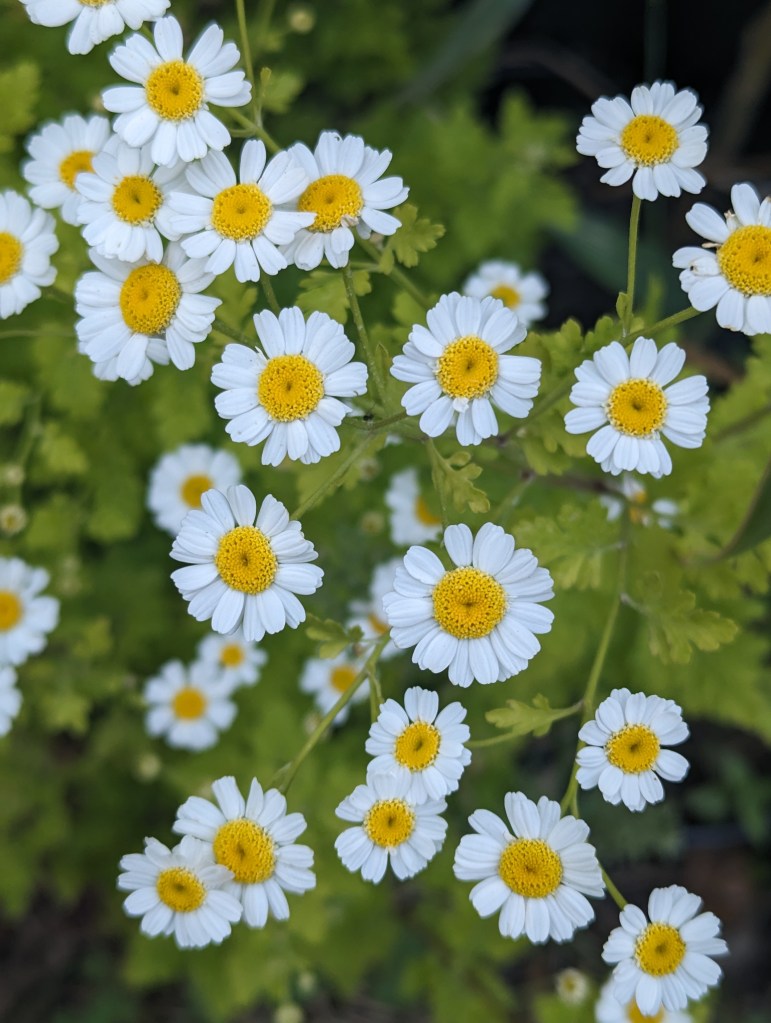
Historical herbal applications were the origin of its now silly name. Feverfew, Tanacetum parthenium, is a relative of chamomile. Its leaves are useful for herbal tea like floral buds of chamomile. Feverfew is delightfully aromatic, although some may disagree about how delightful it is. Some believe that it can repel unwanted insects, but may also repel bees.
Feverfew is likely more popular for its floral display than its aromatic foliage. Its abundant small composite blooms are very similar to those of chamomile. They are nearly as wide as three quarters of an inch. Their yellow centers are a bit flatter. Their ray florets (petals) are a bit wider. They bloom on open trusses that hover loosely above their basal foliage.
Feverfew has lime green foliage with a fine texture. It can stand almost two feet high with bloom standing a bit higher. It migrates slowly, but can slowly get where it should not be. Pruning scraps can root as cuttings. Feverfew prefers rich soil but does not need it. Good sun exposure and even watering are more important. ‘Aureum’ is bright greenish yellow.
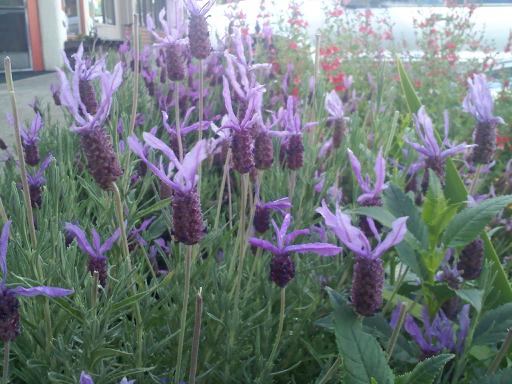
It is neither as variable as the many varieties of English lavender, nor as traditional as French lavender, but Spanish lavender, Lavandula stoechas, has the most unusual flower spikes. These short plump spikes are less than two inches long, but are topped with one or two pairs of distended terminal bracts that are almost as long; like simple little packages with big ornate bows. The flower spikes get their color from densely set bracts that surround the minute flowers, and can be various shades of purple or purplish pink or even grayish white. The large terminal bracts are lighter shades of the same colors.
Bloom begins during warm spring weather and continues into summer. Flower may stay close to foliage on stems less than two inches long, or may stand more than six inches above the foliage. The aromatic grayish leaves are narrow and about an inch long.
Mature plants may be three feet wide, and nearly as tall. Aggressive shearing after bloom promotes secondary bloom later, and keeps plants compact. Without pruning, old plants eventually die out in the center.
All lavenders want good drainage and good exposure, but do not want mulch or fertilizer. Inadequate drainage, crowding or mulch can promote rot. Fertilizer can inhibit bloom. Once established, lavenders do not need much water.
Foliar aromas and flavors that are useful for culinary application deters many grazing animals.
The infinite variety of colors, fragrances, flavors and even textures that plants use to solicit the help of wildlife is amazing. Flower color, fragrance and sometimes texture are customized to attract very specific pollinators, and guide them to where they are needed. Many flowers direct and reward their pollinators with flavorful nectar. Fruit color, flavor and aroma attract specific animals to take the fruit, and disperse the seeds within. There is no end to what plants will do for their friends. We are merely secondary beneficiaries.
It is ironic that we also enjoy aromas and flavors that are instead designed to be objectionable to plundering herbivores. For example, the appealingly pungent foliage of most herbs is actually intended to repel grazing animals or feeding insects. We not only exploit these herbs for culinary purposes, but also to add their aromas to our gardens.
Lavender, mint, rosemary and the various thymes and sages are the most popular herbs that are attractive both aromatically and visually, whether or not we actually use them in the kitchen. Rosemary is actually a common and practical ground cover for large areas. Thyme is a good ground cover for smaller areas, and stays low enough to be grown around stepping stones where it becomes even more aromatic if stepped on.
Grecian or sweet bay is another herb that actually grows into a sizeable but practical evergreen tree. The native bay laurel is a bit too large to be as practical where space is limited, but is even more pungent. Although generally not useful as herbs, the various cypresses, pines, cedars and eucalypti are appreciated for their aromatic foliage as well. Incense cedar is particularly pungent.
Two of my favorite types of plants, junipers and geraniums, are among the more common aromatic shrubbery. Although actually considered to be perennials, zonal, ivy and of course, scented geraniums, can be used as small shrubbery or small scale ground cover. Junipers of course, range from ground covers to shrubbery to small trees.
Rockrose, breath of Heaven (Coleonema spp.) and myrtle are all quite aromatic. The old fashioned myrtle that gets considerably larger than the modern compact variety is even more aromatic. Lantana is an aromatic ground cover or low mounding shrubbery.
The aromas of aromatic foliage are strongest as fresh new foliage emerges in spring, and particularly after spring rain. Some people like to put aromatic plants where they will be slightly in the way, since foliage relinquishes its aroma more readily when slapped with a gate, bumped, or otherwise disturbed.
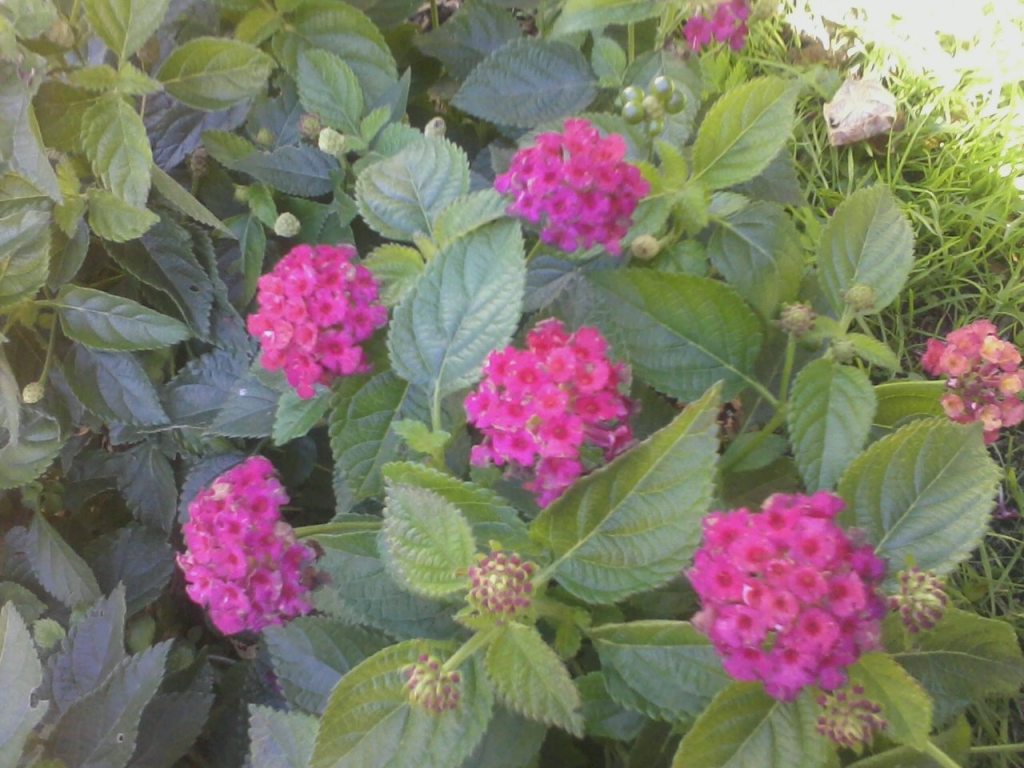
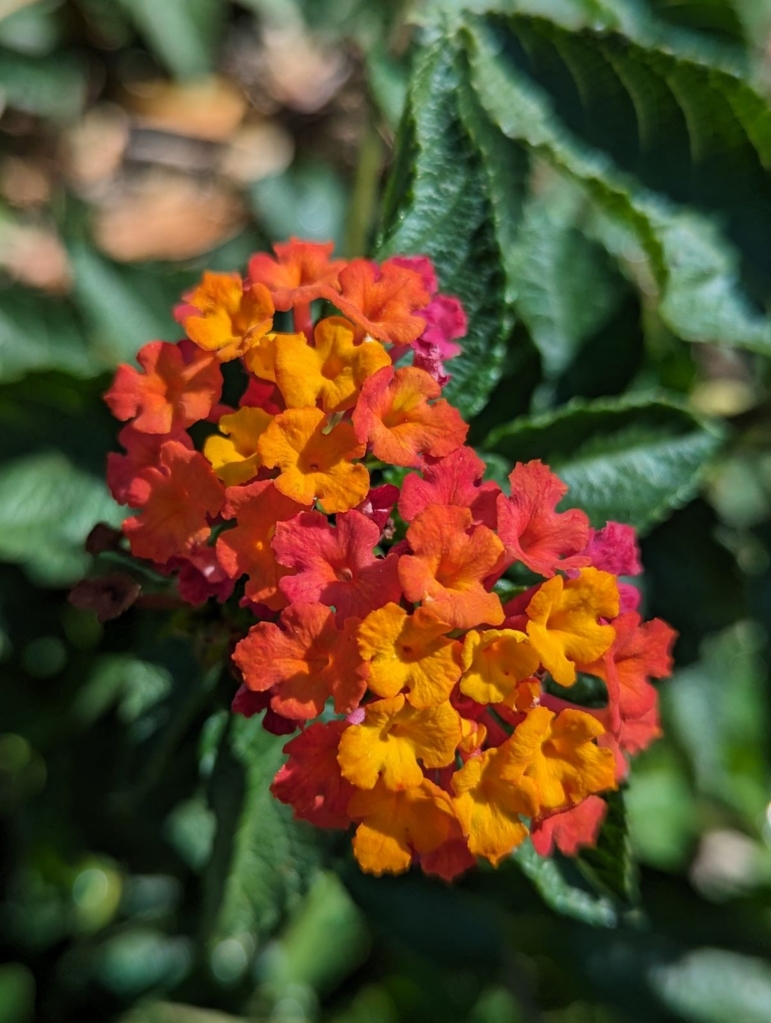
Even as most flowers of summer are finishing, the bright yellow, orange, red, pink and white blooms of Lantana camara continue to brighten gardens until the weather eventually gets too cool and damp for them to perform. This is quite impressive for a species that is endemic to the tropics of Central America, and has a taste for warmth. Blooms are actually one to two inch wide umbels of many small flowers. Individual flowers within each umbel may be different colors at different phases, so that each umbel may have blooms in as many as three different colors.
In the wild, Lantana camara can get almost six feet high and more than six feet broad. Garden varieties are of course much smaller and compact. Since Lantana camara does well in containers, a few cultivars that stay very compact and proportionate to container gardening have been developed, but unfortunately remain somewhat uncommon in nurseries. The potentially objectionably aromatic leaves are about two or three inches long and one or two inches wide, with minor serration and slightly sandy texture. Some dislike the foliar aroma, but many enjoy it.
Lantana camara is not too demanding, wanting only good warm exposure with no more than a bit of shade. Once established, it does not need much water, and can actually rot if watered too frequently, or if soil does not drain adequately. Excessive fertilizer will inhibit bloom. There are not many insects that bother Lantana camara, perhaps because it has an unpleasant flavor. It is actually toxic to animals that may try to eat it. However, butterflies really dig it.
Is this catnip, Nepeta cataria? Again, I am baffled by something that should be very easy to identify. It certainly resembles catnip visually. It almost smells like catnip. If I did not get it from a small curbside garden that Rhody and others of his species leave messages for each other in, I would have confirmed that it tastes like catnip. Perhaps I should be more than adequately convinced that it actually is as I suspect.
Nonetheless, I am not yet convinced. Catnip is rare here. I know of no one who grows it. Those who have tried ultimately found it destroyed by frolicking cats. It really should be grown in hanging pots that cats can not reach. It seems unlikely that it could survive for long within a curbside garden near where a few cats live. It also seems unlikely that it would spontaneously appear where it had not been planted intentionally. Only small succulents were planted below a large camellia within its particular small garden. All the small weeds that grow nearby are common.
Regardless, I could not ignore a branched stem of this questionably identified species that had broken off and was laying limply over undamaged foliage. Obviously, it needed to be removed. Obviously, I obliged. I brought it back and processed it into several small cuttings. I collected the scraps of leaves and internodes for an associate to take to a feline acquaintance of his for possible confirmation of its slightly questionable identity. I await the assessment, although it will be from someone who can not decide to stay inside or go outside after meowing incessantly for someone to open a door. A second or more opinions may be necessary from other members of this innately indecisive species if the first attempt at confirmation is unsuccessful.
Bloom continues as long as warm weather continues. Within warm exposures within the mildest of climates, it does not stop for long. Within cooler climates, Lantana camara may already be decelerating its bloom. Although remarkably resilient to arid warmth, it can be vulnerable to frost farther inland. Once established, lantana does not require much water.
Umbels of several tiny tubular flowers are about an inch and half wide. Individual flowers bloom progressively inward from the edges of their umbels. They are typically yellow, but then fade to orange, red or pink. Blooms therefore develop yellow centers within orange, red or pink edges. One cultivar is uniformly bright yellow. Another fades to creamy white.
Old fashioned lantana can eventually grow six feet tall. Congested old specimens might respond favorably to coppicing after winter. After coppicing, new growth can grow six feet high within its first season. Modern cultivars are generally shorter and relatively compact, and a few sprawl. Their very slightly raspy foliage is pungently aromatic when disturbed.
Mrs. George Washington never grew Martha Washington geranium, Pelargonium X domesticum. It was hybridized in Europe from south African species after she passed away. Although classified as a hybrid species, it is actually a group of distinct hybrids. Most are related to the same pair of primary ancestors. A few other species mingled in the process though.
The largest cultivars do not get much taller than three feet. Some develop rather irregular form. A few grow upward only to fall over. Minor tip pruning can improve awkward form. Stems are woodier than those of common zonal geranium. Consequently, cuttings do not develop roots as efficiently. Old specimens are less likely to recover from major pruning.
Martha Washington geranium may not bloom quite as profusely as zonal geraniums. The flowers are more spectacular though. Floral color can include purple, lavender, pink, red, burgundy or white. Billowy flowers are bordered or blotched with alternate colors. A few flowers bloom together on rounded umbels. Evergreen foliage is light green and ruffly.
Where winters are cooler, zonal geranium, Pelargonium X hortorum, performs as a warm season annual. It is perennial only with shelter from frost. Locally, traditional cultivars are so reliably perennial that they can get congested without thorough pruning and grooming after winter. Frost occasionally ruins outer growth, but rarely kills entire plants with roots.
Modern cultivars bloom more profusely and more colorfully than old cultivars, but are not quite as resilient. They are more likely to rot during the damp and cool weather of winter. They bloom exquisitely from spring through autumn though, with bright hues of red, pink, peach, salmon and white. They stay lower and more compact, so require less grooming.
The more popular modern zonal geraniums should not get much more than two feet high and wide. Their small flowers bloom on globular floral trusses that can get as wide as six inches. Traditional zonal geraniums get bigger, with smaller floral trusses. Nearly circular and aromatic leaves generally exhibit darker halos between lighter centers and margins.
The pendulous foliage of red ironbark eucalyptus moves softly in the breeze. The tall, curvy trunks are elegant and sculptural.
The many varied eucalypti never seem to outgrow the bad reputation of the blue gum and red gum eucalypti that get too big, messy and dangerous for urban gardens. Fortunately though, most others do not get nearly as large, and many stay proportionate to urban gardens. Their smaller canopies are neither as messy, nor as structurally unsound. Their adaptability to so many California climates and tolerance of aridity are serious advantages.
Red ironbark eucalyptus, Eucalyptus sideroxylon, is one of the mid-sized eucalypti that can eventually get quite tall, so is probably best where it has room to grow. Pruning for containment in compact gardens is actually quite a bit of work. Their coffee colored and deeply furrowed bark on elegantly sculptural trunks and limbs contrast nicely behind the mint frosting colored and softly pendulous foliage. The lanceolate leaves are about five inches long and three quarters of an inch wide. Flowers are almost always pinkish red, but can be pink or white.
Where winters are very mild, common lantana, Lantana camara, might bloom through all but the coolest of weather. It generally takes more of a break though. It could finish bloom at any time now, and resume at the end of winter. Where winter weather is cooler, foliage and perhaps stems may succumb to light frost. Growth should regenerate through spring.
The tiny tubular flowers bloom inwardly from the margins of round umbels that are about and inch and a half wide. Flowers typically bloom yellow, and then fade to orange, red or pink. Therefore, the umbels have yellow centers with orange, red or pink margins during the middle of bloom. One cultivar blooms with one hue of yellow. Another fades to white.
Modern cultivars mostly stay rather low and compact. Some sprawl. Older cultivars might get as tall as six feet after a few years. However, after frost damage or coppicing, mature plants may regenerate from their roots, with vigorous stems that get six feet long through summer. The faintly raspy foliage appears to be smooth, and is aromatic when disturbed.