Sunday Best – Unseasonal Azalea
Azaleas make it difficult to limit this post to only six pictures. So many cultivars are now in bloom. However, azaleas also make it easy to comply with suggestion #7 of the Six on Saturday participation guide, which suggests minimal verbiage. There is not much to say about them, since I do not know much about them, or even what cultivars they are. I can only guess the identities of half of them. Even if I could identify the cultivars, I could not identify the species. I only know that all azaleas are of the same genus of Rhododendron. I suppose that, in this regard, they could qualify as a few more of Rhody’s rhodies.
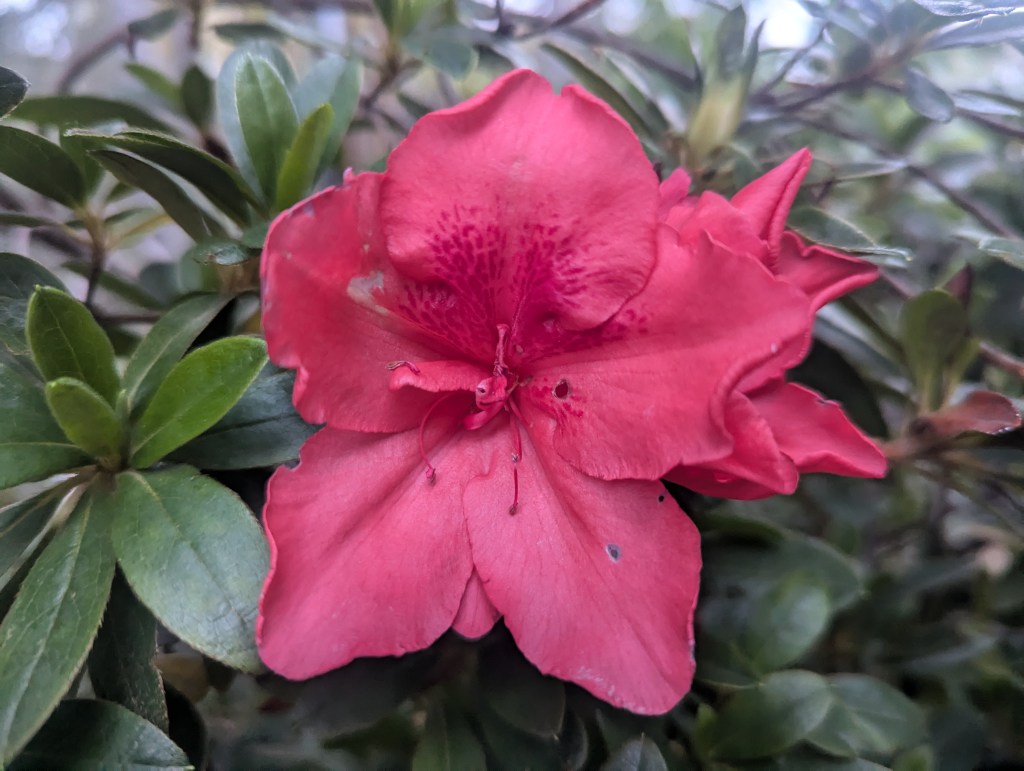
1. ‘Hino Crimson’ happens to look very much like this. The small leaves are dark, but not quite bronzed presently. They were bronzed, but only during the coldest winter weather.

2. ‘Coral Bells’ happens to look very much like this. It is the most common azalea within the landscapes at work, and is remarkably reliable with its remarkably abundant bloom.
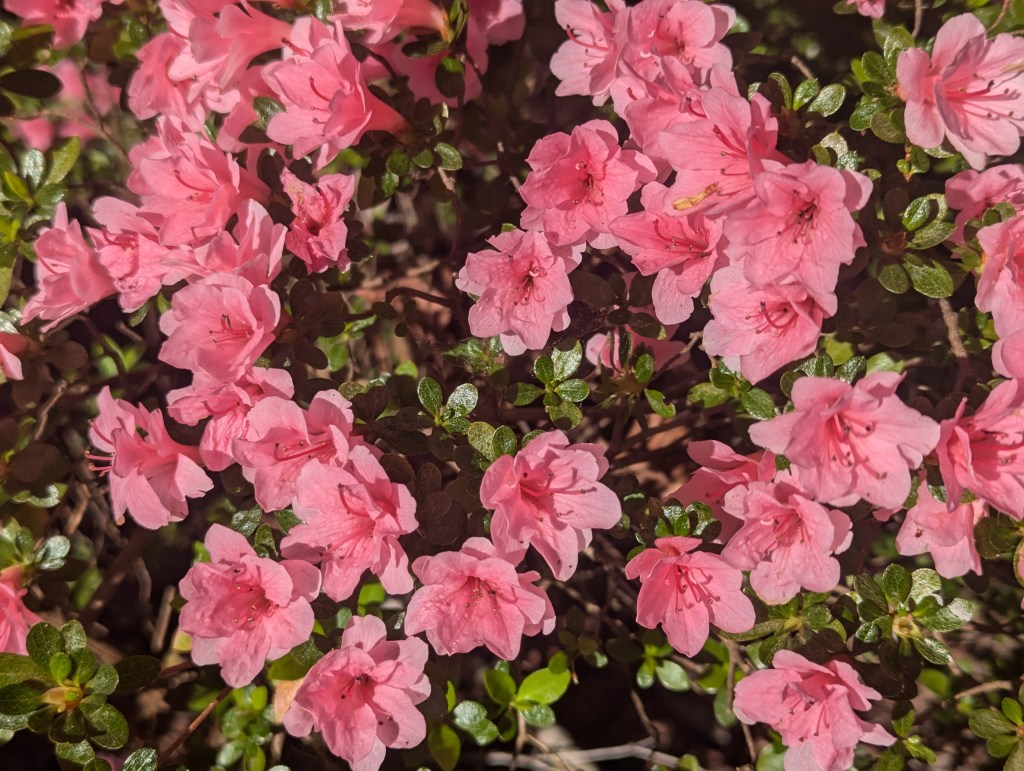
3. The bloom of this cultivar seems to be even more abundant because almost none of its foliage is visible beneath it. These flowers are little, but bigger than those of ‘Coral Bells’.
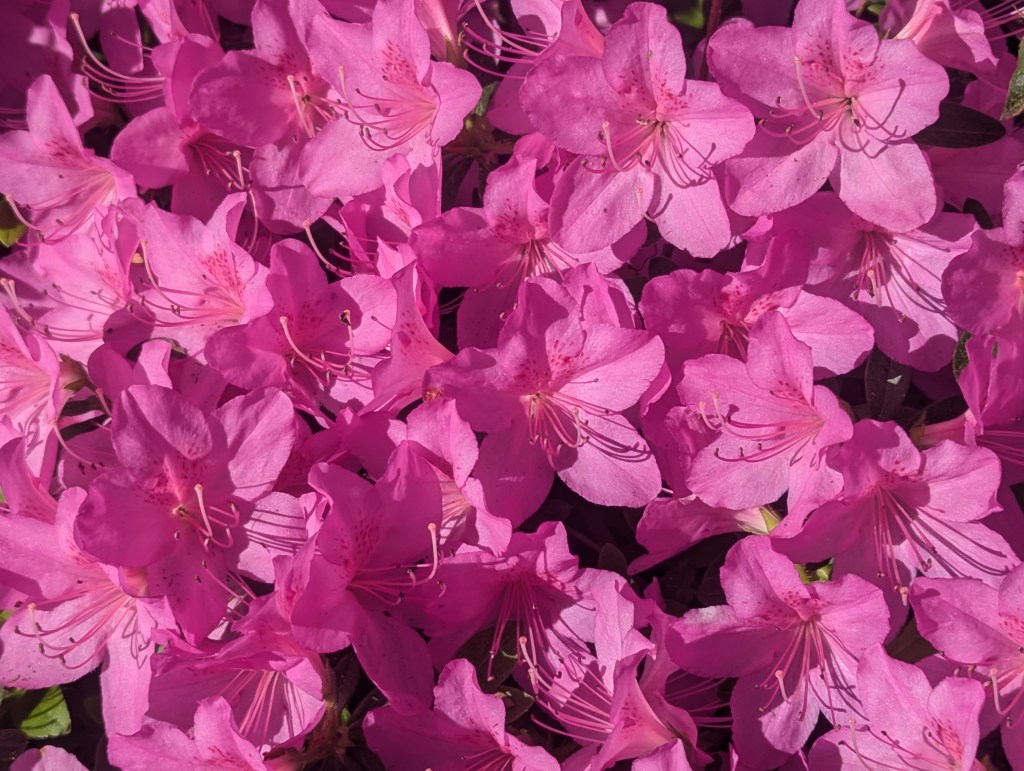
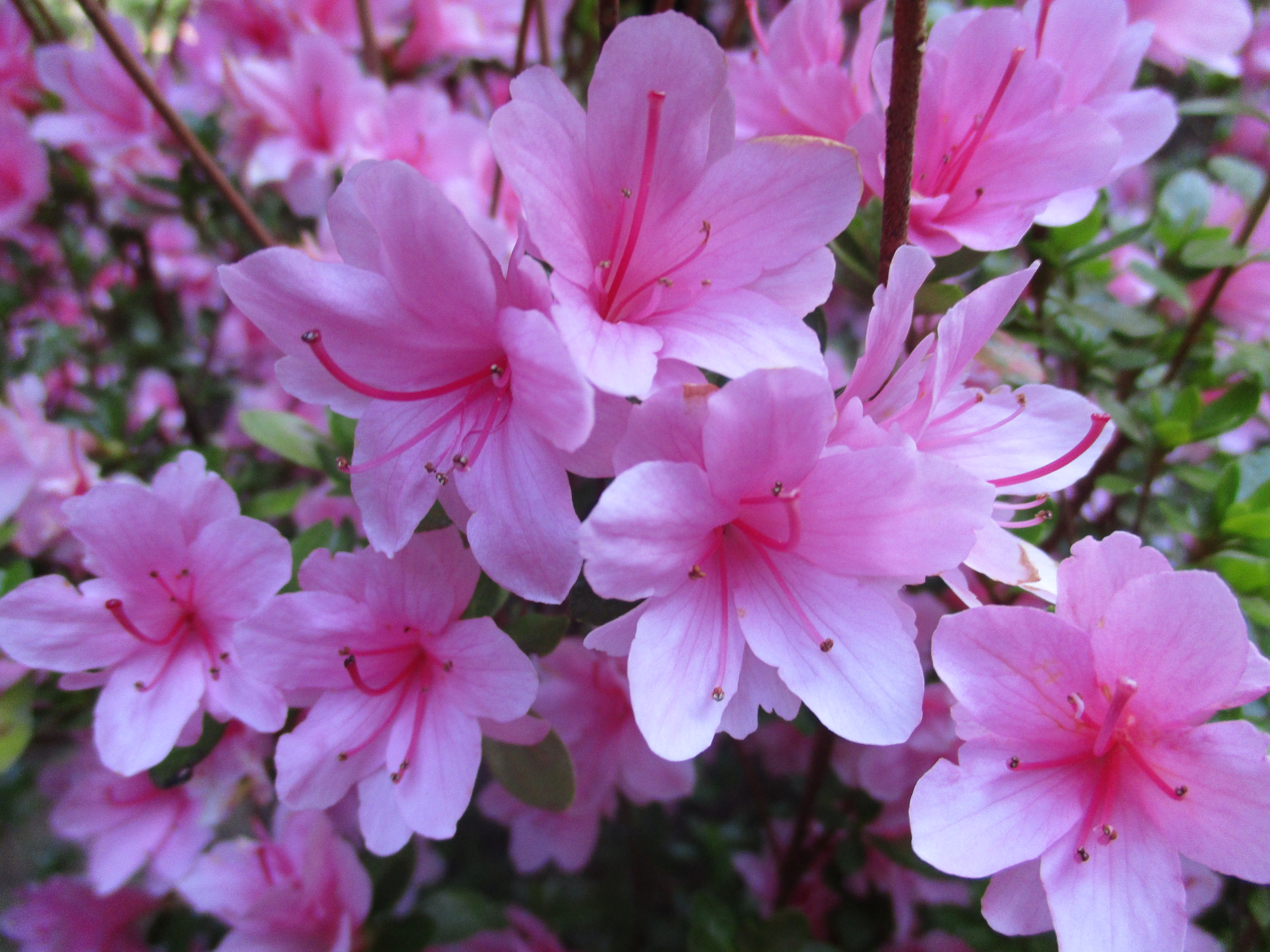
4. This azalea seems to be a ‘florist’ cultivar rather than a landscape cultivar. It was likely left by someone who worked in a nearby office years ago, and then found by a gardener.

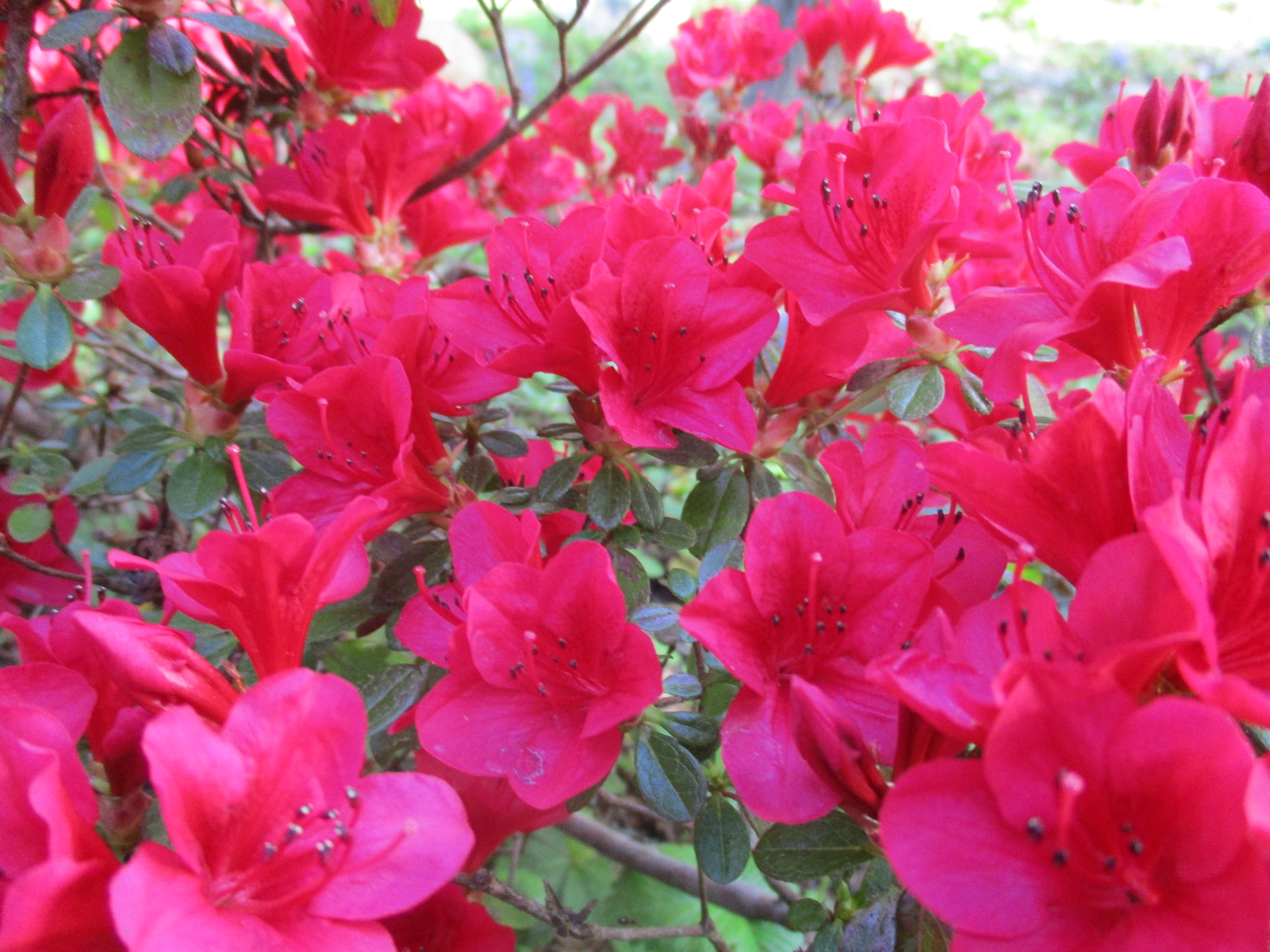
5. Within the spacious landscapes here, each cultivar of azalea is installed in groups of at least a few individual specimens. Like the florist azalea, there is only one of this cultivar.

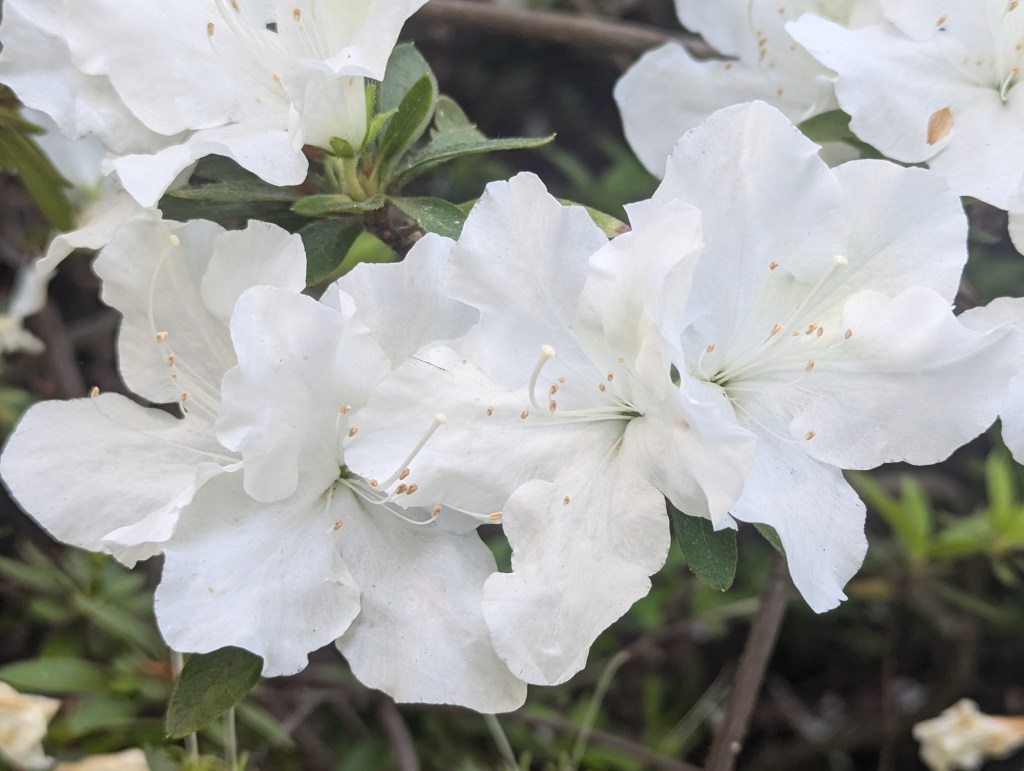
6. ‘Fielder’s White’, which is my favorite of the common azalea cultivars, happens to look very much like this. After restating this phrase thrice, I still can not identify any of these.
This is the link for Six on Saturday, for anyone else who would like to participate: https://thepropagatorblog.wordpress.com/2017/09/18/six-on-saturday-a-participant-guide/
Ericaceae is a prominent family here. Rhododendrons, azaleas and pieris inhabit several of the landscapes. Manzanitas, madrones and, within some situations, huckleberries, are common within the surrounding forests. Even two of my associates, although unrelated to Ericaceae, are named for two members of the family that are popular for landscaping. Half of my Six for this Saturday are azaleas. Just one other is another ericaceous species. Later, I can get better pictures of azaleas as well as rhododendrons. Several impressively large rhododendrons bloom spectacularly in season. Heather would be nice, but is quite rare. I know where abandoned fields of it grew wild, but I have never seen it available in nurseries.
1. Heath is a masculine name. It is of the Erica genus, though; and Erica is the feminine form of Eric. Heather is a similar but feminine name, but is of a different Calluna genus.
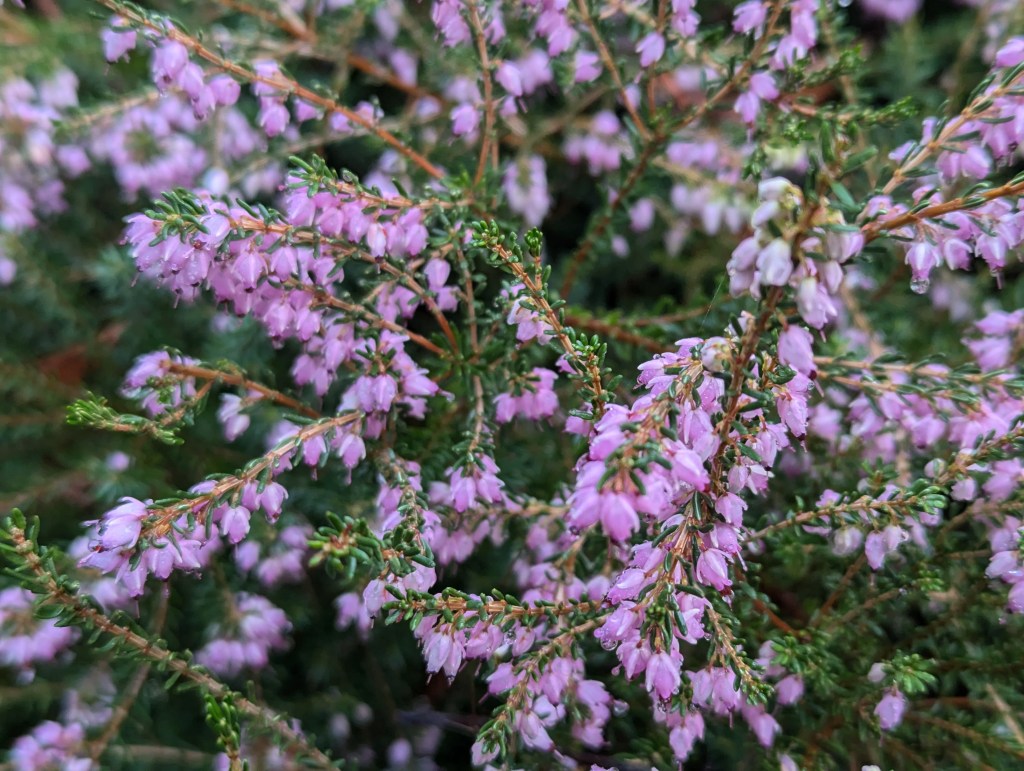
2. ‘Coral Bells’ Azalea, like all azaleas, is of the Rhododendron genus, so like heather and heath, is in the Ericaceae family. All of them are also related to madrone and manzanita.
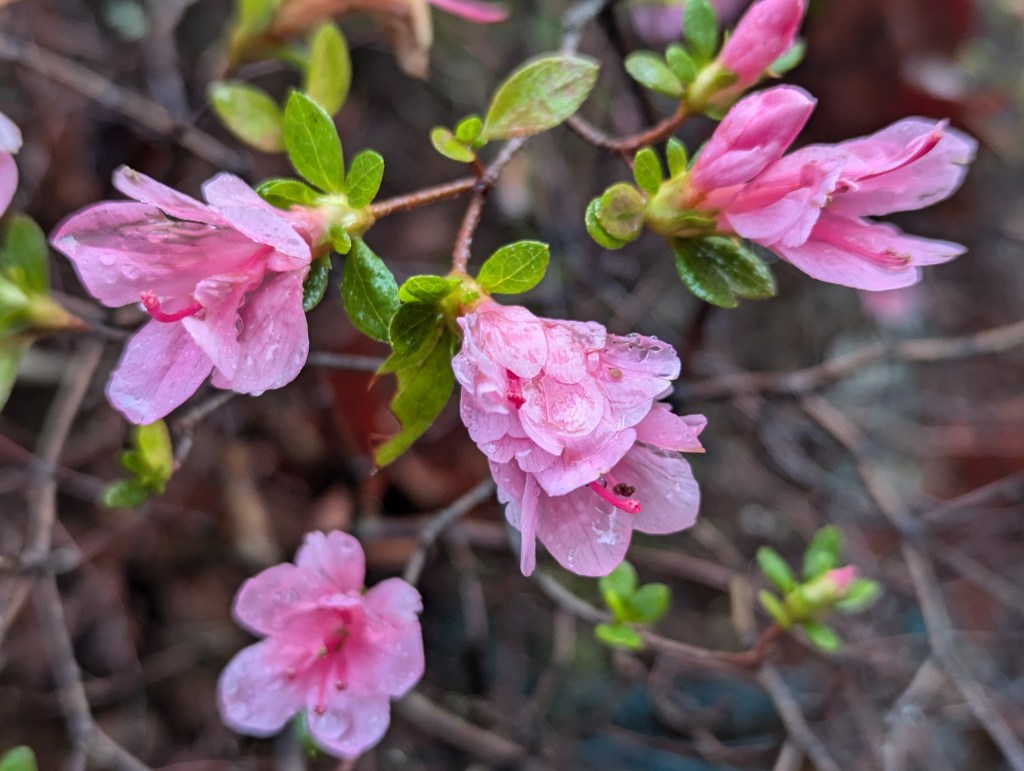
3. Azaleas generally bloom for early spring. These that bloom somewhat too early during the rainy season can get a bit thrashed. They would be prettier if they could delay bloom.

4. Florist azaleas are delightful as fully blooming potted specimens, but generally do not adapt well to landscapes. This specimen is floppy, but otherwise performs impressively.

5. Heather is named for Calluna, which, actually, I have not seen in many years. It grew as a cut flower crop in Montara more than half a century ago. It was abandoned by 1980.

6. Rhody is short, and his name is short for Rhododendron. But of course, he is a terrier, so ignores me regardless of what I call him. He can actually ignore me in four languages!

This is the link for Six on Saturday, for anyone else who would like to participate: https://thepropagatorblog.wordpress.com/2017/09/18/six-on-saturday-a-participant-guide/

Azaleas, which are species of Rhododendron, have been in cultivation for centuries. At least ten thousand cultivars are documentable. Most are interspecific hybrids. Only a few are selections or breeds of simple species. Most of their ancestral species are native to Asia, Europe or North America. Almost all cultivars that are available here are evergreen.
Azaleas can bloom profusely enough during April or May to almost obscure their foliage. Bloom may last for more than two weeks. Floral color ranges between white and red with many tints of pink, salmon and magenta. The most profuse flowers are as narrow as half an inch. Larger flowers may be three inches wide. Rare deciduous azaleas are fragrant.
Azaleas do not grow fast, but can eventually sprawl more than five feet wide. Some can grow nearly twice as wide. Although most do not grow much taller than three feet, some can grow twice as tall. Azaleas are naturally understory species, so can tolerate a bit of partial shade. They should not crave fertilizer. If they do, they prefer acidifying fertilizer.
Contractions are awkward for me. I certainly could use them if I want to, I just prefer not to. It is a pointless habit that I should be more comfortable with breaking sometimes.
Another habit that I should indulge in less is the use of six different cultivars of the same species for my ‘Six on Saturday’ posts. I have done it for camellias, rhododendrons, roses, flowering cherries, bearded iris, African daisies and a few other species, including various annuals. I refrained from featuring six azaleas simultaneously for yesterday morning, although I did feature three bearded iris, which comprised half of the ‘Six on Saturday’. I should remember to limit azaleas to three pictures, or preferably two or one, if I feature them on ‘Six on Saturday’ later, as they continue to bloom.
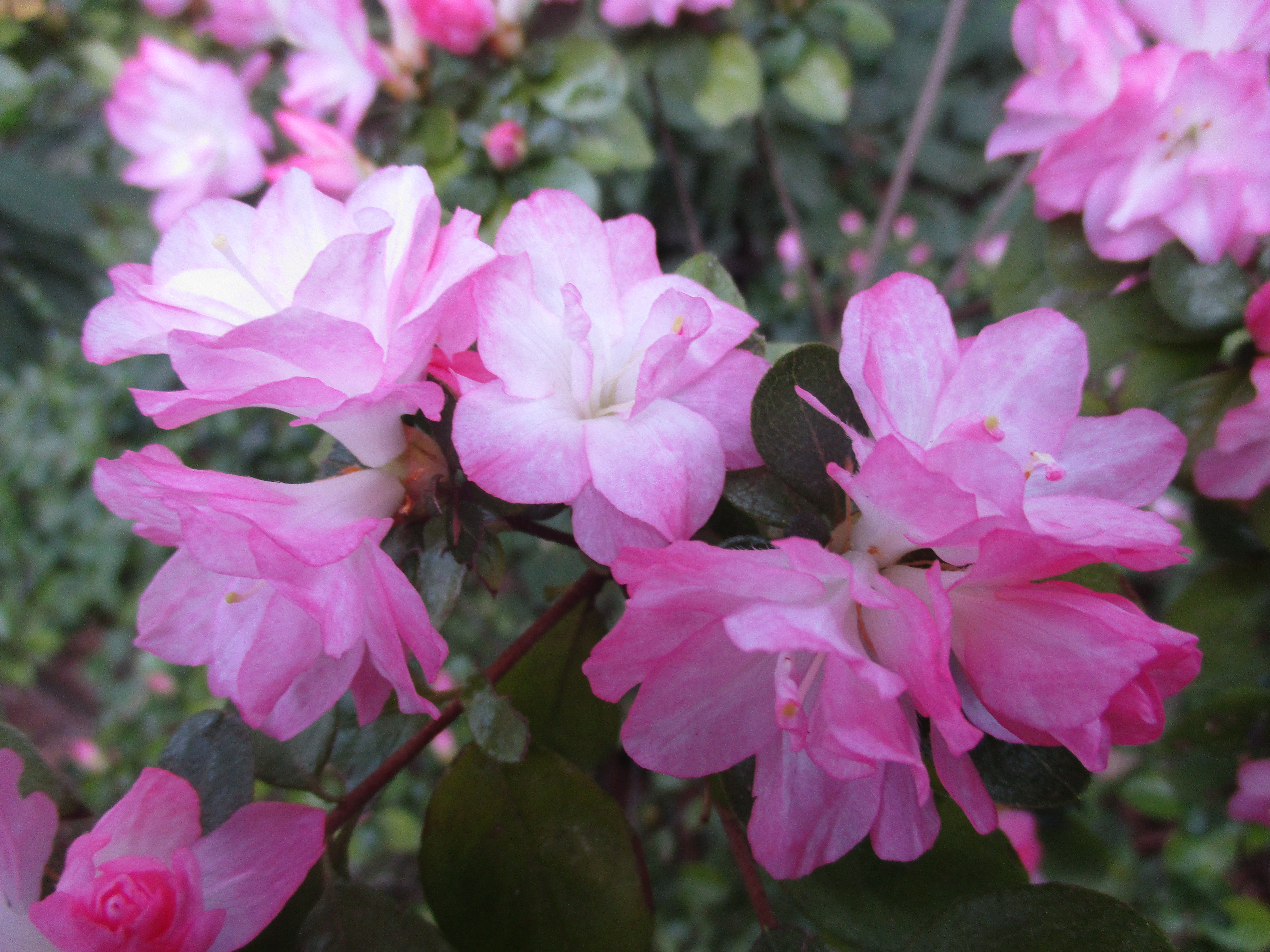
These two pictures of azaleas were omitted from my ‘Six on Saturday’ post yesterday because, as the theme implies, such posts are limited to six pictures. Perhaps I should have used one or both of these pictures instead of one or two pictures of bearded iris. It is too late now.
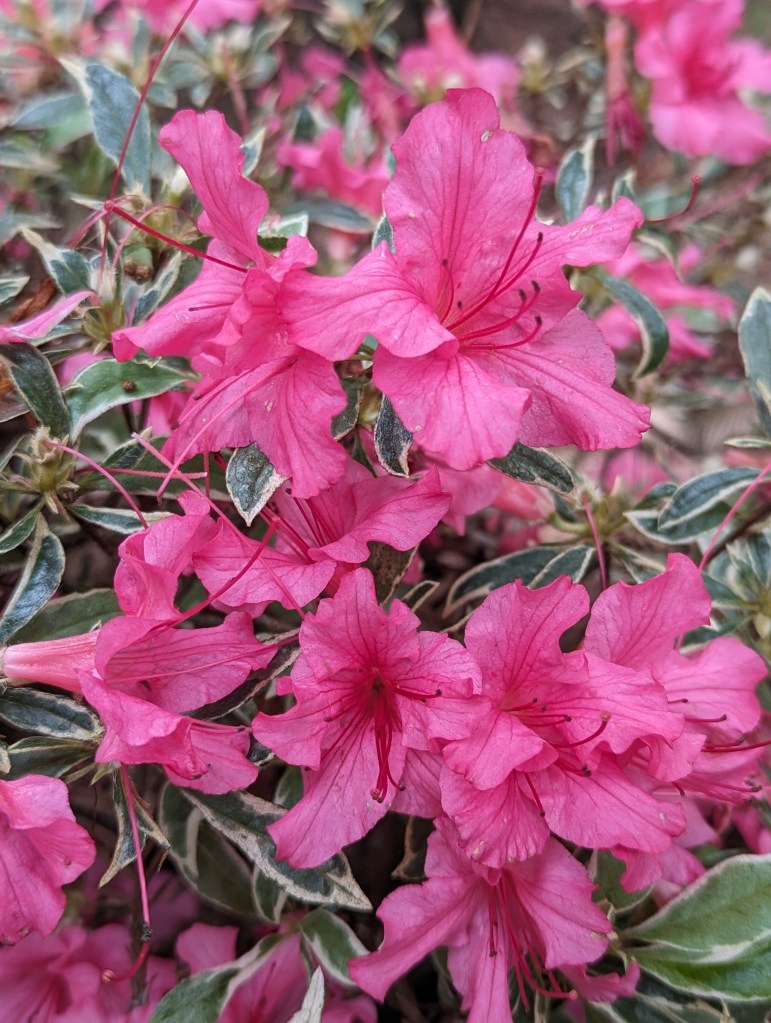
The first azalea above is variegated. Its leaves resemble those of variegated andromeda. I do not remember what cultivar it is, although the label remains attached to at least one specimen. At least three specimens inhabit the same landscape together. They are blooming better this spring than they have in the past, perhaps because, annually, they are bigger and more established than they were for their previous season.
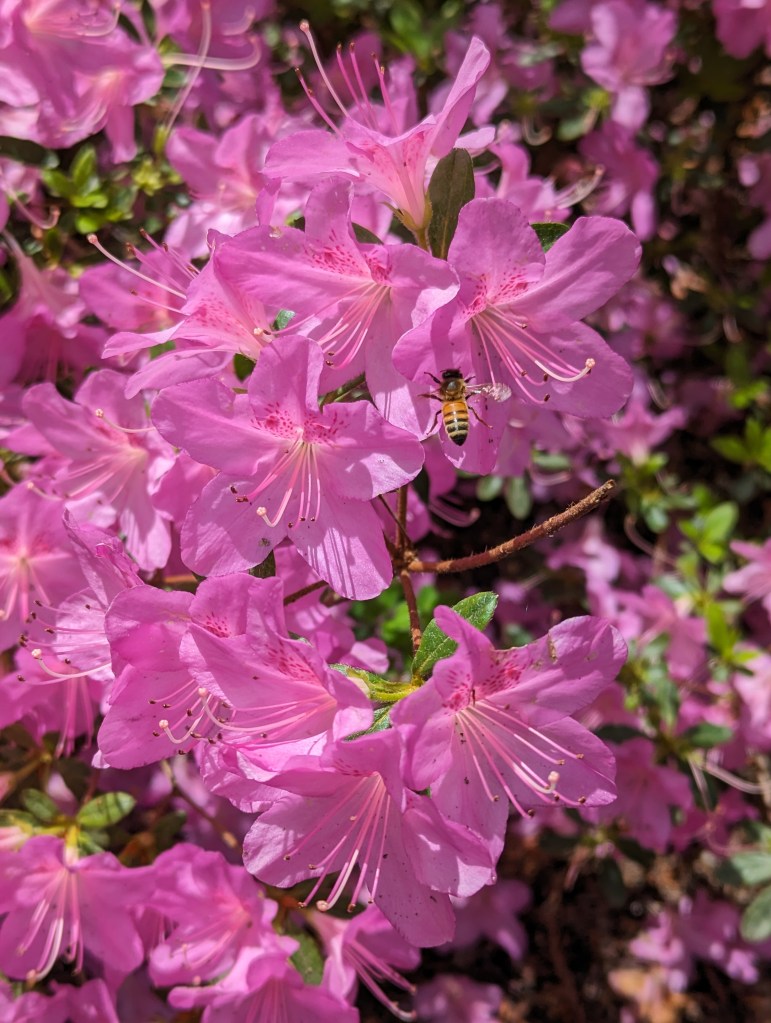
Relative to the many azaleas here, the second azalea below is nothing special. I like this particular picture because it happens to show a bee visiting the bloom. My pictures tend to be more technical than artistic. Perhaps I should try to include a bit of wildlife sometimes.

Okay, so I felt slightly guilty about not posting anything of any horticultural interest today. Okay, perhaps a bit more than slightly. Okay, perhaps guilty enough to post a few pretty flowery pictures . . . and the last one, which some might find objectionable.

I will not put much effort into this. I did not even take these pictures for any particular article. I am only sharing them here and now because I have no use for them, but did not want to just file them away unseen forever. Hey, these flowers work hard to bloom!
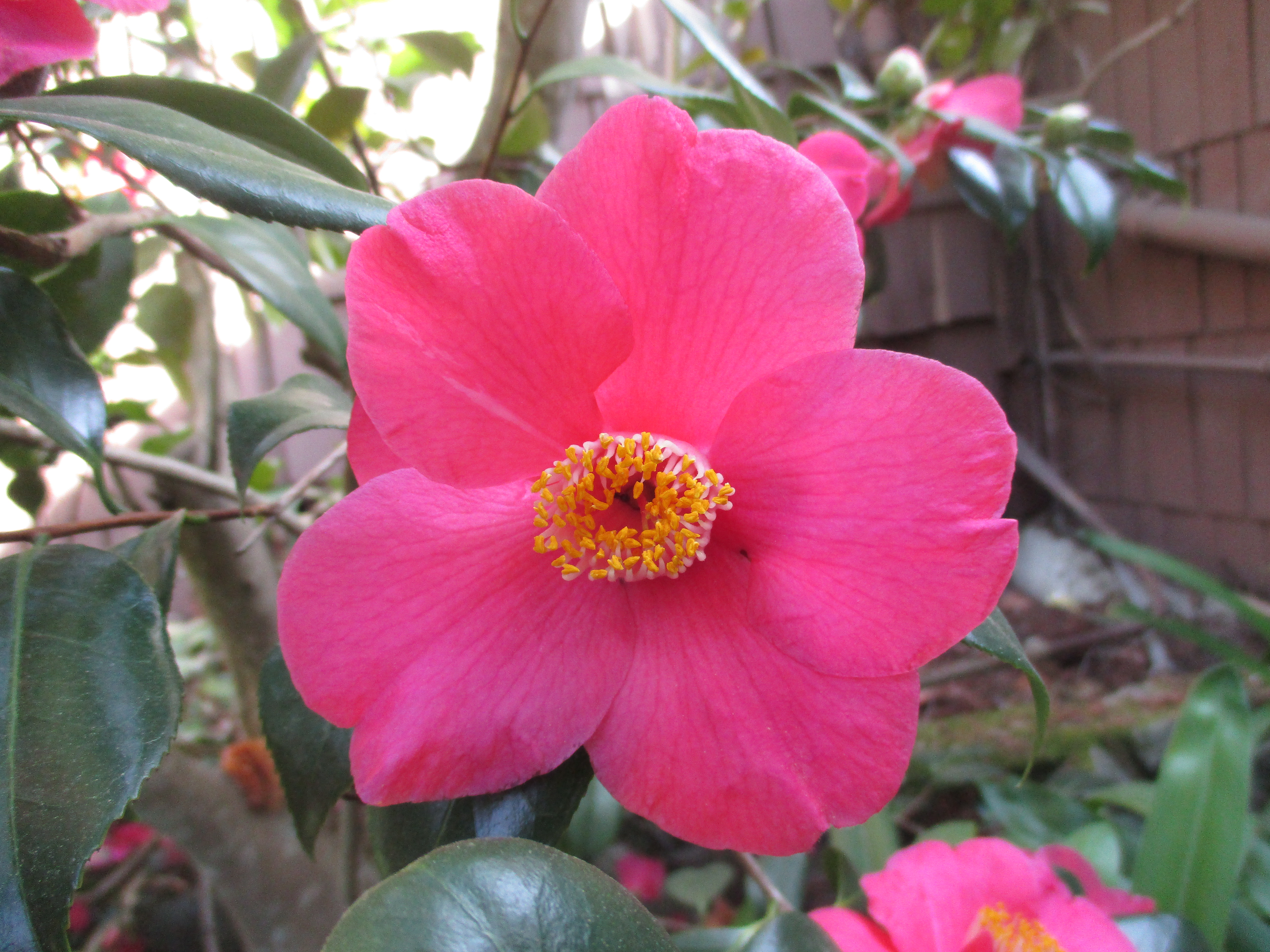
Actually though, except for the last picture, all are about a month old. The last picture is half as old, and the bloom that is shows continues. Otherwise, the other blooms are already finished. Although colorful, none are particularly remarkable or interesting.
This odd camellia seemed to grow from the base of a bigger and older specimen, as if it is a sucker from understock. However, there is no indication that the original specimen is grafted. Nor is there any reason why a Camellia japonica should be grafted. The odd camellia could have grown from seed. It is rare but not impossible for Camellia japonica to produce seed here. It is not crowding anything, so remains.
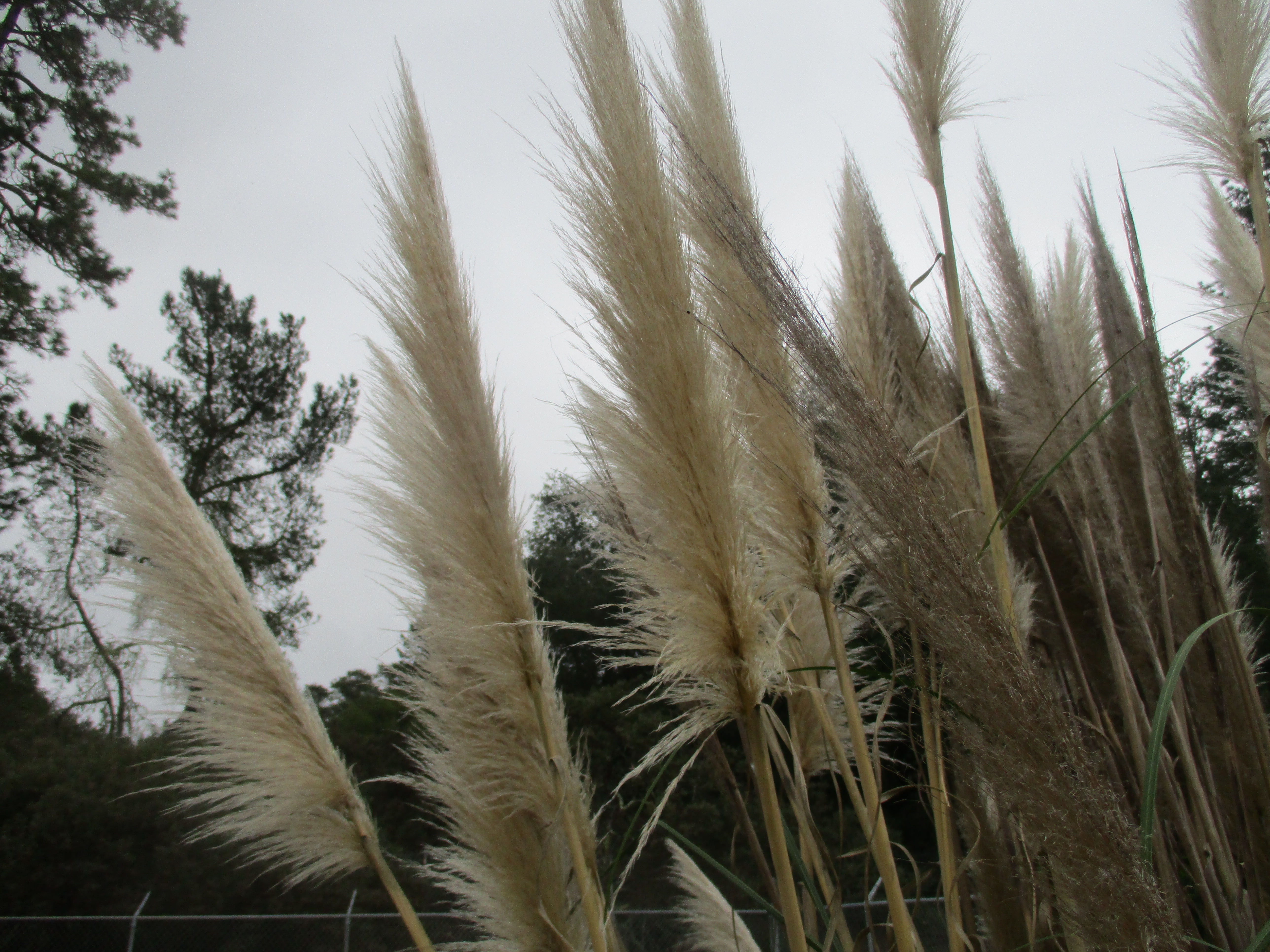
I really should eradicate this pampas grass. However, it has been here for many years without becoming aggressively invasive. We have observed no seedlings nearby. Besides, even if we did eradicate it, there are herds of more just over the ridge. I can not explain why it is not migrating inward, but I am not complaining. I happen to like the bloom.
These pictures are, of course, not nearly as awesome as the pictures of Rhody that posted earlier. They just happen to be more relevant to what should be a horticultural blog.
 There are countless species and cultivars of rhododendrons. Some have been in cultivation for centuries. Their big bold blooms are spectacular against a backdrop of their dark evergreen foliage. They prefer shelters spots, and some are happy to bloom in places that are too cool and too shaded for other flowers to bloom so well. They are so impressive that no one notices that they lack fragrance.
There is certainly a lot of variety among rhododendrons. Some are low mounding shrubs, while other can grow as small trees with open branch structure. Flowers can be white, pink, red, purple, blue or maybe even yellow or orange. Most flowers have some sort of pattern within the main color, but some are solid colors. Nonetheless, regardless of all the variety, we think that we can recognize a rhododendron when we see one.
Then there is Rhododendron occidentale, the Western azalea. The flowers are sort of recognizable as either big azalea flowers or lean rhododendron flowers, but are quite distinct from what we think of as familiar rhododendron flowers. The color range is very different too, with more white, marked with yellow, pink or orange. Even more surprising is that the bloom is quite sweetly fragrant!
Foliage is also very different from what is expected from a rhododendron. Not only is it deciduous, but if well exposed, it can actually develop soft yellow, orange or brownish red color in autumn. Individual leaves are rather narrow and papery.
We have only a few Rhododendron occidentale at work. They are not as tolerant of the partial shade from the redwoods as the more familiar rhododendrons are. However, they do happen to be blooming exceptionally well this year, while the bloom of the more familiar rhododendrons is less impressive than it has been in many years.
As the flowering cherry trees fade, the azaleas get their turn. Like the flowering cherry trees, the azaleas are not as spectacular as they were last year. I know it is relevant to the weather, although I do not know what the weather did to inhibit so much bloom with so many of the early spring bloomers. I know there was a lot of rain, but that should not have been a major problem. There was not much chill, but there should have been enough.
I do not know if this will be the most subdued bloom ever witnessed here, but the limited color might be more apparent because the azaleas and rhododendrons were more spectacular last year than they had ever been. According to their bud set, the rhododendrons will be even less impressive than the azaleas. The dogwoods might have had the potential to be as spectacular as last year, but some were disadvantaged by structural pruning.
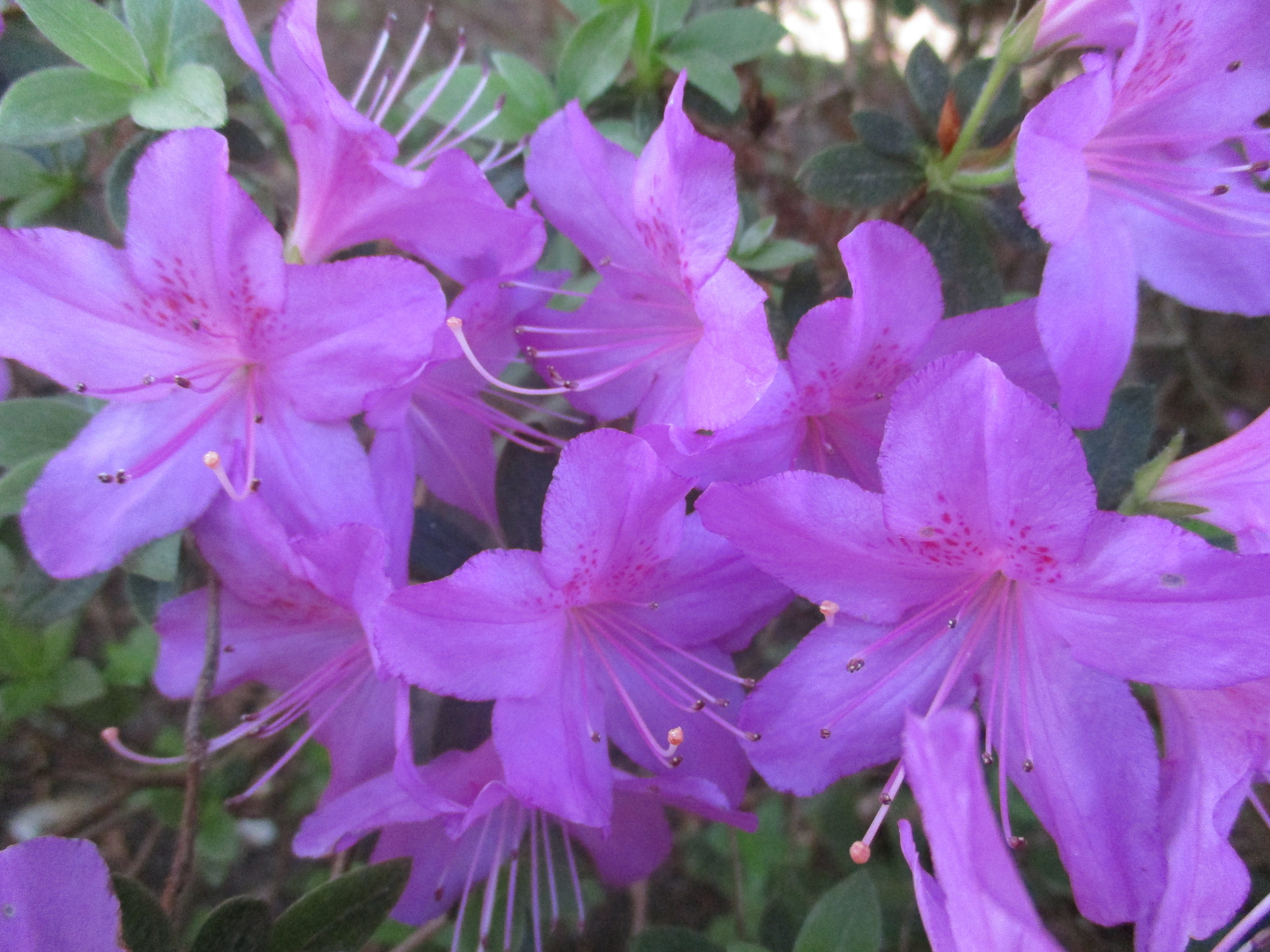
These six azaleas were the best of what was blooming here this year. The pictures were taken about a week ago. I should know the names of all the cultivars, but I don’t. They do not look the same in landscape as they do on the farm where they grow. I could guess on a few. The only one that there is no mistake about is #4, which is ‘Coral Bells’. Color is a bit off in this picture. #5 looks like ‘Hino Crimson’, but without bronzed new foliage.
Rhododendrons are coming along slowly but surely. They will not be ready for next week. Fortunately, as wimpy as our bloom is this spring, there is plenty to get more pictures of for next week.
1.
2.
3.
4.
5.
6.
This is the link for Six on Saturday, for anyone else who would like to participate:
https://thepropagatorblog.wordpress.com/2017/09/18/six-on-saturday-a-participant-guide/
 We think of rhododendrons and azaleas as being from cooler and moister climates. After all, that is where they do best. Yet, there does happen to be a native western azalea, Rhododendron occidentale, that lives in the Sierra Nevada and coastal ranges from San Diego County to just southwest of Portland, Oregon. (Azalea and Rhododendron are varied specie of the same genus.)
Bloom is mostly white, with pink, pale yellow or golden orange. Some of the fancier garden varieties bloom clear white, or with more vibrant color. The lightly fragrant, two inch wide flowers bloom in groups of two or three on open conical trusses. Each truss produces as many as a dozen flowers in sequence, so a new flower replaces a fading flower for a bit more than a week each spring.
Western azaleas plants are unfortunately not much to look at after bloom. They grow somewhat slowly and irregularly to about three to five feet tall. The two or three inch long deciduous leaves that can turn yellow and orange where autumn is cooler are more likely to turn an unimpressive grayish brown here. Foliage can fade prematurely if the weather gets too hot and arid through summer.
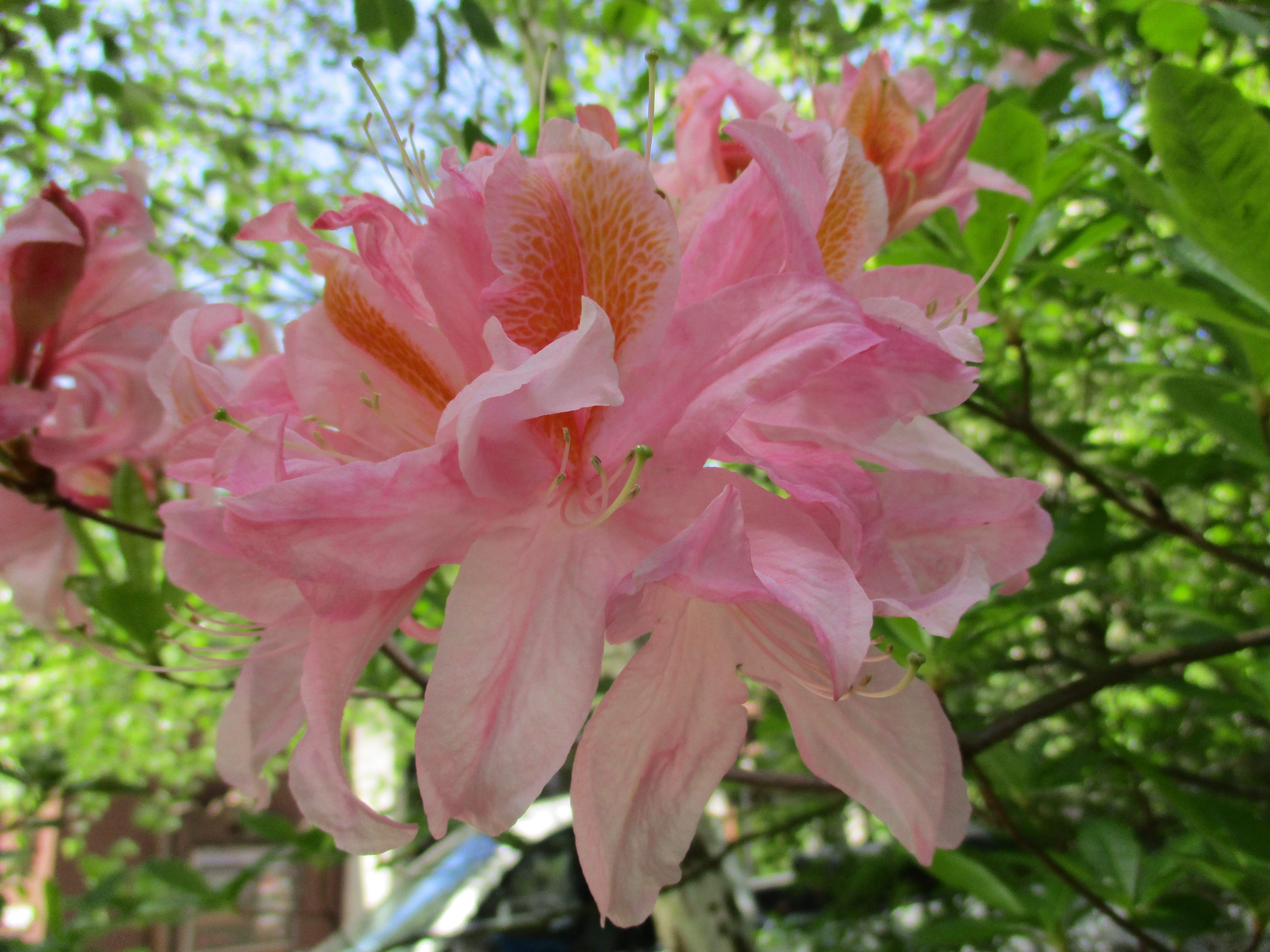 They are not a myth. They are quite real. So are the related and similar deciduous azaleas. There are certainly not as popular or as diverse as the familiar evergreen cultivars, but they have their place.
Like the popular evergreen cultivars, deciduous rhododendrons and azaleas have been extensively bred so that they are more spectacular than their ancestors in the wild. They lack the purples and blues of the evergreens, but they compensate with bright oranges and yellows that are uncommon among the evergreen cultivars, as well as reds, pinks and whites. Some of their colors are bright and fiery, while some are more relaxed. Compared to evergreen rhododendrons, the flowers of the deciduous rhododendrons are smaller, thinner, and suspended in smaller trusses. However, these smaller trusses are often significantly more abundant, and are flashier as they bloom before new foliage develops in spring.
Deciduous rhododendrons and azaleas are not grown for the foliar color in autumn, but where autumn weather is cold enough, their foliage can color somewhat well. It is mostly clear yellow, but can sometimes turn orange before falling away cleanly, leaving neatly bare stems through winter.
What deciduous rhododendrons and azaleas excel at that their evergreen counterparts can not compete with is their fragrance. Many are moderately fragrant. Some are VERY fragrant. It is rare that such showy flowers are also so fragrant. (Most flowers rely on one technique or another to attract pollinators.)
Now that the evergreen rhododendrons are blooming, our few deciduous rhododendrons are just about finishing. Visitors often ask about the fragrance, since they do not expect fragrance from rhododendron or azalea flowers, even though they can see little else blooming in same area. These flowers are so popular that we would like to plant more near windows of meeting rooms. (The article from my weekly gardening column that is typically posted on Thursday was posted yesterday, which is why this article, which is more appropriate for Wednesday is posted today.)
 Tony Tomeo