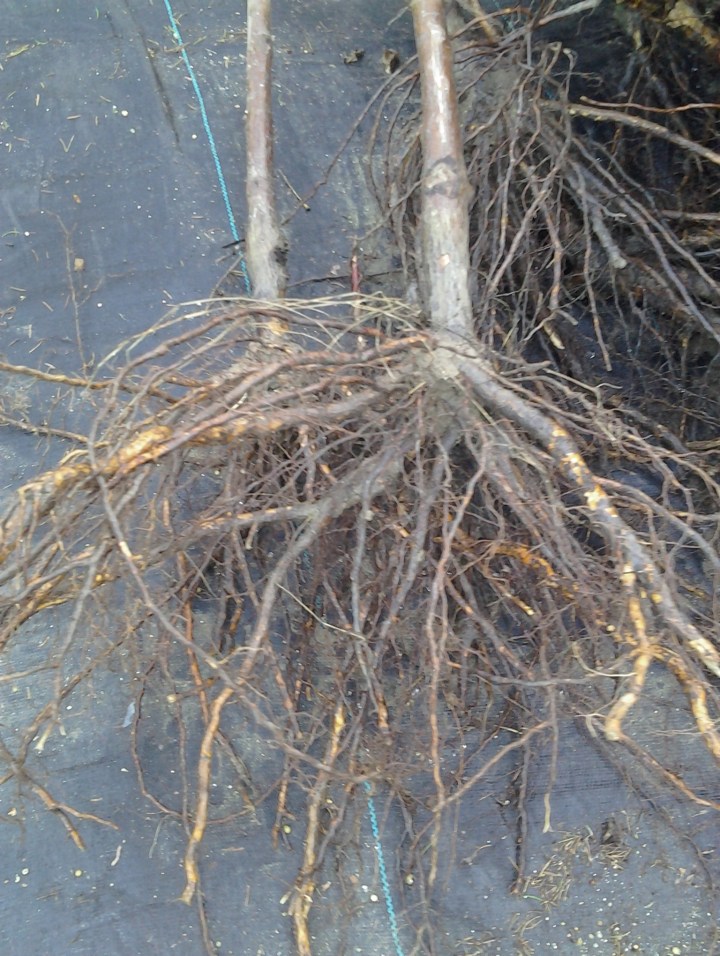
Bare Root Stock

Dormancy makes this process possible.

As soon as any unsold Christmas trees move out of nurseries, bare root plants move in. Like Christmas trees, bare root plants are available within a limited season, while they are dormant through winter. They will all be gone by the time they start blooming and producing new foliage at the end of winter.

Bare root plants of course have ‘bare roots’, without typical media (potting soil) contained within cans or pots. Some get their roots wrapped in lightweight coarse sawdust to keep them moist without too much bulk. Others get their roots heeled into moist sand in nurseries, so that they can simply be dug when purchased.

Because bare root plants need much less space than canned (potted) plants, many more different kinds of deciduous fruit trees, roses, grapes, berries and even a few ornamentals are available. Bare root plants also cost about half as much as typical canned plants.

Since no nursery can stock all of what is available, more varieties are available from mail order catalogues and online. Most of what is available in local nurseries is selected for local climates. Plants purchased from catalogues or online need to be selected accordingly.

A main advantage of bare root plants is that they get established in the garden more efficiently than typical canned (potted) plants do. They get dug, transported and replanted into the garden all while dormant. By the time they wake up in spring, they are already in their new home, where they immediately adapt and start to disperse their roots into relatively uniform soil. Canned plants have confined roots that must disperse into unfamiliar garden soil

Bare root plants should get into the garden as soon as possible. If they do not get planted immediately, plants that were pulled from sand in nurseries should get heeled into damp soil or mulch, and watered to settle the fill. Alternatively, they can wait with their roots in buckets of water for a day to two. Bare root plants that are wrapped in bags of sawdust should be safe for more than a week in the shade outside.

Planting holes should be just large enough to accommodate the roots. If too deep, the loosened soil below is likely to settle and sink. Soil can be mounded into a small cone (known as a ‘volcano’) in the middle of each hole to spread roots over. Graft unions (seen as kinks low on trunks of fruit trees or where rose plants branch) of grafted plants should stand above the surface of the soil. Backfill soil should only be amended lightly, if at all.

Even though dormant plants get more moisture than they need from rain through winter, freshly planted bare root plants should get soaked twice immediately after planting to settle the soil around their roots. Lastly, damaged or superfluous stems can be pruned off. Most bare root fruit trees have much more stems than they should for padding in transportation and to allow more options for pruning.

Bare Root Stock

Bare root stock is none too pretty in the beginning.

Now that Christmas trees have been moved out of the nurseries, it is time for bare root plants to move in! As the term implies, bare root plants have ‘bare roots’, lacking typical media (such as potting soil) which is typically contained in cans or pots. All sorts of deciduous fruit trees, roses, grapes and berries can be purchased bare root, either bagged with moist wood shavings, or out of the ‘sand boxes’ that they are heeled into in the nurseries. Even more are available from mail order catalogues. (Just check climate zone ratings for mail order stock.)

I purchased all of my deciduous fruit trees bare root mainly to save money. Bare root stock typically costs about half of what canned stock (grown in a nursery can or pot) does. Also, because bare root stock does not take up as much space as canned stock does, more varieties can be brought in and made available during bare root season.

Bare root stock gets established into the garden more efficiently than canned stock does. It gets dug, transported and planted while dormant; and can disperse roots into relatively uniform soil immediately after dormancy. However, stock that gets canned wakes up in spring in uncomfortably warm and confining nursery cans. After adapting to nursery conditions, it must then adapt to new garden environments, and disperse roots into soil that is very different from what it already rooted into.

Bare root stock should be planted as soon as possible after it leaves the nursery so that roots do not get too dry. If they can not get planted immediately, plants that were pulled from sand boxes in nurseries should get their roots heeled into (covered with) damp soil. Bagged stock in original packaging is safe for a few days in the shade.

Roots should be soaked a few hours before planting. I prefer to instead keep roots well watered for a day after planting. Broken or damaged roots should be pruned away before planting. Damaged and superfluous stems should be pruned away after planting.

Planting holes for bare root stock can be wide enough to loosen surrounding soil, but should be no deeper than necessary. Plants are likely to settle too deeply if the soil below is too loose. All roots should be buried while graft unions (the odd ‘kinks’ low on the trunks of grafted trees) remain exposed. Soil can be mounded firmly into a ‘volcano’ in the middle of each hole to spread roots over. Backfill soil can be amended lightly; not so much that it is too different from surrounding soil.

A basin should be formed around each new bare root plant so that roots can be soaked and settled in by filling the basins with water twice. Bare root plants are initially dormant and lack foliage, so do not need water again until they develop foliage, and the soil gets dry in spring. Besides, rain and cool weather will keep the soil wet through winter.

Bare Root Begins As Christmas Ends

Bare root stock is exactly what it sounds like.

Now that nurseries and garden centers are no longer selling Christmas trees, they have plenty of room for bare root stock. All sorts of deciduous fruit trees, a few deciduous shade trees, shrubs and vines, and even a few perennials can now be purchased while dormant and without the cumbersome media (soil) that the roots need at all other times of the year. Not only is bare root stock easier to handle and transport in small cars, but it is also much less expensive than canned stock (that has roots contained in media, which is contained in nursery cans). Bare root stock typically costs about a third of what canned stock costs.

Bare root stock also has the advantage of adapting to new garden easier, since it does not need to leave the comfort zone of the media that it would have grown into (within a can) in order to venture out into unfamiliar soil. Instead, it starts to disperse roots into the new home soil immediately as it emerges from dormancy in late winter. Without cans, bare root stock can not get root bound. Instead of developing branch structure that is appealing to nursery marketing, bare root stock can get an early start on developing branch structure that is most practical and efficient for the gardens that it gets installed into.

It seems that all of the ´stone’ fruit can be found as bare root stock. These include apricot, cherry, plum, prune, peach, nectarine, almond (which is the seed, or ´stone’, of a peach like fruit) and the odd hybrids of these. The pomme fruits, apple, pear and quince, are perhaps the second most popular of bare root stock, although quince is still rather rare. Ornamental trees, shrubs and vines include flowering crabapple, flowering cherry, flowering quince, alder, poplar, willow, lilac, forsythia, wisteria and clematis. Perennials include rhubarb and artichoke.

Bare root stock can be purchased as soon as it becomes available, but does not do much until it starts to grow in spring. It should get planted quickly and soaked in, but will get more water than it needs from rain afterward. It should not need water again until after it blooms or gets new leaves in late winter or early spring. Despite guarantees of fruit in the first year, none should be expected. The few fruit trees that might set fruit will probably produce only useless underdeveloped fruit because new plants are busy producing new roots and growing. Actually though, this apples to canned stock as well, except only for citrus, olives and other evergreen fruit trees.

Winter Is Bare Root Season

Plant a bare root peach tree now for peaches like this later.

Now that nurseries and garden centers are no longer selling Christmas trees, they have plenty of room for bare root stock. All sorts of deciduous fruit trees, a few deciduous shade trees, shrubs and vines, and even a few perennials can now be purchased while dormant and without the cumbersome media (soil) that the roots need at all other times of the year. Not only is bare root stock easier to handle and transport in small cars, but it is also much less expensive than canned stock (that has roots contained in media, which is contained in nursery cans). Bare root stock typically costs about a third of what canned stock costs.

Bare root stock also has the advantage of adapting to new garden easier, since it does not need to leave the comfort zone of the media that it would have grown into (within a can) in order to venture out into unfamiliar soil. Instead, it starts to disperse roots into the new home soil immediately as it emerges from dormancy in late winter. Without cans, bare root stock can not get root bound. Instead of developing branch structure that is appealing to nursery marketing, bare root stock can get an early start on developing branch structure that is most practical and efficient for the gardens that it gets installed into.

It seems that all of the ´stone’ fruit can be found as bare root stock. These include apricot, cherry, plum, prune, peach, nectarine, almond (which is the seed, or ´stone’, of a peach like fruit) and the odd hybrids of these. The pomme fruits, apple, pear and quince, are perhaps the second most popular of bare root stock, although quince is still rather rare. Ornamental trees, shrubs and vines include flowering crabapple, flowering cherry, flowering quince, alder, poplar, willow, lilac, forsythia, wisteria and clematis. Perennials include rhubarb and artichoke.

Bare root stock can be purchased as soon as it becomes available, but does not do much until it starts to grow in spring. It should get planted quickly and soaked in, but will get more water than it needs from rain afterward. It should not need water again until after it blooms or gets new leaves in late winter or early spring. Despite guarantees of fruit in the first year, none should be expected. The few fruit trees that might set fruit will probably produce only useless underdeveloped fruit because new plants are busy producing new roots and growing. Actually though, this apples to canned stock as well, except only for citrus, olives and other evergreen fruit trees.

Bare Root Season Is Now

80124thumbAutumn really is the season for planting. That is the general rule. One generalization about general rules is that they generally do not apply to all of the specifics. In other words, there are likely certain exceptions. In this case, there are some types of plants that should not be planted in autumn. The next best season for planting is probably winter, which happens to be ‘bare root season’.

Just before the last of the Christmas trees were being sold, and relinquishing their space in nurseries, bare root stock started moving in. Some bare root stock is prepackaged with its otherwise bare roots in bags of moist sawdust. Nurseries that provide large volumes are likely to heel in unpackaged bare root stock into bins of moist sand, from which it gets pulled and wrapped as sold.

As the term ‘bare root’ implies, bare root stock was dug as early as the onset of dormancy in late autumn, and deprived of the soil that it grew in. Because it is dormant, and the weather is cool and damp, it does not mind much, if it even knows at all. As it emerges from dormancy next spring, it resumes growth, and disperses roots into the new soil that it got planted into while dormant.

Bare root stock is significantly less expensive than canned (potted) stock because it lightweight and does not take up much space in the nursery. It is also more efficient, since it only stops briefly in retail nurseries, on its way from growers to its final home destinations. New plants start dispersing roots right away, instead taking time and effort to recover from earlier confinement of roots.

Deciduous fruit trees and roses are the most familiar of bare root stock. The bare root fruit trees include the stone fruits of the genus Prunus, such as apricot, cherry, plum, prune, peach, nectarine and almond, as well as pomme fruits, such as apple, pear and quince. Figs, pomegranates, persimmons, walnuts, mulberries, grapevines, currants, gooseberries, blueberries, cane berries, strawberries, rhubarb, asparagus and a miscellany of deciduous blooming but fruitless plants are also available.