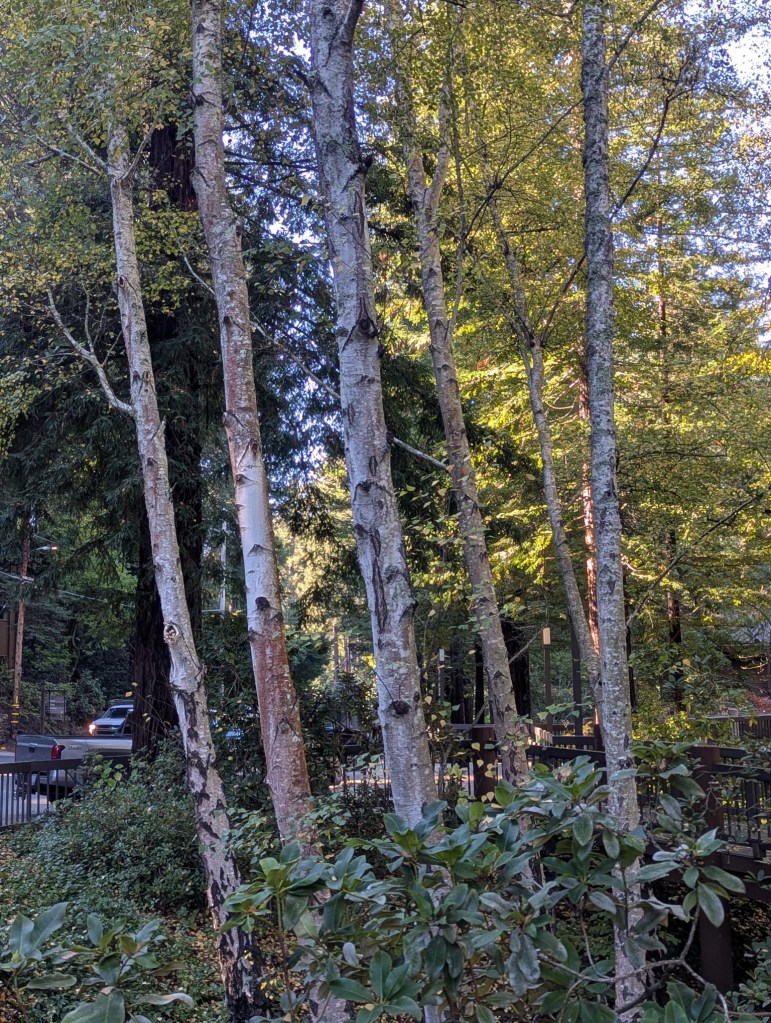
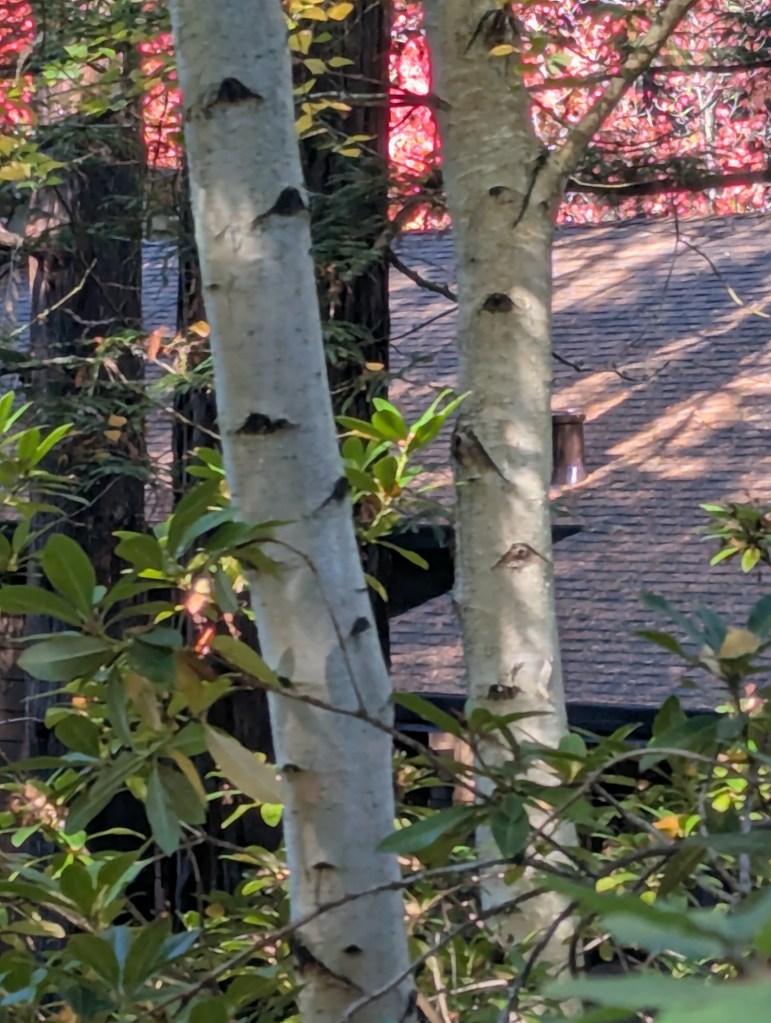
European white birch, Betula pendula, is a team player. It usually inhabits landscapes in groups rather than singly. Some trees have two, three or more trunks. After all, its primary allure is its strikingly white trunks. Because its foliar canopies are not overly broad, a few can fit into limited space. It is an informal and relaxed tree with nicely pendulous growth.
Mature European white birches are not much more than fifty feet tall here. They can grow taller where winters are cooler. Their slender trunks are mostly less than a foot and a half wide. They generally lean with prevailing winds and away from shade. Their smooth and white bark develops rough and black furrows with age. Their little leaves are deciduous.
European white birch appreciates regular irrigation, so should perform well within lawns. It produces only moderate shade. ‘Laciniata’ has intricately lobed foliage and a narrower form. ‘Youngii’ is so pendulous that it needs staking to stand upright. It can not grow very tall. ‘Purpurea’ has bronzed foliage and somewhat tan trunks, but has become very rare. European white birch might self sow.
Autumn foliar color does not seem to last long enough. As it dissipates, though, it reveals silhouettes of bare deciduous trees. Some are delightfully sculptural, with strikingly pale bark on their trunks and stems. Others develop distinctively reddish twigs. Some display interesting bark textures or patterns. Color, texture and patterns are remarkably variable.
Of course, for most species, bark does not change much throughout the year. It becomes more prominent now merely because defoliation increases its exposure. In fact, some of the most distinctive bark belongs to evergreen species. Some belongs to flowering trees, fruiting trees or arboriform shrubbery. The sources are as variable as the characteristics.
European white birch is likely the most familiar tree with white bark. Jacquemontii birch is even whiter. California sycamore is a massive tree with mottled light gray and tan bark. Crape myrtle, which is more proportionate to home gardens, is more mottled. Some elms exhibit elegant tan trunks and limbs. European beech trunks develop metallic gray color.
Melaleucas are evergreen trees with distinctively shaggy trunks. Eucalyptus are likewise evergreen, but generally with pale and smooth trunks. Lemon gum is particularly tall and elegant. However, red ironbark eucalyptus has dark and notably rough trunks and limbs. ‘Marina’ madrone develops smooth trunks and limbs with brown and cinnamon red color.
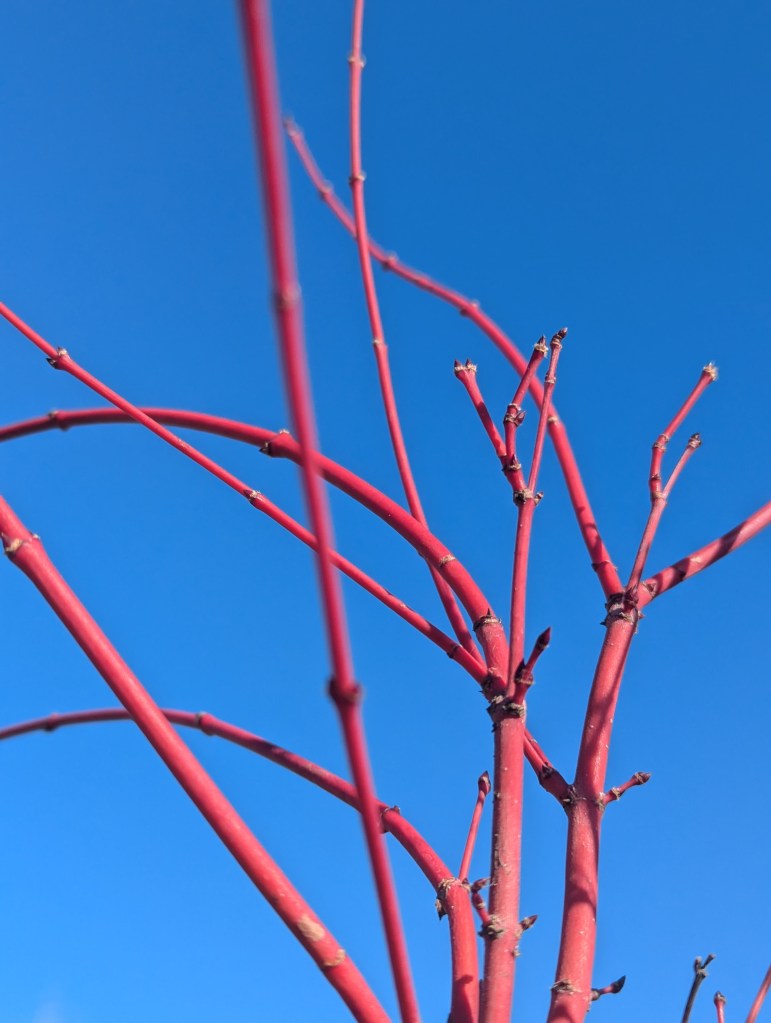
Coral bark Japanese maple and osier dogwood display colorful bark differently. Theirs is on small twigs rather than trunks and main limbs. Color actually develops in response to autumn chill and defoliation. Coral bark Japanese maple develops, pinkish orange color. Osier dogwood is more brownish red, although some cultivars are orangish or yellowish.
Trees that exhibit distinctive bark are subject to the same constraints as all other trees. In other words, they must be appropriate to their particular landscapes. California sycamore for example, is much too large for compact urban gardens. Osier dogwood can grow as a thicket without intensive maintenance. Any new tree or shrubbery should be sustainable.
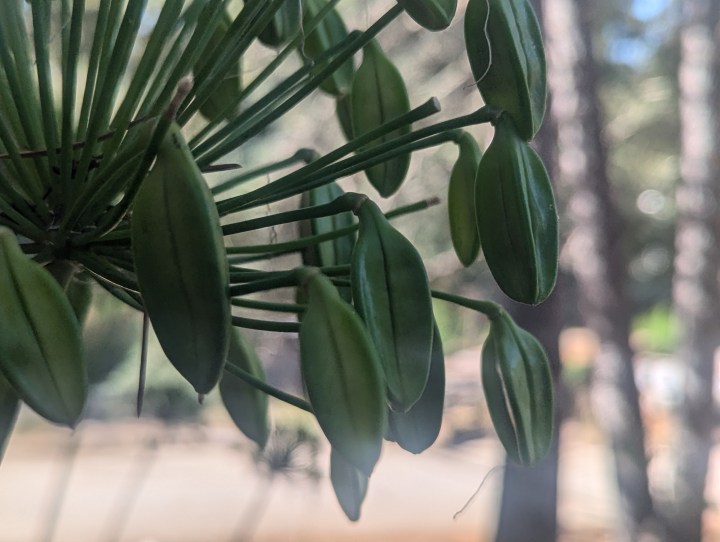
Lily of the Nile floral trusses are appealing even without bloom.
Most flowers bloom in spring. Many bloom a bit later and though summer. Not nearly so many start to bloom in autumn or though winter. This time of year, there is more to clean up from fading blooms than there are fresh blooms to cut and bring in.
Much of the color in the garden through autumn is provided by colorful foliage or foliage that gets colorful as the weather gets cooler. Later in winter, some plants have colorful bark and stems that gets revealed by winter defoliation. Coral bark Japanese maple, red twig dogwood and some arctic willows have remarkably colorful twigs.
Blooms of a few plants are sometimes cut and recycled after they fade because their dried flowers, flower stems or seed pods are appealing. Hydrangeas are not so attractive as they deteriorate out in the garden, but can be cut and hung upside down to dry to substitute for fresh flowers later. If done quickly, many types hold their color somewhat. Those that do not hold their fresh color may turn an appealing shade of brown.
Queen Anne’s lace can likewise be a nice dried flower, but is not so easy to hide in the garden while it dries. If cut and hung to dry, individual stems should be hung separately, since they bend and are difficult to separate if hung in clusters. Their flat-topped flower trusses curve inward as they dry, so they look nothing like they do fresh.
The rigid flower stems of New Zealand flax are rather sculptural protruding from their softer foliage. These same stems can be cut, plucked of seed pods, and like dried hydrangeas, used as cut flowers when there is not much else to get out of the garden. Ironically, New Zealand flax flowers sometimes get cut before they bloom, since not everyone appreciates their contrast against their own softly textured foliage.
Years ago, New Zealand flax flower stems were actually dried and spray painted! For those daring to try this technique, it also works well with lily -of-the-Nile flowers stems and trusses (plucked of their seed pods), Heavenly bamboo flower stems, and even dried pampas grass blooms. However, pampas grass blooms are deprived of their fluffiness and most appealing quality by spray paint. Bird-of-Paradise leaves twist interestingly as they dry, to provide texture with or without paint.
Fronds (leaves) of some fan palms can provide bold cut foliage. Mediterranean fan palm is difficult to handle because of the nasty teeth on the stalks, but has nice rounded leave that fan out nicely behind other flowers. They can be cut into smaller fans, or even other not so rounded shapes. Windmill palm is much easier to handle, but is a bit larger, so is more likely to need to be trimmed to shape. All are easy to cut with common scissors, and can be dried and spray painted.
There is probably more in the garden to substitute for cut flowers than would be guessed. Useful plant parts can be found in the least expected of places.
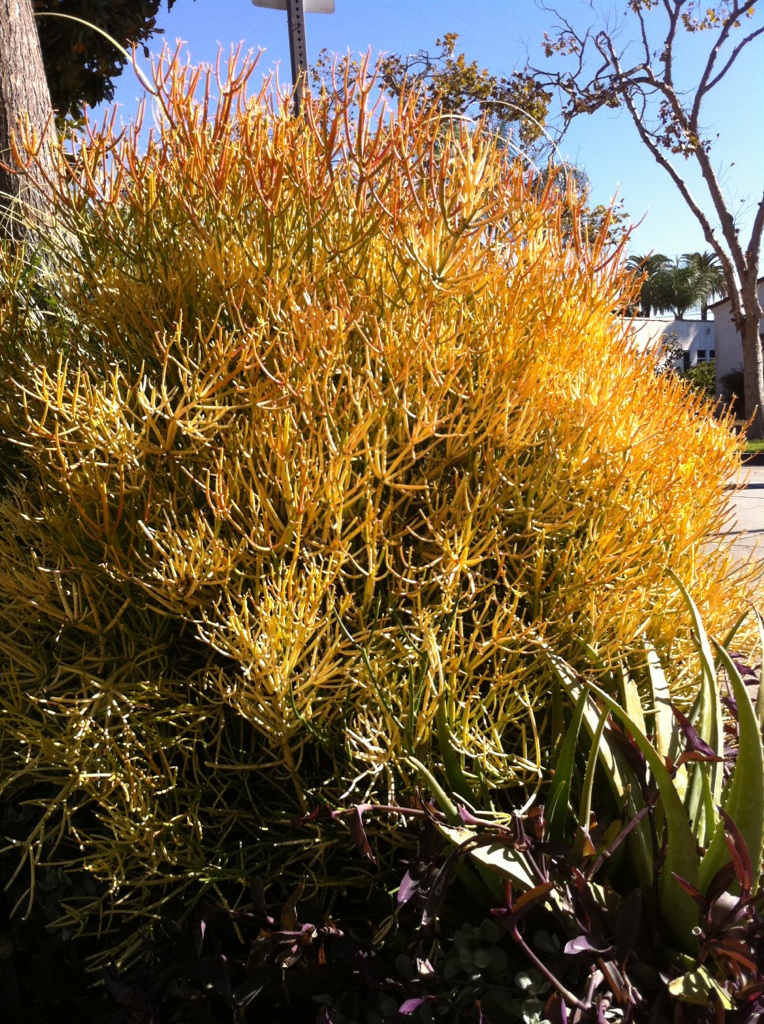
Sticks on fire is a more colorful and more compact version of pencil tree.
The old fashioned pencil tree, with leafless, succulent stems is a strikingly strange plant already. In mild climates of coastal Southern California, it can get quite large, nearly ten feet broad and twice as high. Sticks on Fire, Euphorbia tirucalli ‘Sticks on Fire’, stays less than half as large, but is even weirder because the stems are so oddly colored.
The inconspicuous leaves drop almost as soon as they develop, leaving distended fleshy stems that are either reddish or yellowish orange. Stems fade to softer yellow through summer, and then turn red in winter. Size and growth rate are limited by a lack of chlorophyll. Although related to poinsettia, the flowers of sticks on fire are not significant.
Sticks on fire prefers full sun exposure and warmth, but unfortunately needs protection from frost during winter. It can be happy under an eave on a south or west facing wall, or in a large tub that can be moved to shelter during winter. Plants in tubs are a bit more sensitive to rot if watered too frequently. The sap of sticks on fire is very caustic to skin and can be dangerous if it gets in the eyes.
Bark was actually not Rhody’s suggestion. It was simply a convenient theme while it was difficult for me to get out to take other pictures. These are six trees that I worked around yesterday. I could recycle this theme for native species.
1. Sequoia sempervirens, coastal redwood is the Official State Tree of California, and the tallest tree species in the World. Although native, this particular specimen was grown in a nursery, and is the cultivar ‘Soquel’. It was installed into its landscape likely after 1989.
2. Metasequoia glyptostroboides, dawn redwood is the only of three species of redwood that is not native to California. It is also the only deciduous redwood. Sequoia gigantea, giant redwood, is also represented by a young tree, but I did not get a picture of its bark.
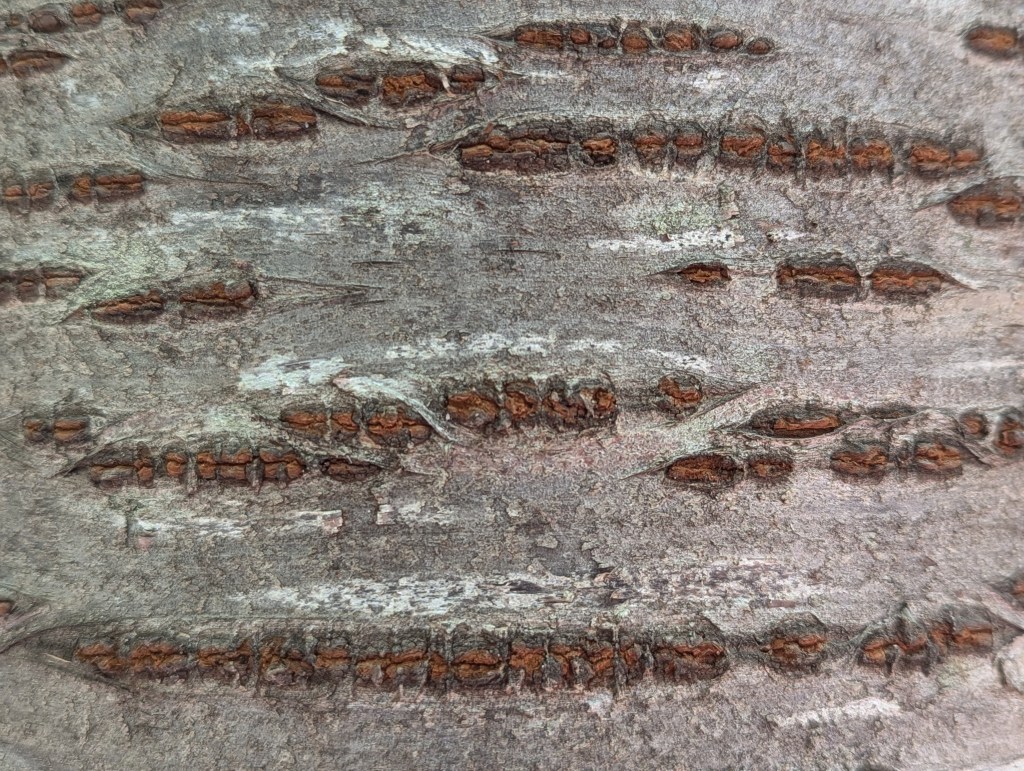
3. Prunus serrulata, flowering cherry seems to be the cultivar ‘Kwanzan’. Perhaps shade from surrounding redwoods, birches, sweetgums and dogwoods interfere with its bloom profusion. Individual flowers are a bit smaller than they should be for typical ‘Kwanzan’.
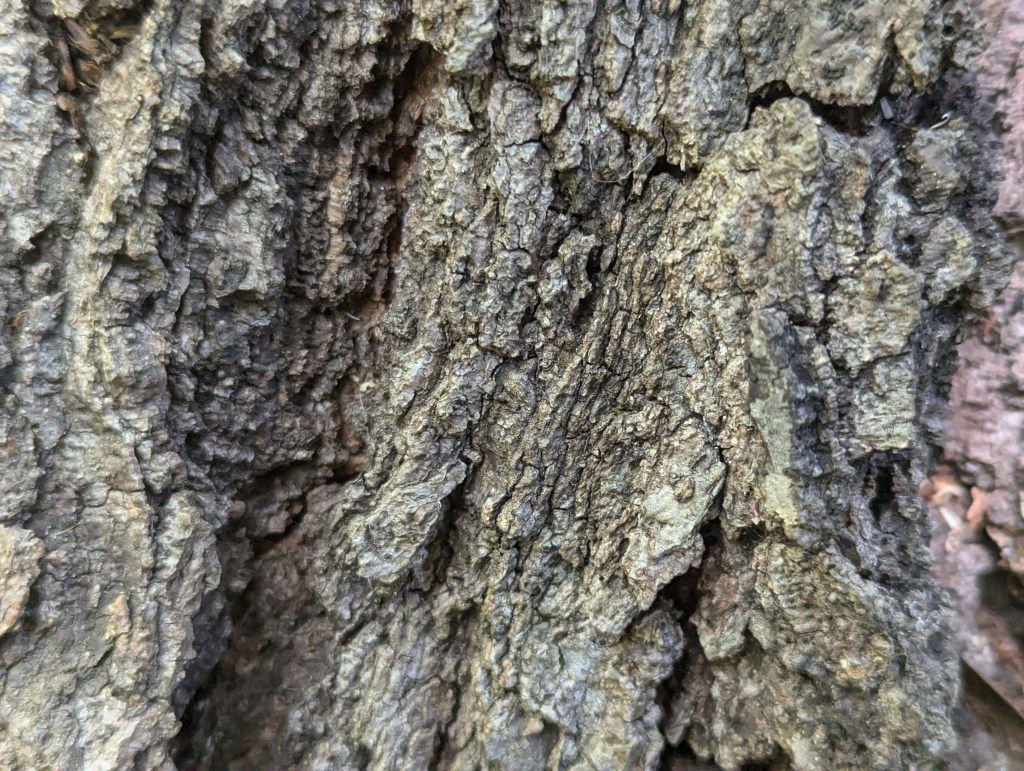
4. Betula pendula, European white birch has distinctly white bark, but also exhibits dark brown or black furrowed bark at the bases of large trunks. I tried to take pictures of both for contrast, but the white bark seemed too gray. I could have gotten both in one picture.
5. Liquidambar styraciflua, sweetgum bark goes through different phases as it matures. Young twigs initially exhibit smooth bark. Then, their smooth bark develops corky wings that grow as the stems grow. Somehow, mature bark shows no evidence of former wings.
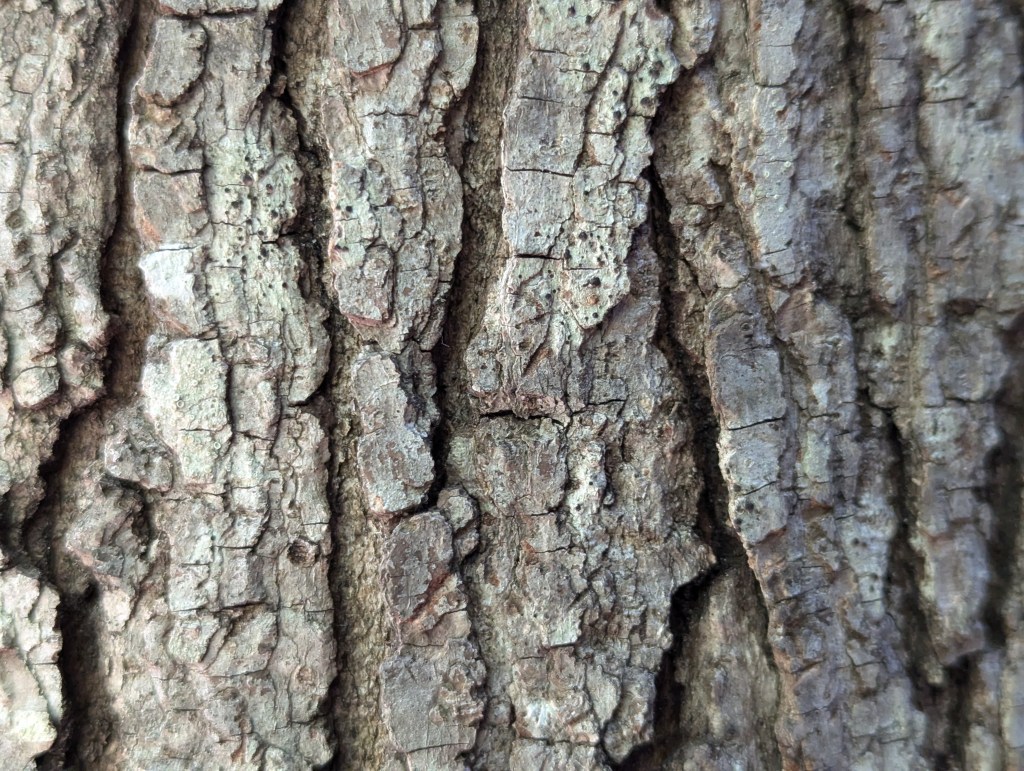
6. Cornus florida, flowering dogwood is supposedly easy to identify by its ruff bark. I do not get it, though. Of these Six, only flowering cherry has more finely textured bark. This particular tree does not bloom so well, but produces spectacular foliar color for autumn.
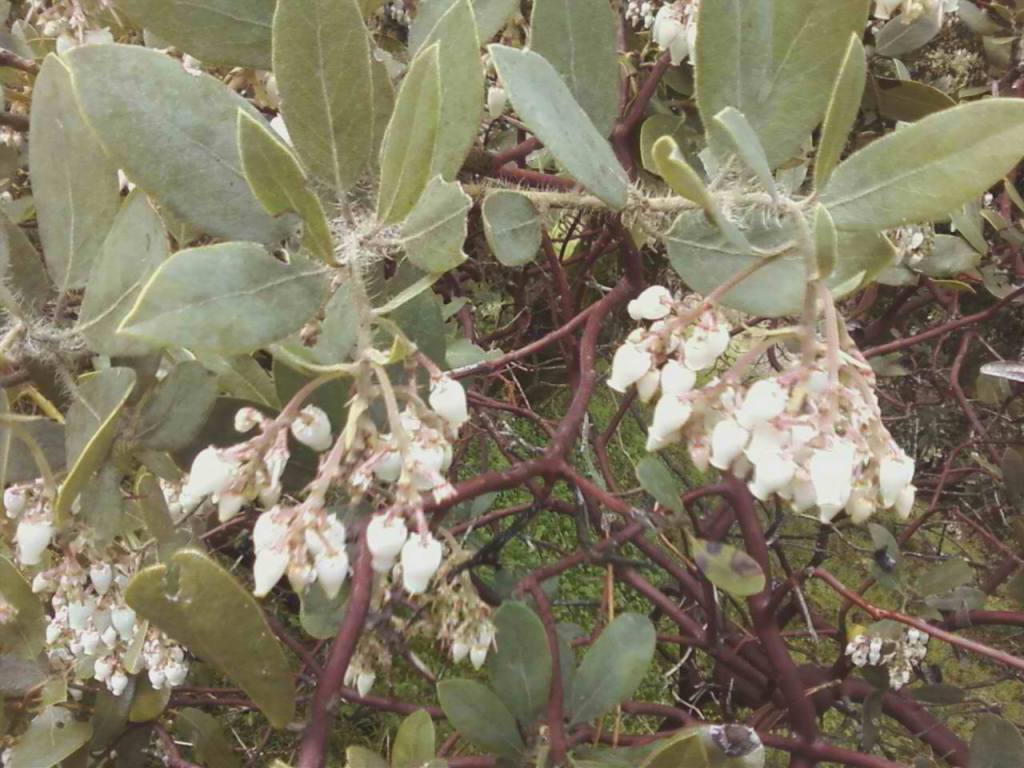
Mature common manzanita, Arctostaphylos manzanita, can get more than fifteen feet tall and about half as wide, so can be rather large shrubbery or small trees. Pruning away lower growth exposes their interestingly sculptural and smooth cinnamon red stems and trunks. The rather stiff light green leaves make light shade that smaller plants can live with. Waxy pinkish buds bloom into small pendulous clusters of tiny white lantern like flowers as winter becomes spring.
Manzanitas prefer to be neglected. They should not be pruned too much, and certainly should not get shorn. Obtrusive stems should be pruned out completely, since stems that get cut back do not regenerate. New plants should only be watered once or twice weekly through the first summer. Mature plants plants only want to be watered monthly or even less. After all, they are native to the surrounding hillsides, so are very satisfied with annual rainfall.
Bloom is probably the favorite component of home gardens. Foliage is likely the second favorite component. Japanese maples are popular as much for their form as for any other characteristic. The intricate textures and autumn color of their foliage is likely secondary. Coral bark Japanese maple, Acer palmatum ‘Sango Kaku’, is even a bit more distinctive.
Relative to other cultivars of Japanese maples, its foliage is not remarkable. Actually, it is more vulnerable to foliar scorch with arid warmth. Its form is not overly remarkable either. For coral bark Japanese maple, the bright red bark of its young twigs is its primary allure. It is obscured by foliage for most of the year, to be revealed by defoliation through winter.
Coral bark Japanese maple is an understory tree, so can tolerate partial shade. With full sun exposure, it particularly dislikes arid wind. It can grow as tall as twenty feet, or might stay as short as ten feet. It naturally produces many long and limber stems with shiny red bark. Severe pruning to promote growth of such stems is likely to ruin its sculptural form.
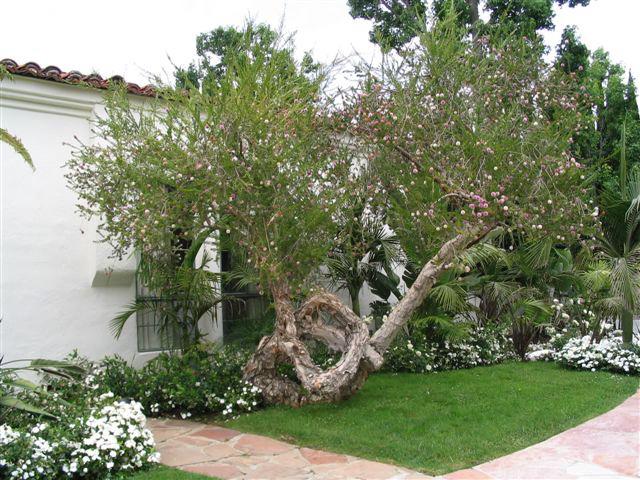
Golden Gate Park in San Francisco has some of the most impressive mature specimens of pink melaleuca, Melaleuca nesophila, outside of their native homeland in Australia. Although most are naturally less than twenty feet tall and wide, their disproportionately bulky trunks are remarkably gnarled and sculptural, as if they have been growing there for centuries. Pink melaleuca actually grows and develops trunk and limb structure rather fast while young, without ever becoming too obtrusively large. Spongy pale tan bark covers the distinguished trunks and limbs like a thick parka.
Sculptural small trees are not the only function of pink melaleuca. They also make nice informal hedges and screens, and can be shorn occasionally if necessary. The round inch long leaves are quite thick. Round inch wide trusses of small staminate flowers bloom slightly purplish pink and fade to pale white through most of the year, except where shorn. (Staminate flowers are showy because of distended stamens instead of petals.) Hummingbirds are grateful for the flowers while not much else blooms through winter. Hard seed capsules that remain in dense cylindrical formation on twigs after blooms are long gone are sometimes used as dried flowers. Like all melaleucas, pink melaleuca is easy to care for, and tolerant of harsh exposure, inferior soil, minimal watering and neglect.
If “verde” translates to “green”, then what color is blue palo verde, Parkinsonia florida? It is simply a bit more bluish green than other species that are a bit more yellowish. Its bark contains chlorophyll to photosynthesize without foliage. Blue palo verde is deciduous so defoliates for winter. Then, it defoliates in response to dryness through much of summer.
Blue palo verde in the wild may develop and retain foliage only during early spring. With landscape irrigation, it can retain some foliage through summer. It can also produce a bit more prior to late autumn defoliation. However, frequent irrigation promotes vigorous but structurally deficient growth. Few blue palo verdes thrive for a century within landscapes.
Blue palo verde can grow almost forty feet tall, but typically grows only about half as tall. It naturally grows as large shrubbery. Removal of lower growth exposes sculptural trunks for small tree form. With staking, trees can develop single trunks. Light yellow flowers are tiny but profuse during spring bloom. Blue palo verde is the Official State Tree of Arizona.
Dutch elm disease became a serious problem for American elms in the 1930s. However, it did not reach California until half a century or so later. Chinese elm, Ulmus parvifolia, is not very susceptible to the disease, but is a vector. In other words, it can survive infection to share it with other species of elm. Consequently, it became unavailable by the 1980s.
Some mature specimens of formerly common Chinese elm still inhabit older landscapes. Younger specimens in newer landscapes are mostly ‘Drake’ Chinese elm. They are a bit more upright, with more symmetrical form. More importantly, they are not vectors of Dutch elm disease. Other cultivars that are also resistant are rarely available at local nurseries.
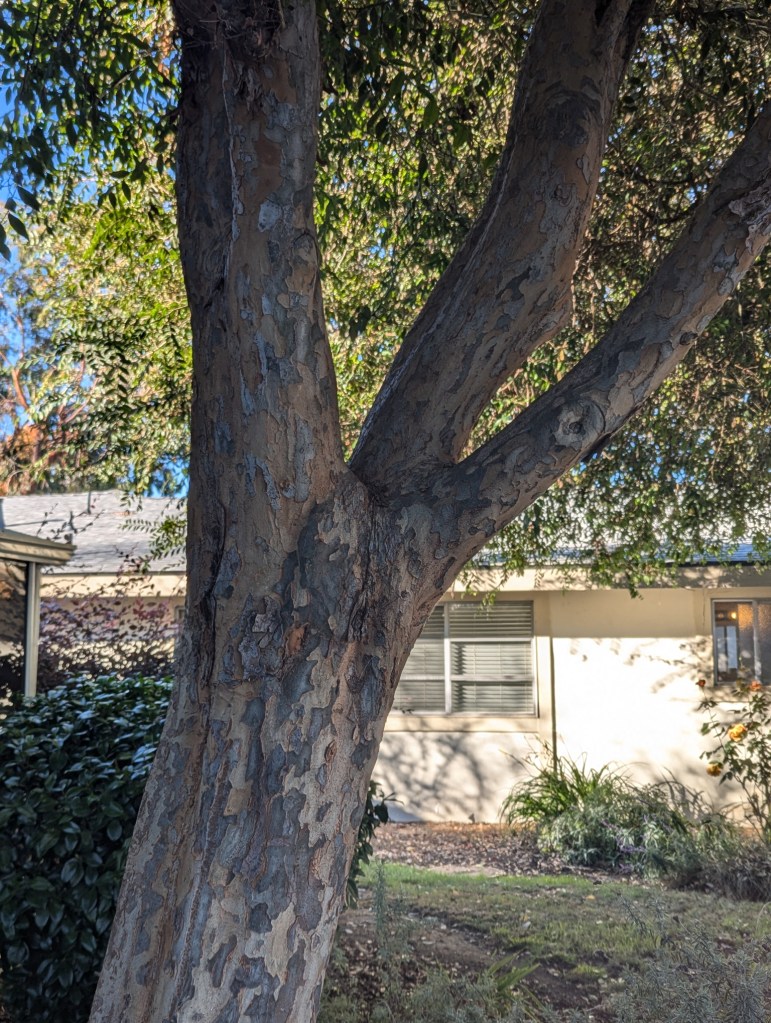
Classic and formerly common Chinese elm can eventually grow more than fifty feet high. Some can grow thirty feet wide to shade an entire urban front lawn. Some cultivars might grow nearly as high, but are generally not quite as broad. Their blotchy gray and tan bark adorns curvaceous limbs. Their small deciduous leaves are not very colorful for autumn. They can be copious, messy and quite tedious to rake.




 Tony Tomeo