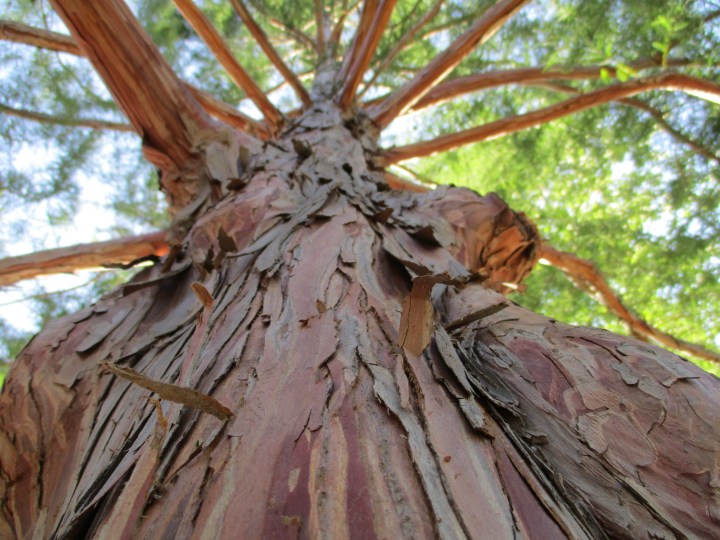
 Lemon eucalyptus, ‘Marina’ madrone, cork oak and all sorts of melaleuca trees are known more for their interesting bark than for their foliage or flowers. It helps that their distinctive trunks and branch structures are ideal for displaying their unique bark. Color and texture of bark is remarkably variable, and tends to get noticed more in winter while blooms and foliage are lacking.
Bark of sycamores, birches, elms and crape myrtles that had been so handsome throughout the year is more visible now that it is not partially obscured or shaded by the deciduous foliage that is associated with it. Trunks and limbs of European white and Jacquemontii birches are strikingly white. ‘Natchez’ crape myrtle has distinctively blotched bark, (although the white flowers are pale.)
Because of their other assets, English walnuts, figs and saucer magnolias are not often grown for their bark. Nonetheless, their pale gray bark shows off their stocky bare branch structure nicely, especially in front of an evergreen backdrop of redwoods or pines. The smooth metallic gray bark of European beech is much more subdued, but is what makes big old trees so distinguished.
A few deciduous trees and shrubs get more colorful as winter weather gets cooler. Instead of white or pale gray, their bark turns brighter yellow, orange or red. Some plants, like sticks-of-fire, do not need much cool weather to develop good color. Others get more colorful in colder climates, and contrast spectacularly to a snowy landscape. Locally, they should be well exposed to chill.
As the name suggests, the coral bark Japanese maple (‘Sango Kaku’) develops pinkish orange bark. It can get ruddier in colder climates, but may get yellowish here. Unlike other Japanese maples that get pruned to display their delicate foliage and branch structure, the coral bark Japanese maple sometimes gets pruned more aggressively to promote more colorful twiggy growth.
Osier dogwood is a shrubby dogwood that lacks colorful bloom, but compensates with ruddy brown, brownish orange or pale yellow bark in winter. (Dogwood bark . . . There is a pun there somewhere.) Because it lacks colorful bloom, it can be pruned aggressively after winter. Older canes that do not color as well can be pruned to the ground as they get replaced by new canes.
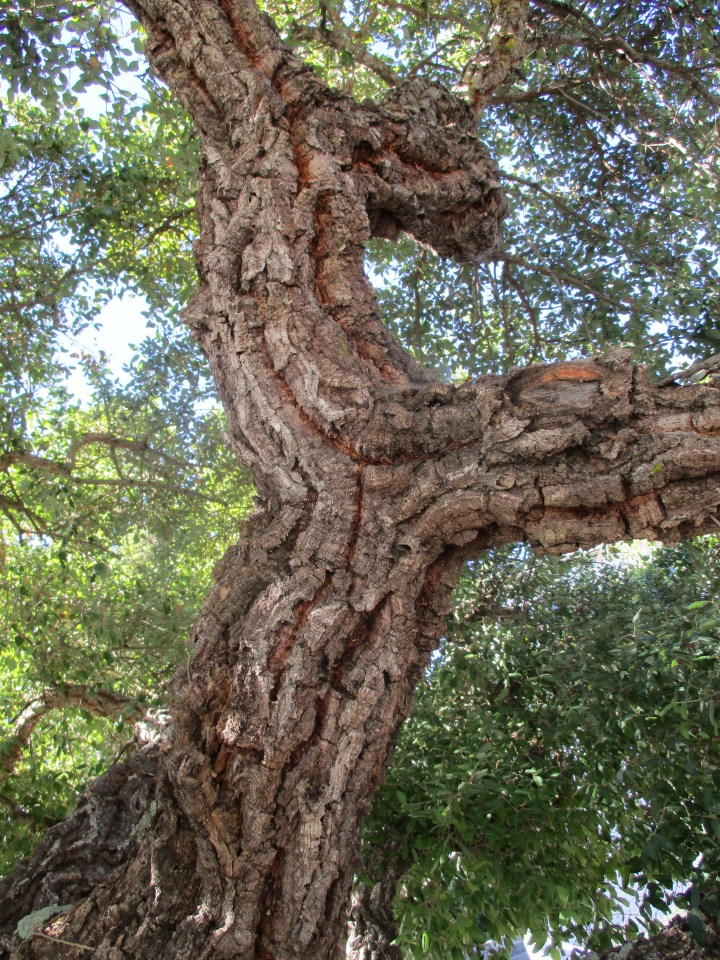 Like redwoods, the cork oak, Quercus suber, is a ‘pyrophyte’, which means that it survives forest fires that burn off competing vegetation. The trunks and main limbs are insulated with a very thick bark. Only the foliage and smaller stems burn off. After a fire, the upper limbs of cork oak regenerate new foliage while other less fortunate plants start over from their roots or seed at ground level.
 There seems to be some discrepancy about the correct spelling of crape myrtle, Lagerstroemia indica. Many of us spell it as ‘crepe’ myrtle, thinking that crepe is the thin colorful paper that the flowers resemble. It is actually a rolled up thin French pancake. The thin paper is actually spelled as ‘crape’. Of course those of us who dislike the commonness of crape myrtle might omit the ‘e’.
 Tony Tomeo