Toyon

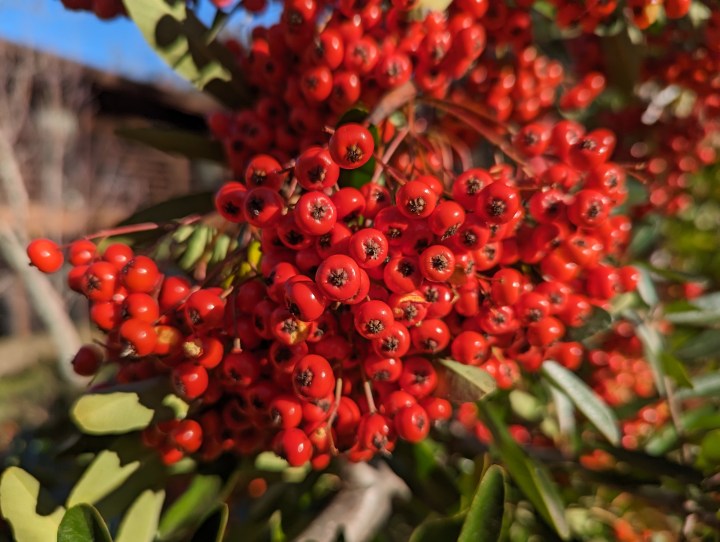
Native toyon berries appeal to birds.

Hooray for Hollywood! It was formerly Hollywoodland because of the California holly that still grows wild there. California holly is not actually holly, though. It formerly classified as hawthorn and two different photinia. It then became two other species of the genus that it is now. Ultimately, but perhaps just temporarily, it became toyon, Heteromeles arbutifolia.

Toyon is native to all but a few counties of California. It is therefore quite happy within the chaparral climates here. Once established, it needs no more water than it gets from rain. Occasional irrigation enhances foliar color and vegetative growth. Excessive or frequent irrigation can cause roots to rot. Fire blight can sometimes become a significant problem.

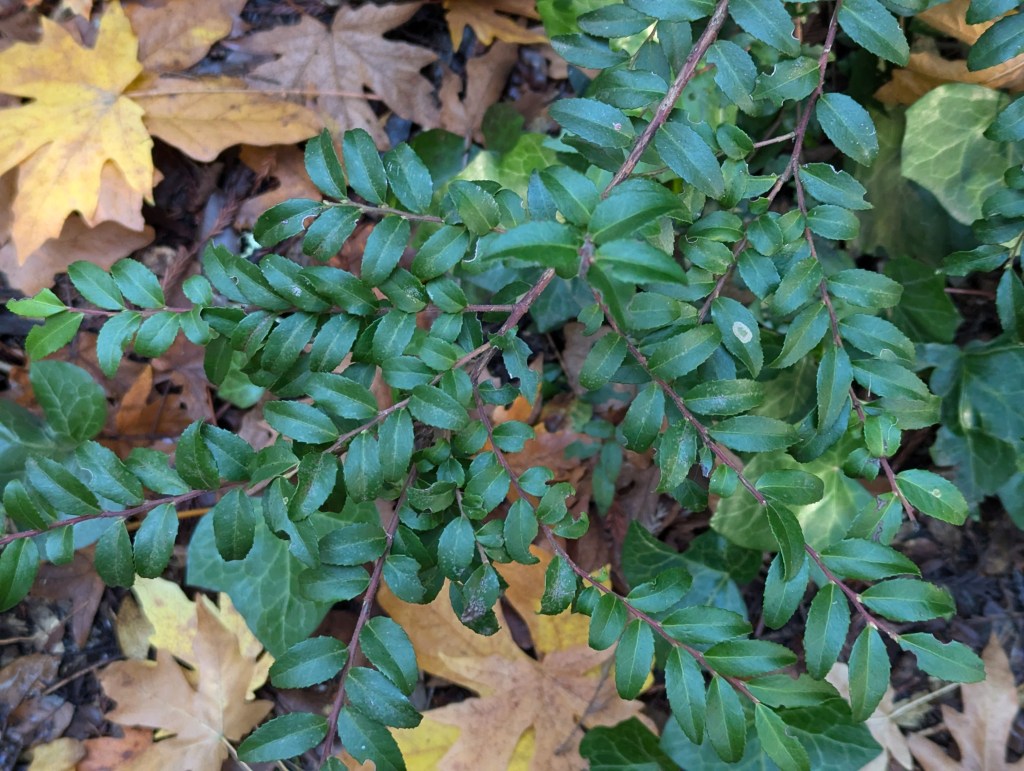
Toyon is unlikely to grow more than twelve feet tall with sunny and warm exposure. It can grow more than twice as tall if it competes for sunlight with larger vegetation. The simple evergreen leaves are narrow and somewhat serrate. Billowy trusses of tiny white flowers bloom for early summer. Trusses of bright red berries feed birds through autumn.

Wintry Berries Are Already Colorful

Most wintry berries are bright red.

Seed of most vegetation here finishes developing by late autumn to be ready for winter. It wants to germinate while soil is damp, and before it gets dry after spring. Some needs to vernalize with a bit of chill to be ready to germinate prior to spring. Some offers incentive to birds or other wildlife to disperse it. It develops within colorful fruits and wintry berries.

Both migrating and overwintering birds enjoy wintry berries while other food gets scarce. Squirrels and other wildlife are likely to indulge as well. Seed within such fruit is resilient to digestion. In fact, many of such seed germinate better after digestion softens their hard exteriors. For them, digestion by their vectors is comparable to vernalization by weather.

This is why wintry berries are so colorful. They want to be visually appealing to birds and other vectors who disperse their seed. Their vectors need no more persuasion than that. They instinctively recognize a free meal when they see it. While they eat well, vegetation which feeds them benefits from dispersion of its seed. It is a mutually beneficial situation.

Birds and wildlife are not exclusive beneficiaries of ripe wintry berries. Many people who enjoy gardening appreciate their vibrant color. Such color is particularly appealing where floral color is deficient during winter. Many who enjoy gardening instead prefer any birds who eat such berries. Unfortunately, wintry berries will not last long after birds find them.

Wintry berries are already developing color, a month or so before the beginning of winter. Some may become more prominent as autumn foliar color eventually diminishes. Almost all wintry berries are bright red, but some are rusty red, orange or even golden. Greenish pittosporum berries are not so prominent. Elderberries are uncommon in home gardens.

Firethorn is the most prominent of wintry berries here. Various cotoneasters are likely the second most prominent, with rustier red color. Toyon berries are more colorful than those of cotoneaster, but are less common. English hawthorn can retain its berries longer than its deciduous foliage, but is rare. Because they lack pollination, most hollies are fruitless.

Elderberry

Blue elderberry is native here.

Although almost never planted intentionally, elderberries occasionally appear in strange places, wherever their seeds get dropped by the birds or rodents who eat their berries. The blue elderberry, Sambucus mexicana / caerulea, is native and most common between California, British Columbia and the Rockies. The American elderberry, Sambucus canadensis, is more common elsewhere, and also appears in the west where it had historically been imported for berry production. Some modern cultivars (cultivated varieties) with gold, bronze, or lacy foliage are actually related to European elderberries.

Except for compact cultivars, elderberries grow rampantly to about fifteen feet tall and wide. Aggressive pruning in winter keeps them looking fuller and more densely foliated. Overgrown plants can be rejuvenated by getting cut to the ground. The big leaves are divided into seven leaflets that are two to six inches long. Blue elderberry foliage is softly serrate and a bit more variable, with five to nine leaflets that may be as short as one inch.

Wide flat trusses of pale white flowers that bloom in late spring or early summer produce small but potentially abundant and richly flavored berries. Blue elderberries are dark blue dusted with white powder on trusses to about six inches wide. American elderberries are darker and more purplish on trusses that can be wider than eight inches. (Red elderberries are toxic!)

Birds Enjoy Colorful Fruits and Berries.

Brightly colored berries are an incentive for birds to disperse the seed within.

Colorful fruit and berries that ripen in autumn and winter bring more than their own color to the garden. They also attract all sorts of birds. Some birds want to fatten up on the earlier and typically more abundant and colorful fruit before migrating south for the winter. Other birds that stay through winter eat fruit and berries that develop over a longer season, after the migratory birds are gone.

The most abundant and brightly colored red fruit of pyracantha (or firethorn) appeals to the early migratory birds that want to fatten up fast and get south. Cotoneaster, toyon and English hawthorn are not quite as flashy, but appeal to the same crowd of migratory birds. These sorts of plants get their colorful fruit early on in the season, but are then stripped of it rather efficiently.

The fruit of pyracantha, cotoneaster and toyon is not often very messy since almost all of it gets consumed; but the birds that eat it can be remarkably messy before they fly south. Coincidentally, these three plants are often grown as informal hedges and screens around the perimeters of large parking lots, so the mess is a traditional nuisance for many parked cars this time of year.

Chokeberry and elderberry ripen early enough for the migratory birds, but do not get devoured so efficiently because they are not so brightly colored. Migratory birds seem to prefer bright red or orange berries, so are likely to leave black chokeberries and blue elderberries for overwintering birds, which stay through winter. Strawberry tree, although not very productive, appeals to both crowds, and anyone else who might be interested in their fruit, by producing bright red berries throughout the year.

Persimmon, holly, loquat, some mahonia and some crabapple are even a bit more selective, by ripening their fruit later in autumn and winter after the migratory birds are gone. Pomegranate fruit splits open in the middle of winter, exposing a buffet of juicy red berries with meaty seeds for anyone who hasn’t gone south for the winter. Many pittosporums do the same, but without the colorful advertisement. Of course, most of us want to get our persimmons, loquats and pomegranates before the birds do!

Citrus such as lemons, oranges, grapefruits and mandarins that ripen later in winter do not attract birds, so we only need to share these fruits with our friends and neighbors. Citrus are colorful enough on their own anyway.

Black Chokeberry

Black chokeberry is already popular within its native range.

The recent popularity of fruits that contain antioxidants is restoring the popularity of an old classic deciduous shrub with an odd name. ‘Black chokeberry’ obviously does not sound very appetizing, so is more commonly known by its Latin name Aronia melanocarpa, or simply ‘Aronia’. It has always been popular within its native range east of the Appalachians and just north of the Canadian border, and is becoming more popular everywhere else since becoming available from mail order catalogues. Although it is not well rated for local climates since it prefers cooler winters, it can sometimes be found in local nurseries.

Shiny, black chokeberries are about half an inch wide, and ripen about now. They are purported to taste something like cranberries. Mine taste more like pithy crabapples so far; but I do not mind. I grow the three or four foot high shrubs just as much for their remarkable autumn color later in the year. The rather unremarkable inch or two wide trusses of small white flowers that bloom in spring can be slightly fragrant.

Pruning is rather simple, as long as chokeberries do not get shorn. Vigorous stems that may get considerably taller than four feet may be pruned back to promote shrubbier growth. Aging stems can be cut to the ground in winter, and will be readily replaced by new sucker growth.

Colorful Autumn Fruit Is For The Birds

Firethorn is typically the most colorful of autumn berries.

It is hard to ignore the slight bronzing of flowering pear trees in the neighborhood. The recent warm weather after such a mild summer may detrimentally accelerate the development of autumn foliar color, as well as the ripening of some of the colorful fruit that adorns gardens through autumn and winter. Sadly, there have been reports of scorched persimmons as well.

Despite their deviation from a more typical schedule, many of the plants that provide the most colorful fruit start to do so about now, just as birds want to fatten up for winter. My favorites of these provide fruit that I like to get before the birds do. I have already harvested gooseberries, currants and grapes, and am in the process of getting to the elderberries and black chokeberries. Pomegranates will ripen later in autumn. Citrus and persimmon will be ready later in winter, followed by loquat. Natal plum produces randomly all year.

Even fruit that I do not want looks good and keeps the birds happy though. Firethorn is probably the showiest and most popular of these, since it produces such abundant bright red berries that linger into winter. Some have orange or even yellowish berries. Cotoneaster and toyon are similar, but not so flashy. English hawthorn makes similar berries, but grows into a larger tree. Fruiting crabapples were harvested in early summer; but the ornamental, albeit sparse fruit of the flowering crabapples will linger after the leaves fall. Plants that provide abundant fruit that is popular with birds may not be so desirable near where cars are parked outside though, since well fed birds can be rather messy.

I am particularly fond of persimmon, pomegranate, English hawthorn and crabapple trees for other reasons as well. Persimmon trees will provide some of the best orange and red autumn foliar color. By the time it falls, there is plenty of comparably bright orange fruit to replace it! Pomegranate blooms with few but bright reddish orange flowers in summer. English hawthorn and crabapple trees are among the most abundant of spring blooming trees. Some of the flowering crabapple trees bloom with unique shades of bright pink and nearly red. 

Heavenly bamboo, Oregon grape (Mahonia) and California pepper tree are not often grown for their colorful fruit, but sometimes like to show it off. Oregon grape is striking because the fruit is so dark purplish black. California pepper tree makes pendulous trusses of small pink berries. Snowberry is an uncommon native that makes few but striking white berries. 

Madonna & Black Lace II

Sambucus nigra ‘Black Lace’ can produce a few berries without pollination from another cultivar.

The internet never ceases to amaze with its inefficiency of providing information that should be more readily available. Old fashioned horticultural texts and even encyclopedias were more reliable. I remember reading that elderberry could be self pollinating, but that it would be more productive with another cultivar of the same species. Because I could not remember what species of the genus that information was relevant to, I more recently tried to determine the requirements of each of the few species that I grow. Ultimately, it seems to me that all are about the same in regard to both their ability to self pollinate to a minimal degree, and their ability to pollinate more efficiently with other cultivars. However, I still do not know. Furthermore, I am now confused about the identity of American elderberry, which many sources insist is merely a variety of common black elderberry of Europe.

Sambucus caerulea, blue elderberry is native and too common for me to know or care if it is more productive with other genetically distinct specimens, which, since the species lacks cultivars, are merely other wild specimens. In other words, blue elderberry specimens here can not be adequately isolated from other specimens to determine how reliant they are on others for pollination. Regardless, I will grow about four together within my garden.

Sambucus racemosa, red elderberry is supposedly native here, but I have never seen it in the wild. Consequently, I do not know if other specimens are close enough to pollinate specimens within my garden. Rather than experiment with single and potentially isolated specimens, and because there is no need to separate the four specimens here anyway, I will grow all of them together within my garden. I am considering adding ‘Sutherland Gold’ or other ornamental cultivars in the future.

Sambucus canadensis, American elderberry is not native, so could be grown in isolation here. However, I want berries more than I want to know how reliant this species is on pollination from other genetically distinct specimens. Before I grow cultivars, I will grow about four specimens within my garden from seed. I might consider cultivars in the future, but for now, would prefer to grow them as most people within their native range experience them, and as I grow blue and red elderberries.

Sambucus nigra, black elderberry is a species that I find to be less interesting than the three North American species that I actually want to grow. However, I have grown ‘Black Lace’ at work for a few years, and recently got it ‘Madonna’ as a pollinator so that the two can make berries together. Because I grew several more copies of each than we can accommodate at work, I will likely grow a pair of each within my own garden. Both are ornamental cultivars that happen to also produce berries. However, formerly without a pollinator, ‘Black Lace’ has been fruitless. This year, one of the copies managed to make these few berries in the picture above without bloom from ‘Madonna’. I suppose that this is consistent with what I read about its ability to self pollinate somewhat. Now, I want to see what it does next year if ‘Madonna’ blooms well.

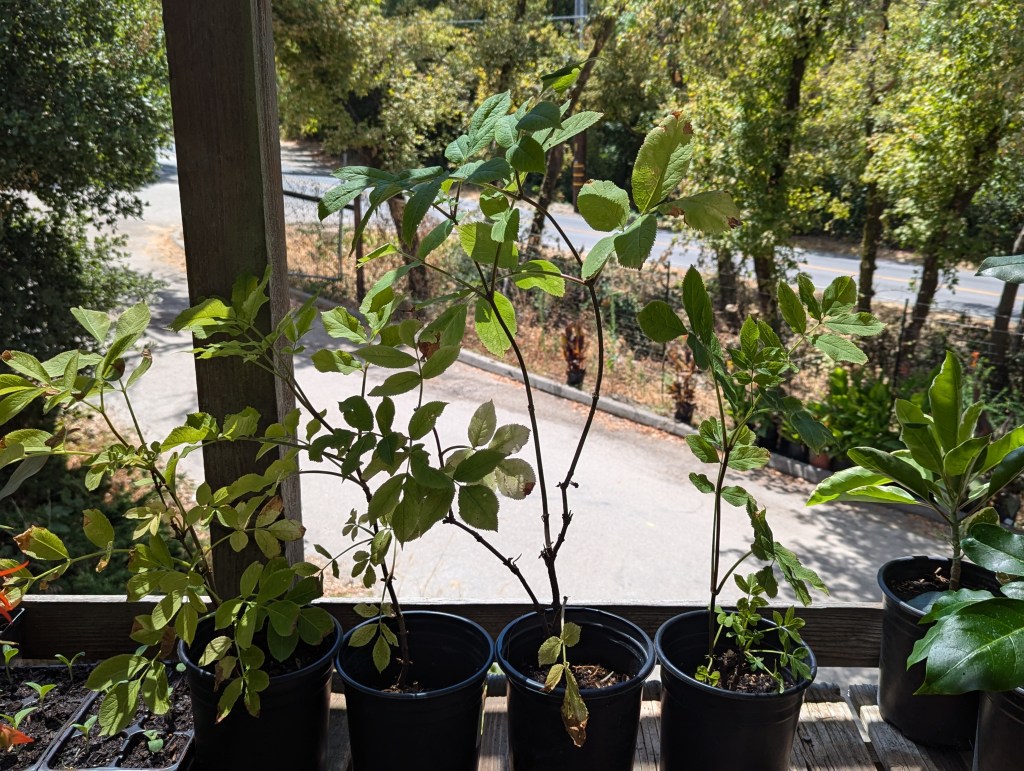
Four wild seed grown specimens of Sambucus racemosa, red elderberry that were a gift from Tangly Cottage Gardening have been canned for too long, and want to get into the garden.

Madonna & Black Lace

Sambucus nigra ‘Black Lace’ European black elderberry

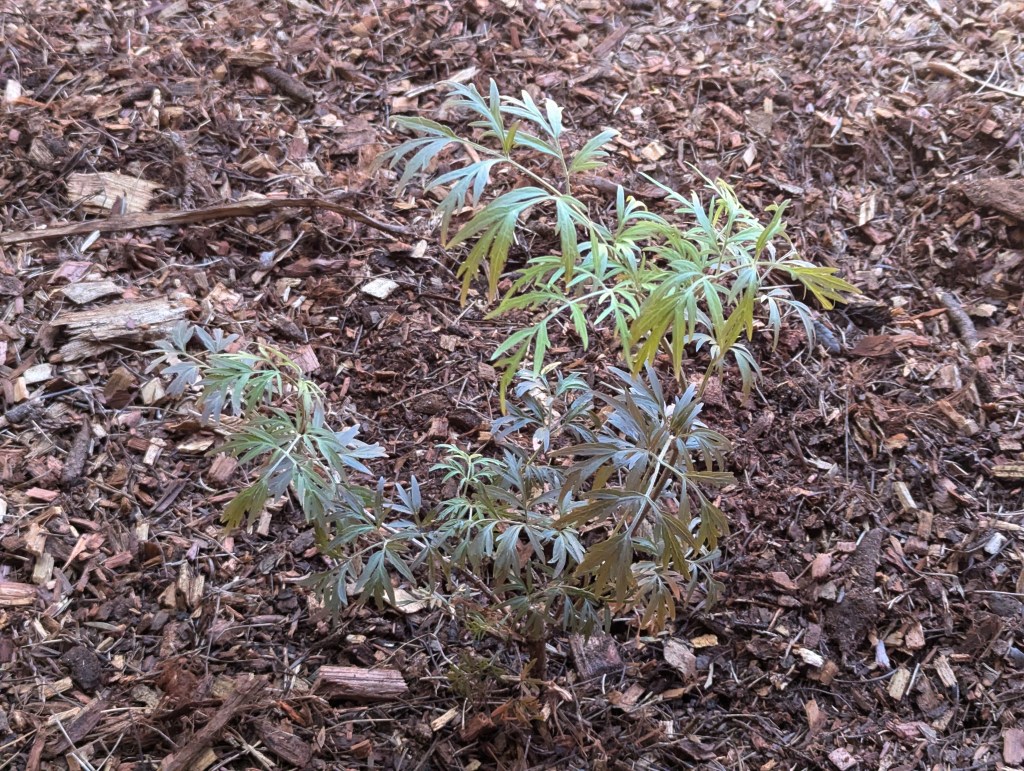
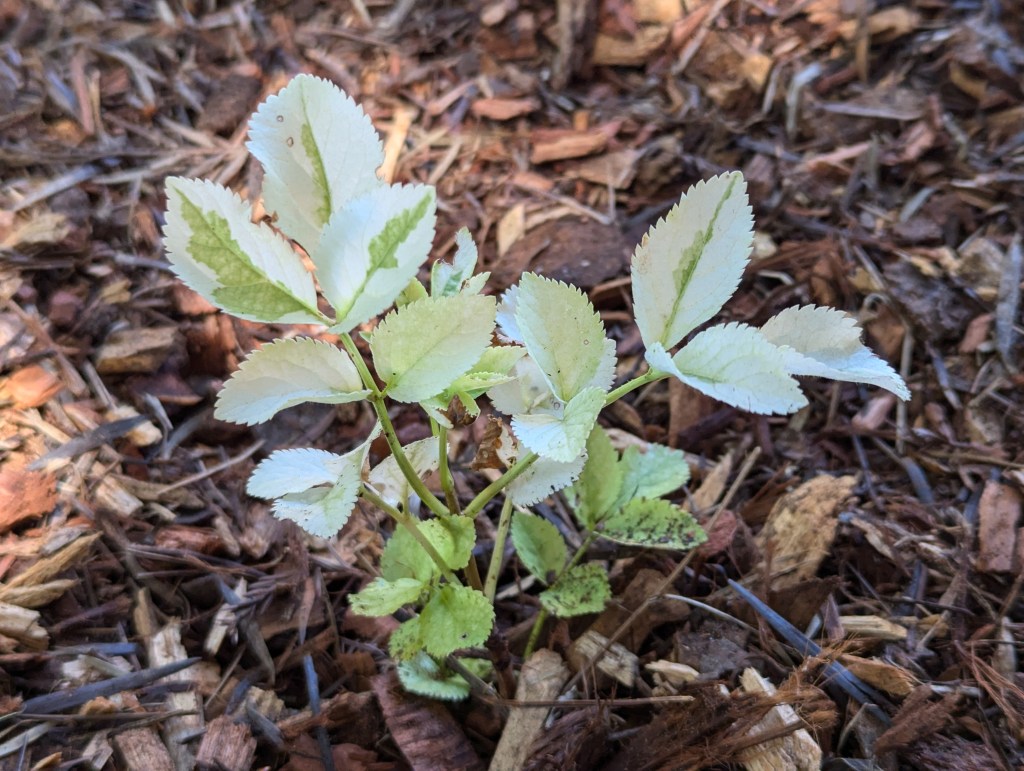
1984 was four decades ago. This is happening right now. Sambucus nigra ‘Black Lace’ European black elderberry, with intricately lacy and richly bronzed foliage, and flaring upright form, has inhabited one of the landscapes here for a few years. I was initially not so keen on it, but eventually learned to appreciate it as others who saw it expressed fondness for its distinctive texture and color. It was so popular that I grew a few too many copies from pruning scraps two winters ago, with the intention of adding a few more to other landscapes. I plugged a few more last winter, as if I did not know better. Several were shared with neighbors, but so far, only one was added to another landscape here, and only a few days ago. It may not look like much in the picture above, but should be a bit bigger and more richly bronzed next year. Sambucus nigra ‘Madonna’ European black elderberry, with simpler and yellowish variegated foliage, and somewhat more rounded form, was a more recent acquisition. Although I am not so keen on its yellowish color, it happened to become available while I was considering acquisition of a pollinator for ‘Black Lace’, which has not produced berries yet. Although each can self pollinate somewhat, different cultivars pollinate each other more effectively. Doves enjoy the resulting berries; and people enjoy seeing happy doves. The original specimen of ‘Madonna’ was thrashed when I acquired it, but provided more than sixteen rooted side shoot copies before going to live in a colleague’s garden. The first of these copies was installed adjacent to and in conjunction with the first copy of ‘Black Lace’. It may not look like much in the picture below, but it is just a dinky copy from a four inch pot.

Sambucus nigra ‘Madonna’ European black elderberry

Saskatoon

Saskatoon prefers significant chill during winter.

Of eighteen species that are native to North America, only two are native to California. Of these two, only one is native locally. However, some of the few nurseries that sell various saskatoons market them as native. Obviously, most are not. A few are hybrids. All of them are species of Amelanchier, and are still rare here. Their common names are numerous.

Serviceberry, sarvisberry or sarvis may be some of the more common of common names. Shadbush, shadwood or shadblow may be less common. Juneberry, chuckley pear, wild plum and sugarplum are likely regional names. They are more familiar where winters are cooler. Some sorts do not perform well locally because they prefer a bit more winter chill.

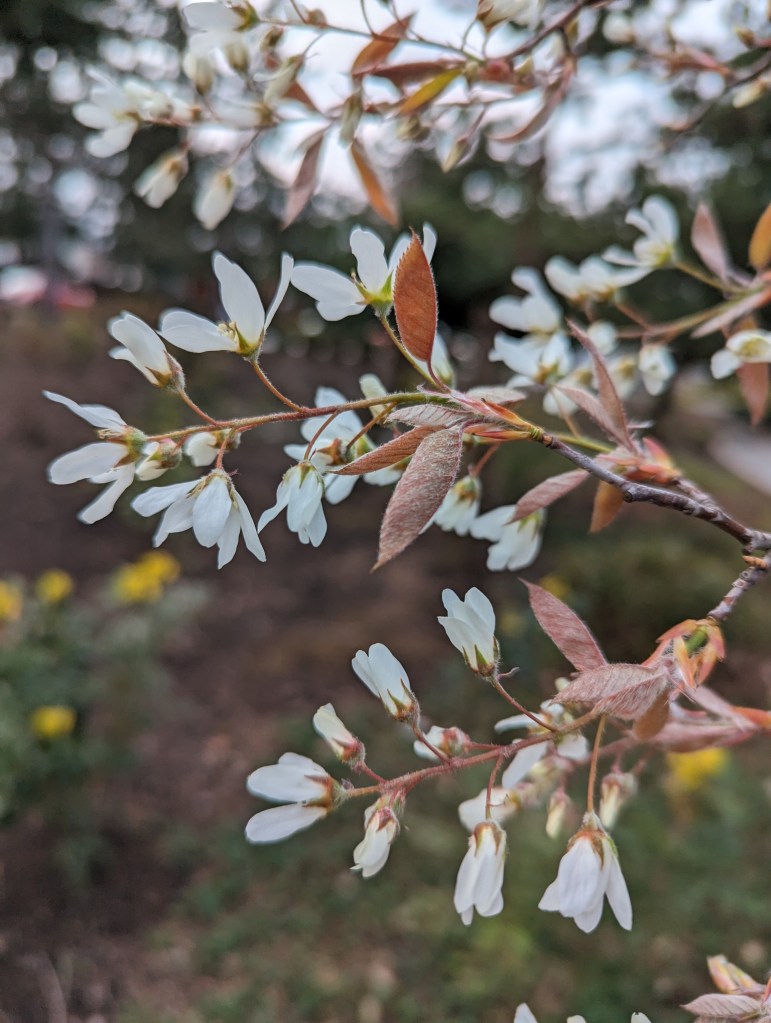
Saskatoons are locally popular primarily for their fruit, and only among a few enthusiasts. They are more available online than in nurseries. The fruits are pommes like tiny apples, but are only the size of blueberries. They ripen to blackish purple for summer. Their early spring flowers are like wispy apple flowers. Most Saskatoons grow less than ten feet tall. Some rarer types can grow thirty feet tall in favorable climates.

Raspberries Are Similar To Blackberries . . . But Different.

Like these dormant fruit trees, raspberry canes should go into the garden during bare root season.

            My grandmother would have gotten better results by sending me out to the garden for zucchini. She should have known better than to send me out for raspberries. I could have brought in as many zucchini as she wanted in a short while. With raspberries though, I was gone too long, and returned with meager spoils and diminished appetite.

            Neither raspberries nor zucchini will be exploitable for a few more months. Raspberries though, can get planted about now. Also, established raspberry canes should be pruned about now to promote abundant production later. Just like most deciduous fruit trees and blackberries, raspberries are not ‘low maintenance’, and require intensive specialized pruning.   

            New bare root plants should be spaced about two to three feet apart and mulched to insulate the soil until they develop enough foliage to shade their own roots. Their canes can then be cut back so that only a single bud is visible above ground. Because raspberries spread, root barriers are sometimes useful to keep them out of neighbors’ gardens.  

            Through summer, new plants should produce three or more new canes. These canes should be able to support themselves, but are less rampant if tied to a trellis or wire. I like to train them onto a fence like grapevines, because there are not many other uses for a fence.

            The more popular everbearing cultivars like Heritage, September, Summit, Golden Summit and Fallgold may develop fruit on the tops of their new canes during their first autumn. During the following winter, the tops of the canes should be cut back as far down as fruit developed. The remaining lower portions of their canes that did not develop fruit in the first year will do so during their second summer, and should get pruned out as they finish producing.

            At about the same time, about five to ten of the best new canes should be selected, and trained if desired. Superfluous canes should be cut to the ground. Like their predecessors, the remaining selected canes should fruit on top during autumn, get pruned in winter, and fruit again during the following summer before getting pruned out. This process should be repeated annually.

            Summer bearing cultivars like Willamette, Canby and Tulameen should not fruit in their first year, and should be pruned to about five feet tall during the following winter. Every subsequent summer, many new canes emerge as the older canes bloom and fruit. Every subsequent winter, about five to ten of these new canes should be selected, tied to support if desired, and pruned to about five feet tall, as all spent canes and superfluous new canes get cut to the ground.

            Black and purple raspberries are shrubbier, so get pruned differently than the more traditional red and yellow raspberries do.  During their first summer, canes should be pruned back to about two feet to promote branching. All except about six or seven of the best of these canes should be removed over winter. The side branches of the selected canes of black raspberries should then get pruned to about half a foot long. Side branches of purple raspberries can be twice as long. After these canes finish fruiting during the following summer, they should be cut to the ground. New canes can then be pruned like during the first summer so that the process can be repeated annually.