California Bay

California bay is not culinary bay.

Grecian bay is, as its name suggests, endemic to Greece and the Mediterranean region. California bay, Umbellularia californica, is native to California and southwestern Oregon. The two are very different. Although California bay can be useful for culinary application, it is twice as pungent. For replacing Grecian bay in recipes, half as much should suffice.

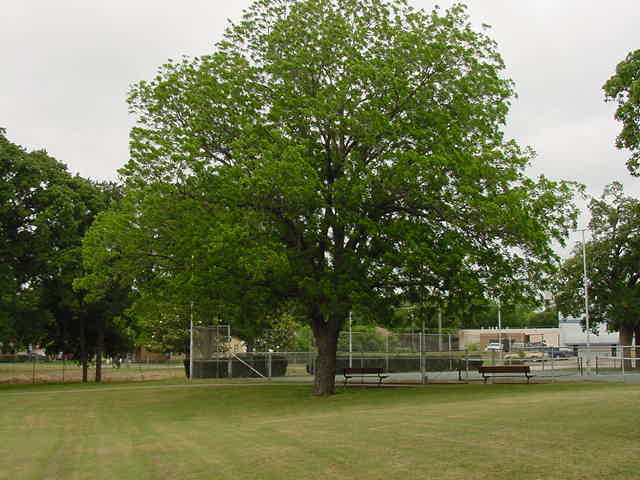
California bay also grows much larger and more irregularly than Grecian bay. With good sun exposure, it grows more than forty feet tall. Where it competes for sunlight in forests, it can grow a hundred feet tall. Domestic trees typically develop on single vertical trunks. Wild trees might develop several leaning trunks. Foliar canopies are densely evergreen.

California bay is uncommon within urban home gardens because it is so big and messy. It is more likely to inhabit rural gardens either by self sowing or by being there first. Some old trees that grew from stumps of older trees can develop basal decay. Stumps might be difficult to kill. Foliar and floral detritus inhibits smaller vegetation and seed germination. Some abhor the foliar aroma.
Western Red Cedar

Western red cedar makes nice garland.

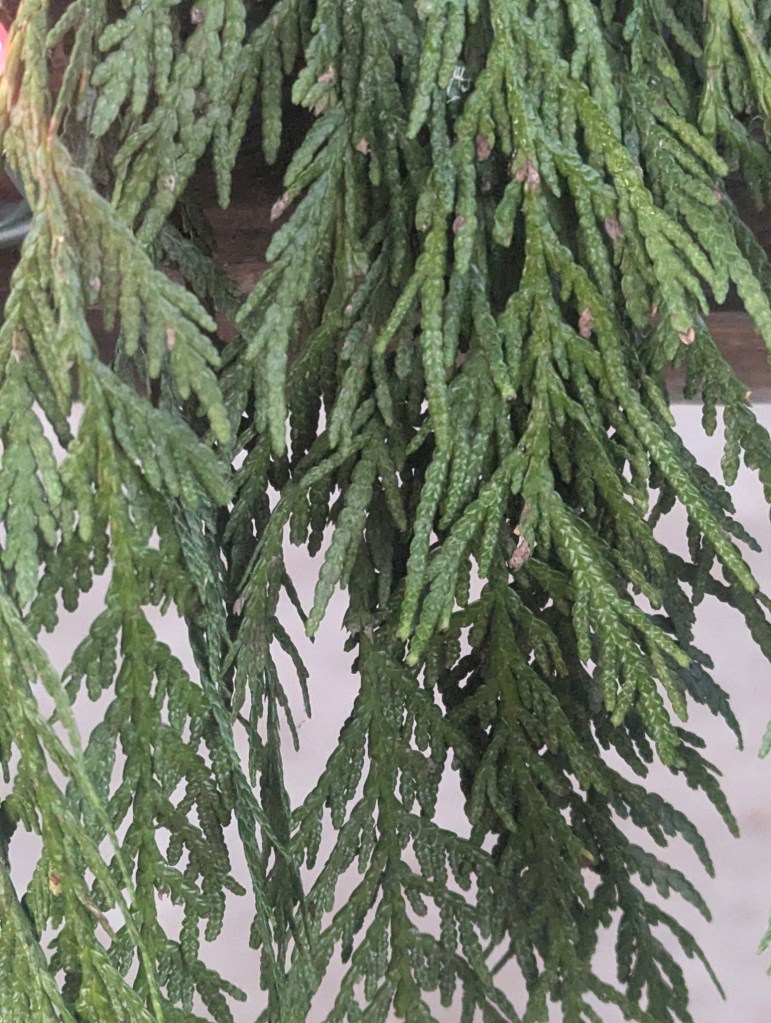
This coniferous evergreen is more appealing as seasonal foliar decor than it is practical. Western red cedar, Thuja plicata, is the most common component of Christmas garlands. Also, it is very popular for wreaths of mixed evergreens. It is the same genus as common arborvitaes. However, this particular species is notably rare among local home gardens.

Western red cedar is native to the Pacific Northwest. Its range extends south to the north coast of California, and east to western Montana. It therefore does not adapt efficiently to the arid warmth of local chaparral climates. Even with generous irrigation, its foliage can be vulnerable to desiccation. The healthiest specimens here are within coastal climates.

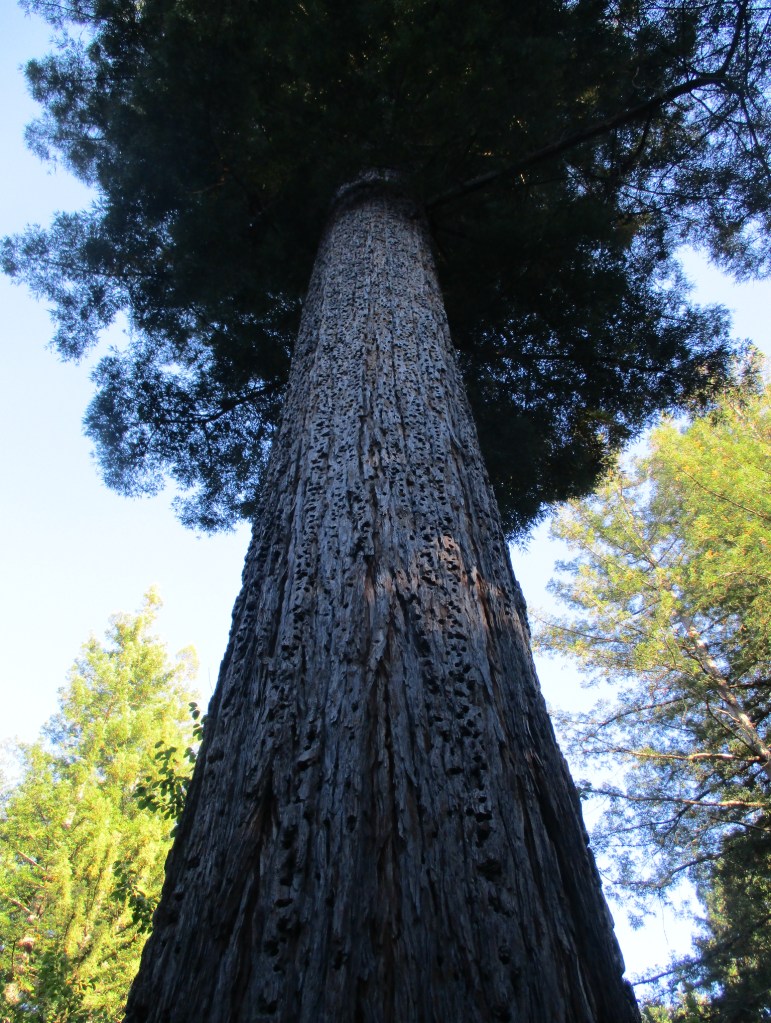
Like some other trees within its native range, western red cedar typically grows very big. It can easily reach a hundred and fifty feet tall, and can grow taller than two hundred feet. Although it does not grow as fast as redwood, it eventually needs about as much space. Western red cedar, here, is appropriate only for large landscapes within coastal climates. It is too obtrusive for compact home gardens.

Coastal Redwood

Coastal redwoods need room to grow.

Not every garden can accommodate coastal redwood, Sequoia sempervirens. Wild trees can grow hundreds of feet tall, with trunks as wide as thirty feet! None are so big in home gardens, but only because they are still young. They can live for more than two thousand years. By that time, those in urban landscapes are very likely to become major concerns.

Realistically though, urban trees are generally more compact than wild trees. There is no need for extreme height without competition from other similarly tall trees. Besides, lower trees are less vulnerable to wind. Warm and dry wind can desiccate foliage. Strong wind can dislodge branches. Limbs that fall from very high canopies are extremely hazardous.

Almost all modern coastal redwoods from nurseries are of the cultivar ‘Soquel’. They are strictly conical and symmetrical in form, with uniform foliation. ‘Aptos Blue’ exhibits more relaxed form and very slightly bluish foliage. ‘Santa Cruz’ should be more available than it is since it is more resilient to arid warmth. Old seed grow trees are genetically variable. For old formal gardens, they are less formal than younger trees.

Redwoods & Gravity

Physics are dangerous!

Sequoia sempervirens, coastal redwood is the Official State Tree of California, and the tallest species of tree in the World. One large specimen can contain more lumber than many acres of Douglas fir (really). While some trees ensnare kites, redwoods collect satellites. Redwood lumber can be delivered anywhere in western North America simply by aiming a tree in the direction of delivery while cutting it down. Redwood shadows reach Japan at dawn and New England at dusk. The moon is covered with craters because it could not dodge the growing redwoods while orbiting over California. You can see for yourself how tall redwoods are just by looking in this direction from wherever you are in the World. Unfortunately though, not all of the debris that falls from the huge canopies of redwoods burns up in the atmosphere on its way down. Such huge canopies generate a lot of debris. Almost all of it is finely textured foliar debris. Some is twiggy detritus. The worst of it are significant branches. The descent of most of such branches is slowed by lower branches and foliage that they encounter on their way down. However, the lowest branches of some canopies are very high up, and falling branches resume acceleration after falling past them. Also, some falling branches fall outside of their canopies. Even branches that weigh only a few pounds can be extremely dangerous. Many falling branches weigh many pounds, and some are as big as trees. The fallen branch in the picture above is only several feet long and about three inches wide, (and happened to fall through the only three inch wide plank in a pedestrian bridge. The replacement plank needed to be custom cut.) I am annoyed by this relatively minor damage, but also relieved that it was not worse.

Seven Weeks

July 12 & August 30

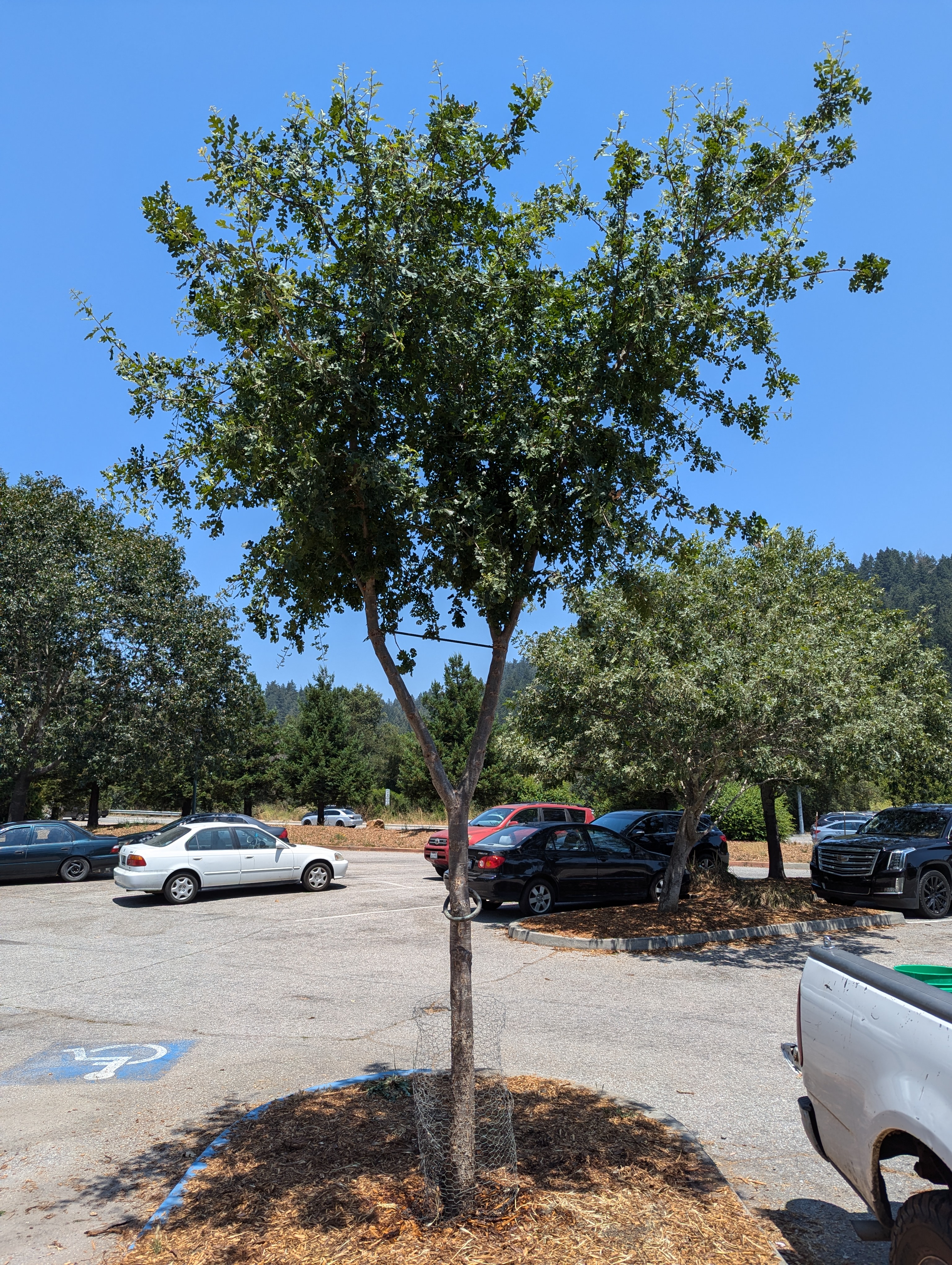
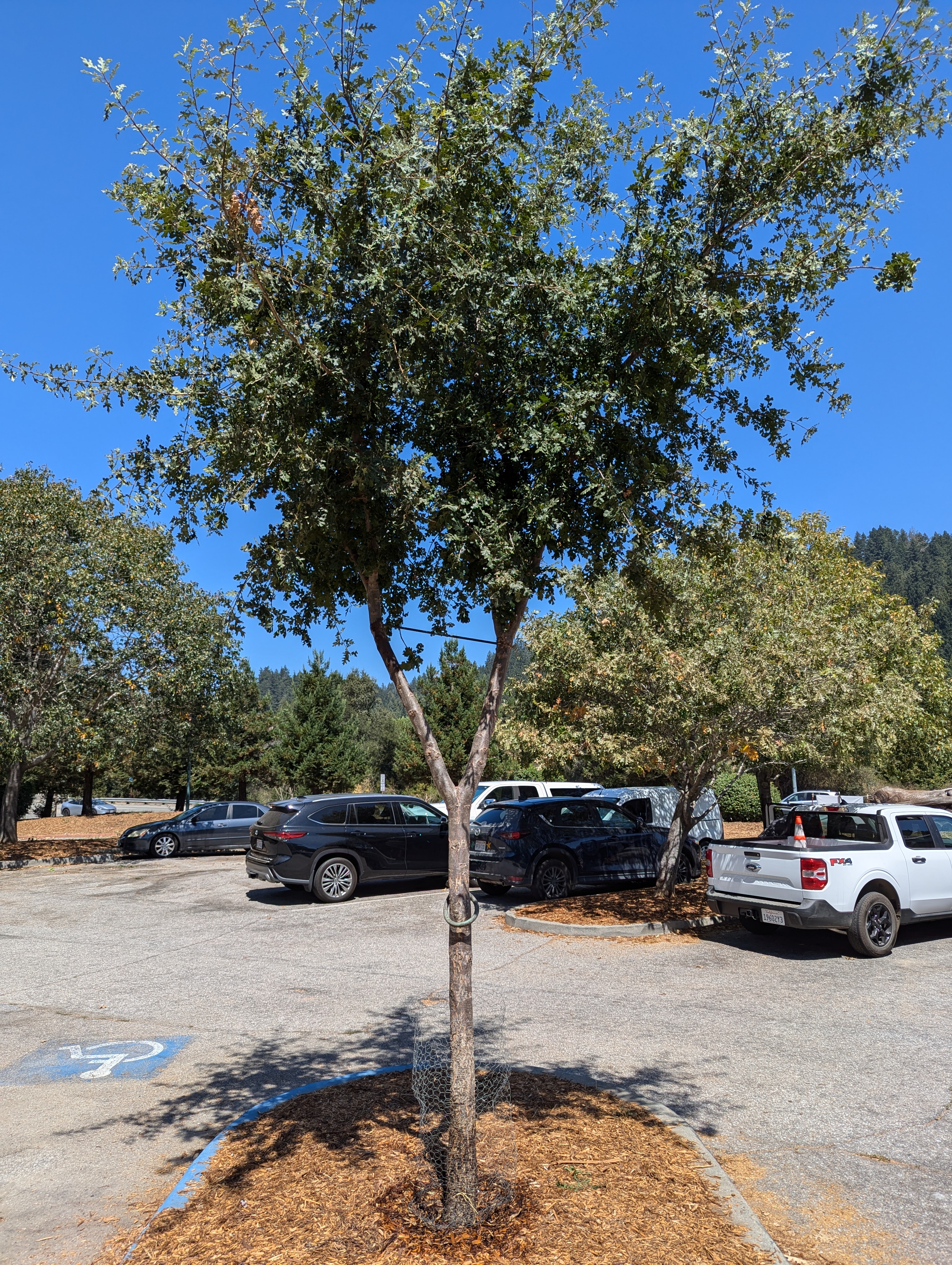
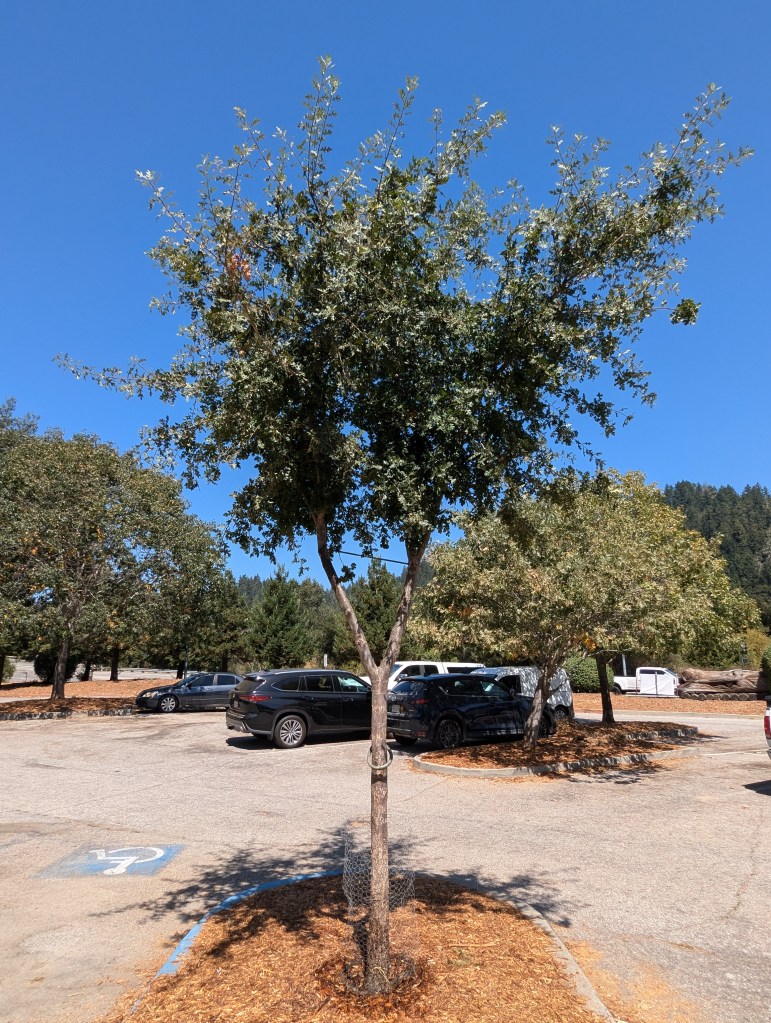
What a difference seven weeks can make! Updates regarding the Memorial Tree in Felton Covered Bridge Park are typically posted annually about the twelfth of July. Growth is obvious after a year. I did not expect it to be so obvious after less than two months between the twelfth of July and the thirtieth of August. I suppose that I should not be surprised. Even after most growth occurs through spring, some growth continues through late summer, and perhaps as late as the beginning of autumn, immediately prior to the slow initiation of dormancy for winter. Specimens of this species, valley oak, Quercus lobata, are innately vigorous and grow faster and more vertically while young. Growth decelerates and redirects itself laterally as trees mature and age. Otherwise, if they continued to grow as vigorously as they do while young, they would collapse from their own weight before they get to be as old as elderly trees get. Some live for more than six centuries, so their technique is obviously effective. Four nearby California black oaks, Quercus kelloggii, are not likely to get to be five centuries old, and are more likely to live for only one or two centuries. Unfortunately, two of them are not in comparably exemplary condition. One must be pruned for removal of major necrosis, and direction of new growth. Another requires major structure pruning. All four should be pruned for clearance above the surrounding parking lot. Perhaps I should be more concerned with these four California black oaks now that the Memorial Tree will need nothing for quite a while. Perhaps I should investigate the condition of the Monterey cypress Memorial Trees within the nearby Memorial Grove, which are growing well enough that surrounding box elders should be pruned away to relinquish more space for them.

August 30 zoomed out

Blue Gum

Blue gum easily outgrows home gardens.

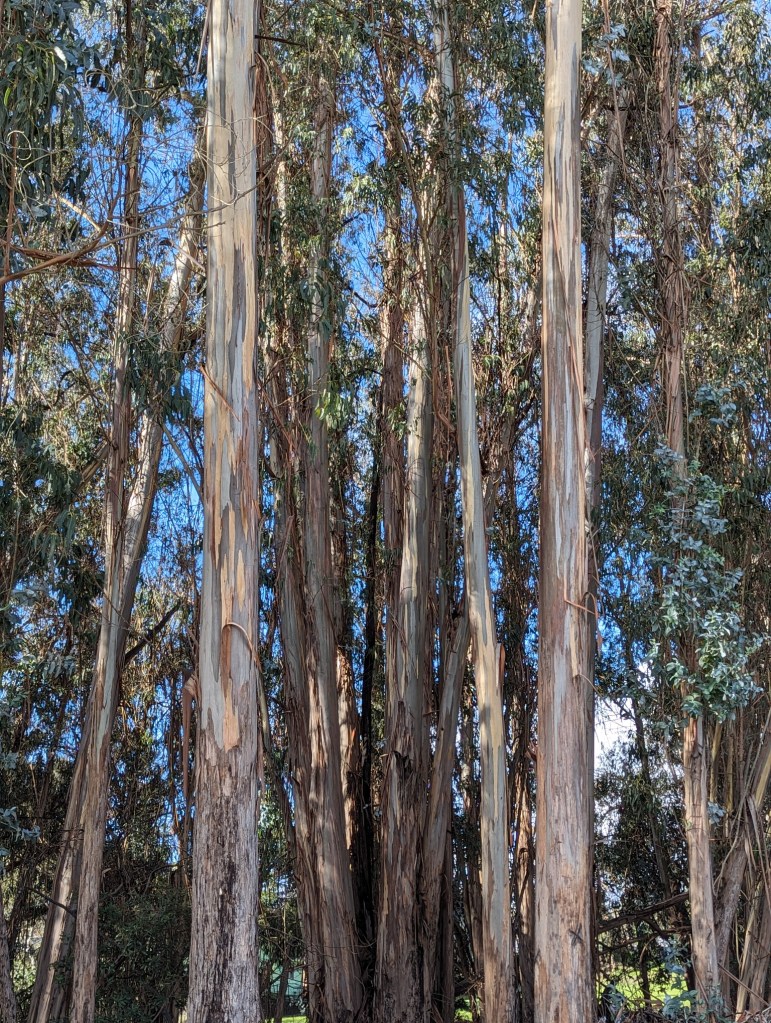
Almost no one adds blue gum, Eucalyptus globulus, to a landscape intentionally. Almost everyone who is familiar with it understands why. It is much too big and much too messy. Even where space is sufficient for it to mature, it is innately hazardous. It sheds big limbs from very high up. It often disperses its roots too shallowly to maintain adequate stability.

However, blue gum inhabits a few home gardens. Some were already there as gardens developed around them. Some grew from seed from nearby trees. Blue gum naturalizes in some regions. Mature trees are tall enough to share their shade, debris and seed with a few gardens. The copious debris inhibits weeds, but also inhibits desirable vegetation.

Blue gum in the wild is one of the tallest trees in the World. Naturalized trees commonly grow more than a hundred and fifty feet tall here. They stay shorter in windy situations. The tall and straight trunks constantly shed long strips of smooth tan bark. Fresher bark is tan, gray, greenish or even pinkish. The curved lanceolate leaves are quite aromatic. Ovoid juvenile leaves are bluish gray, and even more aromatic. Fuzzy staminate bloom is white.

California Sycamore

California sycamore develops massively gnarly trunks.

The tallest, largest and oldest trees of the World are all native to California. So are the rarest pine, rarest fir and largest oak. California sycamore, Platanus racemosa, is loyal to this tradition of distinction. Although not the tallest sycamore, it might be the grandest. It develops gnarly and sculpturally irregular form. Some develop multiple massive trunks.

Because of its scale, California sycamore is uncommonly available from nurseries. It is simply not proportionate to home gardens or even big landscapes. Most old specimens are older than the landscapes around them. They are somewhat adaptable to landscape irrigation. However, increased moisture increases potential for spontaneous limb failure.

California sycamore can grow a hundred feet tall with bulky trunks and limbs. Old trees may exhibit scars from shedding limbs throughout their long lifespans. The mottled bark is gray and tan, and roughens only slowly with age. The deciduous foliage of such large trees is very copious through a long defoliation. Foliar tomentum (fuzz) is quite irritating.

Canary Island Date Palm

Canary Island date palm is the boldest of the common palms here.

The biggest and boldest of the common palms is the Canary Island date palm, Phoenix canariensis, which can get more than sixty feet tall and nearly forty feet wide, with a full canopy of gracefully arching deep green fronds. A young tree actually spends the first many years as a shrubby plant while the base of the trunk develops. Fronds get longer and spread broader every year until the trunk gets big enough to elongate. Vertical growth then accelerates somewhat, but the canopy gets no broader.

Most trees are female, eventually producing ornately orange but messy clusters of inedible dates. Male trees eventually get a bit taller, but are not quite as graceful and bloom with unimpressive dusty tan flowers.

Old deteriorating fronds need to be pruned away close to the trunk. Petiole bases of the most recently removed fronds are often carved into ‘pineapples’ to leave a bit of support directly below the canopy. Removed fronds leave a distinctive pattern on the trunk.

Pecan

It is ‘PEEkan, not ‘piKAHN’!

Texas selected a distinctive state tree; the pecan, Carya illinoensis. It is happy in the south and middle mid-west, where naturally grows about seventy feet tall. It can get almost as large here, so is best in big spaces. Summers are a bit too mild for reliable nut production in autumn, but single trees can sometimes make plenty. Two different trees (to pollinate each other) can actually be quite productive, although not quite as well flavored as in warmer climates. The pinnately compound leaves have about eleven individual leaflets that are about five or six inches long. Shade is not too dark.

Redgum Eucalyptus

Red gum eucalyptus is notably drought tolerant. Apparently, it can also temporarily tolerate saturation.

Although not quite as aggressive, sloppy, big or structurally deficient as the notorious blue-gum eucalyptus, the red-gum eucalyptus, Eucalyptus camadulensis, is one of the ‘other’ eucalyptus that give eucalyptus a bad reputation. It is realistically too big and messy for refined urban gardens, and can be combustible if overgrown or too abundant. It is consequently probably not available in nurseries, despite being one of the most common species of eucalyptus (second only to blue-gum) in California. Red-gum eucalyptus has the advantage of being one of the most resilient large scale trees for unrefined or semi-wild landscapes, and works well where it has space to grow in many of the local county parks.