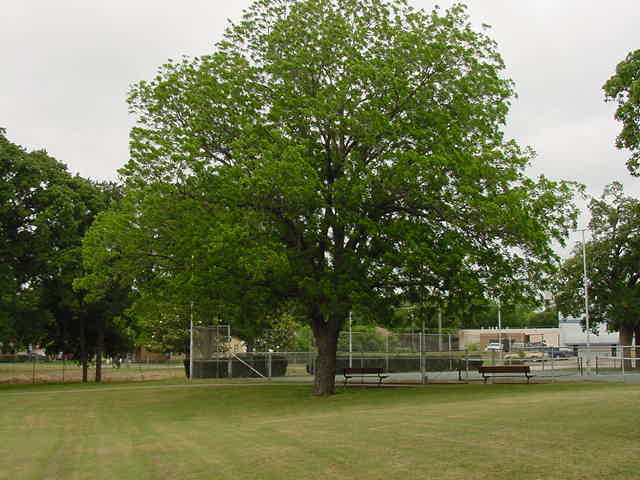
Texas selected a distinctive state tree; the pecan, Carya illinoensis. It is happy in the south and middle mid-west, where naturally grows about seventy feet tall. It can get almost as large here, so is best in big spaces. Summers are a bit too mild for reliable nut production in autumn, but single trees can sometimes make plenty. Two different trees (to pollinate each other) can actually be quite productive, although not quite as well flavored as in warmer climates. The pinnately compound leaves have about eleven individual leaflets that are about five or six inches long. Shade is not too dark.
Red gum eucalyptus is notably drought tolerant. Apparently, it can also temporarily tolerate saturation.
Although not quite as aggressive, sloppy, big or structurally deficient as the notorious blue-gum eucalyptus, the red-gum eucalyptus, Eucalyptus camadulensis, is one of the ‘other’ eucalyptus that give eucalyptus a bad reputation. It is realistically too big and messy for refined urban gardens, and can be combustible if overgrown or too abundant. It is consequently probably not available in nurseries, despite being one of the most common species of eucalyptus (second only to blue-gum) in California. Red-gum eucalyptus has the advantage of being one of the most resilient large scale trees for unrefined or semi-wild landscapes, and works well where it has space to grow in many of the local county parks.
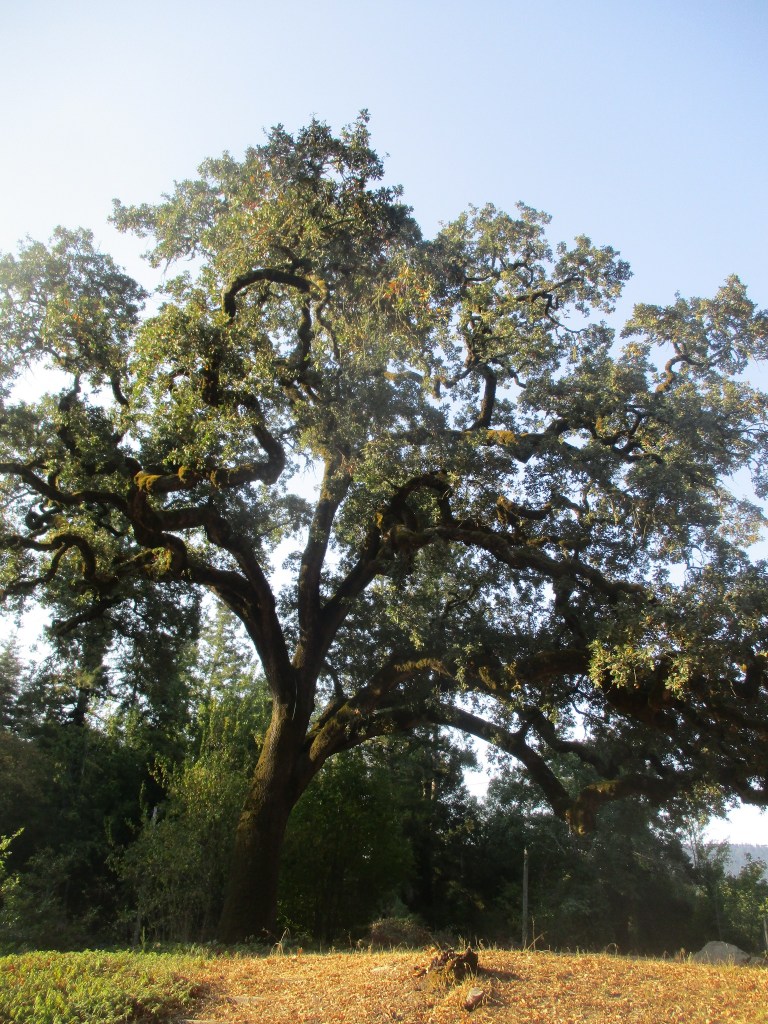
Valley oak and coast live oak are the two most magnificent oaks of California. Valley oak likely receives more notoriety. It stands taller, and defoliates to expose its sculptural form through winter. Coast live oak, Quercus agrifolia, is almost as grand within its evergreen foliage. It can grow as tall and broad as seventy-five feet, with trunks wider than ten feet.
Coast live oak is notably variable in the wild. Exposed and solitary trees can grow bigger and older than grove trees. They can live for many centuries, and hang their canopies to the ground. Grove trees may not live half as long, and tend to shed shaded lower growth. Solitary trees are likely to survive fire. Grove trees within forests are less likely to survive.
Coast live oak is more appealing in the wild than within home gardens. Regularly messy debris is mildly herbicidal to some delicate plants below. It also stains hardscapes. Trees that matured without irrigation are very susceptible to rot with new irrigation. Landscapes around such trees must therefore demand very little. Roots are very sensitive to damage.
Amy Carter had the most boss treehouse in an Atlas cedar.
My generation can remember when Amy Carter, the daughter of former President Carter, got a treehouse built in a mature Atlas cedar, Cedrus atlantica, at the White House. It was so cool that it was ‘boss’! Besides being more luxurious than a typical treehouse, it was designed by President Carter to not damage the tree even slightly.
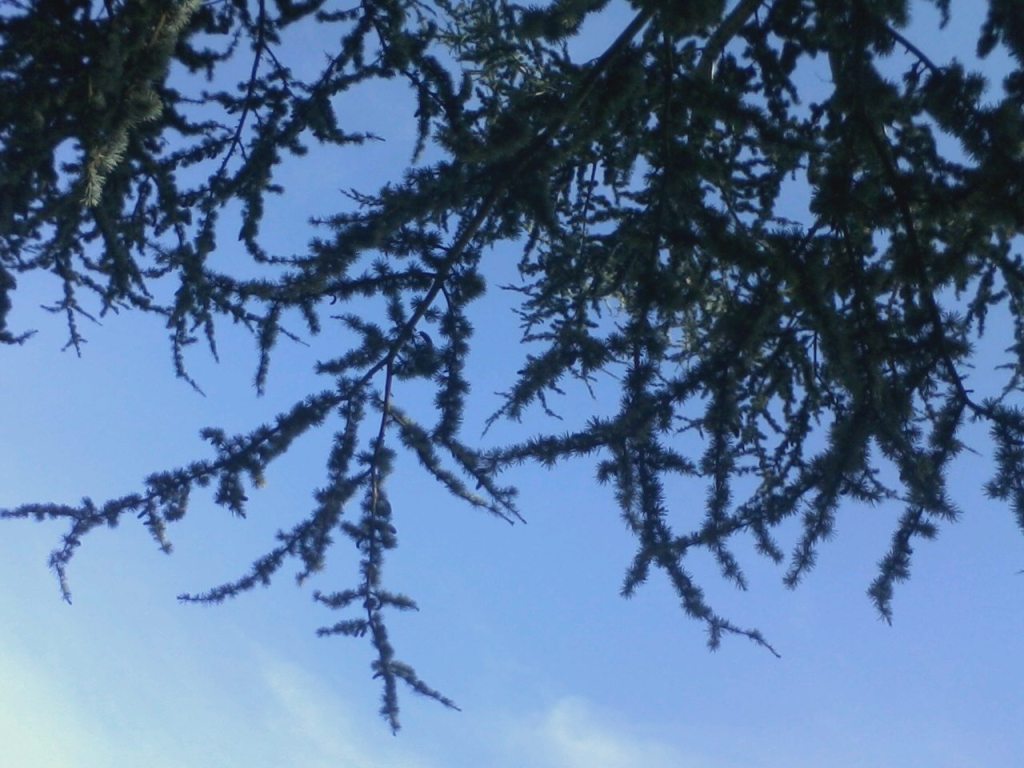
Here in the west, most Atlas cedars are cultivars (cultivated varieties) with blue foliage that often rivals that of Colorado blue spruce. Most have strictly horizontal or angular limbs with stiff, densely foliated branches. Some are so pendulous (weeping) that they need to be staked to be kept off the ground. They actually look great trained along the tops of retaining walls, even without staking, with their blue foliage cascading over. Others are strictly upright and narrow. Colorado blue spruce may have better color; but Atlas cedar has more interesting variation of form.
It is also better adapted to the local Mediterranean climate than spruces and other conifers are, and gets much larger. Mature Atlas cedars can get as tall as a hundred feet, with trunks as wide as five feet.
The most common of a few species of cottonwood that are native to California seems as if it should not be. Populus deltoides is the Eastern cottonwood. This name implies that it should be native primarily to regions of the East. Yet, it naturally inhabits every American State except for Hawaii and Alaska. Since it is so familiar locally, it is simply cottonwood.
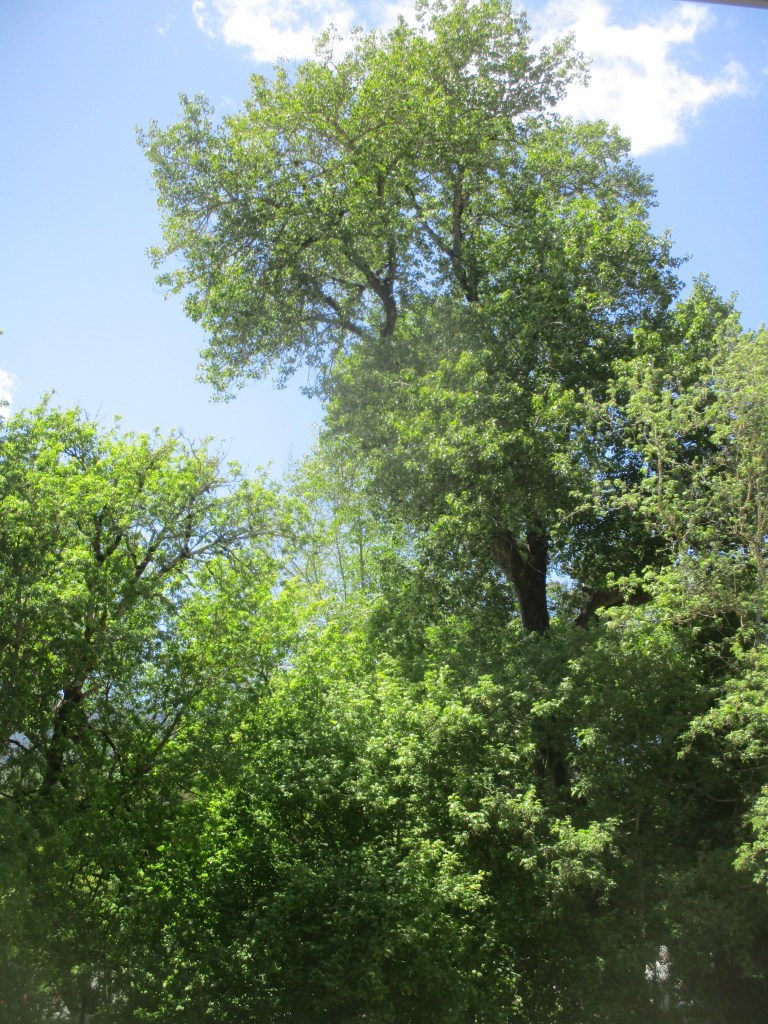
It grows wild in riparian ecosystems, and occasionally sneaks into adjacent landscapes. It is almost never an intentional acquisition. Cottonwood grows too aggressively and too large for refined home gardens. It works better as a grand shade tree for parks and urban waterway trails. As a riparian species, it requires either riparian ecosystems or irrigation.
Mature cottonwood trees may be almost a hundred feet tall, and rather broad if exposed. Their bark is handsomely furrowed. Yellow autumn color of the deciduous foliage can be surprisingly vibrant within arid climates, or if rain is later than frost. Vigorous trees can be susceptible to spontaneous limb failure, so may occasionally justify aggressive pruning. Roots might be voracious.
From the north end of the Sacramento Valley to the San Fernando Valley, the valley oak, Quercus lobata, is among the most familiar and distinctive of native oaks. It is the largest oak of North America, reaching more than a hundred feet tall with trunks as wide as ten feet, which is why it is rare in urban gardens. The hundred fifty foot tall ‘Henley Oak’ of Covelo is the tallest hardwood tree in North America. The oldest trees are about six centuries old.
The two or three inch long leaves have deep and round lobes. The foliage turns only dingy yellow and then brown in autumn, and can be messy as it continues to fall through early winter, particularly since the trees have such big canopies. The gnarly limbs are strikingly sculptural while bare through the rest of winter. The gray bark is evenly furrowed.
Incidentally, Oakland, Thousand Oaks, Paso Robles and various other communities within their range are named for valley oaks. (‘Roble’ is the Spanish name.)
From the northern end of the Sacramento Valley to Santa Catalina Island, valley oak, Quercus lobata, is as Californian as Valley Girl. It inhabits mixed riparian forests and low hillsides up to about 2,000 feet, but prefers alluvial valley meadows in between. Although unpopular for landscaping, it sometimes self sows into home gardens. New landscapes sometimes develop around old trees.
Valley oak is one of the biggest of oaks, and the tallest oak of North America. Mature trees can be more than a hundred feet tall, and several centuries old. Trunks may be more than ten feet wide. Such big trees make big messes of acorns and deciduous foliage, which shed for weeks. Unfortunately, old valley oaks within new landscapes are susceptible to spontaneous limb failure and rot.
Where space is sufficient, new valley oaks are for future generations. They develop their distinctively sculptural branch structure slowly through several decades. If irrigation is not excessive, roots are remarkably complaisant. The evenly furrowed gray bark is rustically distinguished. The elegantly lobed leaves are about three inches long and half as wide. Yellowish autumn color is subdued.
The best camphor trees, Cinnamomum camphora, are in parks and other spacious landscapes. Such trees have sufficient room for their broad canopies. Although they do not grow rapidly, they eventually get quite large, and perhaps too massive for confined urban gardens. Some of the older local trees are nearly fifty feet tall, and nearly as broad. They have potential to get much bigger.
Camphor trees excel as shade trees. Their light green or perhaps yellowish evergreen foliage is quite dense. Shade of groups of trees or large trees with low canopies inhibits the growth of lawn grass. Also, roots are likely to eventually elevate lawn or other features that are close to the trunks. Foliar canopies are billowy, but can be lopsided, especially in windy or partly shaded situations.
Trunks and main limbs of camphor trees are rather stout, and can be rather sculptural. Trees should be pruned for clearance while young. Otherwise, obtrusively low limbs can become prominent components of the canopies. The tan bark is distinctively checkered. It darkens handsomely with rain. All parts of camphor tree are quite aromatic. Frass from spring bloom can be slightly messy.
California sycamore, Platanus racemosa, is a riparian species that wants to be a chaparral species. It seems to passively mingle with valley oaks and coast live oaks in chaparral regions. Yet, it stays close to rivers, creeks, arroyos, or low spots where water drains from winter rain. California sycamore does not follow waterways far up into forests though, as if it dislikes the deeper shade.
In urban situations, California sycamore is best for large scale landscapes, such as parks or medians of broad boulevards. It is complaisant enough for smaller landscapes, and tends to disperse roots too deeply to damage pavement. However, it grows so fast and so very big. Mature trees get to a hundred feet tall. Massive trunks are picturesquely irregular, with mottled tan and gray bark.
All the deciduous foliage generated by such large trees is generous with shade for summer, but stingy with color for autumn. Defoliation starts early and continues late, so is messy for a long time. Foliar tomentum (fuzz) is irritating to the skin, and much worse if inhaled. Anthracnose often deprives trees of their first phase of foliage in early spring. Although harmless, it makes another mess.
Out in rural chaparral regions, where water is scarce, the big and bold California sycamore, Platanus racemosa, somehow seems to find the spots where groundwater is not too far below the surface of the soil. It is technically a riparian tree, that is just as comfortable competing with cottonwoods and willows along forested rivers and floodplains. It eventually get too big and messy for refined urban gardens, but is somewhat popular nonetheless.
The bulky trunks and limbs are just too striking to ignore, especially as trees defoliate to expose the mottled beige and gray bark. Trunks are typically leaning and irregularly sculptural. Many trees have multiple trunks. The biggest trees are a hundred feet tall. The big palmately lobed leaves can be eight inches wide, but unfortunately do not color well in autumn. The foliar tomentum (fuzz) can be irritating to the skin when leaves need to be raked. Athracnose causes much of the early spring foliage to fall, and sometimes distorts and discolors later summer foliage.



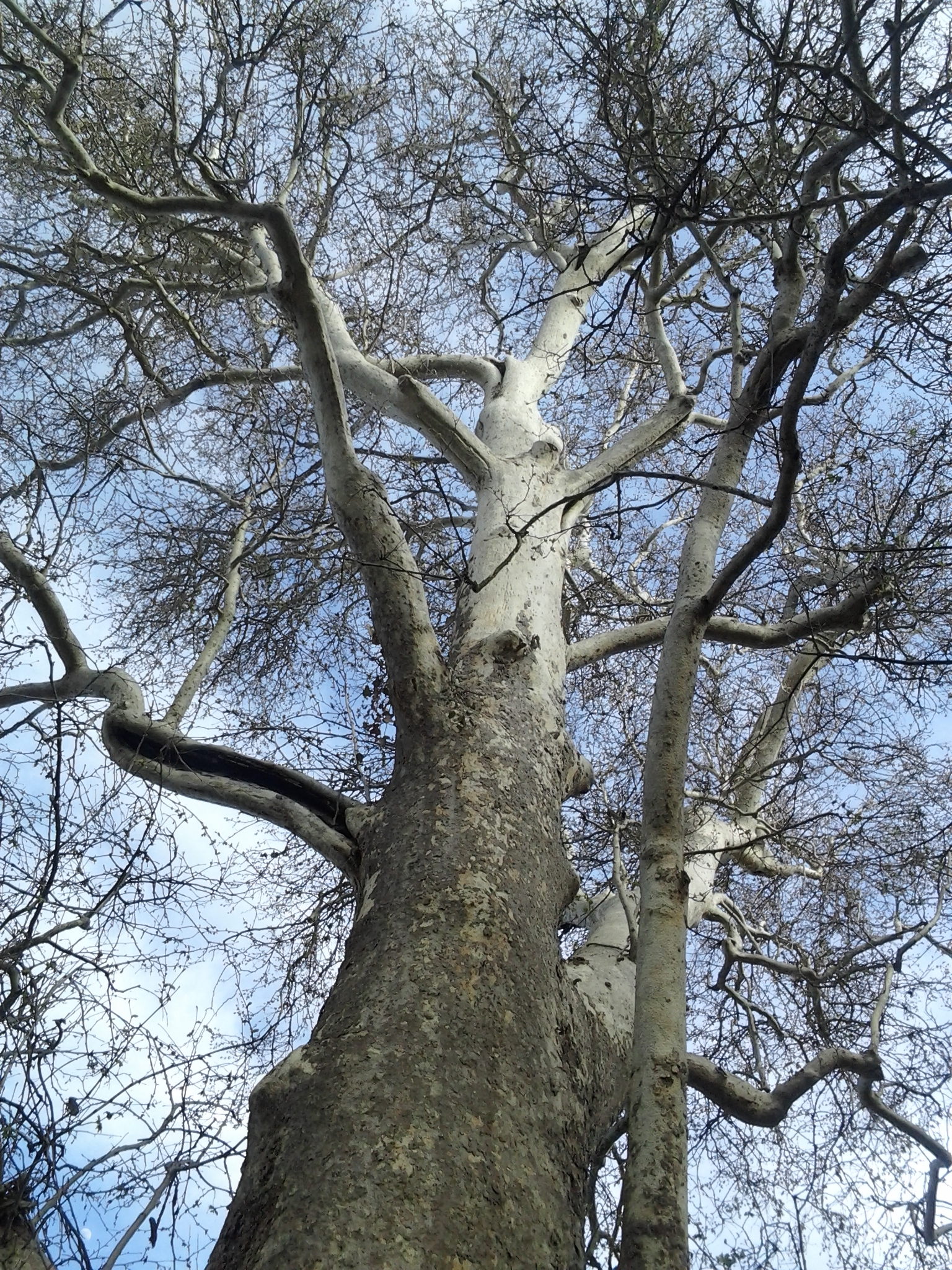
 Out in rural chaparral regions, where water is scarce, the big and bold California sycamore, Platanus racemosa, somehow seems to find the spots where groundwater is not too far below the surface of the soil. It is technically a riparian tree, that is just as comfortable competing with cottonwoods and willows along forested rivers and floodplains. It eventually get too big and messy for refined urban gardens, but is somewhat popular nonetheless.
 Tony Tomeo