Six on Saturday: Coming & Going

Although the weather is predicted to be more typical, it was prematurely autumnish last week. It is a reminder that it really is time for Autumny and wintry flowers to come into season while summery flowers go out of season. This “Six on Saturday” is about some of such coming and going. (To comply with guideline #7 of the participant guide for Six on Saturday, I am limiting verbiage.)

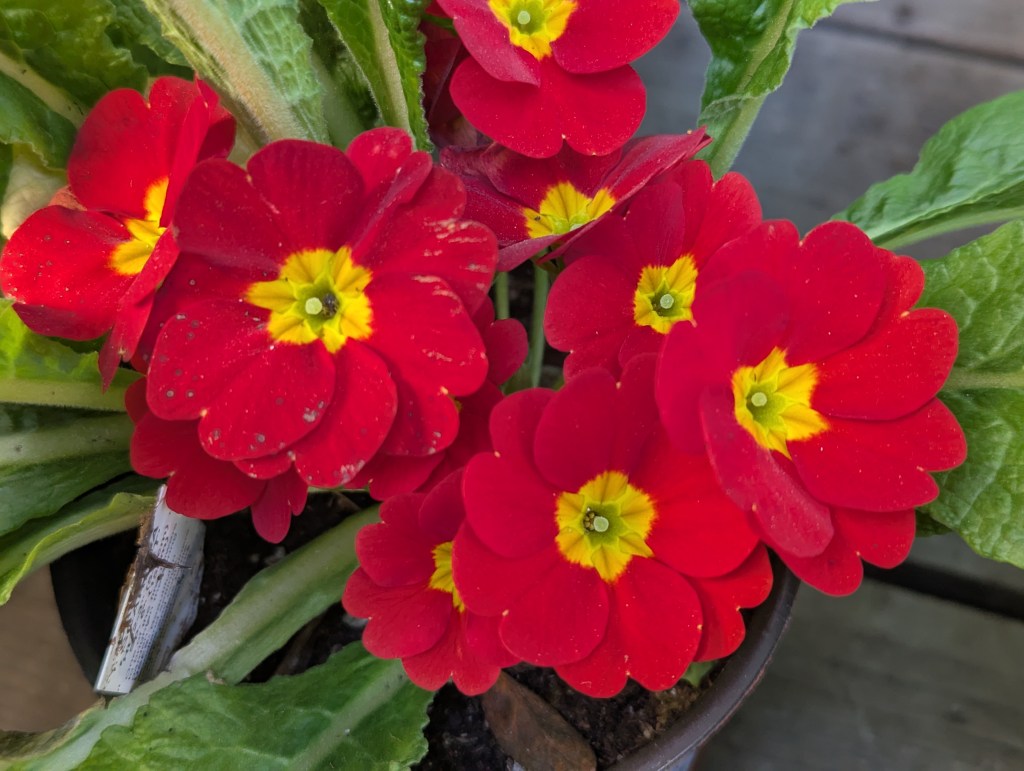
1. Viola wittrockiana, pansy is traditional for winter floral color. It replaces petunia, and should last until petunia becomes seasonable again next spring. It is coming into season.

2. Petunia X hybrida, petunia is traditional for summer floral color. It replaced pansy as pansy finished its season last spring. It is going out of season now. Do you see a pattern?

3. Tagetes patula, marigold is traditional for autumn floral color. It was just installed as a narrow border for a small rose garden. For there, it is one of the more reliable annuals.

4. Pelargonium peltatum, ivy geranium, in eight or so baskets, hung from the eaves of a prominent building at work, but never flourished. They will be recycled somewhere else.

5. Dianthus caryophyllus, carnation does not do much through summer, but now begins to bloom as nights become cooler. I forget that it is here. I also forget how delightful it is.

6. Canna, canna blooms a bit less enthusiastically as the weather begins to cool, but can technically bloom until it gets frosted. If it does not get frosted, it can bloom continually.

This is the link for Six on Saturday, for anyone else who would like to participate: https://thepropagatorblog.wordpress.com/2017/09/18/six-on-saturday-a-participant-guide/
Six on Saturday: A Few More Surprises

The unseasonably relocated roses that I had been so concerned about for the past month or so continue to surprise with more growth and bloom. So do a few other species. These first three happen to be from Tangly Cottage Gardening. The following two happen to be white. The last happens to not be of horticultural orientation.

1. Canna ‘Stuttgart’, along with a few other fancy potted Canna, unfortunately needed to be relocated from the deck that they inhabited at work. However, it seems to be happier after relocation, and makes larger and more ornate leaves, which is what it is grown for.

2. Persicaria amplexicaulis ‘Firetail’ bloomed lightly but on time for early summer, and then bloomed again before the original bloom faded completely. The secondary bloom is only now fading, with a backdrop of duckweed and watercress. (This is an older picture.)

3. Hesperantha coccinea, crimson river lily was not expected to bloom because it was so dinky when it arrived late last winter. I thought that its bulbs would need to mature for a year or so before they would be mature enough to bloom. Apparently, it wastes no time.

4. Albizia julibrissin, silk tree blooms white instead of pink, although, because it blooms on top of its high canopy, not much of it is visible from the ground. It finished blooming already, but some minor pruning recently revealed a few of these aberrant white flowers.

5. Rosa spp., rose is another of the few roses that were not expected to bloom after their unseasonable relocation. It seems to be a climbing type, with long and limber stems, and trusses of small flowers. I am impressed that it not only survived, but is growing so well.

6. Heather fails to be as impressed by these developments that I find to be so surprising.

This is the link for Six on Saturday, for anyone else who would like to participate: https://thepropagatorblog.wordpress.com/2017/09/18/six-on-saturday-a-participant-guide/
Alaska

Just about everything in my garden has history in someone else’s garden. Almost nothing came from a nursery. I like to say that purchases are against the rules. However, I did purchase ‘Alaska’ Canna from Horn Canna Farm because I want to grow a white canna. I am over the shame already, and am very fond of this first white canna that I have seen since I was very young. As you can see, it is not very white, and is more of a creamy white or vanilla white. Actually, it is very pale yellow. It is presently growing as a houseplant in one of the buildings at work, which might have enhanced the pale yellow color of its bloom. I believe that it would have been whiter out in the weather. It is already growing quite nicely, so will need to move out into a landscape with all the other Canna for next year. I doubt that it will be as popular as the other brightly colored Canna, but a few who see it in bloom might recognize how rare creamy white Canna are now. I think that ‘Alaska’ would contrast splendidly with the dark bronze foliage of ‘Australia’.

White Flowers Attract Pollinators Also

Phlox happens to excel at white.

Floral color attracts pollinators. Hummingbirds mostly prefer bright red, pink and orange. Butterflies mostly prefer bright orange and yellow. Bees prefer bright blue and purple, but are less discriminating than other pollinators. Of course, these are mere generalizations. Otherwise, the majority of pollinators might ignore species that bloom with white flowers.

Realistically, most flowers do not rely on pollinators for pollination. They rely exclusively on wind, so are just green or brown, and not visually prominent. These include flowers of grasses and conifers. Otherwise, small but prominently prolific white flowers are the next best option. They rely on either or both wind and pollinators for very effective pollination.

For example, firethorn bloom is very appealing to bees and other pollinators. It is also so prolific that some of its pollen disperses into the wind. Its tiny but abundant white flowers can not avoid pollination by one means or the other. Most orchard trees, such as apricot, plum, apple and pear, use the same technique. So do viburnum, photinia and elderberry.

This should not imply that white is a substandard color, though. After all, white flowers do attract pollinators. Several pollinators, such as nocturnal moths, prefer luminescent white flowers. More importantly, many pollinators see more than white. Several types of Insects see ultraviolet. What seems to be white to us can actually be elaborately colorful to them.

Furthermore, white needs no justification. It happens to be the best color option for some garden applications. It brightens visually dark situations, and mingles well with almost all other colors. A few types of flowers, particularly those with distinctive form, excel at white. Calla, camellia, lily of the valley and various lilies are only a few of numerous examples.

Cool season annuals for autumn and winter will soon replace old warm season annuals. White busy Lizzie, petunia, cosmos, alyssum, snapdragon and zinnia are finishing soon. White pansy, viola, dianthus and wax begonia may replace them. Later in autumn, white cyclamen will become seasonal. There are always enough white flowers to choose from.

Six on Saturday: Major, Minor & Unidentified

Two of my six for this week were purchased, which is rare in my garden. Two were gifts. Two were acquired by other questionable means.

1. Sorbus americana, American mountain ash does not conform to my theme. It is about average and identifiable. I merely wanted to show it off because it is the only seedling to grow from several seed. It can be reasonably productive without another pollinator tree.

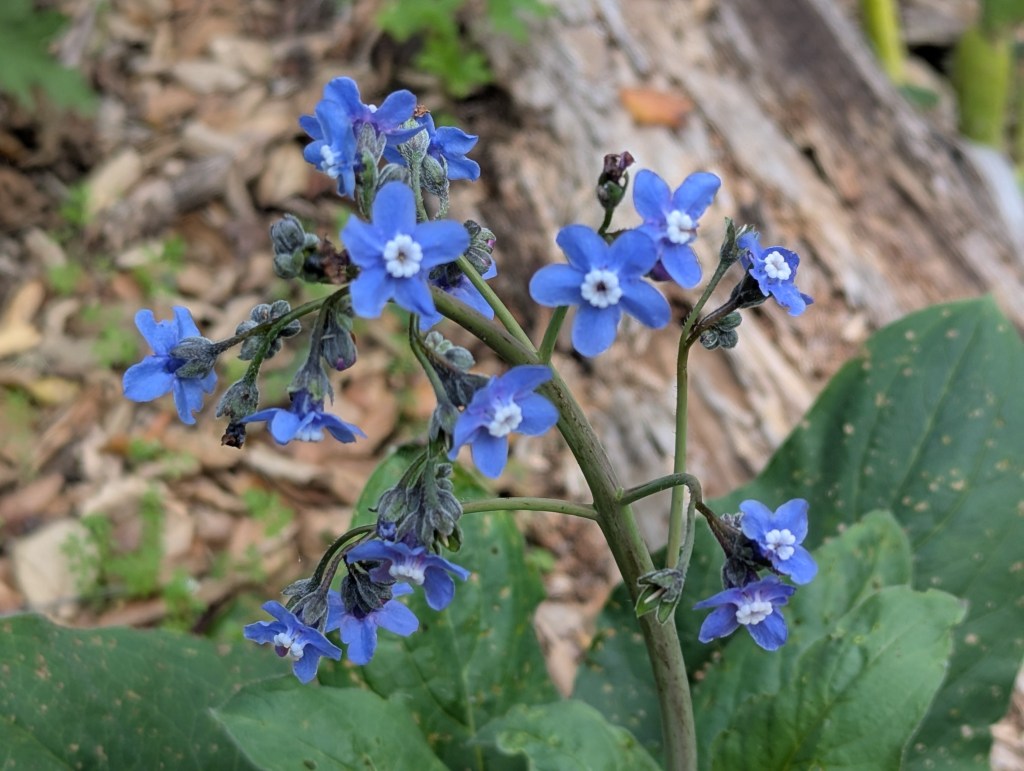
2. Cerinthe major, honeywort grew from seed from Tangly Cottage Gardening. This is its first bloom here. Because I did not sow all the seed this year, I could sow more next year. If it self sows here, it will likely only do so within gardens which are generously irrigated.

3. Vinca minor ‘Alba Variegata’, small white variegated periwinkle was another gift from Tangly Cottage Gardening. Although white is my favorite color, these little white flowers do not look very impressive against the background of their yellowish variegated foliage.

4. Pelargonium graveolens, scented geranium, like two other scented geraniums here, is unidentified. I think that the other two are lemon and rose scented geraniums. This one has a less distinct or identifiable foliar aroma, but has prettier and more colorful bloom.

5. Dahlia is also unidentified. I know what it is not, though. It is most definitely not any type of assorted dinnerplate dahlia, which I purchased it as. Although pretty, its flowers are only about three inches wide. Foliage stands about as tall as that of a bedding dahlia.

6. Canna is the third unidentified subject of these six; but it is one of the most important of the many Canna here. It is a souvenir from the funeral of an old friend two years ago. It did not bloom last year, so this is the first time that I confirmed that it blooms yellow.

This is the link for Six on Saturday, for anyone else who would like to participate: https://thepropagatorblog.wordpress.com/2017/09/18/six-on-saturday-a-participant-guide/
Late Summer Flowers Bloom Now

Pot marigold is an autumn annual.

Spring is the season with the most flowers. Winter is generally the season with the least. That is, of course, a generalization. There are plenty of flowers that bloom exclusively for winter color. Plenty more bloom randomly throughout the year, regardless of season. For now, late summer flowers are the most prominently colorful. Autumn flowers will be next.

Realistically, no bloom is random. Even flowers that bloom randomly throughout the year do so only because they can. Such flowers are mostly from mild climates where they can disperse seed at any time. Any pollinators that they rely on are also active throughout the year. Many randomly blooming flowers can effectively conform to more distinct seasons.

Most flowers bloom within a distinct season because it is most convenient for them. Most bloom for spring to maximize the time for their seed to develop before winter. Many of the earliest are tiny but abundant because they rely on wind for pollination. Later flowers can be bigger and more colorful to attract pollinators. Late summer flowers are no exception.

Different flowers have different priorities. Some of the earliest spring bloom needs time to produce seed after bloom. Several late summer flowers conversely need time to develop their blooms. Then, they produce seed relatively quickly before winter. This is why some late summer flowers are bolder but less abundant than spring flowers. They require time.

For example, sunflowers with relatively small blooms may bloom as early as late spring. However, those with bigger and bolder blooms are more familiar as late summer flowers. Such big blooms do not grow quickly, but are ready for their late pollinators nonetheless. They compensate for their lack of abundance with spectacularly grand individual bloom.

Many late summer flowers happen to be related to sunflowers. They include coneflower, dahlia, zinnia, sneezeweed, aster, and cosmos. Dahlias with larger flowers are later than those with smaller flowers. Marigold and chrysanthemum will become more seasonable later and into autumn. Unrelated canna and various sages are blooming well about now.