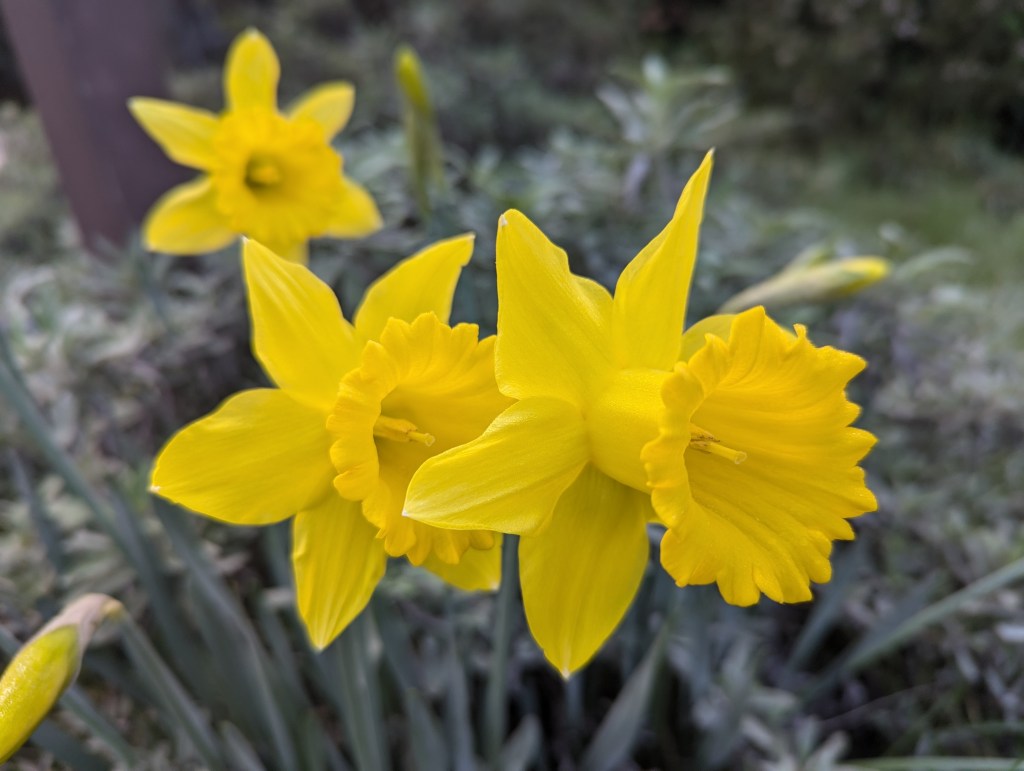
Sunday Best – ‘King Alfred’ Daffodil

Spring bulbs prefer an earlier start, and several appreciate a bit of winter chill. Summery bulbs, or summer bulbs or late bulbs, prefer a later start to avoid such chill. Most tolerate minor frost, but none benefit from it. If too early, some can start to decay while waiting for warmer weather. Some can grow prematurely, and perhaps incur damage from late frost.
Summery bulbs are in season now because they take a bit of time to grow. The potential for frost should be minimal as their foliage emerges above their soil. Once established in their first seasons, many could stay in their gardens indefinitely. They should be resilient to minor frost by their second seasons. Most that incur damage should recover efficiently.
However, many summery bulbs are not reliably perennial. Cannas and gingers can grow aggressively enough to become invasive. Gladiolus, though, may bloom half as much for subsequent seasons until none remain. Some who like to grow dahlias prefer to dig and store the tubers through winter. This is more likely to protect them from rot than from frost.
Incidentally, few summery bulbs are actually bulbs. Most are perennial rhizomes, corms, tubers or tuberous roots. Some, especially those that grow from tubers or tuberous roots, bloom longer. Those that grow from bulbs, corms and rhizomes mostly bloom only once. Succession planting prolongs their first bloom seasons, but they synchronize afterwards.
After their summer bloom seasons, most summery bulbs defoliate for a winter dormancy. This is actually why they are in season now. After all, winter dormancy is the best time for transplanting, division and thinning. Cannas and gingers could try to retain some foliage through winter. Cutting it all back might be easier than grooming it from new foliage later.
Dahlias might be the most popular of summery bulbs. Cannas and gingers are likely the second most common. Alliums and old fashioned tuberous begonias are becoming more popular. Tuberous begonias are not so easy to grow, though. Crocosmias are too easy to grow, and are invasive. Alocasias and colocasias provide colorful and boldly big leaves.

If their bulbs were planted when they became available as summer evolved into autumn, Tazetta Narcissus and their hybrids should begin to bloom about now, a bit prior to related daffodil and jonquil Narcissus. In cooler winter climates, bloom must wait until early spring. The most popular variety, ‘Paper White’ blooms with about five or six small clear white flowers clustered on top of foot tall stems surrounded by vertical and somewhat rubbery, narrow leaves. Other varieties have white or yellow outer petals, known as the ‘perianth’, or orange or white centers, known as the ‘cup’. All are good cut flowers that are quite fragrant.
Because it is best to leave narcissus foliage to yellow and abscise (shed) naturally after bloom and as weather gets warmer, ground covers that are deep enough to conceal their deteriorating foliage are practical companions. (For example, deteriorating narcissus foliage can be stuffed under healthy English ivy, where it can be hidden without being removed.) Ground cover also keeps the soil from being bare during summer and autumn dormancy.
Mature clumps of narcissus bulbs only need to be dug and divided if they become so crowded that they do not bloom as much as they should. They are easiest to dig immediately after foliage dies back and lies on the ground, when they are dormant but still easy to find. Dug bulbs should then be stored in a cool dry place until it is time to plant them late in summer. Bulbs should be planted about five inches deep and about five to eight inches apart, with good sun exposure. The largest bulbs with multiple buds (known as ‘noses’) bloom most abundantly.
If they are happy in their location, narcissus easily naturalize, even if they do not get divided occasionally. They get most of the water they need from rain, since they are mostly dormant before dry weather in summer. Gophers and deer do not bother them.
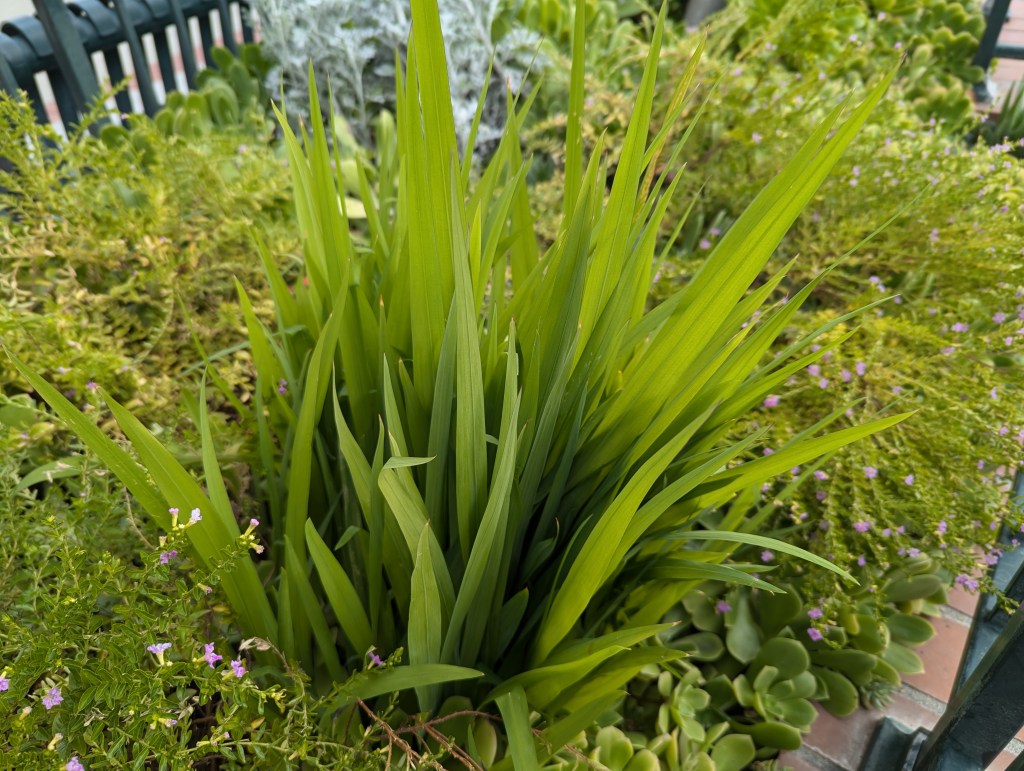
Many exotic species that became aggressively naturalized here escaped from home gardens and landscapes before anyone who enjoyed growing them was aware of how invasive they could be. Although I am aware of this, I was not particularly concerned with it while I lived within a suburban area in town through the 1990s. If I chose to grow something there that had potential to be invasive, it had no place to escape to. I mean that, from my suburban home garden, it could not migrate into a natural ecosystem to naturalize into it. Even if seed from something managed to get into the suburban drainage system, which flows into Los Gatos Creek, it would not be the first. I mean that anything that could naturalize there had likely already done so from seed from the countless other home gardens and landscapes in town. I have not lived within that suburban neighborhood for a very long time, though. I need to be more careful with what I select to inhabit my home garden. For example, the yellow flag iris and montrebetia that I enjoy growing at work can not inhabit my home garden, from which each has potential to escape and naturalize into the wild. The montbretia seems to be sterile and noninvasive, and I have been acquainted with it since childhood, but I just do not trust it. Another variety of montbretia that has inhabited my downtown planter box since before my time, and that I have been acquainted with for many years, also seems to be sterile and even less invasive than my first variety. After all this time, it was tediously slow to migrate outwardly, and provided me with only a few spare bulbs. Nonetheless, I can only enjoy it within the confinement of the downtown planter box.
Angel’s trumpet should be finishing bloom by now. Instead, and even while their foliage is fading with cooler weather, their bloom continues. Only the unidentified cultivar with single pink flowers currently lacks open flowers, but even it is budded for potential later bloom. (I neglected to get a picture of a flower of ‘Charles Grimaldi’ angel’s trumpet only because two pictures of angel’s trumpet is sufficient.) While angel’s trumpet is finishing, Algerian iris and ‘Peach Delight’ ginger lily are blooming for their first time here and red butterfly ginger is generating bulbils for its first time here. I was not aware that this sort of ginger generates bulbils. Otherwise, I could have allowed the other gingers do so also.
1. Hedychium greenii, red butterfly ginger is making bulbils! I did not know that it knew how to do so. I am now glad that I refrained from pruning the bloomed canes out earlier.
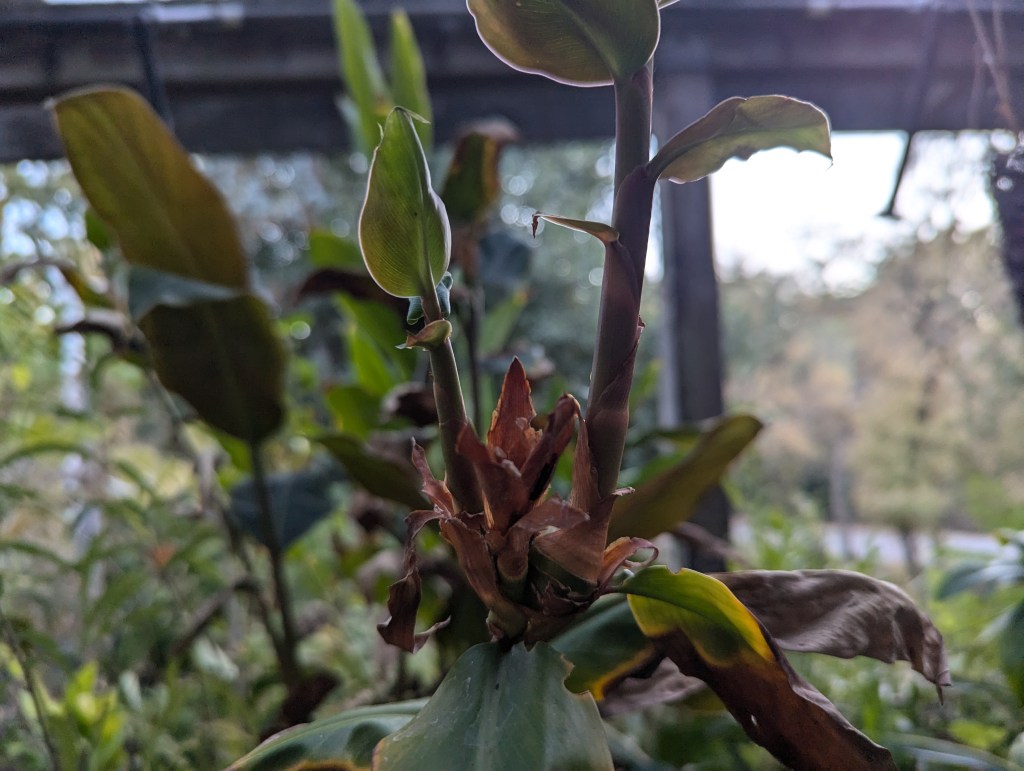
2. Hedychium coccineum X cornonarium ‘Peach Delight’ ginger lily started to bloom so late that I did not expect for it to actually show this much color and confirm its identity.

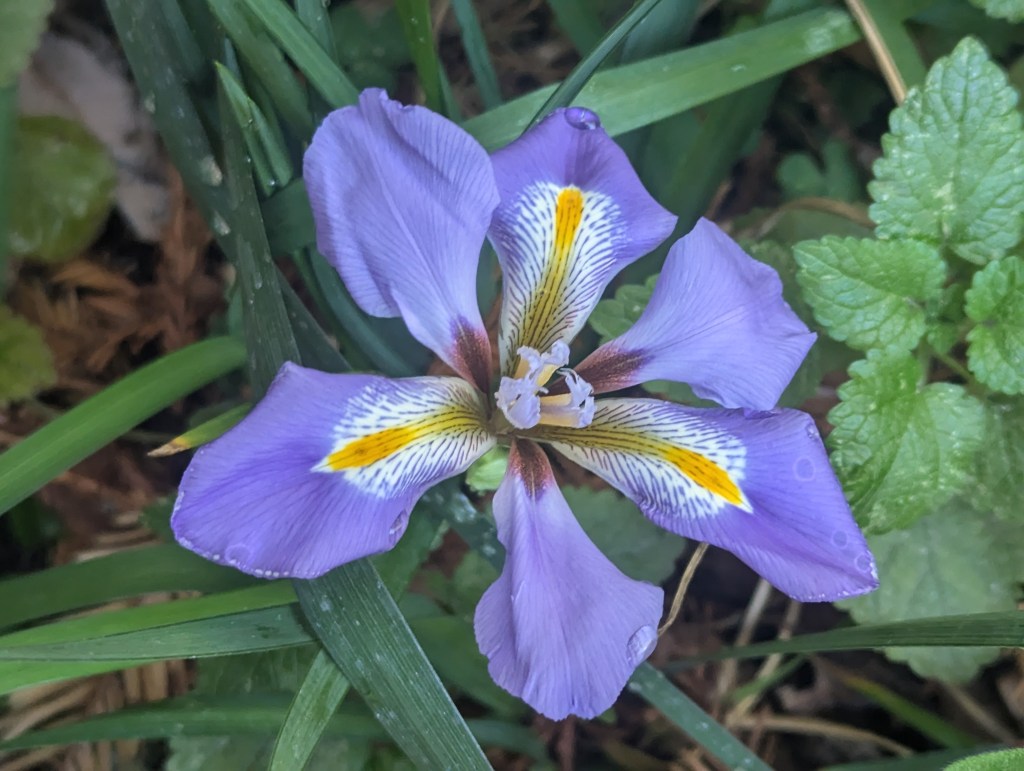
3. Iris unguicularis, Algerian iris is also blooming for the first time here, since its arrival from Tangly Cottage Gardening. It should bloom more for winter. Is it blue or purplish?
4. Brugmansia, angel’s trumpet of an unidentified cultivar, species or perhaps hybrid, is trying to bloom with its last big single pink flowers of the season, and it just might do so.
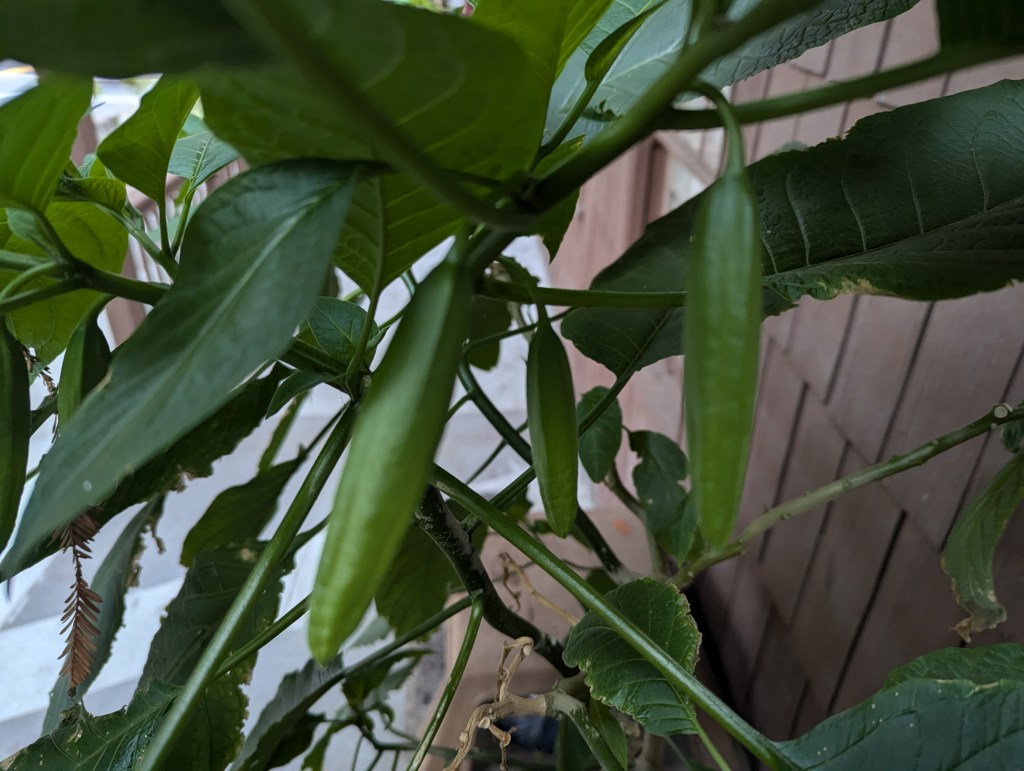
5. Brugmansia insignis ‘Single White’ angel’s trumpet is my favorite in regard to bloom, but not one that I recommend. It is blooming nicely though, now that its season is done.
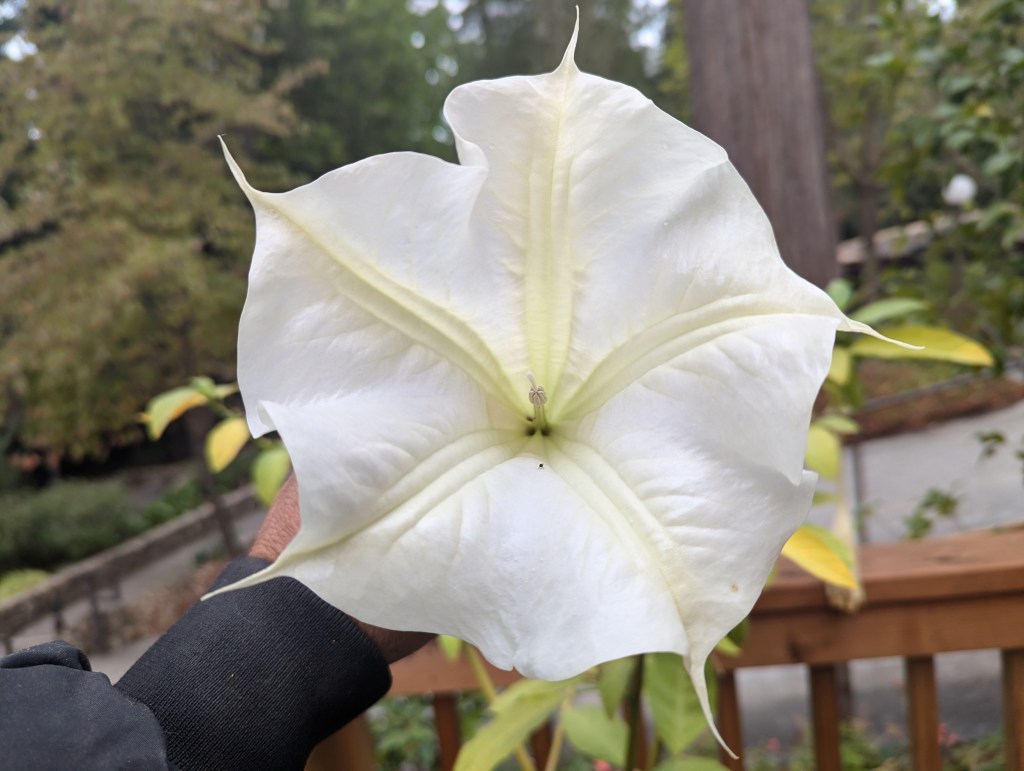
6. Brugmansia candida ‘Double White’ angel’s trumpet also intends to bloom until it no longer can. It bloomed only sporadically since spring, but better than the ‘Single White’.

This is the link for Six on Saturday, for anyone else who would like to participate: https://thepropagatorblog.wordpress.com/2017/09/18/six-on-saturday-a-participant-guide/
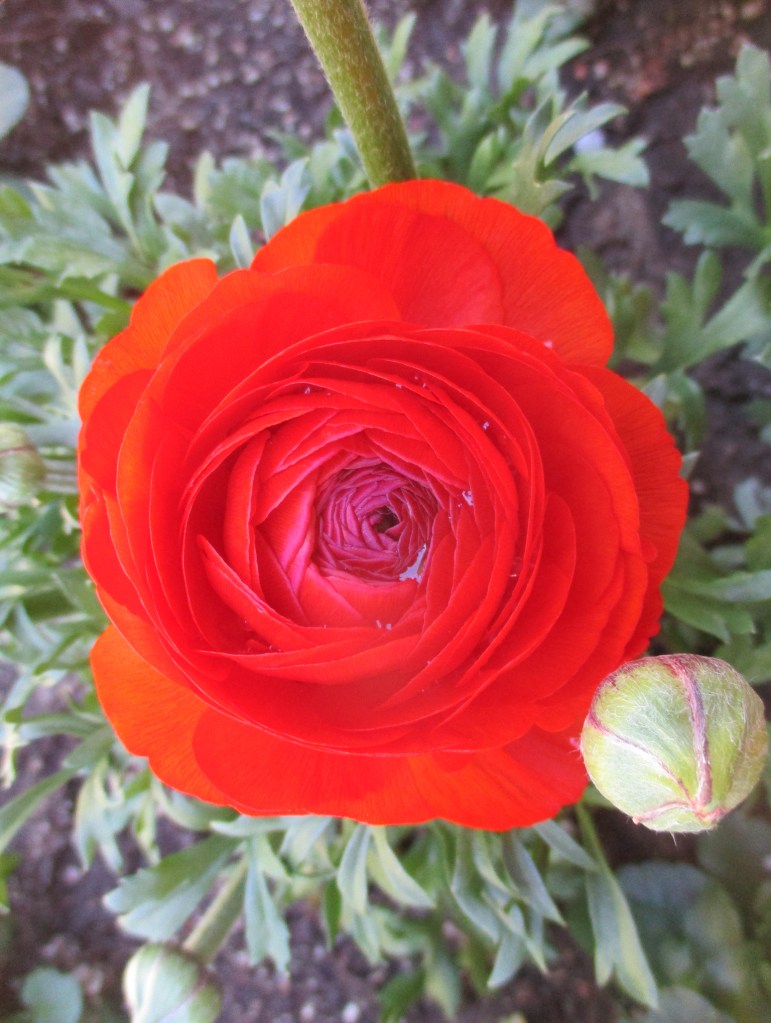
The shriveled and dried tuberous roots of Ranunculus are not much to brag about. They look more like dehydrated mini calamari than dormant and viable spring bulbs. Yet, they somehow bloom as soon as the weather warms enough after winter. Although they need no vernalization, they need time to grow. Bulbs should be into their garden by December.
Alternatively, small budding plants will be available from nurseries after winter. They are too big for cell packs, so are mostly in four inch pots. Larger one gallon plants often have shabby foliage. Although popular as annuals, Ranunculus can be reliably perennial like other bulbs. They are less susceptible to rot if dug and stored while dormant for summer.
Ranunculus bloom is white, yellow, orange, red, pink or purple. The plump flowers have many papery and densely set petals, like small peonies. They typically stand less than a foot high, and may be only half a foot high. Their finely textured basal foliage stays even lower. It resembles parsley, but is a bit more substantial. It shrivels during warm weather.

Spring bulbs obviously bloom for spring. Less obviously, they vernalize with winter chill. They are seasonable about now because this is when they should get into their gardens. Many prefer to be interred into their shallow graves by Halloween. Many can wait as late as New Year’s Day. If too much later, some may not experience enough chill to vernalize.
Planting spring bulbs can be ungratifying because there is nothing to see afterward. After all, they are dormant at the time. They lack foliage or any other parts to extend above the surface of the soil. They seem to remain inactive until they bloom as winter succumbs to spring. However, between now and then, they will secretly reset before resuming growth.
Vernalization is how many spring bulbs finish their previous season and begin their next. They know that it is winter after they experience a particular duration of a particular chill. By then, they should have finished all growth of the previous season. Afterwards, all new growth and bloom is for the next season. It is how they know to bloom on time for spring.
Dutch iris, freesia, ranunculus, anemone and common narcissus do not need much chill. Tulip, hyacinth, crocus and a few narcissus and daffodil do. Some bulbs that benefit from it get a prechill treatment before coming to nurseries. Prechilled tulip and hyacinth bulbs are sadly unlikely to bloom after their first year. They prefer more chill than they get here.
Otherwise, many spring bulbs are supposedly reliably perennial. Naturally, actual results may vary. Anemone can survive for many years, but might bloom only rarely. Ranunculus may be less perennial, but may also bloom better while it survives. Dutch iris and crocus are unpredictable. Freesia and simple varieties of narcissus are more reliably perennial.
Technically, some spring bulbs are not bulbs. Ranunculus and freesia, for example, grow from corms. Nonetheless, almost all spring bulbs bloom only once annually. Succession planting can prolong bloom. It provides subsequent phases to begin bloom as preceding phases finish. However, phases of reliably perennial bulbs synchronize after first bloom. Summer bulbs and bulb-like plants are seasonable later.

Naked ladies like exposure. Amaryllis belladonna can certainly survive and actually develop lushly healthy foliage in partial shade. However, it needs sunshine to bloom. This picture above, which was recycled from yesterday when I mentioned that I might elaborate on it later, demonstrates how discriminating this species is. As mentioned yesterday, a row of naked lady bulbs extends completely across the picture from left to right. It does not extend only from the left to the middle of the picture, as the bloom might imply. Now that bloom is finishing, foliage will develop throughout the entire row, including the portion of the row that currently lacks bloom, so that the extent of their herd will be more apparent. The lack of bloom to the right is the result of the shade of a densely foliated coast live oak above. Because coast live oak is evergreen, it shades the area below its canopy through winter, when naked lady is also foliated and storing resources for subsequent late summer bloom. Those that do not get sufficient sunshine to initiate bloom within any particular season will be unable to bloom for the beginning of their subsequent season. When we installed these recycled bulbs here, we considered that bloom would likely be inhibited below the coast live oak, and that we would relocate bulbs that were too shaded to bloom, but we expected more of a transition between the shaded area and the sunnier area. This is so blunt, with bloom to the left, but none to the right. At least we now know precisely which bulbs to relocate while they are dormant next summer. Although there is technically no need to relocate them, and they can be adequately healthy here, they would be more appealing within a sunnier situation that would promote bloom.
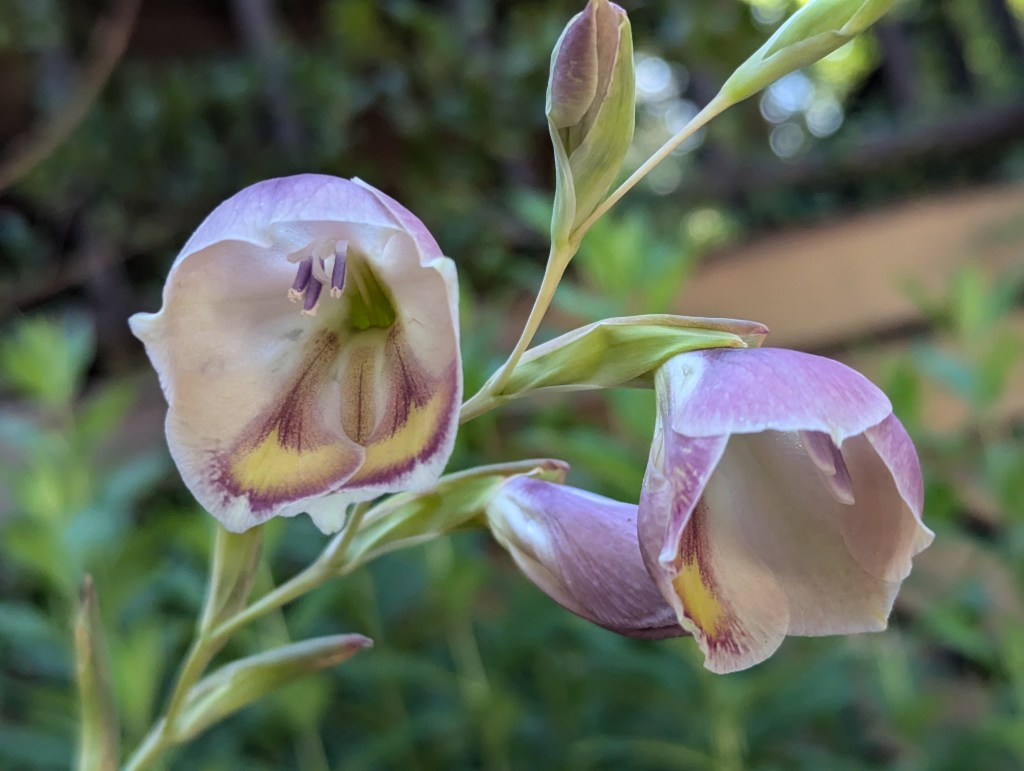
Gladiolus papilio, butterfly gladiolus has been performing very well, and, unlike the more common fancy hybrid gladiolus, it has been very reliably perennial. It multiplies and migrates like a wildflower. I know that I brag about it more than I should, and I just posted a picture of it for Six on Saturday last Saturday, but it happens to be one of my favorite perennials now. It was a gift from Tangly Cottage Gardening in the autumn of 2018, almost six years ago. Prior to that, I had been wanting to grow perennial gladiolus for quite a while, although I was not familiar with such species. I was only familiar with the common fancy hybrid sorts, which are generally not reliably perennial. Gladiolus murielae, Abyssinian gladiolus that arrived a few years ago as a gift from a neighbor may eventually inhabit a different portion of the same landscape that the butterfly gladiolus inhabits. It neither multiplies nor migrates as much as the butterfly gladiolus, and is a bit more garish in bloom, but is both reliably perennial and compatible with wildflowers, and technically, is probably more appropriate to that particular refined landscape. Various cultivars of Watsonia, bugle lily, most of which also came from Tangly Cottage Gardening, could also inhabit the same landscape. There is no rush to decide anytime soon, and the refined landscapes at work are constantly evolving. Within my home garden, I can be less concerned with how visually compatible some of such species and cultivars are, and be more concerned with growing what I enjoy. After all, that is how I acquire so many odd species and cultivars with so much history and from so many important gardens, and even from so many natural ecosystems. It is what makes my home garden so important to me.

It is hard to imagine how the small shriveled clumps of tuberous roots of ranunculus, Ranunculus asiaticus, planted last autumn can produce such bright pink, red, orange, yellow and white flowers between late winter and early spring. The two or three inch wide, semidouble or double flowers stand about a foot high, just above their soft deeply lobed foliage. Those of us who did not get ranunculus in the ground last autumn can find blooming plants now. Ranunculus want to be in full sun, in rich, well draining soil.
Deadheading (removal of fading flowers) promotes subsequent bloom; but the season is rather short. Foliage will soon be turning yellow, and will eventually die back. If not watered too much, dormant ranunculus can survive through summer, but should be dug and stored in a cool dry place until next autumn if they are in pots or areas that will get watered regularly.
 Tony Tomeo