Hippeastrum papilio, butterfly amaryllis is an uncommon and weirdly epiphytic amaryllis. It may not be as pretty as the countless more colorful hybrids of the genus, but it is more reliably perennial. All of the few specimens that I have observed within home gardens are potted or in the ground, either because they are easier to grow that way, or because those who grow them are not aware that they are epiphytic. After all, that is quite weird.
This specimen, from my Six on Saturday post earlier this morning, is blooming in Brent’s garden. As I mentioned earlier, Brent did not know what it was when he acquired it from a neighbor who left it with him when she relocated. I know that it does not look like much in this picture, but that is only because Brent is an idiot, and takes bad pictures. I intend to get a copy of this butterfly amaryllis for my garden, and may try to grow it epiphytically.
I find this species to be more appealing than prettier hybrids, both because it is reliably perennial, and because it is a simple species rather than a hybrid. This is also why I dug a few naturalized Crinum bulbispermum, Orange River lily bulbs for my garden. They are none too pretty, but will last forever. The same applies to Amaryllis belladonna, naked lady, but they are a bit too prolific and common to not potentially qualify as a weed. Their bright pink floral color can be a bit obnoxious anyway. But of course, that is why I was so very pleased to find a bulb that bloomed white, which is my favorite color. It is multiplying nicely here now, just like I know the butterfly amaryllis will once I get a fresh copy of it.
Early spring bulbs that went into their gardens last autumn are now blooming. Some are already done. Some summer bulbs should begin to bloom as the last spring bulbs finish. A few of them might bloom as late as autumn. Ultimately, like the earliest of spring bulbs, all eventually finish. As they do, their deteriorating flowers will necessitate deadheading.
Deadheading is simply the removal of deteriorating blooms. For many species, it diverts resources from fruiting into other growth. Many species can utilize diverted resources for subsequent bloom. Many become more intent on blooming again after deprivation of any prior fruiting. Spring bulbs instead utilize all their diverted resources for new bulb growth.
For spring bulbs, it is the most practical response to deadheading. Most bloom only once annually. Therefore, they can not divert resources directly to subsequent bloom. Instead, they prioritize vegetative growth of bulbs to grow and bloom for the next spring. They are patient. Reproduction remains their priority. They merely regroup before another attempt.
Because of extensive breeding, many spring bulbs can not produce viable seed anyway. Of course, this does not prevent them from trying. Even seeding or fruiting structures that contain no viable seed can be unappealing. For them, deadheading is merely aesthetic. Some complicated hybrids that might produce viable seed are unlikely to be true to type.
Elimination of viable seed that is not true to type is as practical as it is aesthetic. Without deadheading, such seed can grow into feral progeny. Such ferals may be more similar to remote ancestors than to their direct parents. They can be aesthetically inferior, but more prolific. Eventually, less desirable feral bulbs may displace their more desirable parents.
Because they are small but abundant, some freesia avoid deadheading. Resultant ferals are more fragrant but less colorful with pale white bloom. They are more prolific, so might eventually displace their parents. Common grape hyacinth and snowflake are too florific to deadhead, but are true to type. Actually, they can become invasive in some situations. Montbretia are very likely to be invasive.
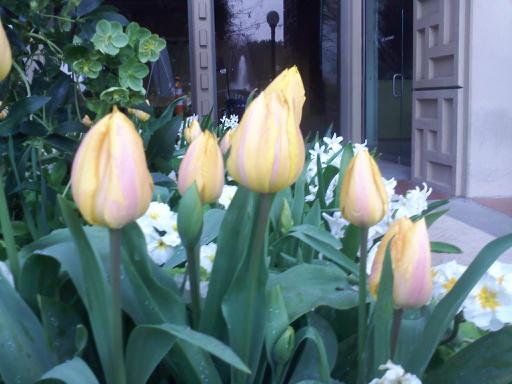
The soft pastel shades of these tulips brighten this somewhat shady landscape.
The mild winters that are so comfortable for us are not so desirable to tulip bulbs, which need to be chilled to perform as perennials. Consequently, they behave as brief season annuals locally. The most popular varieties have simple single flowers in white, yellow, pink, red, purple or pinkish orange. Double tulips are rather ruffled. Parrot tulips are larger and even more ruffled. As the names imply, lily-flowered tulips are shaped like small lilies, with pointy flared petals; and fringed tulips have finely serrate petals. Tulips stand between half a foot to two feet tall. Early types are already finished blooming. Late types, particularly if planted late, may bloom as late as early May.
Daffodil bloom from bulbs that were installed last autumn.
The elegant white callas that are just about to bloom in my garden have their origins in the ‘old country’. I obtained them from the garden of my great grandfather Tomeo in my ancestral homeland; Sunnyvale, near San Jose. I am told that my great grandfather planted them decades ago, and had been trying to get rid of them almost as long. I suppose that means that these callas are easy to grow.
My belladonna lilies that got planted two autumns ago are about as old, since they came from the garden of my mother’s mother in Santa Clara, right near Sunnyvale, and were in her mother’s garden prior to that. These bulbs just keep on growing, blooming and multiplying. Although I do not like their bright pink color much, I can not argue with their reliability.
Bulbs and bulb like plants that can take care of themselves and thrive with minimal or no attention are always welcome in my garden. Bright orange crocosmia is perhaps just as reliable, or should I say ‘persistent’, as callas are, and like callas, should be planted about now. Yellow, red, and orange with red flowering varieties are also available. Pink, red, orange, yellow and salmon cannas are in season too. They are easier to contain, but are likewise prolific.
Some of my other favorites that get planted about now for summer bloom want more attention, but are certainly worth it. Dahlias can naturalize if conditions are right for them, but will more likely do better if dug, divided and replanted in enriched soil at least every few winters. They are remarkably easy to propagate. Asiatic lilies likewise prefer to be dug and replanted as their soil becomes depleted, but are not likely to regenerate year after year if ignored.
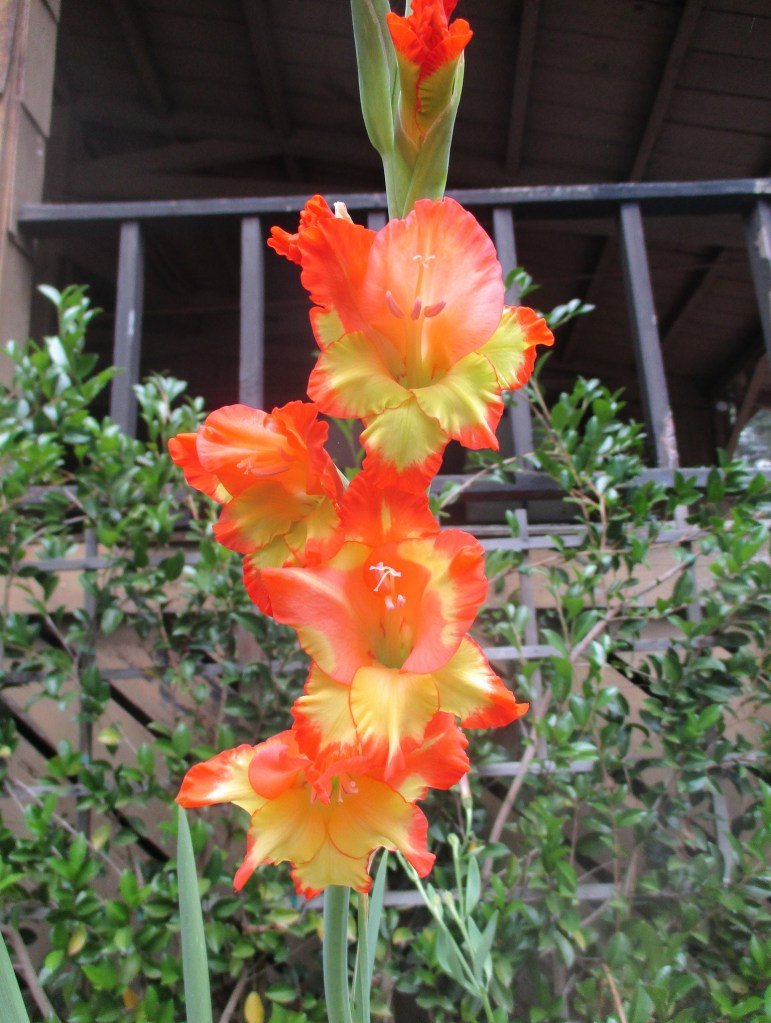
Honestly though, some of the other summer blooming bulbs and bulb like plants that get planted about now are rather risky. I like to grow gladiolus because they happen to be among my favorite flowers. However, unless they get well amended soil and fertilizer, they do not perform very well, if at all, after their first year. Liatris is not much more reliable. Tuberous begonia is still a mystery to me, since I have not been able to prevent them from rotting in their first year!
Of the many bulbs and bulb like plants that get planted in autumn that are now blooming, grape hyacinth, snowdrop, watsonia, bearded iris, daffodil and narcissus are the most reliable and likely to naturalize, particularly with rich soil and regular watering. Daffodil and narcissus do not spread as well as the others, but are probably the most resilient. With a bit more effort, freesia and crocus can be persistent. In some situations, freesias have actually been known to naturalize as effectively as grape hyacinth.
Other early bloomers (that get planted in autumn) are more demanding. The anemones that I planted in about 1990 survived neglected in my garden for nearly a decade, but probably produced more flowers in their first year than in all subsequent years combined. Ranunculus and hyacinth may do the same if conditions are not just right for them. Tulips are perhaps the most profusely colorful of spring bulbs, but are sadly grown mostly as annuals, since they rarely do much more than produce foliage after their first year.
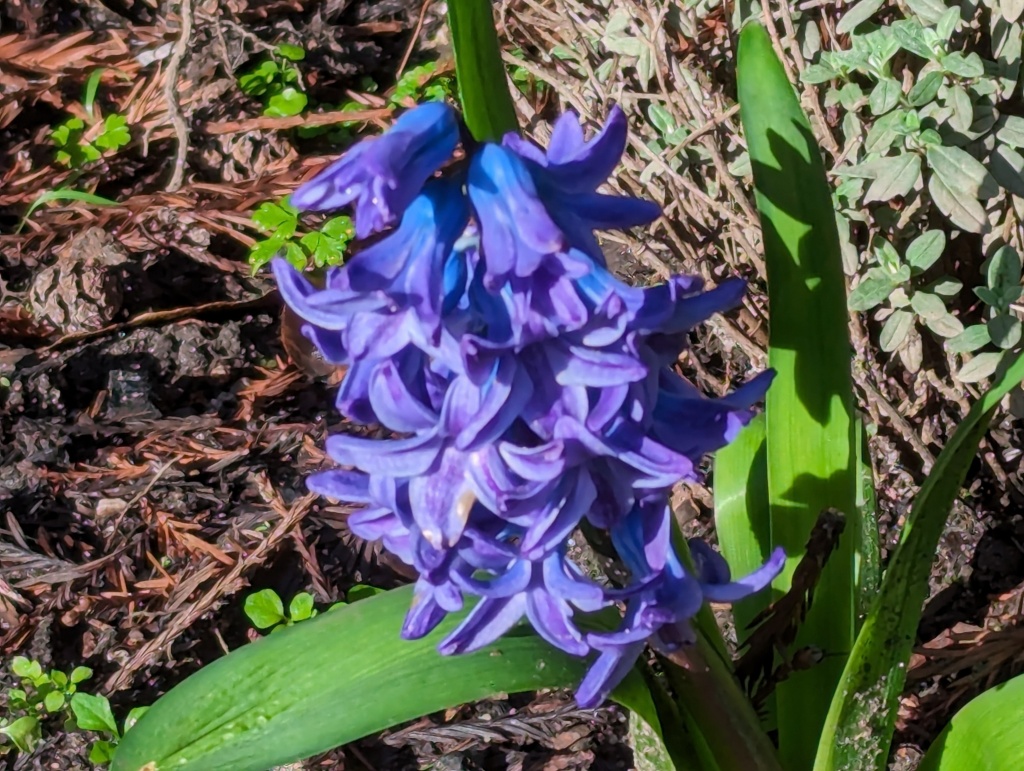
Hyacinth is one of the earliest of spring bulbs, and is notably fragrant.
If their bulbs got into the garden early enough last autumn, Dutch hyacinth, which are hybrids of Hyacinthus orientalis, are now blooming with cartoon shades of red, blue, yellow, purple, pinkish orange, pink and white. The small, surprisingly fragrant flowers are neatly arranged on plump, bottle-brush shaped flower trusses up to eight inches tall. Their typically arching, rubbery, strap shaped leaves look like small lily-of-the-Nile leaves. Some types have more vertical foliage.
Like many bulbs and bulb like plants, hyacinth are unfortunately not reliably perennial in such mild climates. They prefer cooler winters. Consequently, they are typically grown only as annuals. However, I am aware of hyacinth that not only bloom annually, but have been multiplying nicely over the years in a few local gardens. Their flowers spikes are never as full as they were in their first season, but are appealing nonetheless. I actually prefer the less refined style of naturalized hyacinth.
French Roman or Roman hyacinth, Hyacinthus orientalis albulus, are still somewhat rare, but should be more common since they naturalize more reliably without cold winters. Each bulb produces a few flower stems with smaller and more loosely arranged pink, pale blue or white flowers.
Large hyacinth bulbs are easily forced to bloom suspended just above water by small stones in bowls, or individually in hyacinth glasses (vases that hold bulbs just above water). Forced bulbs should be kept in the dark until rooted, and can be moved out as foliage appears. They are as colorful as tulips and as fragrant as narcissus; but sadly, are not likely to survive after being forced.
Both alocasias and colocasias are striking foliar plants. Alocasias generally develop big leaves that point upward. Colocasias generally develop even bigger leaves that hang downward. Alocasias are generally more colorful, perhaps with striking foliar patterns. Also, most tolerate more shade than colocasias. Of course, these are generalizations.
Asian taro, Alocasia odora, resembles colocasias as much as alocasias. Its big cordate leaves may point only slightly upward, and might sag downward. They can grow two feet long and a foot wide, on petioles as long as three feet. Collectively, foliage can get more than five feet tall. It is bright but monochromatic green, similar to that of Kermit the Frog.
Asian taro is only occasionally available from nurseries. Small plants are too delicate for nurseries to market too many of them for too long. Their dormant bulbs are more likely to become available with summer bulbs. They can be wider than three inches! They grow slowly though, especially while weather is cool. Foliage may not appear for two months.
Spring bulbs begin to go into the garden during autumn to benefit from the chill of winter. Summer bulbs begin to go into the garden during late winter to avoid the chill of winter. Spring bulbs know to remain dormant through winter. Some summer bulbs do not. If they grow prematurely, they can be vulnerable to cool wintry weather. Late is better than early.
Frost is still possible within some climates. However, summer bulbs are now in season. That is because, like spring bulbs, they disperse roots prior to developing foliage. By the time they extend foliage in a month or so, the weather will not be so cool. Later phases of a few sorts bloom later to prolong bloom for the first season. They synchronize afterward.
That is because they establish themselves within the garden. Once they do, some types of summer bulbs become hardy perennials. Some might try to grow prematurely during subsequent winters. If they incur frost damage as established perennials, they can easily replace the damage. Ornamental gingers and cannas do so regularly in inland climates.
Ornamental gingers and cannas may eventually benefit from division. Even if they do not become too crowded, they can migrate where they are not wanted. Their surplus is easy to relocate or share while dormant for winter. Their foliage becomes shabby or dies back during dormancy anyway. Even if mostly green, its removal stimulates healthy refoliation.
Ornamental gingers and cannas also are oblivious to phasing. Gingers bloom only once for late summer or autumn. Cannas bloom randomly from spring until autumn. Gladiolus bloom only once like gingers, but are more conducive to phasing. Early planting allows early bloom. Late planting delays bloom. Unfortunately, they are much less sustainable.
If summer bulbs do not look like bulbs, it is because few actually are. Most are rhizomes. Dahlias, which, like cannas, bloom from spring until autumn, grow from tuberous roots. As the name implies, tuberous begonias grow from tubers. Crocosmias grow from corms. So do taros, which are large foliar perennials. Gingers and cannas are familiar rhizomes. Although alliums bloom as summer bulbs, they go into the garden along with earlier spring bulbs.
This is no ordinary daffodil. I realize that it looks just like the daffodils that I posted a picture of two Saturdays ago, and it could actually be the same variety, but it is quite distinct. I acquired this particular daffodil in about summer of 1986. It could have been a year or two earlier or later, and might not have been summer. The foliage was not completely shriveled as it should have been during summer, but it lasts longer in the coastal climate that I took it from. I really do not remember when I acquired it, but I know that it was a long time ago, about the summer of 1986.
Although we have not been acquainted for as long as I have been acquainted with my paternal paternal great grandfather’s rhubarb and my maternal maternal great grandmother’s Dalmatian iris, both of which I acquired prior to kindergarten, we have significant mutual history.
I ‘borrowed’ several large clumps of bulbs from an abandoned flower field to the east of my Pa’s home in Montara. The clumps were very overgrown and very crowded, but still in their original rows, as they had been arranged for cut flower production many years prior. Shortly afterward, all of the other bulbs were somehow and seemingly pointlessly removed from the field by an excavator. A monster home was built on the highest part of the field, with a view of the field, which remained completely uncultivated afterward. No one knows how or why all the daffodil bulbs were removed so completely, but none were ever seen again. The naturalized field of daffodils seemed like it would have been an attribute to the home.
Over many years, the bulbs grew at most of the homes that I lived in, until the last few years, after I left the last of them at a former home in town. Then, after bringing a few roses here from my old rose garden at a previous home, I noticed that a few bulbs came with them. I thought that they were fancier daffodils, but now that this one bloomed, it is obvious that they are the familiar daffodils from Montara.
Daffodil bloom here as if they were in the Pacific Northwest.
Narcissus make me wonder. Both paperwhite and common daffodil, as well as a few fancier daffodil, bloom here as if they were in a climate that is more conducive to such performance. The happiest naturalize and slowly multiply. Not many bulbs do so where winter weather is so mild. That is why I do not bother with tulip or hyacinth, although a few hyacinth have also been performing reliably here for many years.
Peony is very marginal here. I know that they perform inexplicably well for some neighbors, but none have ever done well for me. I really do believe that they prefer more chill than they experience here. Realistically, winter weather is relatively mild here.
Yet, I am not convinced that it is as mild as I have always believed it to be. Some who are unfamiliar with California believe that we experience only two seasons, which are summer, and a few days annually that are not summer. I know better. No one argues that the warm and dry summers here last longer than elsewhere. Prior to summer though, spring is likely comparably to spring within other climates. After summer, autumn, although mild, is cool enough to initiate autumn foliar color. Then, winter is cool. Really, it is cool enough for deciduous species to defoliate, and for mild frost. It may not get as cold as it does in other climates, but how cold does it need to be to qualify as winter?
I am satisfied with the winters here. I can grow all of the deciduous fruit trees that I want to grow. This is one of the best climates in the World for roses. These daffodils seem to be quite satisfied as well. In fact, they sometimes stay dormant later here than in climates with cooler winters!
Dinnerplate dahlias should be about ten inches wide.
Mail order scams are a topic that I have been avoiding. I do not want to consider that some of a few items that I purchase by mail order may not be what they were sold as; and, if so, I will not know until they grow, bloom or produce fruit. Furthermore, I want to believe that if such items are not what they were sold as, that the situation is merely accidental.
This was no accident.
It began with the purchase of thirty rhizomes of ‘Red King Humbert’ canna last year. They were the cheap sort that become available after their primary season. I did not expect them to be of exemplary quality. Nor did I expect them to bloom. I only wanted them to grow a bit during the remainder of their season so that their rhizomes could survive winter dormancy to grow and bloom for the following season, which would have been last spring.
They grew as expected, but seemed to be virused. I tried to believe that the supplier would not send me virused stock, and that the striations of their foliage were normal. However, as growth resumed last spring, the foliage was very obviously virused.
Also, as they grew, they were very obviously not ‘Red King Humbert’. They grew only about two feet tall, and bloomed with scrawny orange flowers. ‘Red King Humbert’ gets about six feet tall, with big and billowy orangish red bloom.
The supplier gave me a credit for the expenditure, to spend on more of their products, I should have requested a simple refund. Instead, with the credit and a slight bit more for the difference in price, I purchased two dozen rhizomes of assorted dinnerplate dahlias.
As with the canna, I did not expect exemplary performance from these dahlias so late in the season. I only wanted them to survive and grow enough to store enough resources to survive their winter dormancy, to grow and bloom for the next season.
Most were completely necrotic and mummified upon arrival. Because this was after my experience with the canna, the supplier agreed to refund what I spent, but then only refunded a random amount of a dollar and a few cents. When I asked about the refund, I was informed that it was comparable to the cost of the one rhizome that I sent a picture of, as if I was expected to send a picture of every rhizome that I wanted a refund for. I explained that almost all of the rhizomes were comparable the the one that I sent a picture of, but received no more response.
I still have heard nothing about it. I decided to be satisfied with the few rhizomes that survived, and just accept the loss. The time that I had already wasted on pursuing a refund was worth more than any refund that I would have gotten.
So, . . . a few of the dinnerplate dahlia rhizomes survived and generated a bit of growth to partially recharge their resources prior to their next dormancy. Two actually bloomed. Apparently, these are very special dinnerplate dahlias. Instead of producing blooms that are about ten inches wide, the largest bloom is less than three inches wide. I have never seen such a dinky dinnerplate.







 Tony Tomeo