Gardening With Succulents

(This article is recycled from many years ago, so contains very outdated information.)

Many succulents are remarkably easy to propagate from cuttings.

Succulent plants that were so trendy during the 1970’s seem to be gaining popularity again. This is actually one of the few trends that I like to see, since succulents are such useful and practical plants in modern urban gardens. Although some cacti, agave and larger succulents become quite imposing, most other succulents are quite compact and proportionate to small garden spaces. Some can by happy in the partial shade of atriums and under eaves. Succulents generally do not need much attention, are remarkably easy to grow, and are even easier to propagate. Most do not need much water. 

‘Gardening with Succulents’, with master gardener Laura Balaoro and the Guadalupe River Park Conservancy, is a great program for experiencing the potential for succulents in containers and the garden. There will be several samples of container gardens to demonstrate some of the many possibilities for succulents, as well as their variety of textures and colors. Common pathogens, propagation methods, succulent that grow through winter, and succulents that are adaptable to partial shade will all be discussed. After a planting demonstration, there will be free cuttings for those who can not wait to add new succulents to their gardens.

‘Gardening with Succulents’ is only in a few days, from 10:00 a.m. to noon on September 11, so it is important to register right away by telephoning 298 7657 or online at www.grpg.org. If this program gets full to capacity first, there are many other interesting classes and programs described at the website for later. Admission is $15, or $10 for members of Friends of Guadalupe River Park and Gardens. ‘Gardening with Succulents’ will be at the Guadalupe River Park and Gardens Visitor and Education Center, which is located at 438 Coleman Avenue in San Jose.

Nearby in the San Jose Heritage Rose Garden, the last of the Rose Deadheading Blitzes will be from 5:00 to 7:30 p.m. on September 14, in order to remove spent blooms and promote more blooms before autumn. Volunteers should bring pruning shears and gloves, and wear closed-toe shoes; and of course, stay for ice cream afterward. (Loaner shears are available if necessary.) The San Jose Heritage Rose Garden is located on Taylor Street at Spring Street, just east of Coleman Avenue. Visit www.grpg.org or telephone 298 7657 for more information or to register.

Succulents

Succulents are remarkably diverse.

Among the many garden chores that I neglected so far this summer is the ‘processing’ of many of the bits and pieces of unusual succulent plants that I acquired from earlier volunteer work days at the Arizona Garden at Stanford. Volunteers are always welcome to take any of the debris that we generate. After everyone present took what they could, I could not bear to waste what was left; so I took more than I should. Cacti, agaves and yuccas cannot be recycled as green waste, so would otherwise have been disposed of.

I really wanted large canes of a particular unusual yucca, so processed them as large cuttings first. I only needed to cut away all but the foliage on top, stick them in the ground and keep them watered until roots grow. This particular desert yucca does not grow roots as efficiently as tropical yuccas do, though.

Meanwhile, many pieces of cacti, ice plant, and succulents that I can not even tell you the names of remain out in a pile in the driveway. However, as I was looking them over today, I noticed that they are not only alive, but actually seem to doing quite well. Some are even blooming!  

This is just too weird. There is no soil. There is no watering. Even if there were, there are no roots to exploit the resources that are necessary to keep plants alive. These bits and pieces of various succulents get only sunlight and warmth during the day. Apparently, this is all they need for now.

They know that it will eventually rain. When it does, they will develop new roots into the soil wherever they are. Since I do not intend to let them do this in my driveway, I will eventually get them into the garden, and water them in to hasten the rooting process. I will groom them and strip lower foliage from agaves and aloes, so that they look better than the debris that they are. They should actually grow slightly and look pretty good by autumn.   

There are so many different kinds of ‘succulent plants’ or ‘succulents’, that the definition is not always so clear. All cacti are succulents that are equipped with spines. Many relatives of poinsettia (euphorbs) have fleshy green stems just like cacti, so are also succulents. Some of these even look like cacti, with comparable spines. Aloes and agaves are succulents as well, with large fleshy leaves, some with very sharp leaf tips and teeth on their leaf margins. The list goes on, including sedums, sempervivums, echiverias, aeoniums, crassulas, lithops, ice plants and more.

Simply speaking, succulents store water in distended ‘succulent’ leaves, stems or even roots, in order to survive long dry seasons. Most happen to be remarkably easy to propagate from cuttings. Some can even be grown from relatively large cuttings. In the desert where water is a very limited commodity, many succulents defend themselves with spines or teeth.

Yuccas, which are related to aloes and agaves, are considered (by ‘some’) to be succulents as well, even though they lack fleshy leaves or stems. Some yuccas that form trunks and branches, particularly those that are from tropical or forest environments, and especially the common Yucca elephantipes, are just as easy to propagate from cuttings as other succulents are.

Not Ocotillo

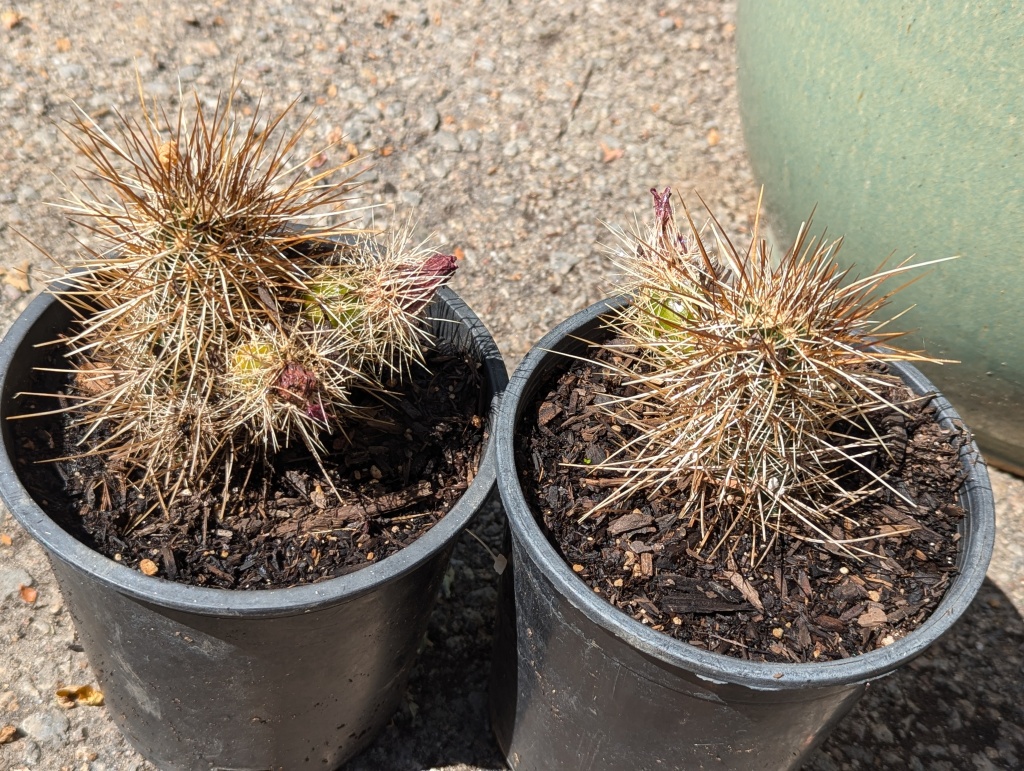
Echinocereus engelmannii, hedgehog cactus?

Ocotillo, Fouquieria splendens, was the species that I intended to procure as Rhody and I walked out and into the desert that surrounded the home we lodged at northwest of Phoenix at the end of last April. I had seen it from the roads on the way there. I should have stopped to procure cuttings or small specimens while I had the chance. Furthermore, I should have stopped for cuttings or small specimens as we left without procuring any earlier. It is a fascinating species that I am completely unfamiliar with.

Hedgehog cactus, Echinocereus engelmannii, is all I procured instead. At least I believe that it is this particular species. I really do not know for sure. A few species of the genus are native to the area. This species just happens to be the most common among them, and its description seems to conform to my observations of this specimen. Other species bloom with floral color that is different from that which I observed with a few remaining shriveled floral carcasses. Most other species exhibit different foliar patterns or textures with their spines. This particular species is distinctly more unappealing than the others, but I got it.

Now, I have no idea of what to do with it. First, I should probably wait to see if it survives. The bits that I got might have been a bit too fresh to root before they rot. I suppose that I should remove the developing fruit to divert resources to vegetative growth and root development. I thought that they would abscise naturally after bloom, in response to the distress of separation from the original specimen. I would prefer natural abscission to unnatural intervention. Pruning wounds from such intervention might promote rot while the cuttings are already vulnerable to rot from below.

Timeout

A moment before sunrise over Phoenix.

Apologies for my absence.

Perhaps no one noticed. Most of my posts were automated prior to my departure, and I managed to compose a few brief articles for what was not automated; so ultimately, there was no lapse of posting. I may have only been negligent with response to comments for the last two weeks.

Realistically though, I have been intending to discontinue blogging and recycling old articles, and to post only my weekly gardening column, in two parts, on Mondays and Tuesdays. I merely have not done so yet.

Anyway, my trip, although very different from how it was planned, was totally excellent! Just a short distance from the turnoff for the southbound San Diego Freeway towards my primary destination in Los Angeles, I was diverted to my secondary destination northwest of Phoenix. I missed the desert scenery as I drove all night to arrive shortly before four in the morning, and began my vacation exhausted. Although I missed out on some of my plans in Los Angeles, I got more time in Arizona. The weather was weirdly excellent, with a weirdly torrential thunderstorm right in the middle of it. It was too early in the year to collect the seed that I wanted, but I really was not expecting to find any anyway. I did happen to procure a hedgehog cactus of some sort. I decided that, since my return was already delayed by a day, that I may as well delay it for two days. (I had brought some of my work with me, so was able to tend to it prior to my return rather than after.) Therefore, I came to my original primary destination in Los Angeles secondarily, stayed to help Brent with the View Park Garden Tour on Sunday, and returned home on Monday.

Six on Saturday: Arizona

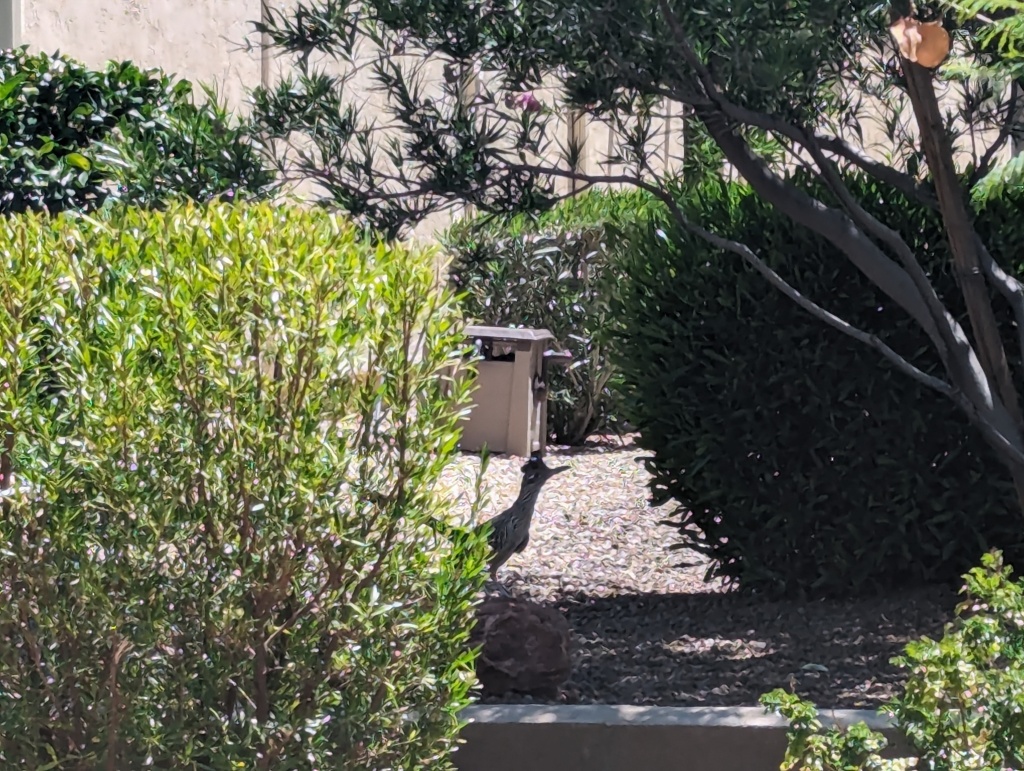
Arizona will be in the rear view mirror shortly after this episode of Six on Saturday posts at midnight on Saturday morning. I got a few pictures this time though. They are not too colorful only because I found the diverse cacti to be more compelling than the abundant desert bloom. Palo verde, esperanza, ocotillo, caliandra, oleander, bougainvillea, lantana and a few other flowers that I did not identify were all in bloom. A few others will bloom soon. We should be in Los Angeles by about noon, and at the View Park Garden Tour on Sunday. This is not how I planned this excursion, but it is working out rather splendidly.

1. Wile E. Coyote, of whom I posted a picture last week, may have been requesting a ride to visit his old colleague, the Road Runner, here in Arizona. I neglected to consider that.

2. Cacti are obviously popular in Arizona, likely because they perform so reliably and are so striking. This and the next two are field grown nursery stock. I can not identify them.

3. This cactus developed a rather wide colony. Many impressively big cacti get relocated. However, I doubt that this entire colony can be relocated intact. It will likely be divided.

4. This unidentified lumpy cactus seems to be quite tame. The few that I have noticed in my neighborhood grow less than three feet high. They grow almost twenty feet tall here.

5. Hesperaloe parviflora, red yucca is difficult to get a good picture of. Its grassy texture and grayish color can look shabby. Its pink bloom is nice against a clear blue sky though.

6. Carnegiea gigantea, saguaro is the State Flower of Arizona, and what tourists like me expect to see in Arizona. I pulled over outside of town to take this picture from the road.

This is the link for Six on Saturday, for anyone else who would like to participate: https://thepropagatorblog.wordpress.com/2017/09/18/six-on-saturday-a-participant-guide/

Six on Saturday: Are We There Yet?

As expected, the second half of my vacation was delayed. Then, very unexpectedly, all of our delays worked out. Rhody, Carson and I left exactly on time. Then, as unexpectedly, and just an hour from our first destination at Brent’s Jungalow, we were diverted to our final destination near Buckeye near Phoenix in Arizona. The explanation is as tedious as the additional six hour drive, at night and partially through Los Angeles style traffic. We are here now but got almost no pictures yet. We stopped only briefly in San Luis Obispo, where Brent and I were in school from 1985 to 1990, and where a few of our friends live.

1. From his shelf in back, through the dirty windshield, and through the dirty window of a cafe, Rhody stared impatiently at me as I tried to enjoy a bit of coffee the day before we left. ‘Hot Lips’ Salvia microphylla to the left is the only vegetation visible in this picture.

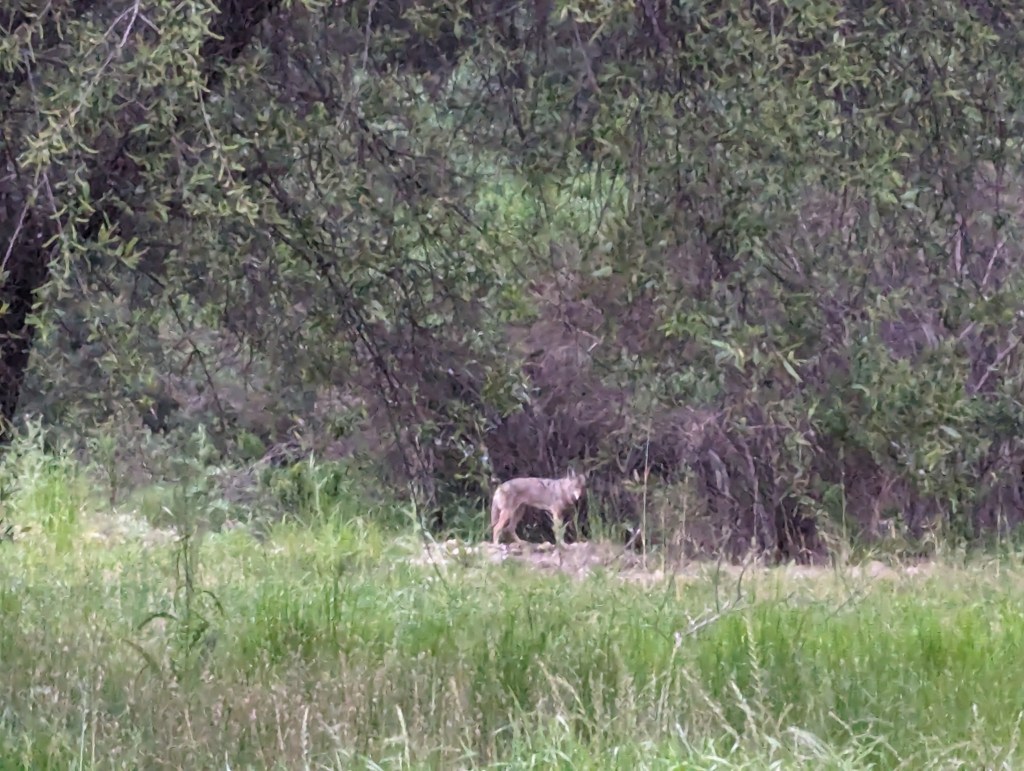
2. Wile E. Coyote also stared at me impatiently, at the end of the same day, as I finished a last task prior to leaving. I can not identify the vegetation that is visible in this picture. I suspect that the tree to the left and above is a common Pacific willow, Salix lasiandra.

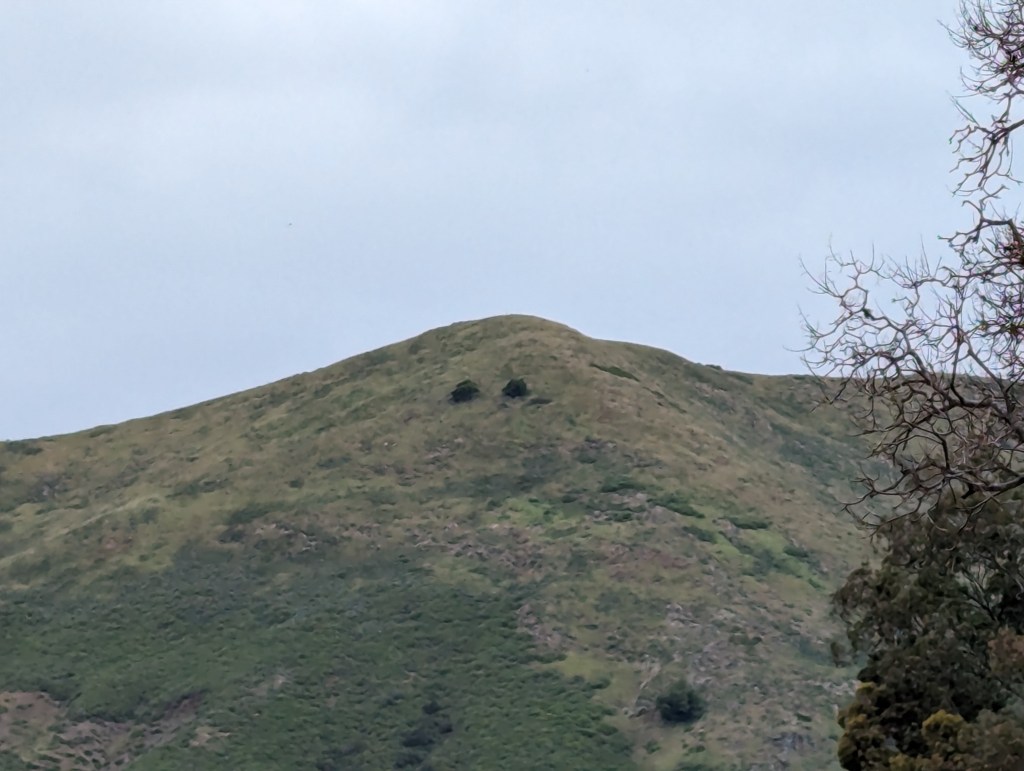
3. The hills have eyes. I have no idea what the pair of shrubs at the center of this picture are. I only know that they have not changed since I arrived at Cal Poly in 1985. I got this picture right outside of my classmate’s office in the Alan A. Erhart Agriculture Building.

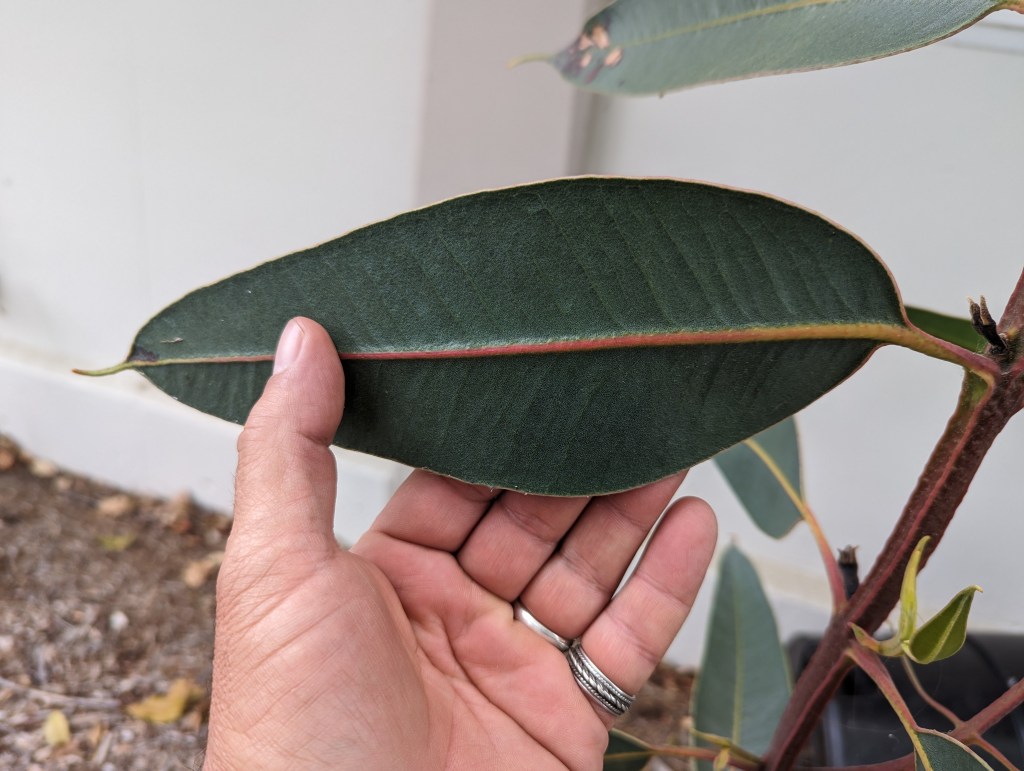
4. Also right outside of my classmate’s office, several specimens of unidentified eucalypti were recently installed. I recognize none of them. This specimen exhibits remarkably big leaves for the genus. These trees are very close to where I first met Eucalyptus torquata.

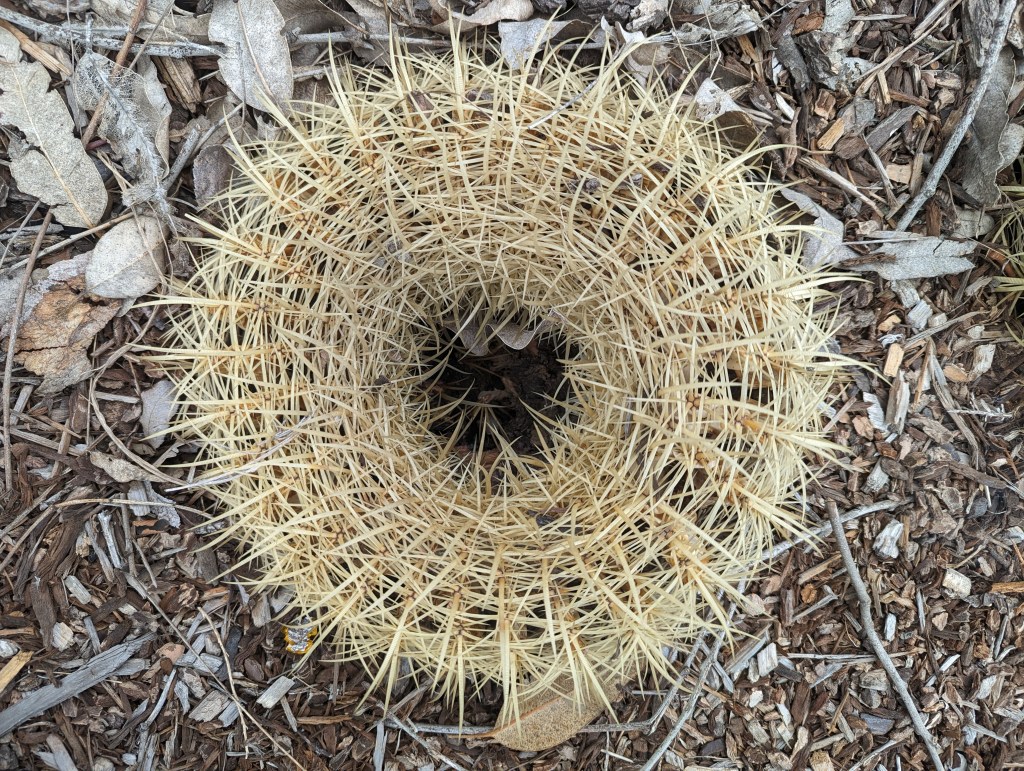
5. Barrel cactus, Echinocactus grusonii, dies ugly. It looks like something out of a horror movie, or like it consumed a horror movie. I suspect that this and several other similarly imploded carcasses decayed because of automated irrigation that is intolerably frequent.

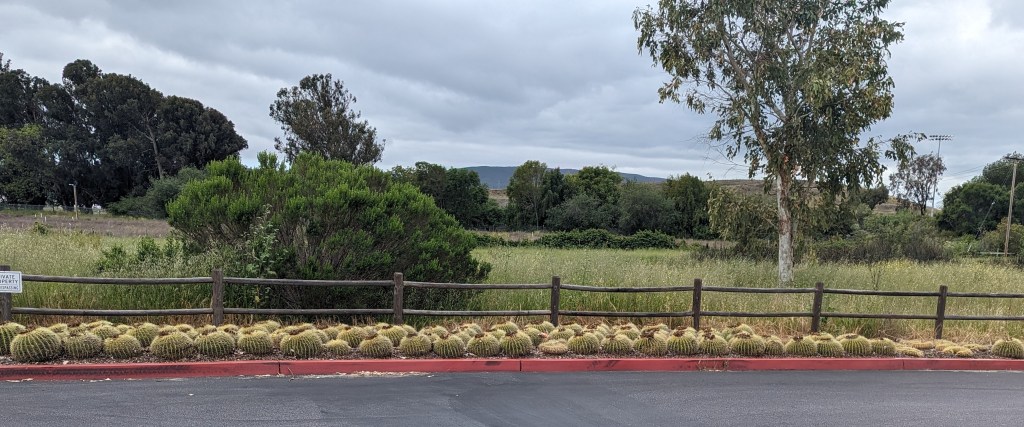
6. Is this good or bad landscape design? I typically prefer uniformity and symmetry, but this seems to be excessive. Several rotting specimens, mostly to the right, are disrupting the symmetry, but also leaving voids. I got this random picture as I left San Luis Obispo.

This is the link for Six on Saturday, for anyone else who would like to participate: https://thepropagatorblog.wordpress.com/2017/09/18/six-on-saturday-a-participant-guide/

Volunteer Days at the Arizona Garden of Stanford

Green waste from the Arizona Garden is fair game for volunteers.

(This article is from 2010, so contains irrelevantly outdated information.)

Some gardens are native gardens. Some are wildflower gardens. Others are vegetable gardens, white gardens or rose gardens. There are really all sorts of gardens. Mine though is the only garden that I am aware that is described by some as a ‘felony garden’.

This less than appealing distinction originates from my habit of ‘recycling’ green waste from other gardens. From the bits and pieces of debris generated by normal maintenance, I like to propagate copies of plants that I like for my own garden. Sometimes, I get large volumes of material, such as clumps of New Zealand flax or African iris. Sometimes, I just get small bits of pelargonium or English ivy. Sometimes, the small bits are not exactly generated by maintenance.

On March 20, I really scored big! I procured a pick up full of large canes of a somewhat uncommon species of yucca, along with more than a wheelbarrow full of pieces of various cacti, agaves, aloes and succulents! I suppose that I should feel guilty; but I was helping to dispose of the green waste generated by the volunteers at the Arizona Garden at Stanford University.

The historic Arizona Garden could actually use the help of more volunteers during their Volunteer Days every third Saturday of each month. Most of us were pulling weeds last month, and will likely be pulling more this month. Although there is not always booty to be had, (and no one scores like I did!) volunteers are welcome to the debris they generate from any needed grooming and pruning.

The next Volunteer Days will be on April 17, May 15 and June 19. Volunteers can arrive at any time after 9:00 a.m., and should bring heavy gloves since almost everything in the Arizona Garden is equipped with nasty thorns or spines. Some who stay through noon like to bring bag lunches. New volunteers should contact Arizona Garden Coordinator, Christy Smith at 650 – 723 7459 or christy.smith@stanford.edu before attending a Volunteer Day to get any other necessary information and specific directions to access the Garden.

On April 18, the day after the next Volunteer Day at the Arizona Garden, the Going Native Garden Tour will be visiting more than 65 gardens throughout the Santa Clara Valley and the Peninsula from 10:00 a.m. to 4:00 p.m.. The gardens range from newly planted to established, from townhome lots to acre parcels, but all feature native plants. Some gardens feature talks about native plant gardening. A few gardens will have native plants available for purchase.

It is not possible to see all the gardens within this self guided tour, so guests can choose which gardens to visit. Admission is free, but limited; so early registration is recommended. Registration is required prior to noon on the day of the Tour. Registration can be arranged, and more information about the Going Native Garden Tour and about volunteering can be found at www.gngt.org.

Prickly Pear

I can make good use of this bit of greenwaste.

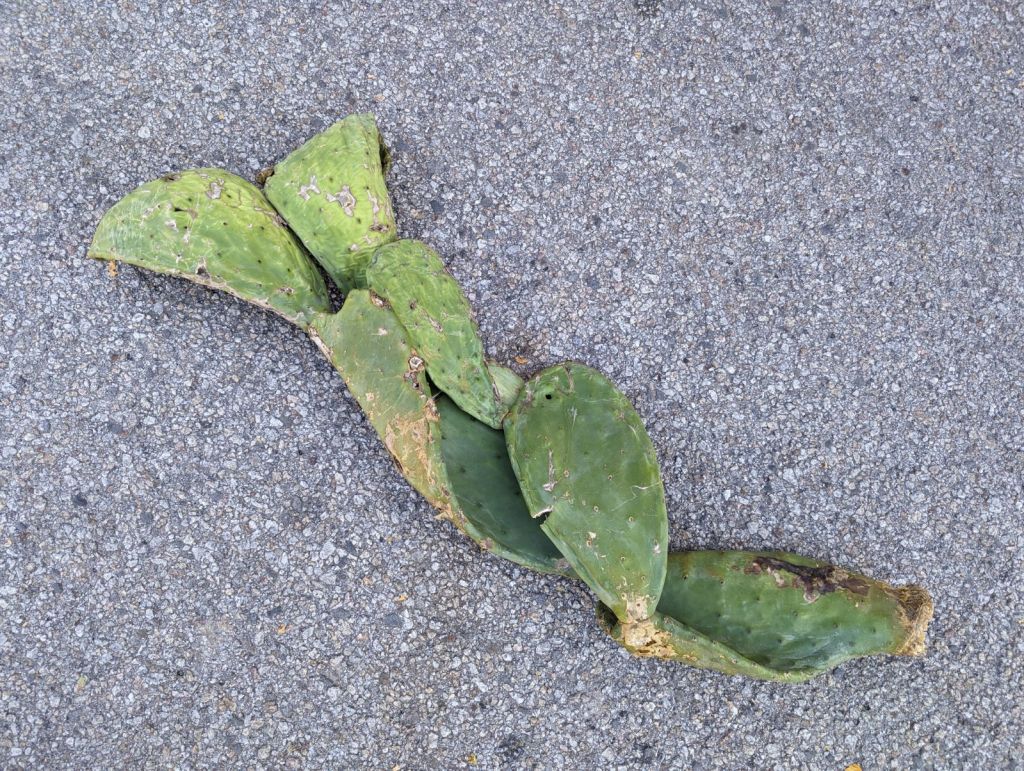
It is certainly no pear, and its particular cultivar is not overly prickly. Nonetheless, it is commonly known as ‘prickly pear’. It is also known as ‘Indian fig’, but is neither a fig, nor from India. The Mexican Spanish name for its fruit is ‘tuna’, but in American English, that seems fishy.

However, within its proper linguistic context, ‘tuna’ would be the least misleading of the common names of the fruit of ‘nopal’. ‘Nopal’ is the common name of various species of Opuntia, many of which are popularly grown as vegetables. ‘Nopales’ are plural. ‘Nopalitos’ are sliced or otherwise processed as small bits for culinary application.

Anyway, this shabby bit of nopal appeared within our big greenwaste pile at work. I find it annoying when neighbors exploit our greenwaste pile for disposal of greenwaste that is obviously not from our landscapes, as if I will not notice. Such debris often includes dirt and other crud or even trash that can not be chipped, and is almost never staged to facilitate efficient chipping.

This was quite a find though. It can be cut into six separate pieces to be plugged in between the five Arizona cypress that I installed as an informal hedge along the outer road. I would not have considered doing so if this had not appeared unwanted on our greenwaste pile. Nopal that I plugged a bit farther out, closer to the road, were shredded by weed whackers on a few occasions until they ultimately succumbed.

I already grow one unidentified cultivar of nopal for its eventual production of rich red tuna. I have no idea what this new acquisition is either, and it could be the same as what is already here, but I sort of hope that it produces yellow or gold tuna with milder flavor.

Succulent Plants Exhibit Unique Foliage

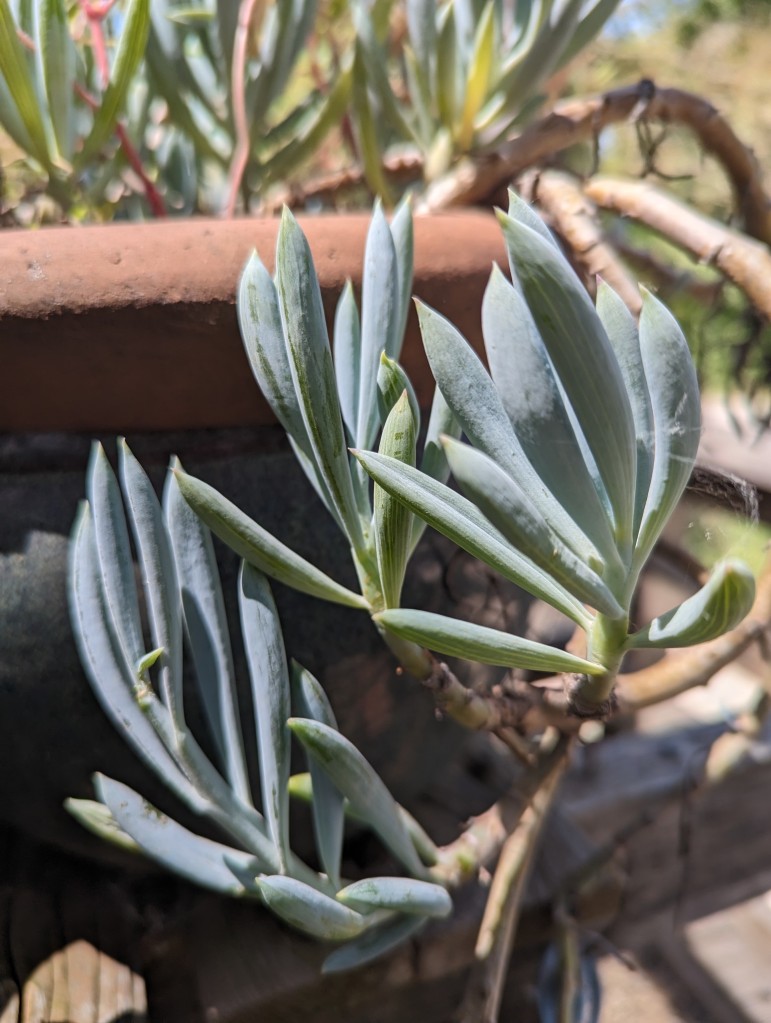
Succulents provide unique texture and form.

All cacti are succulents. However, not all succulents are cacti. Actually, cacti are a very unique family. Their distinctive spines and thorns are very specialized leaves and stems. Such specialized leaves can not photosynthesize without green chlorophyll. Therefore, cacti rely on their succulent green trunks for photosynthesis. Their trunks work as foliage.

But of course, not all succulents are cacti. Other succulents have succulent leaves. Most also have succulent stems. Some, such as most agaves and some aloes, are spiny, but not like cacti are. They have real leaves that happen to be spiny. Yucca are supposedly succulent, likely because of their relation to agave. However, they lack succulent parts.

Furthermore, not all succulents are drought tolerant. Many are so only because they are naturally native to desert or chaparral climates. Many others are naturally native to less arid climates. Some that are native to tropical rainforests, like epiphyllum, crave regular watering. Many succulents thrive in harsh exposure. Some prefer a bit of cooling shade.

Succulents are generally very adaptable to container gardening. Ironically though, a few of the most familiar sorts are not as complaisant to containment. Several cacti and other desert species need more water while confined. They must compensate for their inability to disperse roots. However, frequent watering or even excessive rain might promote rot.

Agaves, including those of desert climates, happen to perform splendidly within big pots. In fact, some perform too splendidly. If they grow too big and heavy to move, they are as permanent as if in the ground. Their dangerously spiny foliage compounds the problem. Overgrown cacti are both very difficult to move, and likely to break apart in the process.

Fortunately, there are plenty of smaller, tamer and thornless succulents to choose from. They contribute a remarkable range of foliar form, texture and color to the garden. Some contribute colorful bloom. A few, such as aloes and agaves, produce sculptural bloom. Most succulents are naturally resistant to pathogens, and easy to propagate vegetatively. Rooted scraps are less expensive than nursery stock is.

Six on Saturday: Hollywood

Vacation complicates blogging. So does spring. There is too much to get pictures of now. The pictures that I get are difficult to process while traveling without internet access. As has become typical for the past few weeks, these six pictures are already outdated. I took them prior to last Saturday, but I am only able to post them now. That is not the worst of it though. Even with so much blooming now, the only bloom within my Six for this week is scarcely visible, and half of these Six lack identifiable vegetation. The last is essentially devoid of vegetation. Heck, when it was more foliated between 1966 and 1968, the most prominent vegetation was fake. I might share six more appropriately floral pictures from the same location next week.

1. Opuntia phaeacantha or Opuntia littoralis, prickly pear grows wild in the Hollywood Hills. I got a picture closer to another herd for next week, but it may be another species.

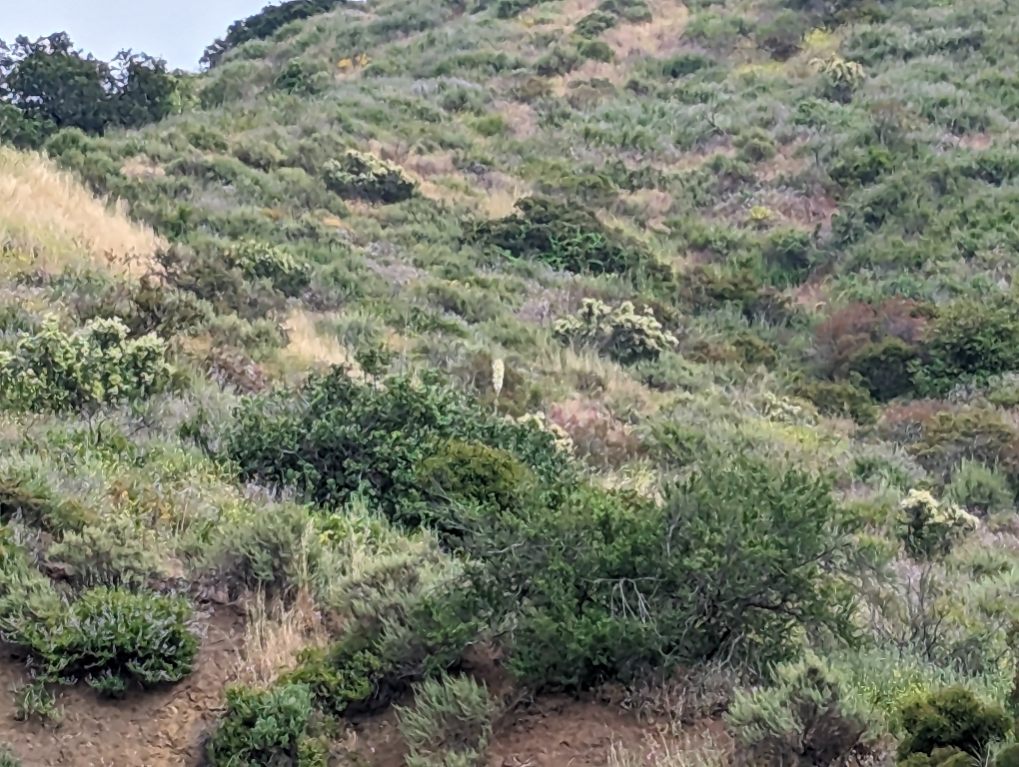
2. Hesperoyucca whipplei, our Lord’s candle blooms with an impressively tall and white floral stalk, but is barely visible at the center of this picture, taken from quite a distance.

3. Pinus pinea, Italian stone pine is obviously not native to the Hollywood Hills. I took a picture of this feral specimen because I thought it might be the legendary Wisdom Tree.

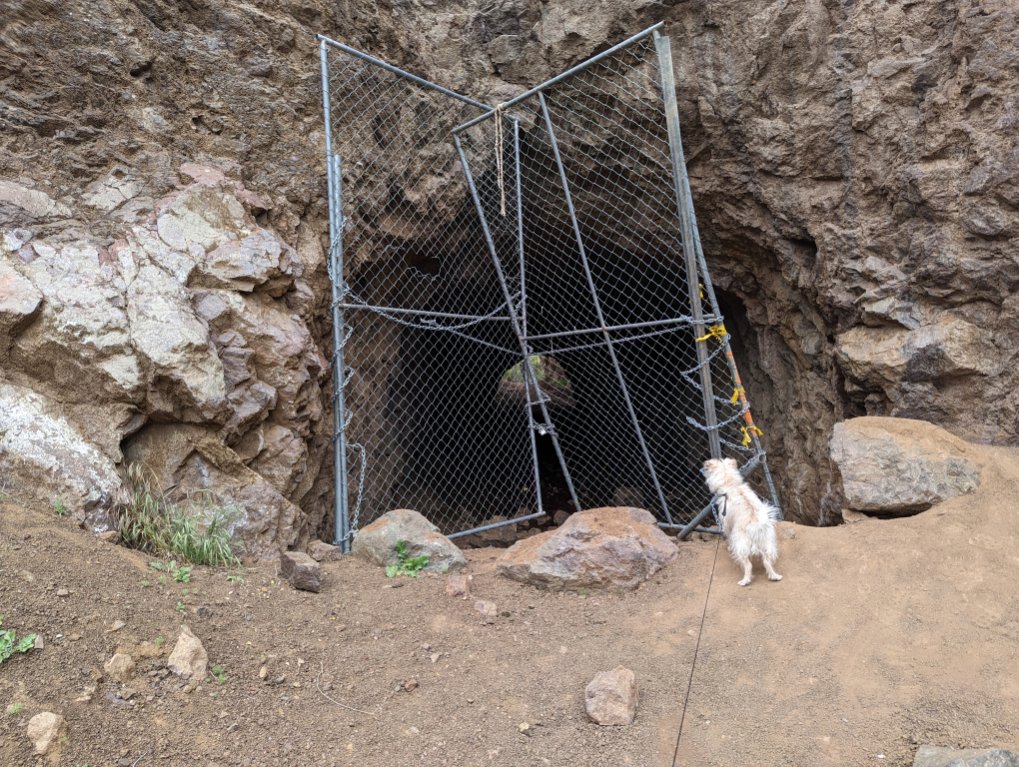
4. Not much vegetation is visible within this picture of an abandoned quarry, but Rhody directed me to this captivating scenery. Because of limited accessibility, we got no closer.

5. Zooming into the previous picture makes its scenery more captivating, and also shows a bit more vegetation within a residential landscape. Most of it is unidentifiable though.

6. Artificial English ivy with random native vegetation formerly inhabited this presently barren landscape. The busted fence is now quite uninviting. Does anyone recognize this?

This is the link for Six on Saturday, for anyone else who would like to participate: https://thepropagatorblog.wordpress.com/2017/09/18/six-on-saturday-a-participant-guide/