SNOW!?

P80110If you do not know what it is, ‘snow’ is like frozen rain.

If you do not know what rain is, I wrote about it earlier for those of us who are native to the drier parts of California. If you notice strange drops of water falling from the sky tonight, that would be rain. There is no need to be alarmed. It is expected to happen here tonight, and a few times for the next few days. Contrary to former experience, it is normal for this time of year.

Anyway, getting back to snow. Unlike rain, which sometimes happens here, snow does not happen here.

Well, perhaps that is not entirely true. It might have happened as recently as 11,700 years ago, as the Ice Age ended, and again in more recent history, in February of 1976, when an epically humongous snowstorm deposited as much as half an inch of snow over the Santa Clara Valley!

It is difficult to imagine such a huge volume of snow! It must have been disastrous! It would be even more disastrous now, with more than a million people just in San Jose, and many of them driving cars!

In 1976, we third graders did not consider it to be disastrous. We were not old enough to drive. We were perplexed and mystified at first, but rather quickly discovered that snow had serious potential for being fun. Our parents wadded it up into something known as ‘snowballs’ and then threw these snowballs at each other and the neighbors. Yes, I know it sounds crazy. Nonetheless, it looked like fun, so we tried it. It really was fun. We also discovered that we could just as easily throw snowballs at cars driving by, but we were instructed to not do that. We could see that the Santa Cruz Mountains were discolored by snow. They were an almost white hue of very pale blue, speckled with the more typical darker blue.

On very rare occasion, when the ‘smog’* and smoke blew away on clear and cold wintry days, we could see snow on the tops of the highest peaks of the Diablo Range east of the Santa Clara Valley, particularly on Mount Hamilton where Lick Observatory is located. We did not know what it was. Before snow happened in our own neighborhood, we wondered what discolored the peaks like that.

Now that smog rarely obscures the view of the Diablo Range, snow is visible on the group of peaks around Mount Hamilton almost annually. If it gets cold enough, a slight blush of snow might be seen on the lower East Hills in front of the Diablo Range. It is quite scary to think of how close to home snow can be. There happens to be snow up there right now!

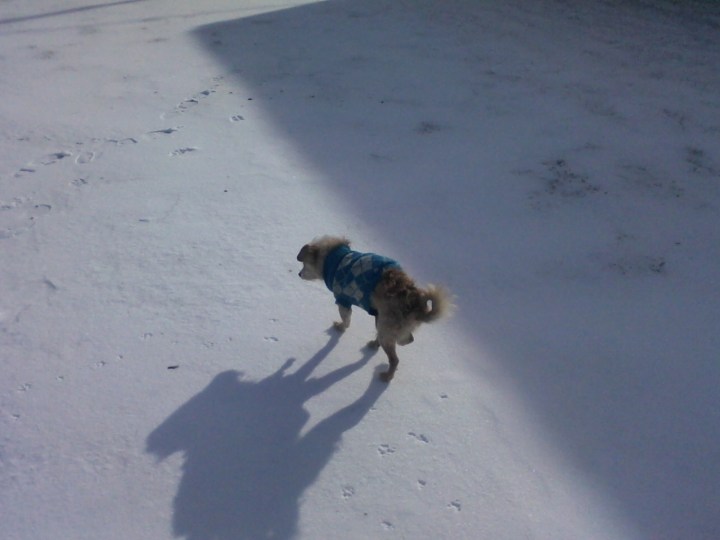
I am sorry that I do not have a picture of the snow on Mount Hamilton. I will just recycle this picture of Bill trying to escape snow south of Oklahoma City.

* Historical notation – The East Hills and Diablo Range to the east of the Santa Clara Valley were rarely visible in the olden days because of ‘smog’. If you do not know what smog is, you are fortunate. I have not written about smog yet because it is a part of our history that we would prefer to forget. To be brief, smog was a common form of air pollution. Although there was less smog in winter, there was more smoke from ‘fireplaces’ and burning ‘orchard’ stubble. A fireplace was a primitive heating device that warmed the interiors of homes and other buildings with the combustion of wood. An orchard was a grove of trees that were installed and maintained for the production of fruits, nuts and a few other horticultural commodities. Orchards once occupied vast areas of the Santa Clara Valley. Orchards that were removed to relinquish space for other development provided some of the wood for fireplaces. Perhaps I should write more about these later. I understand that the ancient history of the Santa Clara Valley can be rather baffling at times.
The Weather Outside Is Frightful

P80110It is certainly not as cold as it is in other regions at or north of this latitude. Nor is it unusually cold for this time of year. It is not stormy. We got only a few heavy but brief rain showers with a bit of small hail. A slight bit of snow fell only on the Summit of the Santa Cruz Mountains

The problem is that the weather had been so mild earlier, and at times, downright warm. Many plants were coerced into premature bloom. Some started to generate new spring growth. When the weather suddenly became more seasonably cool, many of the flowers and new growth got frosted and ruined.

Fortunately, most of the deciduous fruiting trees seemed to know what they were being set up for, and abstained from bloom. So far, even the early blooming apricots, cherries, almonds prunes and plums are safe. The wild American plums bloomed, but not many of us use their fruit anyway. (I want some – both amber and red – for jelly, but there will be plenty of other fruit.)

Saucer magnolias were just beginning to bloom when the cool weather moved in. Now, some of the big pink flowers are spotting and melting before they open completely. Many of the camellias are succumbing to blight, and falling to the ground shortly after they open.

Weather is always risky, even in mild climates. Actually, our mild climate allows us to grow more of the plants that are sensitive to anomalies of the weather. Perhaps such anomalies would be less of a problem in harsher climates where the weather is naturally more variable. If so, it is probably a fair compromise. The problems with such a mild climate are still less significantly less than the advantages.

The Coast Is Clear

P80218Between here and Hawaii, there is a whole lot of water. Between Hawaii and Australia, there is a whole lot more. Everywhere to the west and southwest of California, there is a lot of water. Unfortunately, none of this huge volume of water is useful for gardening. It is saline. It would kill plants.

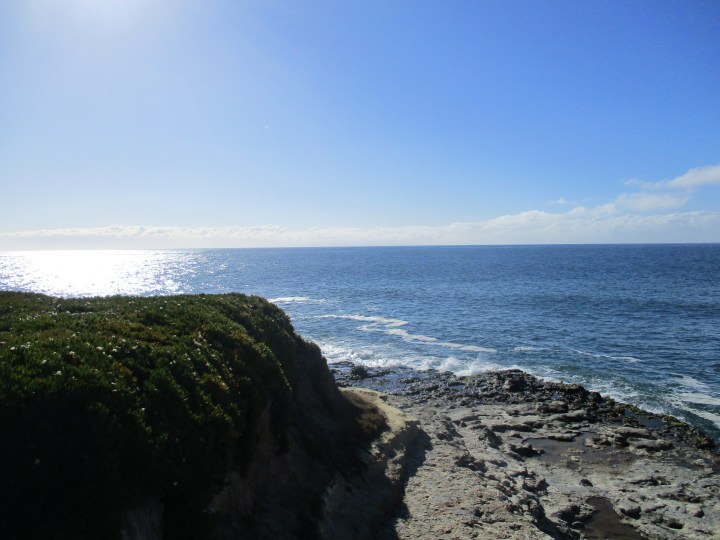
Of course this is not just any water. It is the Pacific Ocean. Although the water within it is useless directly, it is what feeds the weather that provides the precipitation that becomes the water that makes gardening and everything else possible. Rain fills local aquifers. Snow in the Sierra Nevada fills reservoirs as it melts.

The weather that the Pacific Ocean feeds gets shared over a very large area. Weather that does not make rain here might make rain or snow in Nevada, or Oklahoma, or really anywhere the weather wants to go to. In fact all the oceans all over the world cooperate to make climate and weather what it is.

What is so special about the Pacific Ocean being right here off the coast is that it moderates our climate and weather. Places like Nevada and Oklahoma that are not on the coast get water from the Pacific Ocean because weather is mobilized. The moderating effect of all that saline water is not. It stays right here in coastal regions.

Water has a high specific heat. That means that it takes a lot of energy to change the temperature of water. Saline water has an even higher specific heat. The temperature of the Pacific Ocean therefore changes very slowly and very minimally.

This inhibits extremes of temperature in the air above all that saline water. Small batches of extremely cold weather tends to collect a bit of heat energy as they pass over the Pacific Ocean. Weather coming in over so much saline water can not get extremely hot without the water absorbing at least some of all that heat energy. Therefore, coastal weather is rarely extremely cold or extremely hot. Temperatures can be more pronounced a few miles inland from the Pacific Ocean, especially when the weather comes from inland. Farther inland cold and heat can get significantly more extreme.

A lack of cold weather in winter limits what can be grown here. Plants that require a good chill are not satisfied with our pathetic winters. That is why some bulbs that do well as perennials farther inland bloom only once here, and why some varieties of apple that perform well in central Washington are not grown here.

However, a lack of hard frost allows us to grow many plants that can not be grown where winters are more severe. Even if bougainvillea gets frosted every few years or so, it typically recovers. Avocados and lemons are likewise quite happy here. The weather may seem to be boring, but it certainly has its advantages.

Snow

P80110It seems that almost all of us in the Northern Hemisphere are talking about it. Those of us who lack it can get to feeling somewhat deprived. It looks so pretty in pictures. It seems like such a natural part of winter. To many of us, it is a good excuse to take a break from gardening, stay inside, and write more compelling articles than the more technical sorts written when there is more activity in the garden.

In California, we get almost everything. Although most of the most densely populated ares lack snow, parts of the Sierra Nevada get more snow than anywhere else in the world. Californians can go to the snow to ski, hike, take pictures and do whatever people want to do in the snow; but we do not need to live with it at home like most people in other states do.

I grew up without snow. It snowed only once in 1976. It was only half an inch deep. The snow fell overnight while everyone slept, and it melted by early afternoon. Because the turf in the schoolyard was not resilient to snow, we were not allowed out there until the snow was gone. I later saw snow only when we went to where the snow was, in the Sierra Nevada. Snow only rarely fell at my home near the summit of the Santa Cruz Mountains above town, and it stayed for only a few hours.

I never had to live with snow until I went to Oklahoma at the end of 2012. Even then, it was minimal. The first snow fell only about three weeks before we left, and it never accumulated more than two inches or so. The difference from what I had experienced prior to that was that it lingered. It took a few days to melt. As minimal as it was, I could totally understand why people who live with snow dislike it so. I really can not imagine living with more accumulation of snow for months at a time.

First of all, snow is cold. It is very cold. It is, after all, frozen. That would not seem like much of a problem when the air is already cold, but snow is different. It sticks to the sides of boot and makes them cold inside. It seems to hold the cold on whatever it covers, including parked cars.

Also, snow is wet. Yes, as I already mentioned, it is is frozen, but it is frozen ‘water’, and it does not stay frozen when one is trying to get warm after being out in it. It gets clothing and everything else wet, just like a light rain. Frozen snow gets tracked in on boots and then melts just inside the doorway.

To go along with that, snow is messy. As cars drive through it, it becomes muddy, but does not necessarily melt right away. It becomes slushy mud that splatters onto otherwise clean cars.

There is actually quite a list of things to dislike about snow. It is dangerous on roadways. When it gets pushed off of roadways, it piles up around parked cars and on top of plants that happen to be in the way. I think that I prefer to see it in pictures of Switzerland, Minnesota, Ontario and Mount Hood as it looks from Portland.

Sometimes I think that it would be nice if we got a bit more of a chill here. We would be able to grow more varieties of apples, pears and other fruits. Perhaps peonies would do better, and autumn foliar color would be more spectacular. There are so many things that we can not grow or that do not perform as well as they want to in such a mild climate. However, all those frost sensitive plants that we can grow that others can not grow are nice too. Either way, I will pass on the snow.

Bill was mostly blind by the time we went to Oklahoma, but he could feel the snow on the ground well enough to determine that he did not like it either.P80110+.jpg

My Internship Was NOT In Australia

P80106Australia, New Zealand and South Africa were the hip and trendy places to do internships in horticulture back in the late 1980s. Everyone who was anyone was doing it; which is sort of why I was not that interested in doing what everyone else was doing already, even if I could have afforded to go to any of those exotic places. I did my internship in Saratoga.
All I knew about Australia was Olivia Newton John, Helen Reddy, eucalyptus trees, and that it is the place where summer goes when it leaves here.

Since writing online and learning a bit more about horticulture in Australia, I incidentally found that Australia is stranger than I would have imagined.

There are no Pontiacs in Australia! Seriously! When someone asked about what to do with a surplus of peaches that were too overripe and squishy to can, I suggested that they get thrown at the neighbor’s Pontiac. It was such a fun tradition among kids in the Santa Clara Valley back in the 1970s. I did not expect to be taken seriously; but I did not expect to be informed that there are no Pontiacs there! How totally primitive! I did not even ask about Buicks. If they lack Buicks, I REALLY do not want to know about it. I did happen to ask if cars were driven on the left side of the road, which they are; not that it matters. Without Pontiacs, who cares?P80106+

Then there are these terrifying animals known as wallabies! They look like humongous rats! They come out early in the morning and again in the evening, when their victims are most vulnerable. They always stare at whomever is taking their picture, as if plotting revenge. They aim their ears too, in order to hear everything that is being said. They are watching and listening right now!P80106++

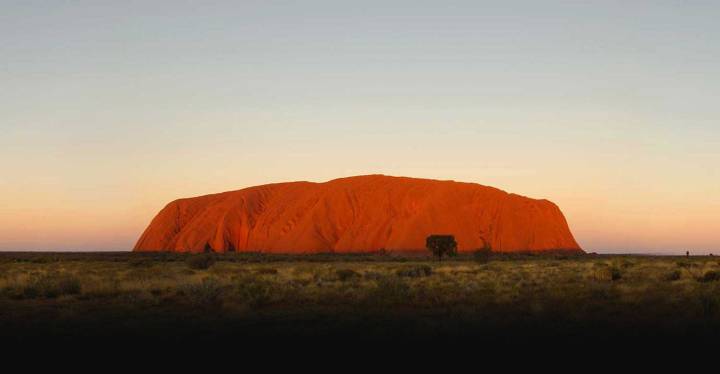
The middle of Australia is known as the Red Center, which sounds rather like Oklahoma. Uluru is a huge red rock at the center of the Red Center. It really is the color of Oklahoma, and sort of shaped like the 1979 Pontiac Bonneville in the other picture above. You should have seen the pictures that another blogger posted of this fascinating place, and nearby places! The geology alone is fascinating, and mixed with it are all sorts of eucalyptus trees just growing wild. I mean wild, as in they are native there; not exotic like they are here. It is weird to see them out in their natural environments, like valley oaks and coast live oaks here. Wallabies do not seem to bother them much. Most of Australia seems rather flat. There are not many high mountains, and they are not really all that high.P80106+++

Queenslander is an architectural style developed for the climate of Australia. It is named for the northeastern state of Queensland; so has nothing to do with slandering an unpopular queen. I did not know that it was all that different from the Ranch architecture that is common here until someone explained that the homes are up off the ground to allow for air circulation underneath. Some are up high enough for another story to fit below. I suppose that the lower floor could either be at ground level, or elevated as well. Unlike Ranch architecture, Queenslander can be either one or two stories. Also, they tend to be somewhat bisymmetrical, with the front door and steps in the middle, and the left side matching the right side. Some have extra rooms, such as a solarium, on one side. Porches extend at least across the fronts of the homes. Many extend around the sides as well. Simple Queenslander homes tend to be rather square, with only four sides. Their roofs are also rather square, sloping toward all four sides, instead of just sloping to the front and back like roofs of common Ranch architecture often do. One advantage over Ranch architecture is the hood over the steps to the porch. It diverts rain to the sides if there are no gutters. Queenslander homes do not seem to have prominent garages visible from the front, perhaps because Australians lack Pontiacs or other cars that are worth showing off.P80106++++

Australia is less populous than California is, and almost everyone lives near the coast. That is something that I was sort of aware of. What I did not know is that there are FIVE cities that are more populous than San Jose! BOTH Melbourne AND Sydney are more populous than Los Angeles! How are there enough people left over to live anywhere else? Adelaide is one of the five major cities, and also has a climate remarkably similar to that of San Jose. It even sort of looks like San Jose, with the East Hills in the background. It does not look as big as San Jose though. Adelaide seems to be a bit more centralized, with more high density development, and less urban sprawl. This might be a result of a lack of Pontiacs or other nice cars to drive to suburban areas. Perhaps people just prefer to live closer to town because wallabies live on the outskirts. Queenslander homes seem to be on suburban parcels that are probably on the outskirts, but they are also outfitted with those distinctive fences.

‘Rain’

P80103+Like something from an old fashioned science fiction movie, this anomaly appeared in a roadway overnight. There are several more in other roadways and elsewhere about town. They are quite wet. In fact, they are composed almost completely of water. What is even weirder is that the water that they are composed of actually fell mysteriously from the sky overnight as many countless droplets all over town! Many of these droplets migrated into low spots such as this one to form what we now see in this picture.

People in other climates where these mysterious droplets are not so rare might be familiar with this sort of phenomenon. The droplets of water are known as ‘rain’. They precipitate out of the atmosphere as it cools and can not contain as much water vapor as it did when it was warmer. As the droplets migrate into low spots in roadways and anywhere else, they accumulate into these collective herds of droplets known as ‘puddles’. Many of the droplets continue to migrate as huge herds known as ‘creeks’, and even bigger creeks known as ‘rivers’. Some of these creeks and rivers migrate into really big puddles known as ‘ponds’, and even bigger ponds known as ‘lakes’. Sadly, not all of the droplets can be accommodated in ponds and lakes, so many continue to migrate out into the ‘ocean’, which is that really big pond full of salty water to the west that we are all familiar with.

Hopefully, some of these droplets of rain will stay around for a while and provide water for the plants in our gardens and forests. Ideally, some will burrow into the ground and stay for a very long time, and maybe even migrate into the aquifer to hibernate. In our climate, particularly after such a long and dry summer and autumn, these strange droplets of rain are very welcome to stay as long as they want to.

Unseasonable Weather Can Confuse Plants

70920thumbEven without any of the five senses that we are outfitted with, plants are remarkably perceptive of the weather and the changing seasons. They know precisely what time of year it is because they know how long the sun is up. Their calendar is just as accurate as ours is. They also know that the weather has been getting progressively cooler through autumn, and that it rained a bit earlier.

New Zealand tea tree, torch lily, euryops daisy and many other plants from other temperate climates do not seem to care that they should not be blooming at this time of the year, if the weather is telling them otherwise. If the weather is warm enough during the day, even if it gets cool at night, these plants will bloom right up until things get really cold, even if some of their bloom gets frosted.

Saucer magnolia, lilac, apple and the many other plants from climates with cooler winters should know better than to bloom this time of year. Many bloom only once annually, so whatever blooms now will not bloom when it should next spring. Besides, the flowers that try to bloom now will bloom slowly, and probably be ruined by cool or rainy weather before they can develop completely.

Roses had a particularly weird year. They bloomed well and on schedule last spring, but then idled through much of summer, only to express a new interest in blooming now that they should be going dormant for winter! No one wants to prune them while they have more buds than they did in August. Fortunately for them, they bloom more than once annually, so should recover by spring.

The colorful foliage of sweetgum and Chinese pistache, as well as the observable weather, indicate that everything is more or less in order for this time of year. Autumn might have started out mild, but it had been even warmer in past years. It is impossible to say why some magnolia, lilac and apple are trying to bloom already. They each have such distinct personalities, and respond to so many different variables besides the obvious; daylength, temperature and humidity.

Oklahoma

P71119Standin’ on the corner in Winslow, Arizona, specifically on the corner of West Second Street and North Kinsley Avenue, there was this bronze statue of someone famous. I am still not certain who he was. A statue of Glenn Frey was added nearby later, and might have replaced this one, but I could not find much news about it. The new statue does not look anything like this statue, which was the only one there when we stopped to get our picture taken there five years ago on our way to Oklahoma.

We did not plan the trip very well. We did not plan it much at all. We were in a less than ideal situation at home, so loaded up a tired old Blazer and went on our way. I sort of planned on staying for a few days or maybe two weeks, and then returning alone to Felton, and then tending to some work near Hilo in Hawaii by early December. Steven and Gayle who are with me and the bronze guy in the picture were to stay in Oklahoma. Of course, even these meager plans did not go as planned. I stayed much later, and all three of us, Bill the terrier and Darla the kitty all returned to Felton on the last day of 2012.

What a trip! It was the farthest I had ever gone from the West Coast, and the longest time I had ever been out of California. It was my first time in another time zone, and then another! I actually ‘lived’, albeit temporarily, in Oklahoma; and I got to drive through Arizona, New Mexico and a small part of Texas to get there!

I had always wanted to go to Oklahoma because I had heard so much about it growing up. My maternal grandmother was an Okie, so much of what I learned about horticulture was from that background. To me, it was one of those magical places where great grandparents lived and grew tons of fruits and vegetables in the rich red soil on their farm. It was where the wind comes sweepin’ down the plain, and the fragrant wheat sure smells sweet . . . okay, so maybe not that part.

Oklahoma certainly did not disappoint. It was exactly as I knew it would be, but was completely fascinating anyway. Pecan, black walnut and various hickory trees grew wild, as well as American persimmon, Eastern red cedar, redbud, honeylocust and blackjack oak. Vacant parcels were overrun with native red mulberry, campsis, honeysuckle, Arkansas yucca and sumac. I collected seed from more specie than I can remember.

The funny thing about all this is that the Okies did not understand my interest in all their flora. Much of it was the sort of stuff that they cut down and burn. The Eastern red cedar, honeylocust, red mulberry, campsis and sumac were quite unpopular for their habit of growing into rangeland. Even less invasive plants did not impress those who had always been around them. To them, redwood, big oaks, avocado, citrus and all the cool exotic specie that we grow in California are much more interesting. It was a matter of perspective.

Change of Format

P71019

This blog is now two months old; so it is about time that I start to recycle old articles instead of writing so many ‘elaborations’. The articles are probably more interesting and relevant anyway. They will be from the same time last year, or previous years. Like I have been doing with new articles, the old articles will be split into two separate postings. One will be the main topic. The other will be the ‘plant’ of the week. So, one new article and one old article split into two postings each week leaves only three days for ‘elaborations’. Redundant articles will be omitted. Eventually, I will refrain from daily postings. Also, I will try to keep my ‘elaborations’ brief. I know I tend to get carried away with this. Alternatively, I may recycle another article each week, leaving only one day for ‘elaborations’. I will figure this out as I go along.

While I am taking the time to post something that has nothing to do with gardening, I should also mention that one of my main objections to writing a blog is that so much of what I write about is specifically for the climate in which I live, and not necessarily applicable to other regions. My articles are written for newspapers between San Francisco and Beverly Hills (in Los Angeles County). However, since starting this blog, I have found that not only do the newspapers that I write for already share my articles with newspapers in other regions, but that people who read my articles in other regions are already as aware of regional differences as I am. People in Australia seem to be as interested in reading about autumn during their spring as I am interested in reading about their spring during autumn. People seem to know how much of the information that I present is actually useful to them, and can distinguish information that is not accurate for their respective applications. Now, I feel much better about posting my articles, as well as writing about whatever I want to write about.

If you are wondering how the picture of Rhody above is relevant to the posting, it has no relevance. He just had a way of getting you to read my blog earlier, so I tried it again, and it worked.

The Trees Know

P71014The trees look spooky now. Box elders, honeylocusts and alders, and even some of the sycamores, have dropped so much of their foliage since that weirdly hot weather a few weeks ago. The smoky sky as a backdrop enhances the spooky factor. The trees do not seem to be too distressed. They just dropped their leaves a bit early to conserve resources. If they had not dropped foliage by now, they would be dropping it soon anyway.

Trees are not stupid. They know what they are doing. Otherwise, they would not survive as long as they do out in the elements. Sometimes, they seem to know what the weather will do before it does it; like dogs, cats and horses that start to get their undercoats early before a cold winter.

Deciduous trees and other plants defoliate for winter for a few reasons. Those from farther north probably see no need to work so hard to collect sunlight while sunlight is so minimal. Up north, days are shorter, and sunlight is diminished as it passes through so much of the atmosphere at a lower angle. Deciduous plants from colder climates shed their foliage because they know that if they do not, it will get frozen anyway. Those from snowy climates do not want foliage to collect heavy snow that can break limbs. Defoliation also eliminates much of the wind resistance that can break limbs during winter storms. There are a few advantages to being deciduous.

In California, we have a native California buckeye, Aesculus californica. In chaparral conditions, it can be ‘twice-deciduous’. It does not need to be so in less arid regions, such as the Santa Cruz Mountains. It really depends on the weather.

As a twice-deciduous plant, the California buckeye develops new foliage in spring like other deciduous plants do. It stays foliated as long as it wants to; but if things get too dry and warm in the middle summer, the foliage shrivels and falls. To a casual observer, the trees seem to die. However, between the first autumn rain and the first winter frost, California buckeye develops a second phase of autumn foliage to briefly compensate for summer dormancy. This foliage stays late until it gets frosted and falls. Winter dormancy is just like that of any other deciduous tree. In spring, the process starts all over again.