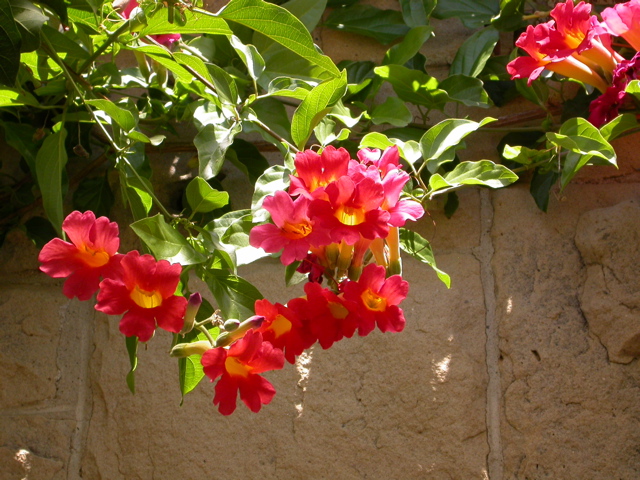
Abundant lush foliage is actually the main asset of blood-red trumpet vine, Distictis buccinatoria, with the sporadic clusters of three inch long tubular flowers blooming as an added benefit during warm weather. Bloom can certainly be impressive when least expected though; and has a sneaky way of getting a late blast of color out during Indian summer weather patterns, when the weather gets warm after a cool phase in autumn. Contrary to the name, the flowers are more ruddy orange with yellow throats than blood red. The rich green leaves are compound, with a pair of three inch long leaflets and a three fingered tendril reaching out from between.
The vines are somewhat aggressive and can climb more than twenty feet, so need adequate support. They should not be allowed to overwhelm smaller or slower plants, or escape out of reach into adjacent trees. The tendrils can grab onto and damage shingles and light fences, but are an advantage for covering chain link fences. Given the opportunity, blood-red trumpet vine can even climb rough cinder block or stucco walls.
So many of the vines that we enjoy in our gardens might not be so appealing if we knew how they behave in the wild. Many of their characteristics that are often practical in garden situations are detrimental to neighboring plants in natural settings. If they can get away with it, vines can be just as brutal in our own gardens.
Creeping fig is perhaps the most brutally aggressive of vines. Like many other vines, it exploits trees for support. While it reaches the top of the trees, it wraps the tree trunks with a grafted network of stems that expands as it grows, literally strangling the trees that gave it support. By the time the supporting tree trunks decay, the creeping fig has developed its own self supporting trunk. Algerian and English ivies can do the same.
Fortunately, these vines rarely get such opportunities in garden situations. Nonetheless, they need to be kept out of trees that might otherwise get overwhelmed. Since they attach to the surfaces that they climb by aerial roots, they should not be allowed to climb onto painted surfaces, stucco, or anything else that they can damage.
Boston ivy supports itself by holdfast disks, which it leaves on everything that it gets a hold of. If the vines get removed to paint a wall, the disks remain. Like creeping fig and the ivies, Boston ivy, should therefore only be allowed to climb surfaces that are not likely to be damaged by its climbing techniques. Creeping fig and Boston ivy both happen to be quite practical for freeway infrastructure and sound-walls, but are difficult to accommodate in tame urban landscapes.
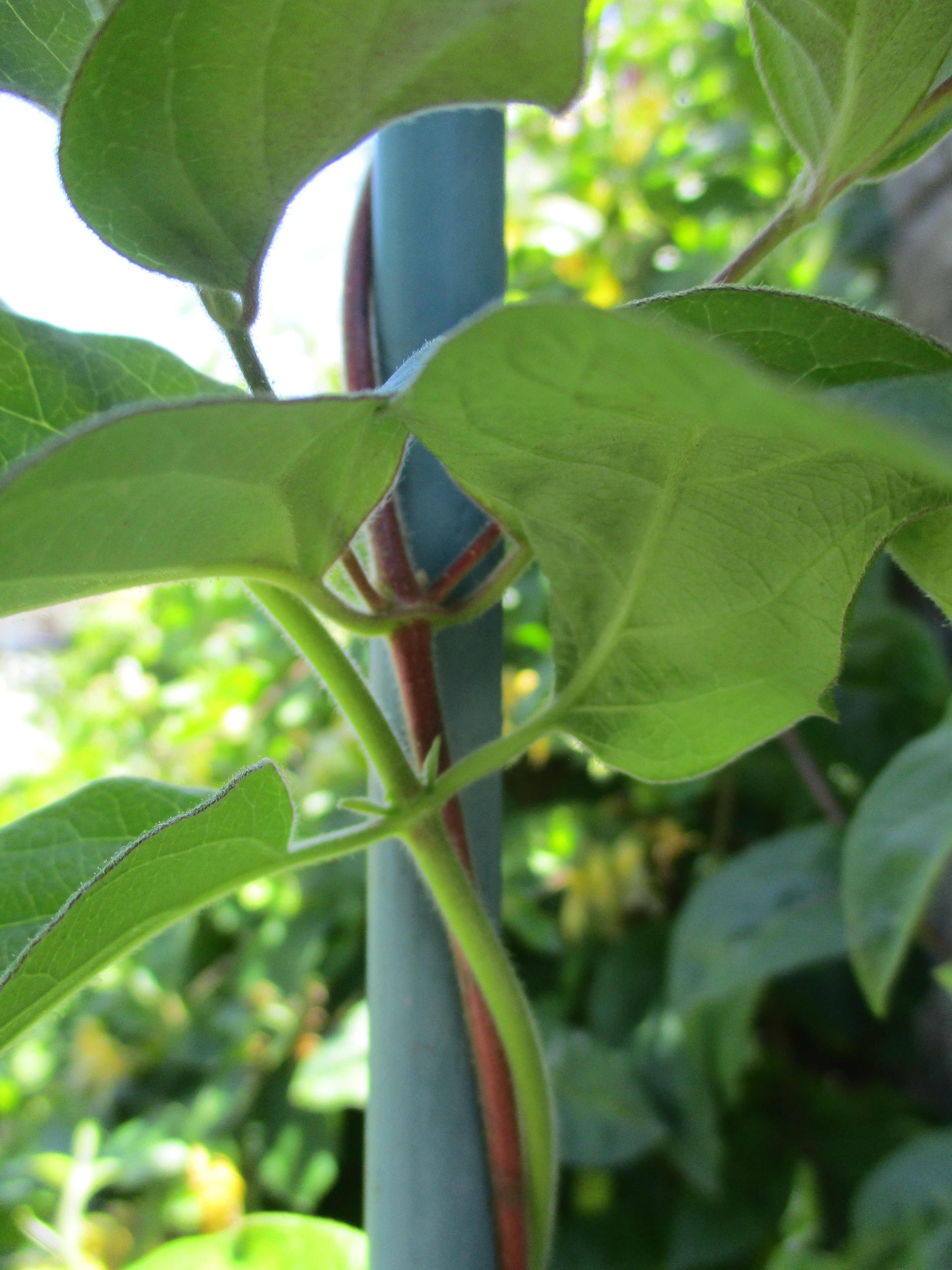
Wisteria is another very aggressive vine that can overwhelm small trees and shrubbery, but lacks aerial roots. It instead climbs by twining stems, which are safer for painted surfaces, but can constrict and crush light trellises, wooden shingles, lattice or anything else that that wrap around. It is certainly worth growing, but needs adequate support.
Bougainvillea and climbing roses do not climb on their own, but instead produce ‘scrambling’ canes that shoot upward and then lean onto their surroundings for support. If grown as vines, they need to be fastened to their support. If not pruned back occasionally, they can get quite overgrown and shrubby. Most varieties that are popular now fortunately stay small and manageable.
Honeysuckle, potato vine, blue dawn flower, evergreen clematis, star jasmine and the various trumpet vines are more manageable, but are still moderately aggressive. Carolina Jessamine, lilac vine, mandevilla, and passion vine are among the more docile of vines, only outdone by the annual vines like annual morning glory and climbing nasturtium.
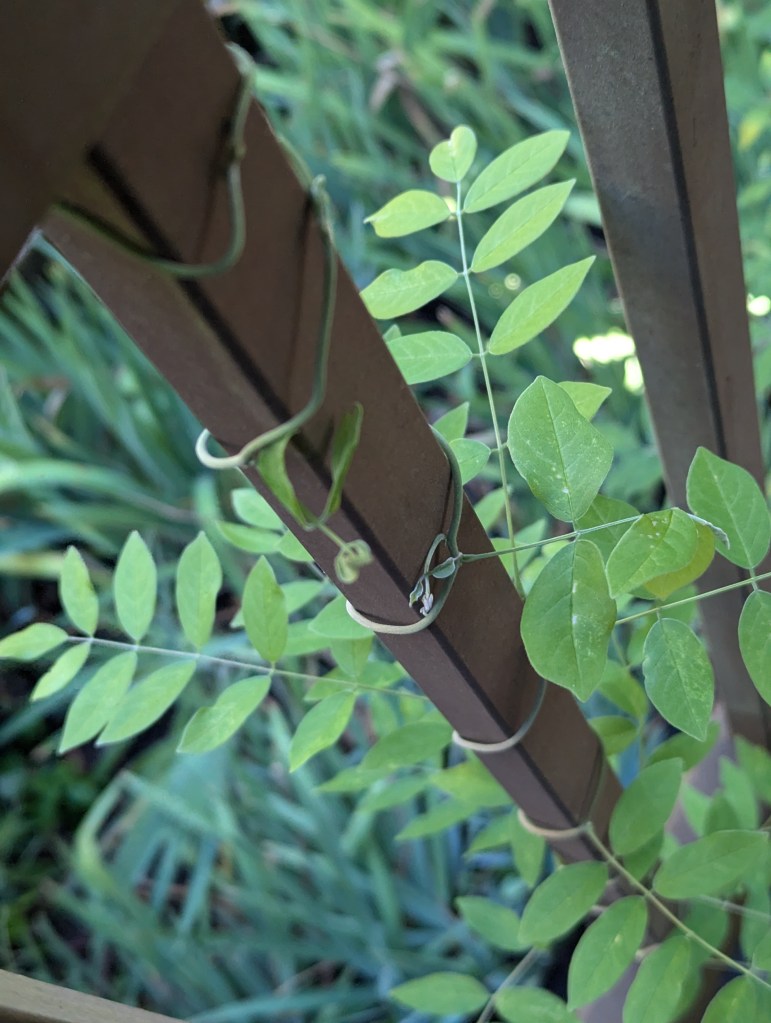
Chinese wisteria is an aggressive vine! A few that have gone wild near here have climbed high into redwoods, or spread over large areas of forest, or both. Some may have been planted intentionally, and then been abandoned. Some may be feral. Japanese wisteria may have potential to do the same, and perhaps some have already done so without being recognized as a different species from more common Chinese wisteria. Both species are spectacular while blooming within refined landscapes, but can be difficult to accommodate within the often neglected or partially forested landscapes here. That is why I am so pleased to try the much more docile American wisteria, Wisteria frutescens. I do not remember the name of this particular cultivar, but it blooms with bluish lavender floral color that is comparable to that of the more traditional Chinese wisteria. Like Chinese wisteria, other cultivars can bloom white or more purplish, and supposedly even pink, although I have yet to see even pictures of it blooming pink. It is not as spectacular, primarily because it is so much more docile, so does not grow nearly as large. Also, the floral trusses are relatively short, stout, and cylindrical in form, so protrude more rigidly outward like bottlebrush bloom, rather than more pendulously like the familiarly elongated and conical floral trusses of Chinese wisteria, or the more elegantly elongated floral trusses of Japanese wisteria. Kentucky wisteria, Wisteria macrostachya, is supposedly quite similar, but blooms later with more bluish color, rather than lavender. ‘Clara Mack’ is a cultivar that blooms white. After I see how American wisteria performs here, with its traditional wisteria colored bloom, I would also like to see how ‘Clara Mack’ Kentucky wisteria performs here. It could be a delightfully docile alternative to traditional Chinese wisteria for the White Garden.
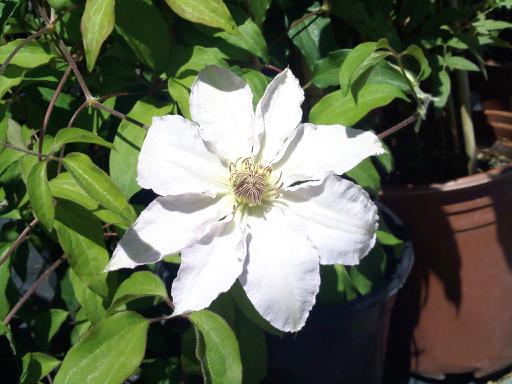
Like the big bark of a little terrier, the big and boldly colored flowers of large-flowered hybrid clematis seem to be more than their delicate vines should be able to produce. Almost all of the many modern varieties bloom with flowers that are at least three inches wide; and some have slightly ruffled double flowers. Their rich, deep, and sometimes two toned shades of red, blue, purple or pink, as well as white seem too opulent for their simple wiry stems that may climb to only six feet or so. The dark green compound leaves grab harmlessly onto light trellises, stakes or lattice. Although the foliage and flowers want sunny exposure, clematis roots do not like warm soil, so appreciate generous mulching. Some people like to give them a wide rock to disperse their roots under, or plant them next to large pots that sit directly on the soil. I planted mine on the north side of the northwestern corner of the house where the soil was always shaded, and allowed it to climb around the corner onto an iron banister on the west side.
Clematis want to be watered and fertilized regularly, and well drained organically rich soil. They should be pruned rather aggressively in winter while they seem to be dead, but are really just dormant.
Bougainvillea does not cling to its support. It merely leans on it, or must be tied.
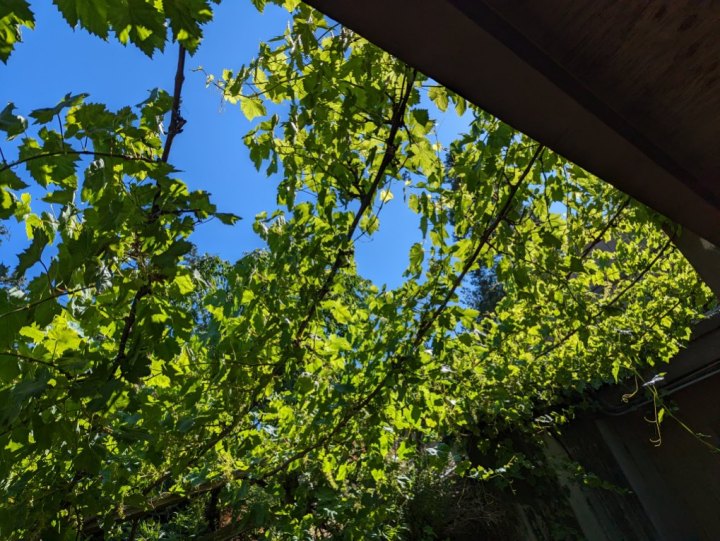
Harvesting grapes from a pear tree last summer reminded me why it is so important to control the grape vines this year. Without proper confinement to the fence below, the grape vines had climbed into and overwhelmed the pear tree above. My neighbor who witnessed the consequences of my lack of diligence in the garden, and helped me with the harvest, mentioned that the ‘grape tree’ was more productive than the vines had been when properly maintained during the previous year. I was embarrassed about my transgression nonetheless.
My colleague in Southern California has no problem grooming the many different kinds of vines that adorn arbors, trellises, walls, fences and railings in his garden. I certainly could not let him find out that I was vanquished by my single grapevine, which he refers to as ‘Dago wisteria’. I probably remind him of how important it is to control his vines more often than I am offended by racial slurs.
The trick is to select vines that are appropriate to each particular application. Vines for small, light trellises must be relatively complaisant, like lilac vine, pink jasmine, Carolina jessamine or clematis. Aggressive vines like wisteria, grape (the ‘other’ wisteria) and the larger trumpet vines need hefty trellises or arbors. Brambles and scrambling plants like bougainvillea and climbing roses do not actively climb, so need to be tied or ‘tucked’ into their supports.
Some of the seemingly innocent vines can actually become somewhat aggressive. Mandevillea, potato vine and star jasmine have wiry stems that seem harmless enough, but can eventually tear apart lattice or light trellises. Perennial morning glory and passion vine are potentially invasive. Trailing nasturtiums and annual morning glory really are as innocent as they look, so are nice small annual vines where space is limited. I prefer pole beans though.
Vines like Boston ivy, Virginia creeper and creeping fig that attach to their supports with roots or discs (modified tendrils) are too destructive for most applications in home gardens. They are fine on unpainted reinforced concrete buildings and concrete walls, such as the retaining walls and sound walls of freeways, but will ruin paint, siding, stucco and shingles. Unlike the other vines, these lack colorful bloom. Boston ivy and Virginia creeper produce remarkable fall color though, but then defoliate revealing bare stems through winter.
Algerian and the various English ivies are good ground cover plants that will become climbing foliar (without showy blooms) vines if they reach support. Unfortunately, they root into their support like creeping fig does, so have limited practicality. Honeysuckle is an aggressive vine that can also double as a ground cover.
These pale, inch-wide, star shaped flowers of pink jasmine may not be much to look at, but are remarkably fragrant.
As winter turns to spring, pink jasmine, Jasminum polyanthum, blooms with abundant, loose trusses of small but very fragrant star shaped flowers. The flower buds that are initially deep pink open to soft pink, and then fade almost to white. Light shade inhibits bloom and limits foliar density, but does not prevent the wiry vines from climbing to twenty feet or so. The dark green leaves are compound with five or seven leaflets. Pink jasmine is one of the few vines that can climb lattice and light trellises without tearing them apart like wisteria and so many other popular vines eventually do. Even if it escapes confinement and gets into trees or onto roofs, it does not get too far to be pruned back within bounds.
Grapevines that were not pruned aggressively enough last winter are tangled messes by now. Many grapevines that were pruned properly are tangled messes as well. That is their nature. Woody vines like grapevines grow rapidly and vigorously. They rely on other plants for support, and do what they must to get to the top. Woody vines are not concerned about the plants that support them.
Woody vines climb structures also. Some cling to stucco and siding with aerial roots or modified tendrils (holdfast discs), that ruin paint and promote decay. Woody vines with twining stems wrap around posts and beams, and then crush them as they grow. All sorts of vines can dislodge shingles, roof tiles, gutters, downspouts or window screens. Some sneak into basement or attic vents.
Even relatively docile woody vines can get out of control fast. Star jasmine performs well as ground cover, but can climb more than twenty feet up trees if neglected long enough. Pink jasmine, lilac vine and Carolina jessamine are tame enough for lattice, but get overgrown on top if not pruned down. American wisteria is much smaller than Chinese wisteria, but can still strangle small shrubs.
Woody vines are certainly worth growing. Chinese wisteria, autumn clematis, honeysuckle, bougainvilleas and various trumpet vines all have their attributes. They just require diligent maintenance and serious commitment. Most need more than just winter pruning. Some of the more vigorous sorts may need specialized pruning a few times annually. They also need serious accommodation.
Trellises and supportive structures must be resilient to the destructive forces of particular woody vines. For example, Chinese wisteria deserves a trellis or arbor of posts and lumber that its heavy vines will not crush. Boston ivy can climb bare concrete retaining walls, but must not attach to painted or wooden surfaces. No vines should climb on roofs, chimneys, vents, gutters or utility cables.
Just as importantly, woody vines require enough room to grow without crowding or climbing into trees or other plants.


 Tony Tomeo