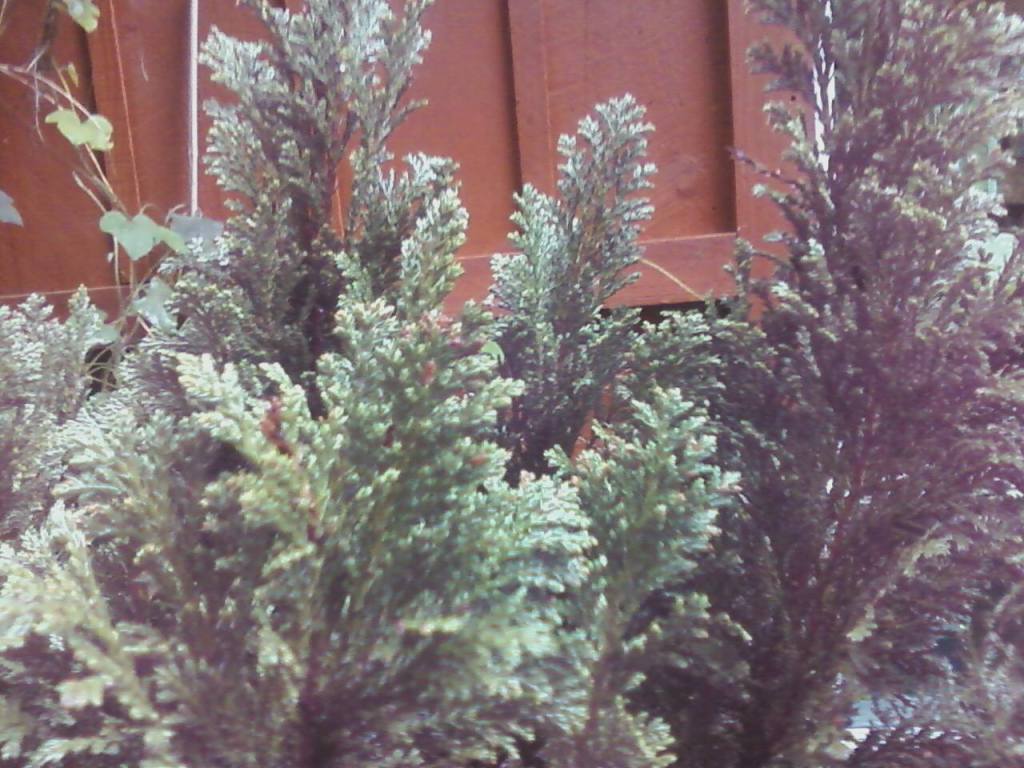
Sawara false cypress cultivars do not develop into real trees.
Just like other types of false cypress, the Sawara false cypress, Chamaecyparis pisifera, naturally gets much larger than its many cultivars that are sometime grown in gardens for their colorful and interestingly textured foliage. Although not large trees, they can get nearly thirty feet tall in wild groves in Japan. Most garden varieties stay less than ten feet tall, and some stay much shorter.
‘Cyano-Viridis’ (‘Boulevard’), with feathery blue green foliage, is one of the more popular cultivars. It grows slowly to more than six feet tall and broad. ‘Filifera’ has very different foliage, with tightly fitting scale leaves on limber cord shaped branches. It stays a bit shorter but can get a bit broader. ‘Mops’ is similar to ‘Filifera’, but stays about a foot and a half tall and broad. ‘Filifera Aurea’ and ‘Golden Mops’ are just like ‘Filfera’ and ‘Mops’, but with yellow foliage.
Reflected glare or harsh exposures can burn foliage. Full sun is not a problem, unless enhanced by glare from surrounding pavement or lightly colored walls. Partial shade is not a problem either, but compromises foliar color, particularly yellow.
Shearing or major pruning deprives false cypress of their naturally appealing forms and textures. They should therefore get plenty of space for their mature size, and get trimmed lightly for shape only when necessary.
Cultivars are much more compact than the simple species.
Fifty foot tall Port Orford cedar trees, Chamaecyparis lawsoniana, like those that get harvested for timber from their native range on the south coast of Oregon and the northwest corner of California are almost never found in refined gardens. Their remarkably diverse garden varieties mostly stay less than half as tall, as dense, compact trees or large shrubbery that resembles arborvitaes. Many have bluish or greyish foliage. Some have gold foliage. Finely textured needle-like juvenile foliage that is so prominent among young plants continues to appear sporadically with scale-like adult growth as plants mature. The small round cones are not prominent. Like related arborvitae, Port Orford cedar tolerates a bit of shade.
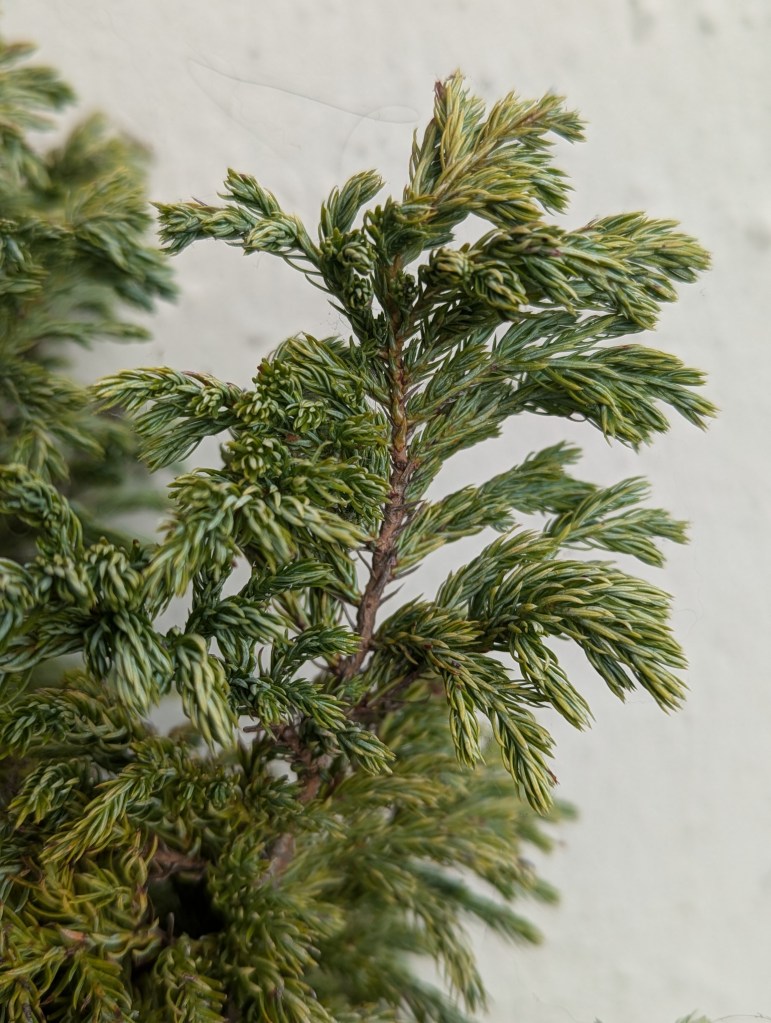
Dwarf Alberts spruce is more like a conical shrub than a tree.
Most of the familiar conifers, or ‘cone-bearing’ plants, are large trees like pines, spruces, cedars and cypresses. They are practical trees only with sufficient space, and where their debris and constant evergreen shade will not interfere with lawns or other plants below. Their less familiar compact specie and cultivars (cultivated varieties) that grow as smaller trees or large shrubbery are actually more proportionate, and therefore more useful for refined landscapes.
There are actually several small specie of pine, like Scots, Austrian black, dwarf Swiss stone, mugo, and the various Japanese red, black and white pines. Some of the most compact cultivars grow as dense shrubbery. Others grow as small to mid sized trees with the personalities of larger pines.
There are fewer compact spruce to choose from. Dwarf Alberta spruce, which is a very compact cultivar of white spruce, is perhaps the smallest and most symmetrical, growing as a dense and strictly conical shrub. Columnar and pendulous cultivars of blue spruce grow in opposite directions, upright and downward, but stay compact enough to be grown as sculptural specimens or shrubbery. There are also pendulous white and Norway spruce.
Several compact cultivars of western red cedar and northern white cedar (Thuja spp.) are popularly grown as tall hedges. They are not actually cedars (Cedrus spp.) and are more often known by the common name of ‘arborvitae’. There are even more Asian arborvitaes (Platycladus spp.) to choose from; many of which have bright golden foliage. ‘Swane’s Golden’ Italian cypress is narrower and denser than the arborvitaes, but not as brightly colored.
Despite the bad reputation of certain cultivars that were planted too extensively decades ago, many junipers are very practical and sculptural coniferous shrubs, as well as ground covers and even small specimen trees. Some ground cover types stay less than a foot deep. Shrubby and small tree types are at their best where they have room to grow without pruning. If ‘Hollywood’ juniper is too old fashioned, the various Rocky Mountain junipers and Eastern red cedar (again, not really a cedar) are worth investigating for their distinctively picturesque forms.
Chamaecyparis are perhaps the most variable of the evergreen coniferous shrubs and trees. Although there are naturally only a few specie which grow into substantial timber trees, there are countless cultivars that are compact enough for residential gardens. Most stay less than thirty feet tall. Many stay less than half as tall. Most have rich deep green foliage; and many have bluish, greyish or golden foliage.
Chamaecyparis are known by a few different but inaccurate common names, including ‘cypress’, ‘false cypress’ and ‘cedar’. (Although the Alaskan cedar is now classified as a cypress, Cupressus or Callitropsis nootkatensis.) Like almost all other conifers, they are best where they can grow naturally without major pruning or shearing to compromise their naturally appealing forms and textures. The most diminutive cultivars are excellent for bonsai and rock gardens, or even in urns of mixed perennials.
Like the majority of cedars, Eastern redcedar, Juniperus virginiana, is not really a ‘cedar’. According to its genus name, it is a juniper. That may be why it is less common here than within its native range. Even in its native range, most grow wild rather than in cultivation. Junipers gained an unfavorable reputation after becoming overly common decades ago.
Eastern redcedar has traditionally been more utilitarian than merely aesthetic. It can be a delightful Christmas tree, either cut or potted. While old cedar closets are native incense cedar, cedar chests are Eastern redcedar. Baton Rouge derived its name from a red stick demarcation pole. Indigenous people traditionally used Eastern redcedar for such poles.
Wild Eastern redcedar trees are variable and range in height from fifteen to fifty feet high. Cultivars develop compact conical or columnar form. Some are grayish or golden green. The small evergreen foliar scales, particularly juvenile foliage, can be somewhat prickly. The rusty red to grayish brown bark can display a handsomely fibrous or shaggy texture. The ‘silicicola‘ variety of Eastern redcedar is rare.
It is difficult to imagine Sawara cypress, Chamaecyparis pisifera, as a timber tree. Within its native range in Japan, it can grow as tall as one hundred and fifty feet. Its trunk can be six feet wide. It is no surprise that it grows slowly though. Its more familiar types rarely grow taller than ground floor eaves. Only the oldest and biggest are nearly thirty feet tall.
Sawara cypress cultivars are uncommon, and some are rare. Among them, ‘Boulevard’ is less uncommon. It has feathery bluish foliage, and can grow eight feet tall. Supposedly, it can eventually grow nearly three times as tall. ‘Filifera Aurea’ has bright yellowish foliage on limber cord like stems. It supposedly gets taller, but it is typically lower and mounding.
Although its cultivars are more diverse, Sawara cypress resembles compact arborvitaes. Its densely evergreen foliage has a similarly soft texture. Its bark is similarly ruddy with a similarly fibrous texture. Individual scale leaves are less than a sixteenth of an inch long. Sawara cypress classifies as the false cypress because it is not of the genus Cupressus.
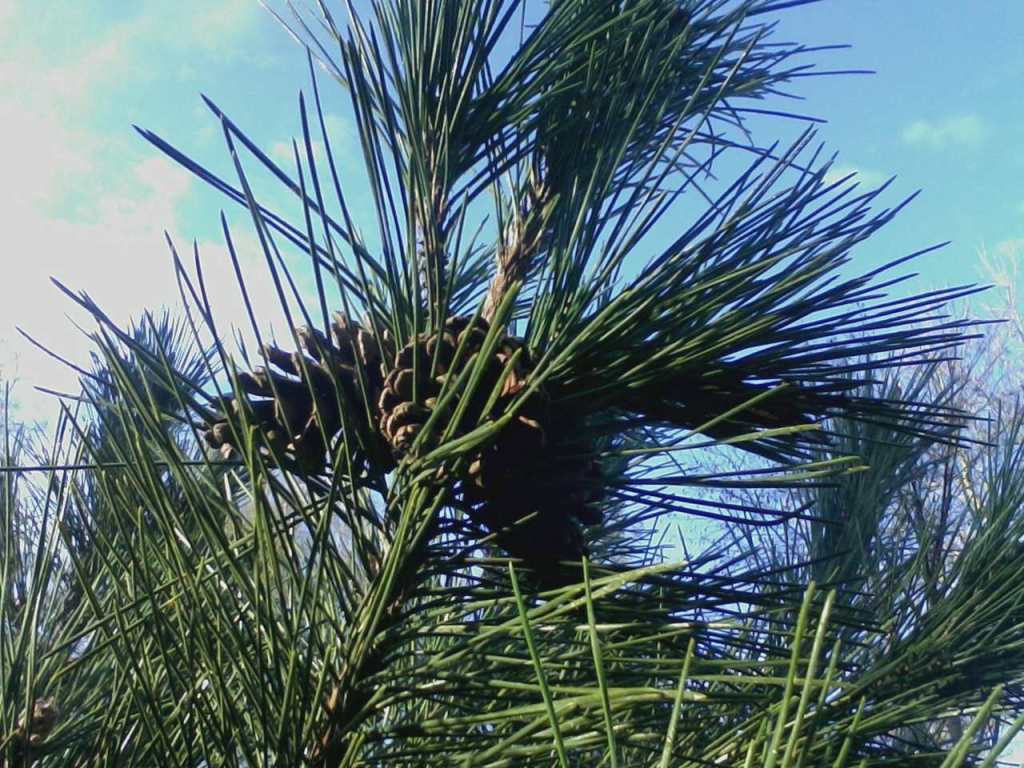
Japanese pine is more proportionate to confined urban home gardens than more common species.
Not many large specimens of Japanese black pine, Pinus thunbergiana, can be seen around the Santa Clara Valley. They can get taller than a hundred feet on straight trunks in their natural range on the coast of Japan, but locally, rarely get more than a quarter as tall on leaning and irregular trunks. They just are not quite as happy in the dry air here (minimal humidity). They are purported to be more tolerant of smog than most other pines that were so sensitive to the nasty smog of the 1970’s, but are more likely to become infested with insect pathogens as they get old.
With their angular and somewhat open growth, and classic pine foliage and cones, Japanese black pines are one of the more distinctive pines. Since they do not get too large, they can work well as sculptural specimen trees in small garden spaces and atriums. Even if they grow up above the eaves, their leaning trunks and outstretched lower limbs with rough gray bark are as distinguished as those of larger trees.
The paired somewhat stiff needles are about three or four inches long. The small but stout cones stay green through most of their first year of development, and then turn brown as they mature and open to disperse their seed in the second year. They are only about two inches long, but can become annoyingly abundant among aging trees.
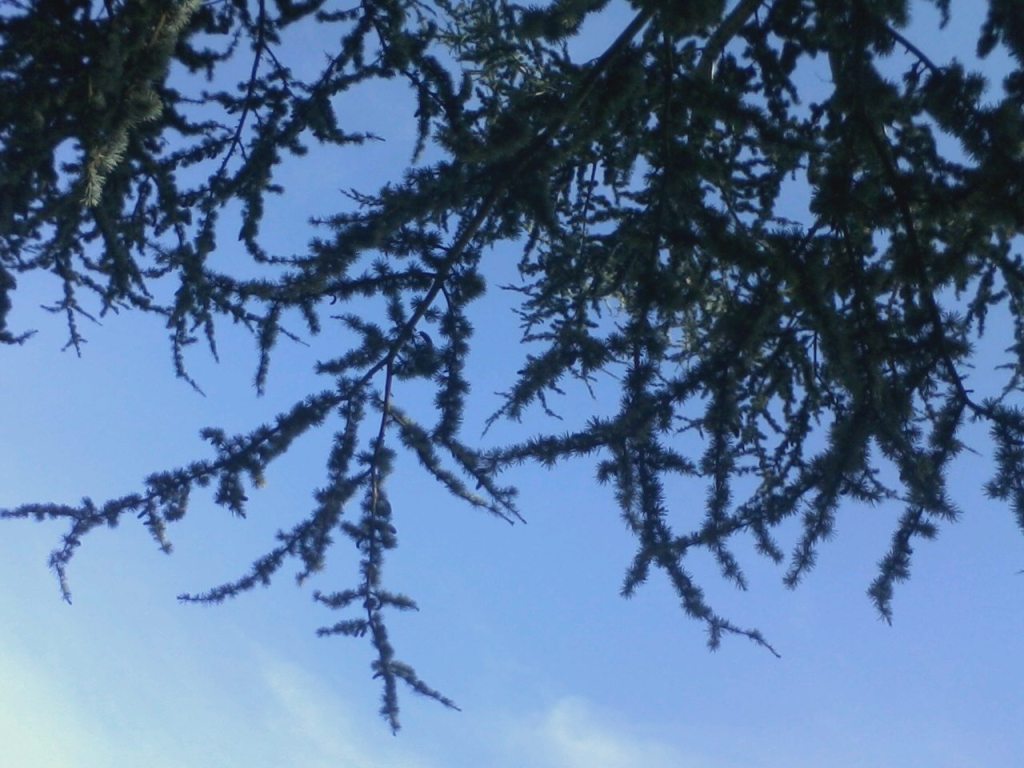
Amy Carter had the most boss treehouse in an Atlas cedar.
My generation can remember when Amy Carter, the daughter of former President Carter, got a treehouse built in a mature Atlas cedar, Cedrus atlantica, at the White House. It was so cool that it was ‘boss’! Besides being more luxurious than a typical treehouse, it was designed by President Carter to not damage the tree even slightly.
Here in the west, most Atlas cedars are cultivars (cultivated varieties) with blue foliage that often rivals that of Colorado blue spruce. Most have strictly horizontal or angular limbs with stiff, densely foliated branches. Some are so pendulous (weeping) that they need to be staked to be kept off the ground. They actually look great trained along the tops of retaining walls, even without staking, with their blue foliage cascading over. Others are strictly upright and narrow. Colorado blue spruce may have better color; but Atlas cedar has more interesting variation of form.
It is also better adapted to the local Mediterranean climate than spruces and other conifers are, and gets much larger. Mature Atlas cedars can get as tall as a hundred feet, with trunks as wide as five feet.
During the Colonial Period of America, American arborvitae, Thuja occidentalis, was one of the first native species to become popular for home gardening. It is native as far south as the Great Smoky Mountains, and as far east as Minnesota. Wild trees can be fifty feet tall, with trunks as wide as three feet. They might grow larger to compete with other trees.
Of course, the oldest cultivated varieties, as well as relatively modern cultivars, are much more compact. Many modern cultivars are hybrids. Some are different species. They are densely evergreen shrubbery that work well as hedging. Their distinctly ruddy or grayish brown bark is barely visible. Their bloom is unimpressive. Foliage is their primary asset.
It is quite an asset. Although arborvitae is conducive to shearing, its billowy foliar texture is too appealing to compromise by frequent shearing. Scale leaves are barely more than an eighth of an inch long, like those of junipers, but are more pliable on soft and flattened foliar sprays. Such sprays are delightful coniferous evergreens for wreaths and garlands.
Most shrubs and many perennials get larger than the diminutive mugo pine, Pinus mugo. The most common type grows very slowly as a dense and rounded mound only a few feet tall and maybe twice as wide. Only a very old specimen might reach an eave. The paired dark green needles are about one or two inches long. The symmetrical brown cones are a bit shorter. Mugo pine is also known as Swiss mountain pine and because of a misprint in the eighteenth century, mugho pine. Although native to mountains in Europe, mugo pine is most popular in Japanese gardens and for bonsai. Because it grows so slowly, it can be happy in planters and large pots. In large urns of regularly changed flowering annuals, it can be a nice permanent and evergreen centerpiece.
‘Conifer’ and ‘evergreen’ are almost synonymous. Of the two, ‘evergreen’ is the more familiar term. Some people do not know what a ‘conifer’ is. Simply speaking, an evergreen is a plant that retains foliage throughout the year, even while deciduous plants defoliate through winter. A conifer is a plant that produces seeds in cones, such as pine cones, although many are not easy to recognize as such. Actually though, not all evergreens are conifers; and not all conifers are evergreens.
Southern magnolia, glossy privet, lily of the Nile, all sorts of eucalyptus and all sorts of palms retain their foliage through winter, but none are conifers. Larch, dawn redwood and bald cypress are conifers, but are also deciduous. This can be quite a surprise for anyone expecting them to be evergreen. The foliage turns brown enough to resemble death before defoliation, although larch can get quite colorful in autumn where winters are cooler.
Now that flowers for cutting are scarce, evergreen foliage is popularly cut and brought into the home instead. Here in California, not many of us have fir or spruce out in the garden. Redwood, pine, cypress and cedar (deodar and Atlas) are more common. Leyland cypress, Western red cedar, incense cedar and the various chamaecyparis are not as common, but are just as effective. Incense cedar as well as some of the junipers (unshorn) are particularly aromatic.
Since the various hollies are uncommon here, Californians prefer other evergreens with berries, such as firethorn (pyracantha), contoneaster and toyon. Incidentally, toyon had been so recognized as a substitute for holly that it had historically been known as California holly, and is the origin of the name of Hollywood. Magnolia grenades (fruiting structures) can function like weird pine cones. Southern magnolia has big and glossy leaves with rusty orange undersides. They can provide bold color and texture, even if they have dried to a rich brown.
There are of course no rules for cut foliage. Anything that is still foliated and appealing in the garden may work nicely in the home. Ferns are an obvious choice, although some drop spores that stain fabric. Various pittosporums, podocarpus, eucalyptus, New Zealand flax and even the leaves of bird of paradise are all worth a try.



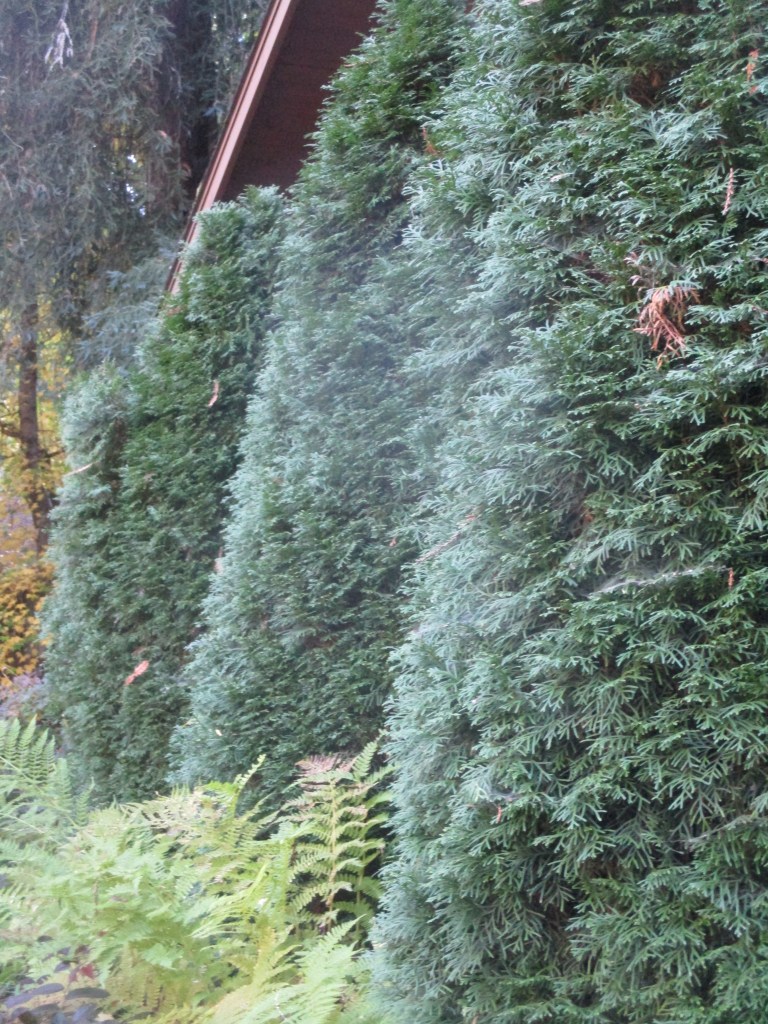

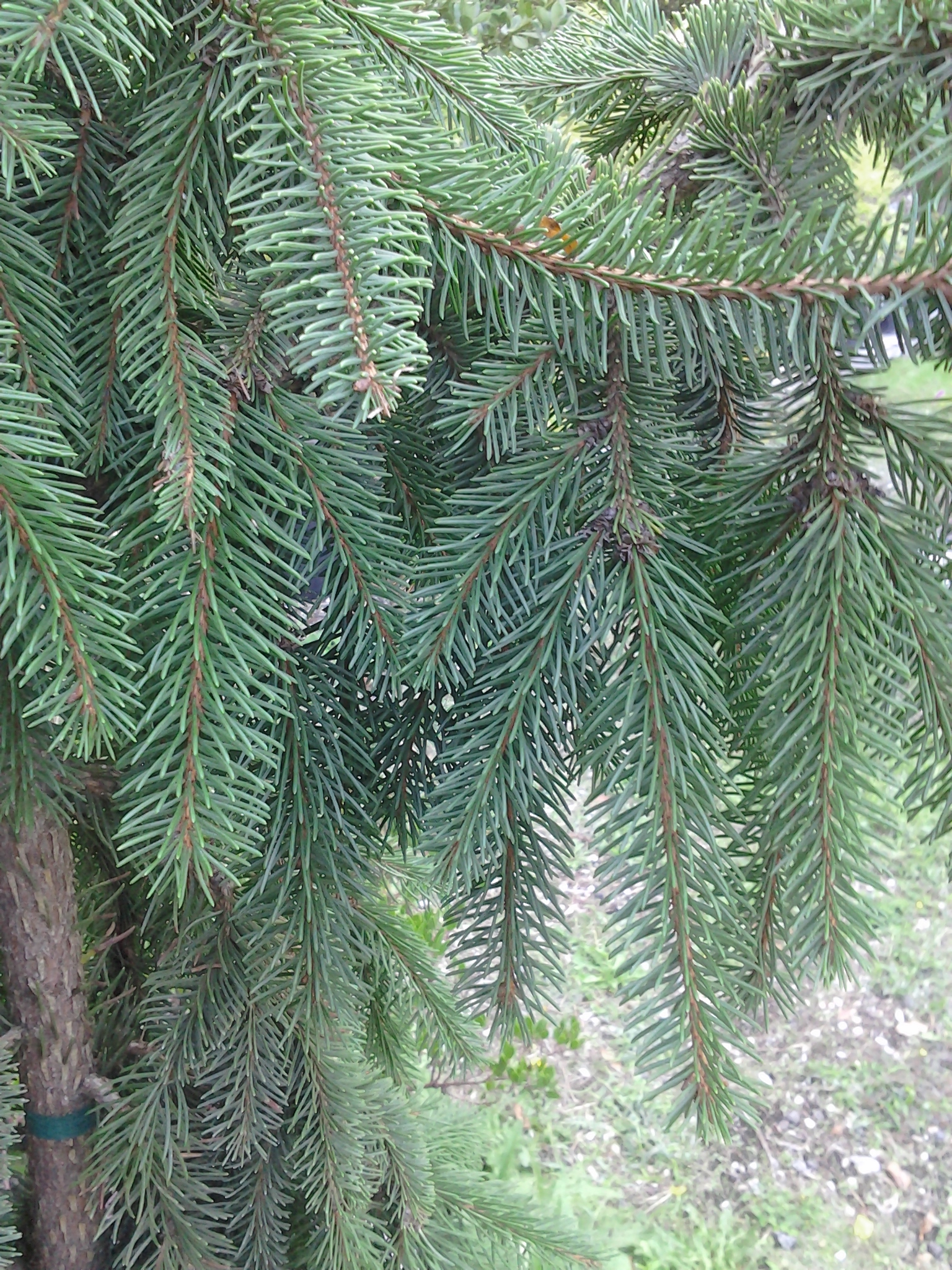 ‘Conifer’ and ‘evergreen’ are almost synonymous. Of the two, ‘evergreen’ is the more familiar term. Some people do not know what a ‘conifer’ is. Simply speaking, an evergreen is a plant that retains foliage throughout the year, even while deciduous plants defoliate through winter. A conifer is a plant that produces seeds in cones, such as pine cones, although many are not easy to recognize as such. Actually though, not all evergreens are conifers; and not all conifers are evergreens.
 Tony Tomeo