
Of all the live Christmas trees available, the dwarf Alberta spruce is perhaps the most practical. It is a shrubby little tree with a big name, Picea glauca ‘Albertiana’ ‘Conica’. (‘Albertiana’ is typically omitted.) It is a dwarf cultivar of white spruce that grows very slowly. It takes many years to potentially get eight feet tall and half as wide at the base. Wild white spruce can grow a hundred feet tall.
The main disadvantage of the dwarf Alberta spruce as a live Christmas tree is the very dense foliage. It almost seems to be artificial. The small needles are only slightly bristly, and finely textured. Otherwise, dwarf Alberta spruce can remain potted as a Christmas tree for several years. It stays sufficiently compact to return to the home annually. It just does not want to be indoors for too long.
The strictly conical form of dwarf Alberta spruce is a distinctive feature in the garden. A pair of trees elegantly flanks a doorway or walkway. A row of evenly spaced trees instills formality to a linear border of bedding plants. Although they do not get too broad, they should have enough room to grow naturally. Pruning for confinement or clearance compromises their naturally symmetrical form.


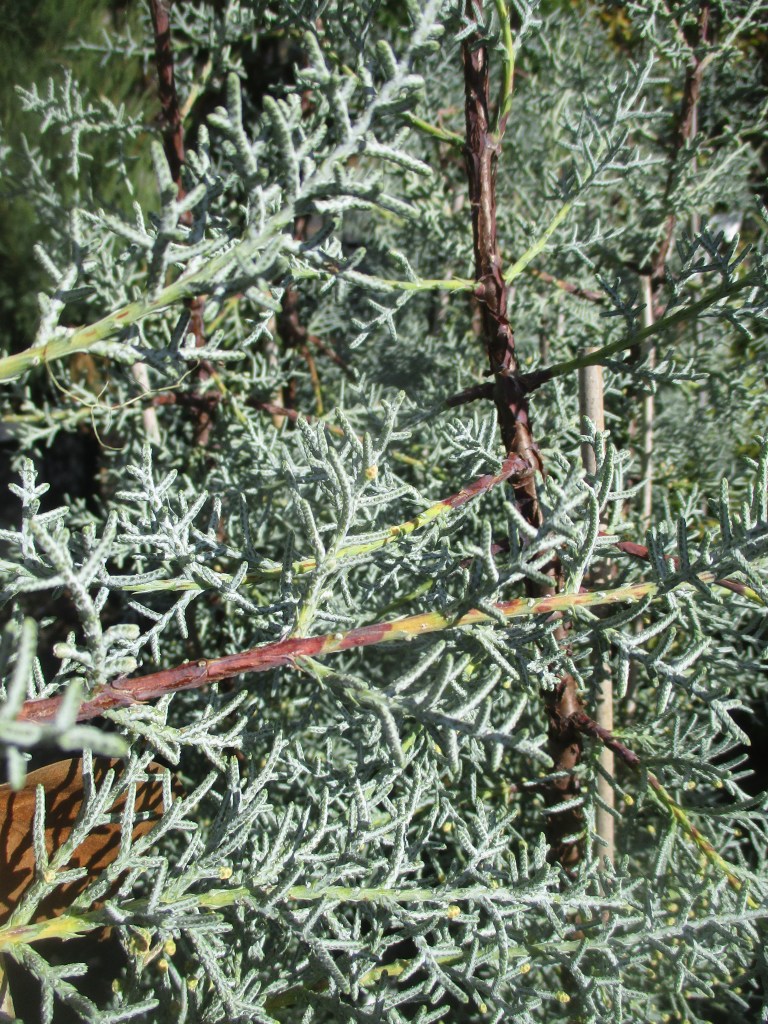

 Climate is why the European larch, Larix decidua, is so rare here. It prefers cooler weather in both winter and summer, and more humidity. Foliage can roast if too exposed through summer. Small trees that are partly sheltered or partly shaded by larger trees have the best color and foliar density. Larch are innately reliant on somewhat regular watering, so are not drought tolerant. The mildly cool weather of autumn is enough to brown the formerly bluish foliage, which falls shortly afterward.
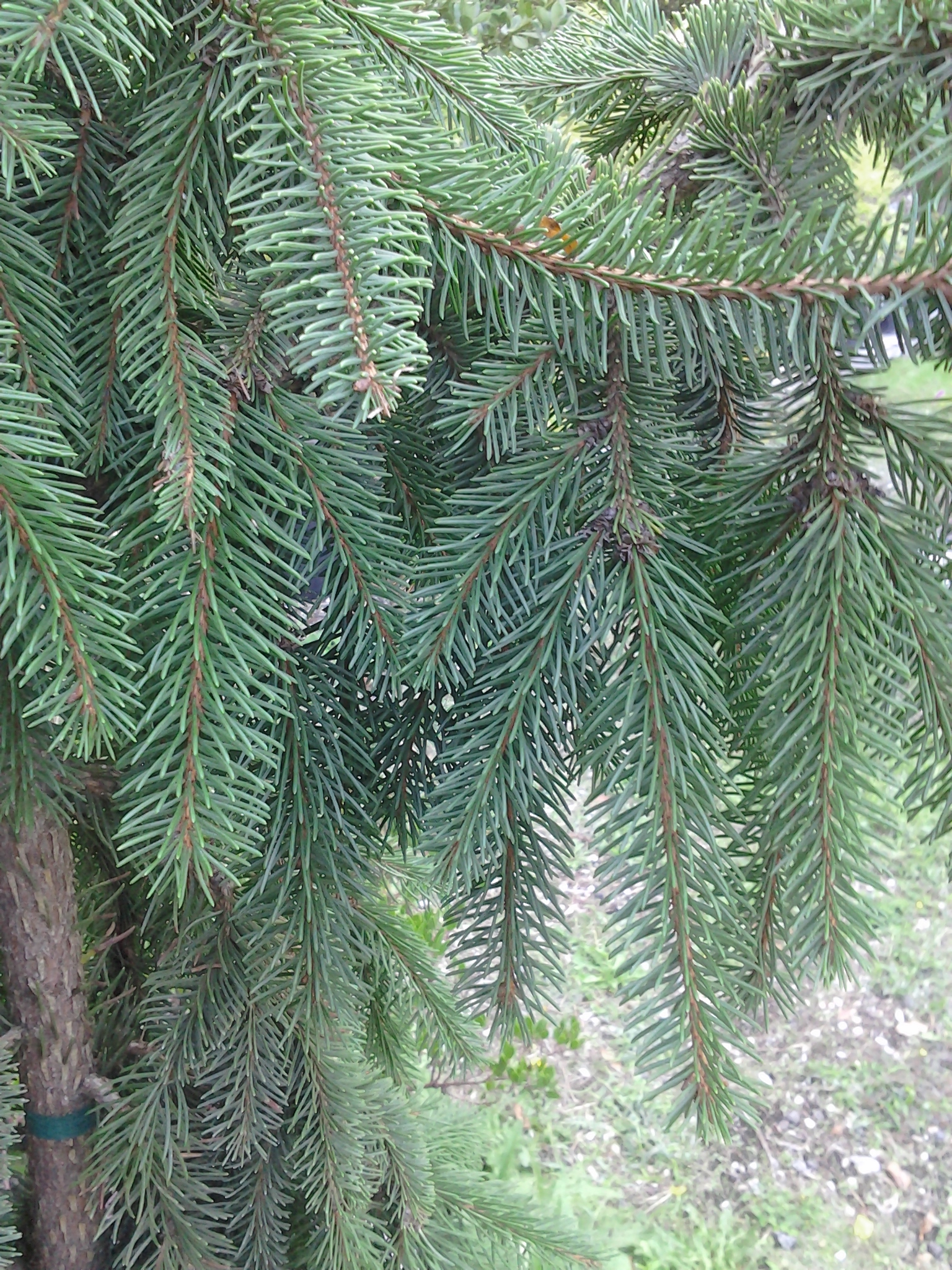 ‘Conifer’ and ‘evergreen’ are almost synonymous. Of the two, ‘evergreen’ is the more familiar term. Some people do not know what a ‘conifer’ is. Simply speaking, an evergreen is a plant that retains foliage throughout the year, even while deciduous plants defoliate through winter. A conifer is a plant that produces seeds in cones, such as pine cones, although many are not easy to recognize as such. Actually though, not all evergreens are conifers; and not all conifers are evergreens.
 Spruce happen to very compatible with the landscape style here. They fit in nicely with surrounding redwoods, but are more proportionate to sunny spots of some of the refined landscapes. We intend to add a few into some of the landscapes as they get renovated. They will stay branched to the ground, like big dense shrubbery, with the personality of distinguished forest trees.
 Well, that is certainly a contradiction of terms. One might say it is an oxymoron. Decades ago, it really was how we classified what we now know more simply as ‘deciduous conifers’. There are not many of them. Ginkgo is a gymnosperm like conifers are, but is not really a conifer. Otherwise, there are only five other types of deciduous conifers, which defoliate through winter.
 As the deciduous trees that will soon be coloring for autumn defoliate for winter, the evergreen trees will become more prominent. Some evergreen trees will drop some of their foliage along with deciduous trees through autumn and winter. Many drop some of their old foliage as new foliage develops in spring, or later in summer. All are on distinct schedules, but are never completely bare.
 Tony Tomeo