
Clay pots have been around for a very long time. It is impossible to know for how long exactly. It is logical to say that they have been around long enough to evolve into the perfect shape for their function. Although the dimensions and proportions are variable, the basic design characteristics of the simplest and best engineered clay pots can not be improved on.
Clay pots are circular from above and below for a few reasons. Such a shape is easily formed on a potters’ wheel. It is more structurally sound than a form with flat sides and more corners. The space within is evenly distributed around the vertical center, without more remote corners. Although roots will circle within, there are not so many corners for them to congregate in.
Drainage holes are at the bottoms because that is where water drains to.
Thick rims around the top edges of common clay pots enhance durability where it is most necessary, and also prevent pots of the same size from becoming wedged into each other when stacked. The weight of stacked pots rests firmly and vertically on such rims, rather than being diverted laterally to break wedged pots to pieces.
It would not be possible to stack clay pots if they were not tapered to be wider on top. Of course, they are tapered for a few reasons, just like they are circular and outfitted with rims for a few reasons. Tapered form fits the natural dispersion of the roots of most plants better. More importantly, tapered form facilitates the removal of firm root systems with minimal disruption.
So, after perhaps thousands of years of evolution to achieve the perfect form, who thought it was a good idea to taper pots inward at the top? The lack of a rim is not so important if pots are not so numerous that efficient stacking is a concern. Such pots can not be staked anyway. They do not get reused as much as common clay pots either, so do not need to be so durable.
However, that upper inward taper is a serious problem for plants that mature and develop firm root systems within. Such mature plants can only be removed from such pots only by tearing their root systems apart, or by breaking the pots apart. Such form is only practical for big pots that contain multiple small plants that, individually, do not get big enough to fill the pots.
For example, big urns of bedding plants or mixed perennials function more as planters than as pots. Bedding plants get removed and replaced seasonally, and even if the don’t, they can not get big enough to develop a solid root system that is wider than the inwardly tapered top of a big urn. Likewise, most perennials get removed from such big pots before they get stuck within.
Palms, agaves, yuccas and other more substantial perennials must not be allowed to live within an inwardly tapered urn long enough to develop a firm root system that can not be removed.

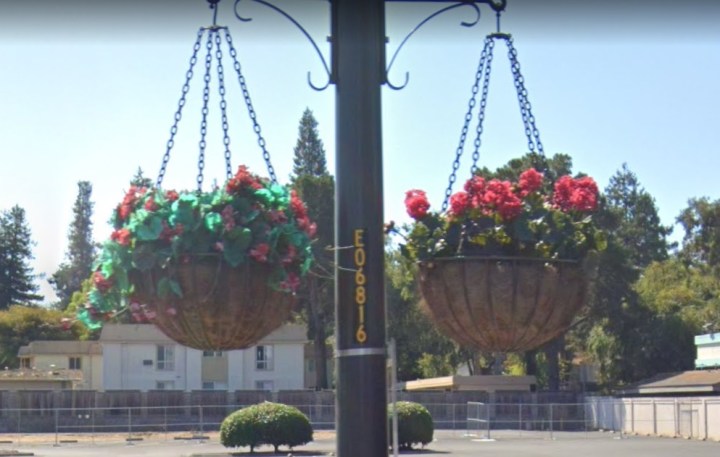
 This is no way to get the dirt on someone. There is no dirt involved. If there were, it would be referred to as ‘soil’. ‘Dirt’ is a term used by those who do not know any better.
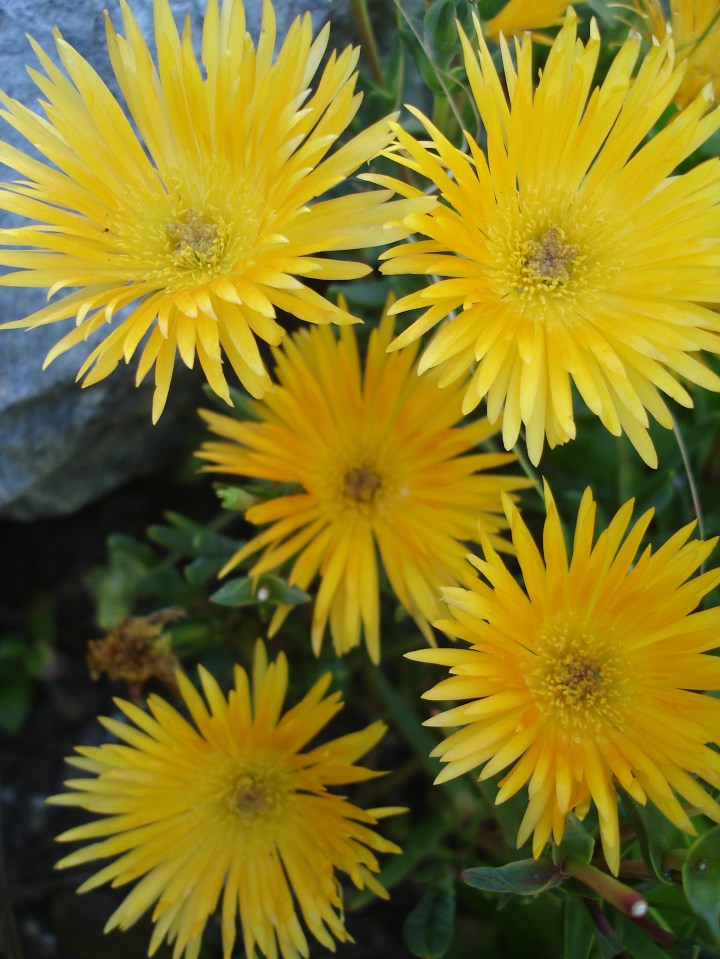 Bright pink bloom that can be profuse enough to obscure the succulent foliage below is nothing new for iceplant. Some bloom bright purplish pink. Others are reddish pink. A few are softer pink or white. What is unexpected is iceplant that blooms bright yellow, orange or gold, like Lampranthus aureus does. (Freeway or beach iceplant that blooms soft yellow or pink is not a true iceplant.)
 Aside from all the seasonal raking and dormant pruning, there is not as much to do in the garden as there was earlier in the year. Lawns do not need much mowing. Hedges do not need much shearing. Untimely mowing and shearing can actually damage lawns and hedges. Watering, which was so important while the weather was warm, is now rare in the cool weather between rain.
 This is one of those warm season annuals that we do not hear much about. Verbena looks something like lantana, but rather than maturing into a nice shallow ground cover or low mounding shrub with a bit of staying power, verbena lasts only until frost next autumn. The blooms are a bit larger. The leaves are a bit greener. They stay lower than a foot, and get only a few inches wider than tall.
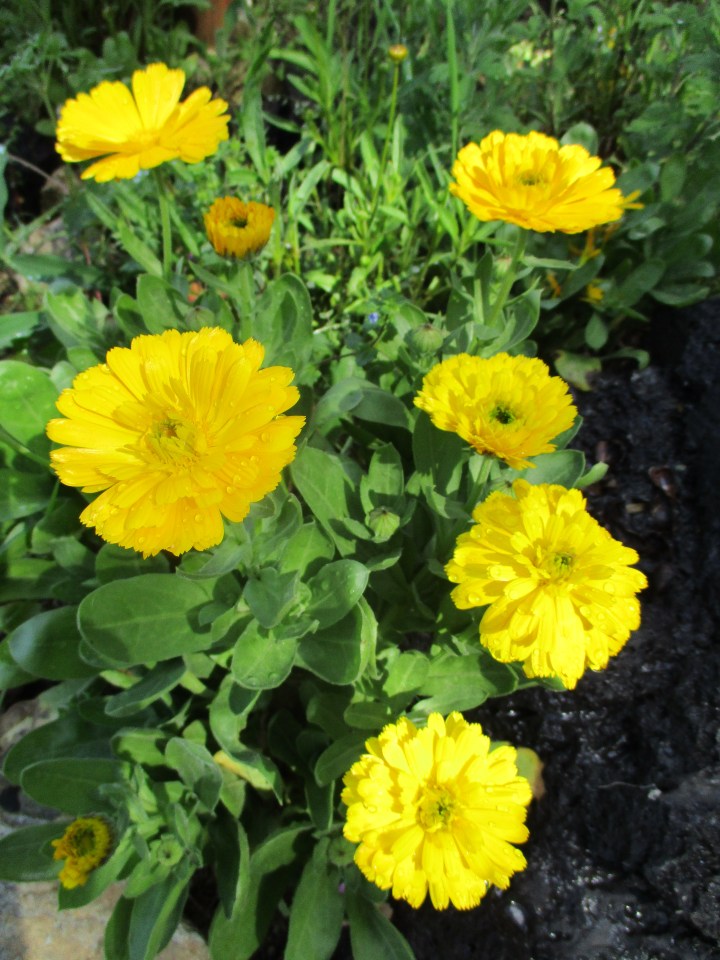 Just before the weather gets warm enough for real marigolds, and after the weather starts to get too cool and rainy for them, pot marigold, Calendula officinalis, is at its best. It can bloom at any time of year, depending on when it gets planted, but prefers cool and humid spring and autumn weather. It is not so keen on frost in winter, or the arid warmth of summer that real marigolds enjoy.
 They were not always houseplants. They came from somewhere else. Most came from shady tropical forests, which is why they have such big dark green leaves, and are so tolerant of shady home interiors. They are pretty good sports about tolerating the domestic lifestyles that we subject them to, but they would really prefer to be thousands of miles away, growing wild back home.
 Tony Tomeo