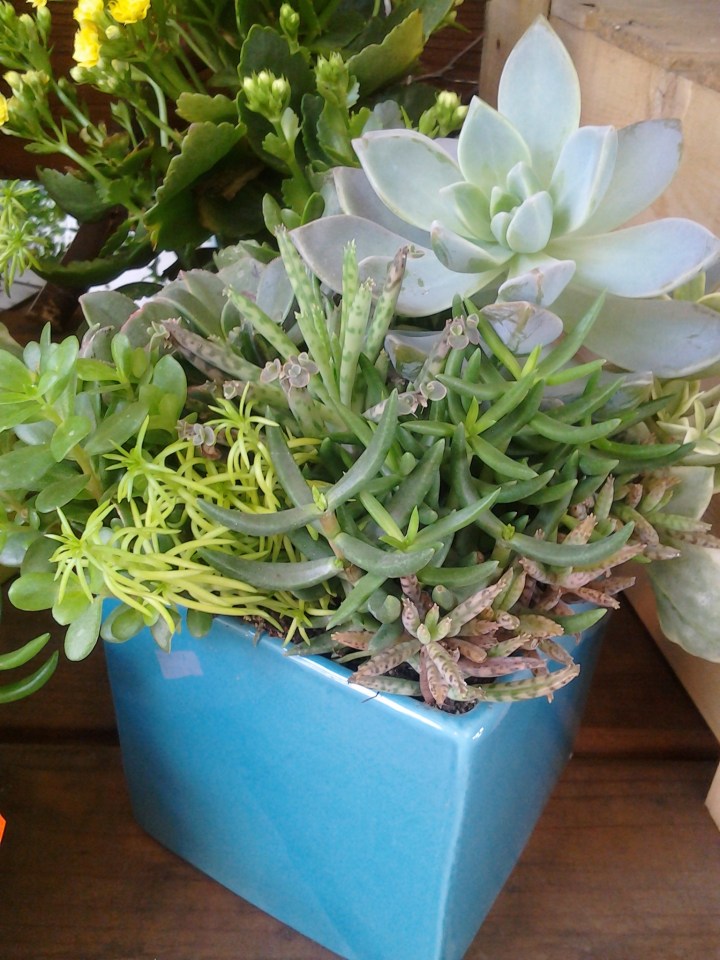
There are all sorts of succulent plants, ranging from finely textured small stonecrops to huge suguaro cactus. Because aloes and agaves are succulents, the closely related yuccas, such as Joshua tree and Spanish bayonet, are commonly considered to be succulents as well. Even begonias and impatiens could be considered to be succulents.
Succulent plants are some of the most distinctive plants available. Foliage can be various shades of green, as well as yellow, red, blue, orange, purplish, gray, bronze, nearly black or variegated. Leaves may be thick and fleshy like those of jade plants, or thin and neatly arranged in tight rosettes like those of aeoniums. Cacti have no real foliage, but some have flashy flowers.
Except for the larger sorts of cacti and some yucca, most succulents are very easy to propagate. Jade plants and iceplants grow very easily from stems simply stuck wherever new plants are desired. Aloes and hen-and-chicks grow just as easily from pups (sideshoots) separated from parent plants. Technically, even leaves can be rooted, and will eventually grow into new plants.
Because scraps from pruning can be used as cuttings, there is rarely any need to actually take cuttings from desirable growth. Where more Hottentot fig (freeway iceplant) is needed on a freeway, it simply gets ‘plugged’ (as cuttings) from scraps of debris from where established growth needs to be cut back to an edge. There is much more debris than can be used!
Pots of mixed succulents are ridiculously easy to grow simply be filling pots with potting soil, and then plugging bits of various succulents. All sorts of contrasting colors and forms can be mixed. As plants grow, those that dominate can either be pruned back, or given more space by removing slower plants. The removed plants need not be wasted, but can be plugged somewhere else.
Small succulents are just as easy to plug into informal walls of stacked stone or broken concrete. Some small succulents actually stabilize loose stone. Their docile and finely textured roots are not likely to do any damage.



 This is no way to get the dirt on someone. There is no dirt involved. If there were, it would be referred to as ‘soil’. ‘Dirt’ is a term used by those who do not know any better.
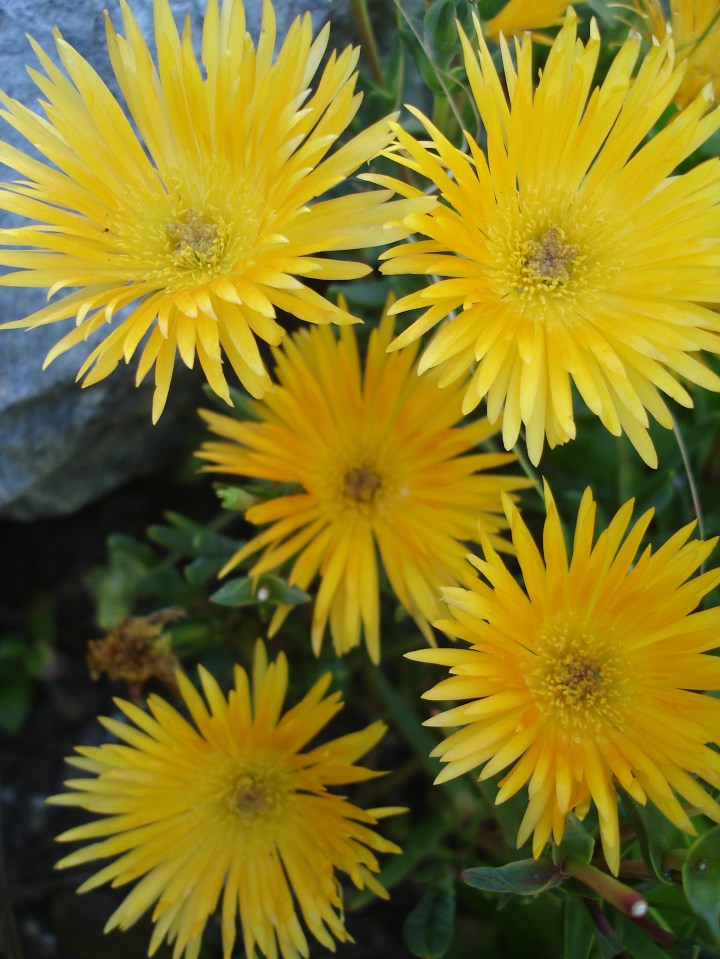 Bright pink bloom that can be profuse enough to obscure the succulent foliage below is nothing new for iceplant. Some bloom bright purplish pink. Others are reddish pink. A few are softer pink or white. What is unexpected is iceplant that blooms bright yellow, orange or gold, like Lampranthus aureus does. (Freeway or beach iceplant that blooms soft yellow or pink is not a true iceplant.)
 Aside from all the seasonal raking and dormant pruning, there is not as much to do in the garden as there was earlier in the year. Lawns do not need much mowing. Hedges do not need much shearing. Untimely mowing and shearing can actually damage lawns and hedges. Watering, which was so important while the weather was warm, is now rare in the cool weather between rain.
 This is one of those warm season annuals that we do not hear much about. Verbena looks something like lantana, but rather than maturing into a nice shallow ground cover or low mounding shrub with a bit of staying power, verbena lasts only until frost next autumn. The blooms are a bit larger. The leaves are a bit greener. They stay lower than a foot, and get only a few inches wider than tall.
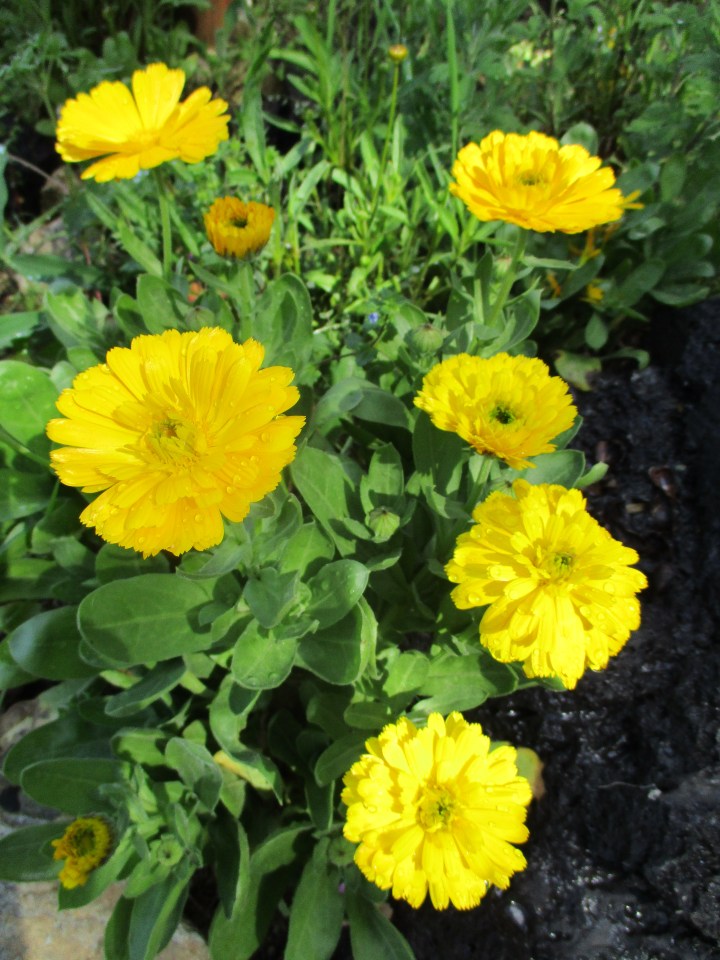 Just before the weather gets warm enough for real marigolds, and after the weather starts to get too cool and rainy for them, pot marigold, Calendula officinalis, is at its best. It can bloom at any time of year, depending on when it gets planted, but prefers cool and humid spring and autumn weather. It is not so keen on frost in winter, or the arid warmth of summer that real marigolds enjoy.
 They were not always houseplants. They came from somewhere else. Most came from shady tropical forests, which is why they have such big dark green leaves, and are so tolerant of shady home interiors. They are pretty good sports about tolerating the domestic lifestyles that we subject them to, but they would really prefer to be thousands of miles away, growing wild back home.
