Too Much Mix & Match Gets Sloppy

Conformity has practical application even in casual landscapes.

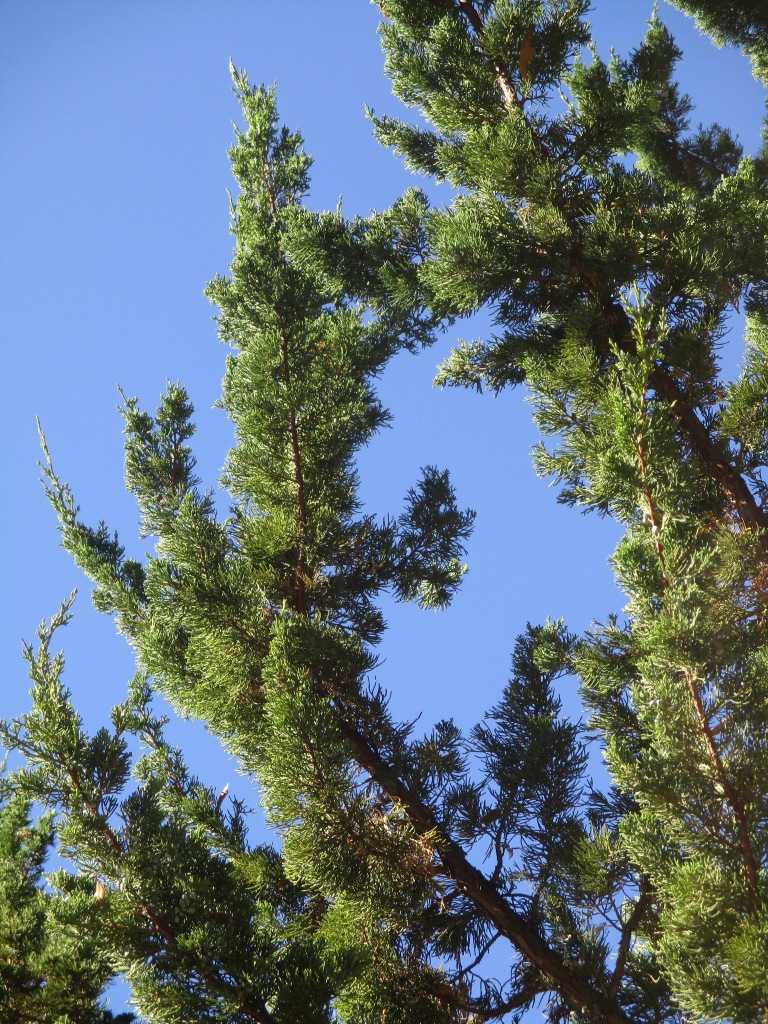
A combination of modern horticultural apathy and too many choices was probably the demise of conformity in home gardens. Formal hedges or even informal screens of several of the same plants are nearly obsolete. Ironically, long and low barrier hedges and so called ‘orchards’ of identical trees planted in regimented rows or grid patterns have become common in large landscapes in public spaces

Those of us who still crave formal hedges, paired trees or any such symmetry in our home gardens must be more careful with the selection of the plants that need to conform than would have been necessary decades ago when there was less variety to complicate things. It is just too easy to get different varieties of the same plant. Only plants with matching cultivar (cultivated variety) names will necessarily match. (Yet, on rare occasion, even these are inaccurate.) For example, ‘Emerald’ arborvitaes will match other ‘Emerald’ arborvitaes, but will not match ‘Green splendor’ arborvitae, no matter how they resemble each other in the nursery.

Plants that are identified by their characteristics instead of by cultivar name are riskier. Blue lily-of-the-Nile could be any one of many different cultivars with blue flowers. It is therefore best to obtain all lily-of-the-Nile for any matching group from the same group in the same nursery at the same time. What will be available next week may actually be a different variety with a different shade of blue and different foliar characteristics. Nurseries bring stock in from so many different growers.

Adding new plants to replace those that have died within established hedges or streets flanked with the same trees can be particularly difficult, especially if the old varieties are no longer available. The old fashioned yellowish Japanese boxwood that was so common for small hedges in the 1950’s has not been common in nurseries for several decades. Replacement plants are darker green. Some are even compact cultivars or different specie like English boxwood. When lined up and shorn together, they make ‘calico’ hedges.

Six on Saturday: ?

So much of the vegetation that we work with is unidentified. I know most of the species, but not all. Cultivars and varieties are more difficult to distinguish. There are too many! I am completely unfamiliar with some of the most modern of them. Of my Six this week, only the second might be a cultivar. The others are likely straight species. I am uncertain of their identities though, because I am unfamiliar with them. Actually, the third is not as labeled! That is because I thought it was something else until it foliated last spring. This Six on Saturday is about six questions of identity. I hope that someone might identify #1 for me.

1. Opuntia littoralis, prickly pear came from the Bat Cave in Los Angeles County, where a few other species of this genus are also native. I do not know if I identified it correctly.

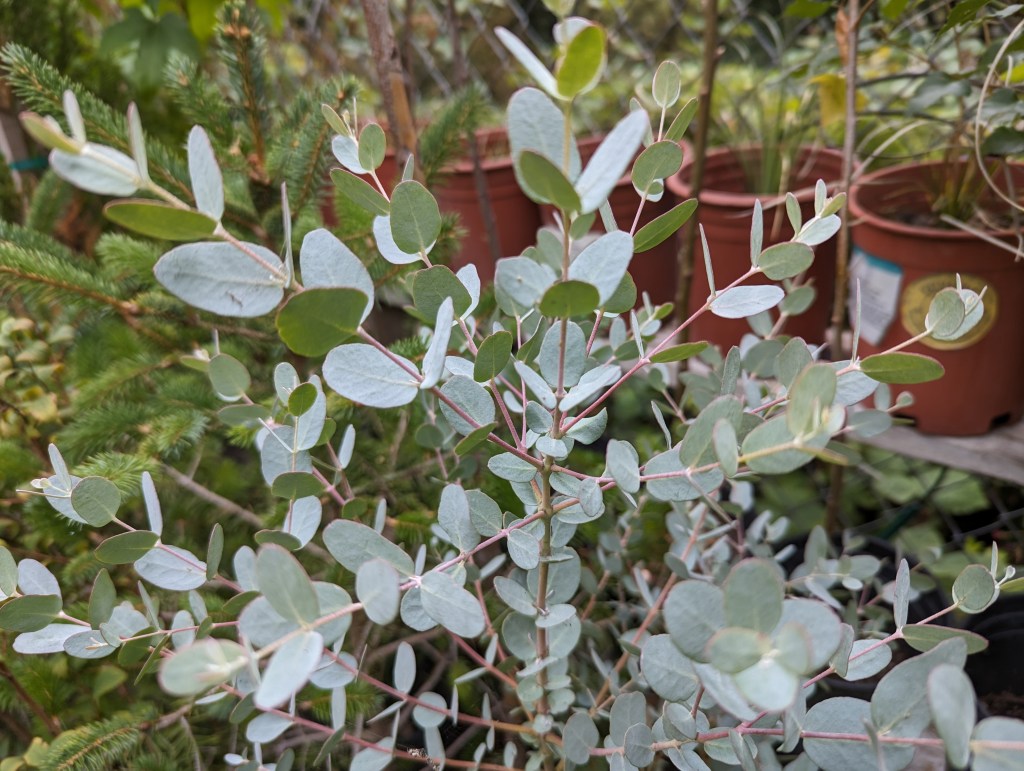
2. Eucalyptus gunnii, cider gum looks just like this while young, but so does the juvenile foliage of a few other species. Adult foliage and associated bloom is easier to distinguish.

3. Vitus californica, California grape looks nothing like this. I brought this here from the roadside while it was defoliated for winter. I hoped that it would be the California grape.

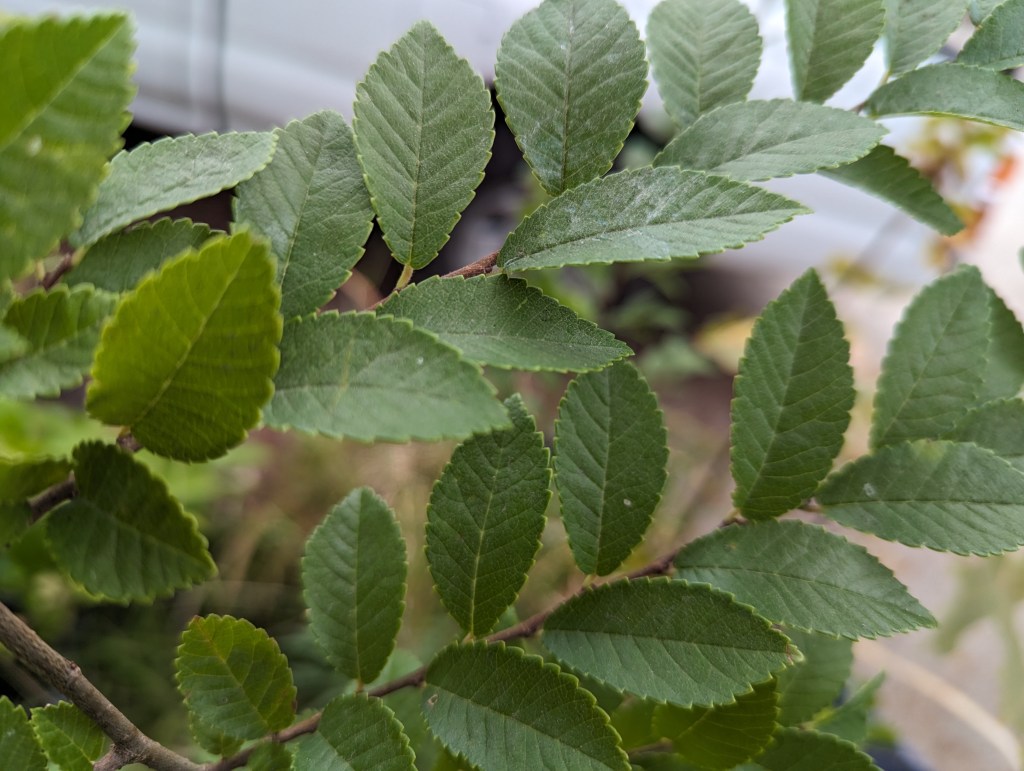
4. Ulmus parvifolia, Chinese elm was common when I was a kid. Only modern cultivars and hybrids are available nowadays. If this is common Chinese elm, it is now quite rare.

5. Populus alba, silver poplar is what I believe this might be. I grew it from cutting from a tree that I met in San Jose a few years ago. I am unfamiliar with this particular species.

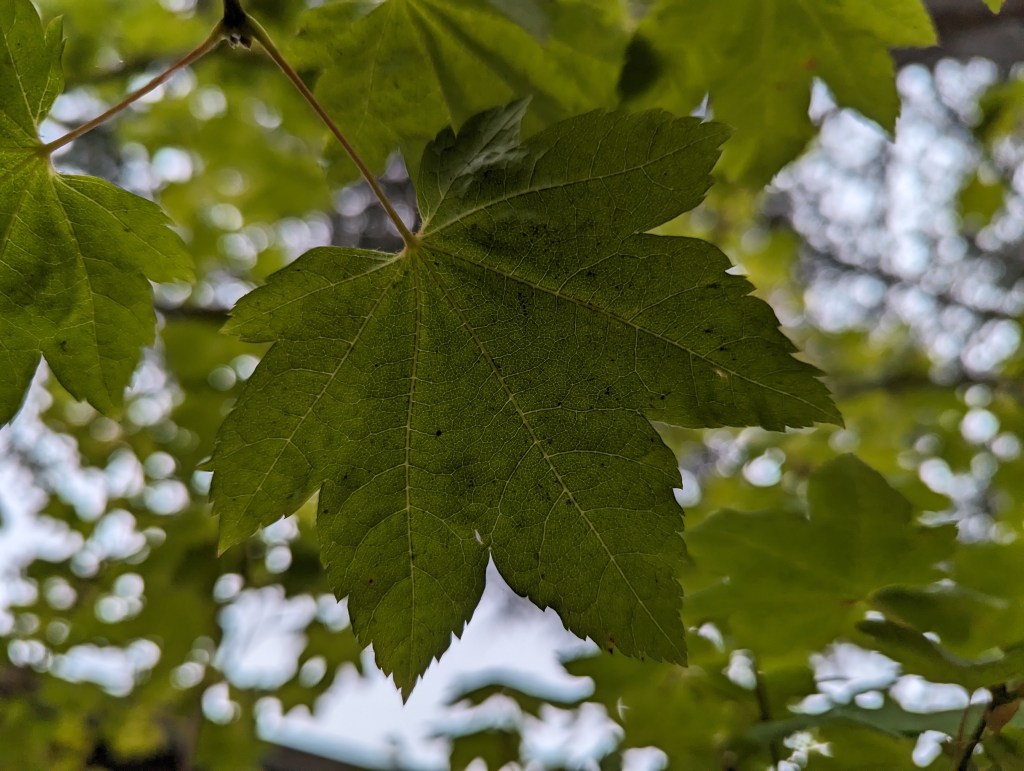
6. Acer circinatum, vine maple should be a gratifying alternative for another ubiquitous Japanese maple. I could be disappointed if this is merely another passe Japanese maple.

This is the link for Six on Saturday, for anyone else who would like to participate: https://thepropagatorblog.wordpress.com/2017/09/18/six-on-saturday-a-participant-guide

Hydrangea

Hydrangea have certainly evolved.

Things were simpler decades ago when hydrangeas, Hydrangea macrophylla, were either white or not white. Those that were not white were mostly pink locally because of the alkaline soil of the Santa Clara Valley. Blue hydrangeas where seen where the soil is acidic in the Santa Cruz Mountains, or where the soil was amended to be acidic. (Acidity causes flowers to be blue. Alkalinity causes flowers to be pink.)

Now there are more than five hundred cultivars of hydrangea! Although bloom color is really determined by pH, many cultivars make better blue shades, and many others make better pink shades. Purple and red have been added to the mix, while white has become less common. After getting pruned low while dormant through winter, most hydrangeas grow about three or four feet tall and broad through summer. Some can get twice as large, while many stay low and compact.

Most hydrangeas have ‘mophead’ blooms, which are large, round ‘panicles’ (clusters) of smaller sterile flowers. ‘Lacecap’ blooms are flat topped panicles with narrow borders of the same small sterile flowers surrounding lacy centers of minute fertile flowers. Hydrangeas bloom from early spring late into autumn.

California Native Plants Grow Wild

Some natives are difficult to domesticate.

California native plants seem like they should be very appropriate for home gardens. In the wild, they require neither irrigation nor maintenance. They are quite satisfied with local climate and soil. Of course, gardening with natives is not so simple. Home gardens are very different from wild ecosystems.

Furthermore, wild ecosystems here are very different from wild ecosystems elsewhere. California is a very big place, with many different ecosystems. Some alpine species from the Sierra Nevada would be unhappy on the coast. Some coastal species from Del Norte County would be unhappy in the Mojave Desert. California native plants should be regionally appropriate.

Therefore, chaparral species are generally most appropriate for local chaparral climates. Many riparian species perform satisfactorily here as well, but expect more irrigation. However, appropriateness to a climate is not the same as appropriateness to a garden. Actually, many chaparral species are unappealing within home gardens. Some are difficult to domesticate.

A few species of California lilac are native here. Any of them are pleased to inhabit local home gardens. However, some grow quite large, and then die after only ten years or so. They may not last even that long with typical irrigation. Few respond favorably to pruning. They prefer to grow wild. Such big, awkward and temporary plants are undesirable within many compact and refined home gardens.

Combustibility might also be a concern for chaparral plants. Some chaparral ecosystems rely on fire for periodic renovation. In the wild, some such ecosystems may burn as frequently as every few decades. After burning, fuel begins to accumulate for the next fire. Even if not copious enough to be hazardous, such accumulation can be unkempt.

Only a few specialty nurseries provide wild California native plants. Most nurseries provide cultivars of such plants that are more adaptable to home gardens. ‘Carmel Creeper’ is a densely sprawling California lilac that gets only a few feet tall. It is commonly available. The original species can get more than fifteen feet tall, with open branch structure.

Conformity Is No Simple Task

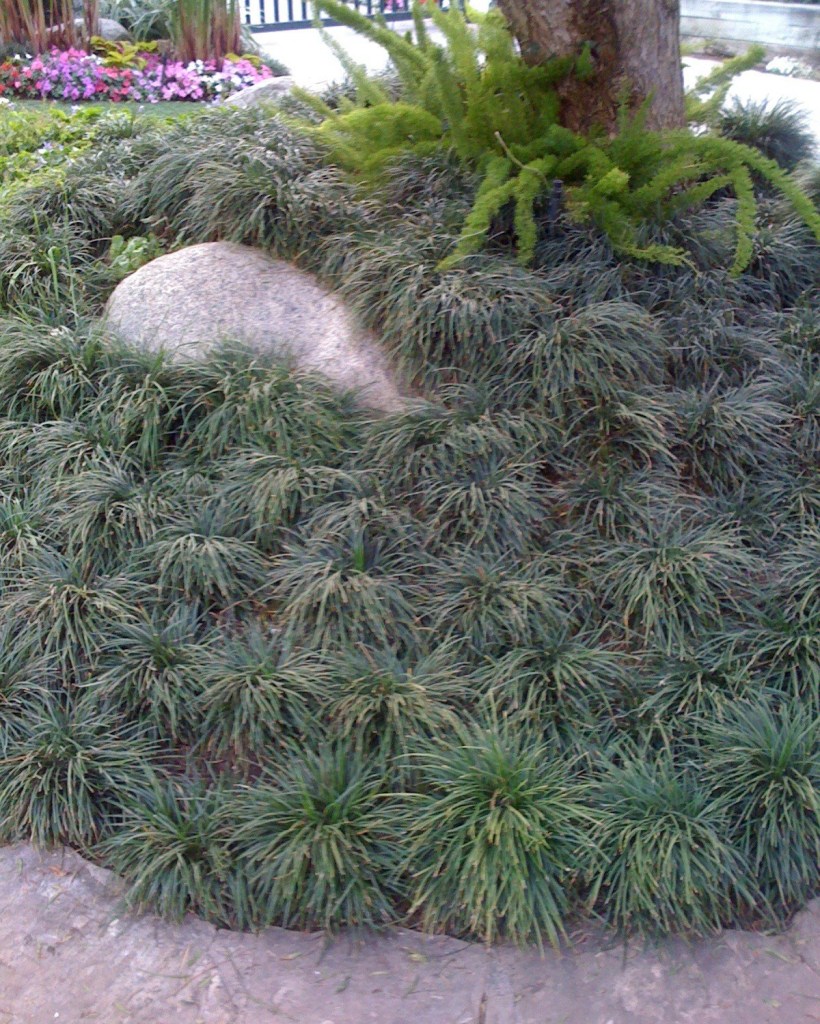
Patching bald spots within Iris moss with Scottish moss might look . . . odd.

A combination of modern horticultural apathy and too many choices was probably the demise of conformity in home gardens. Formal hedges or even informal screens of several of the same plants are nearly obsolete. Ironically, long and low barrier hedges and so called ‘orchards’ of identical trees planted in regimented rows or grid patterns have become common in large landscapes in public spaces.

Those of us who still crave formal hedges, paired trees or any such symmetry in our home gardens must be more careful with the selection of the plants that need to conform than would have been necessary decades ago when there was less variety to complicate things. It is just too easy to get different varieties of the same plant. Only plants with matching cultivar (cultivated variety) names will necessarily match. (Yet, on rare occasion, even these are inaccurate.) For example, ‘Emerald’ arborvitaes will match other ‘Emerald’ arborvitaes, but will not match ‘Green splendor’ arborvitae, no matter how they resemble each other in the nursery.

Plants that are identified by their characteristics instead of by cultivar name are riskier. Blue lily-of-the-Nile could be any one of many different cultivars with blue flowers. It is therefore best to obtain all lily-of-the-Nile for any matching group from the same group in the same nursery at the same time. What will be available next week may actually be a different variety with a different shade of blue and different foliar characteristics. Nurseries bring stock in from so many different growers.

Adding new plants to replace those that have died within established hedges or streets flanked with the same trees can be particularly difficult, especially if the old varieties are no longer available. The old fashioned yellowish Japanese boxwood that was so common for small hedges in the 1950’s has not been common in nurseries for several decades. Replacement plants are darker green. Some are even compact cultivars or different specie like English boxwood. When lined up and shorn together, they make ‘calico’ hedges.

Cultivars Are Merely Cultivated Varieties

Cultivars are distinct within their species.

Nomenclature is simply the technique of naming. Botanically and horticulturally, it is also a precise method of classification. Large classifications divide into smaller and exclusive classifications, which likewise divide. Botanical families divide into many genera, which likewise divide into many species. Some species divide further into varieties or cultivars. 

For example, Schwedler maple is within the Sapindaceae family. This family divides into many genera including the maple genus of Acer. (Genera is plural of genus.) This genus divides into varied species, including the Norway maple species of platanoides. Norway maple divides into more cultivars, including ‘Schwedlerii’, which is the Schwedler maple. 

Therefore, the botanical name of the Schwedler maple is Acer platanoides ‘Schwedlerii’. Family names are omissible. Genus names justify capitalization. Species names do not. Both genus and species names appear in italics. (Incidentally, genera are more ‘genera’l than ‘speci’fic species.) Single quotation marks contain names of varieties and cultivars.

Varieties are, as their designation implies, variants of a species. Some are dwarf, like the dwarf pampas grass. Some bloom with atypical color, like the maroon Texas bluebonnet. Their variations are natural and at least somewhat inheritable. Cultivars are varieties that can not perpetuate naturally, so are reliant on cultivation. They are ‘cultiva’ted ‘var’ieties.

Some cultivars developed from breeding. Others are naturally occurring mutants that are desirable enough to perpetuate. Because their unique characteristics are not inheritable, perpetuation is artificial. Seed of cultivars that originated as mutants lacks any desirable mutation. Seed of extensively bred cultivars is genetically unstable, or may not be viable. 

Most cultivars therefore rely on cloning for perpetuation. Propagation by cutting, grafting, division, layering and tissue culture, generates genetically identical copies of an original. Although it is illegal to propagate patented cultivars for profit, most common cultivars are too old for patents. Many perennial cultivars, such as iris and canna, proliferate naturally. 

Six on Saturday: How It Should Be


Well, I can not argue that ‘everything is as it should be’. Turkeys serve more of a purpose than food, although I can not figure out what their other purpose is. Coleus are so delightfully colorful that those with more discerning taste than mine enjoy new and ‘improved’ cultivars. Many of those same people with discerning taste also enjoy Japanese maple too much to consider options. Both my blue and white lily of the Nile are still the best! Yes, but . . .

1. Turkey belongs in an oven, or perhaps in a freezer. She should not be doing this at the shops as I write. At least she is not somewhere else shredding flowers or pulling up irrigation emitters.

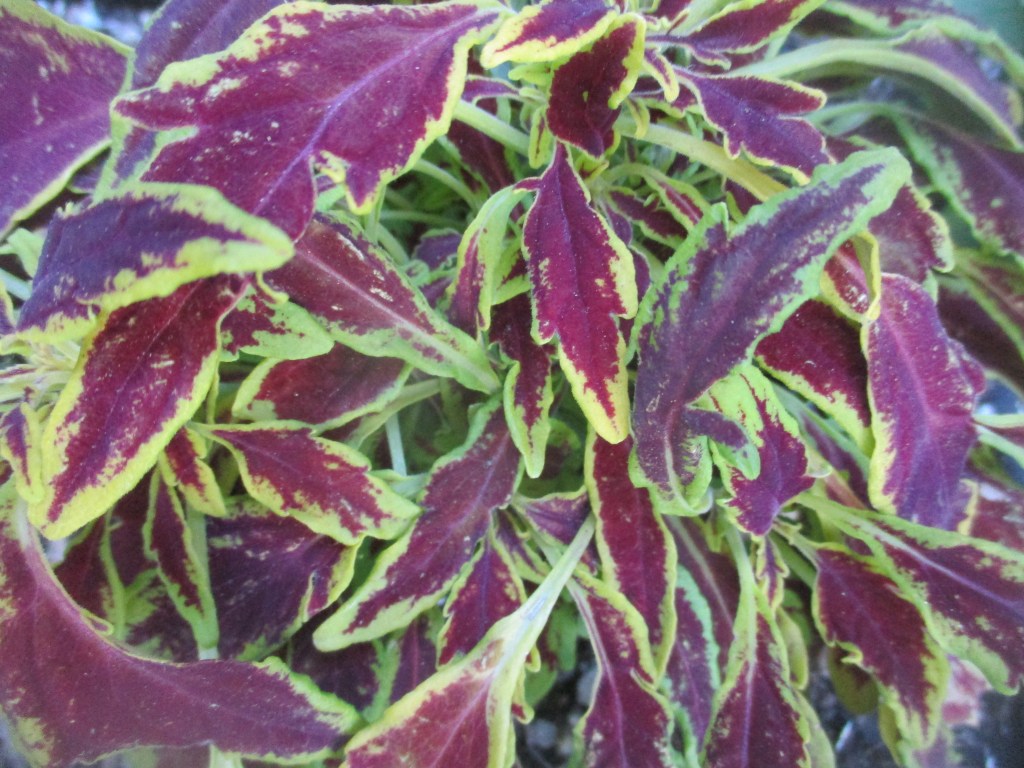
2. Coleus reminds me why I dislike most modern cultivars. I would find this to be more appealing if I did not know what this is, or if I did not know the potential of good old fashioned coleus.

3. Coleus should look like this, which is more similar to how it looked when it was popular as a houseplant decades ago. My kindergarten teacher grew one like this in our classroom back then.

4. Vine maple should be more popular than Japanese maple is. I realize that Japanese maple is much more interesting and diverse. However, now that it is very popular, it is almost mundane.

5. Lily of the Nile should also bloom red, for a red white and blue bloom on Independence Day. There are plenty that bloom blue here. The first that will bloom white were added a month ago.

6. Rhody should cooperate when I need his help with an illustration. I needed a picture of mulch. I had visions of a stylish model in a Halston dress, leaning on a fender of a new 1972 Electra.

This is the link for Six on Saturday, for anyone else who would like to participate:

https://thepropagatorblog.wordpress.com/2017/09/18/six-on-saturday-a-participant-guide/

Cultivars Of California Native Plants

Some natives belong in the wild.

Native plants are obviously happy with local climates and soils. Otherwise, they would not be native. They had been living here long before the first landscapes. They survived without irrigation, fertilizer or any maintenance. Regional varieties adapted to regional environmental conditions. Some of such varieties became cultivars that are now familiar.
A variety is, more or less, a naturally occurring variant. Unnatural selection and breeding produced some varieties. Generally, varieties are genetically stable enough to replicate for at least a few generations. A cultivar is a cultivated variety. It is unable to replicate by natural processes, so propagates by cloning. All clones are genetically identical copies.
Most cultivars grow from cuttings. Some cultivars of exotic (nonnative) plants are grafts. (Not many natives are conducive to grafting.) Regardless of technique, propagation of all cultivars is vegetative (without seed). Seed of some cultivars can produce plants that are similar to the parents, but not indistinguishable. Some will likely be completely different.
Honestly, most native plants are not as appealing in home gardens as their cultivars are. Some are desert or chaparral plants, which can get scraggly through summer. Some are sparsely foliated with irregular branch structure. Like the majority of exotic plants, several native plants benefited from some degree of refinement. It is a fair aesthetic compromise.
This is partly why landscapes of native plants look nothing like forests or unlandscaped areas. The dense and strictly conical form of ‘Soquel’ redwood is very different from that of wild trees. ‘Carmel Creeper’ ceanothus is greener and more densely foliated than wild counterparts. ‘Ken Taylor’ flannel bush is likewise unnaturally dense, low and mounding.
The other primary reason that landscapes of native plants are so different from the wild is that they typically include species from other regions. Some of the penstemons that are popular as native plants throughout California are actually only native to the Siskiyous. Limiting landscapes to true regional natives would produce very different results.

Juniper Turns A New Leaf

Hollywood juniper was formerly overly popular.

Juniperus, which is the entire genus of juniper, had been languishing in a bad reputation for too long. The problem likely began nearly three quarters of a century ago. More people than ever were enjoying leisurely suburban gardening. Many appreciated the resiliency of juniper cultivars. At that time, a few species of juniper were gaining popularity. Evolving cultivars sustained new demand.

Unfortunately, these modern and once distinctive cultivars of juniper eventually became passe and too common. As practical and resilient as they truly are, they collectively shared the stigma of a minority that were problematic. Their problems were disproportionately evident merely because of their commonness. Many matured at the same time, so developed problems at the same time.

Realistically though, the majority of the garden varieties of juniper that grew during that time were quite practical. Those that started in the 1950s, but developed problems in the 1990s, performed satisfactorily for four decades. Not many other types of plants perform as reliably for as long. Many problems resulted from selection of cultivars that were inappropriate for particular applications.

Although all junipers are evergreen foliar plants that provide no obvious bloom, they are remarkably diverse. The most popular sorts are low and dense shrubbery. Others are lower and sprawling ground cover. Some are small trees. A few species grow more than thirty feet tall! Branch structure is mostly densely compact, but can be sculpturally irregular, rigidly upright or gracefully arching.

Foliage is generally rich deep green. Some cultivars exhibit yellowish new foliage that fades to green through summer. A few are variegated with creamy white. Several popular cultivars are gray or bluish gray. Leaves of almost all popular cultivars are scale like. Some have needle like leaves. A few have both. Even without prominent bloom, a few cultivars produce appealing tiny berries.

It is time for the many cultivars of juniper to grow beyond their former bad reputation and turn a new scale or needle.