This is one of those annuals that could be a short term perennial if it gets the opportunity to do so. In most climates, stock, Matthiola incana, is a popular warm season annual that relinquishes its space to cool season annuals before it gets too worn in autumn. Locally, because it does not mind mild frost, it is more popular as a cool season annual for winter.
Floral color ranges through both pale and rich pastels of purple, red, pink, yellow, cream and also pure white. Flowers may be single or double. In close proximity, bloom is richly fragrant. Foliage is light grayish green. Individual leaves are somewhat narrow. Removal of deteriorating floral stalks before they develop seed pods prolongs subsequent bloom.
Many garden varieties of stock stay relatively low and compact. Some may get no higher than a foot. Florist varieties that produce long stems for cutting might get as high as three feet. Overgrown plants get shabby after a primary season, but may regenerate from hard pruning. However, secondary growth is generally irregular and likely marginally reliable.
Gardens might be colorful throughout the year here. There is not much time between the latest of the autumn flowers and the earliest of the spring flowers. Winter flowers are glad to compensate for the lapse. Of course, there are plenty of flowers in spring and summer. Nonetheless, dried flowers are more popular now that there are fewer flowers for cutting.
The quantity of flowers blooming within a particular season might not be proportionate to the quantity of flowers available for cutting. Flowers that bloom through winter, even if as abundant as spring or summer flowers, do not develop as fast. Harvesting too many bird of Paradise flowers depletes the limited supply before something else can replace them.
Deciduous foliage that provides spectacular color through autumn is no substitute for cut flowers. Nor is the majority of colorful bark that becomes more prominent through winter. Some colorful berries can function like cut flowers, but only if there are plenty to spare in the garden. Conventional dried flowers that grew last summer may be useful about now.
For the venturesome and resourceful, unconventional dried flowers and other dried plant parts can also be fun. Such items, unlike statice, straw flower, lavender and other familiar dried flowers, might be byproducts of gardening. They might be derived from detritus that should otherwise go to compost or greenwaste. Some might even be products of weeds!
Pampas grass, both garden varieties and the invasively naturalized type, produces bold blooms that dry quite well. Because the leaves can cause such nasty paper cuts, flowers might be easier to harvest from a distance, with a pole pruner. Hair spray can contain the fuzz, so that it does not disperse indoors. Cat tails, if still intact, are compatible with them.
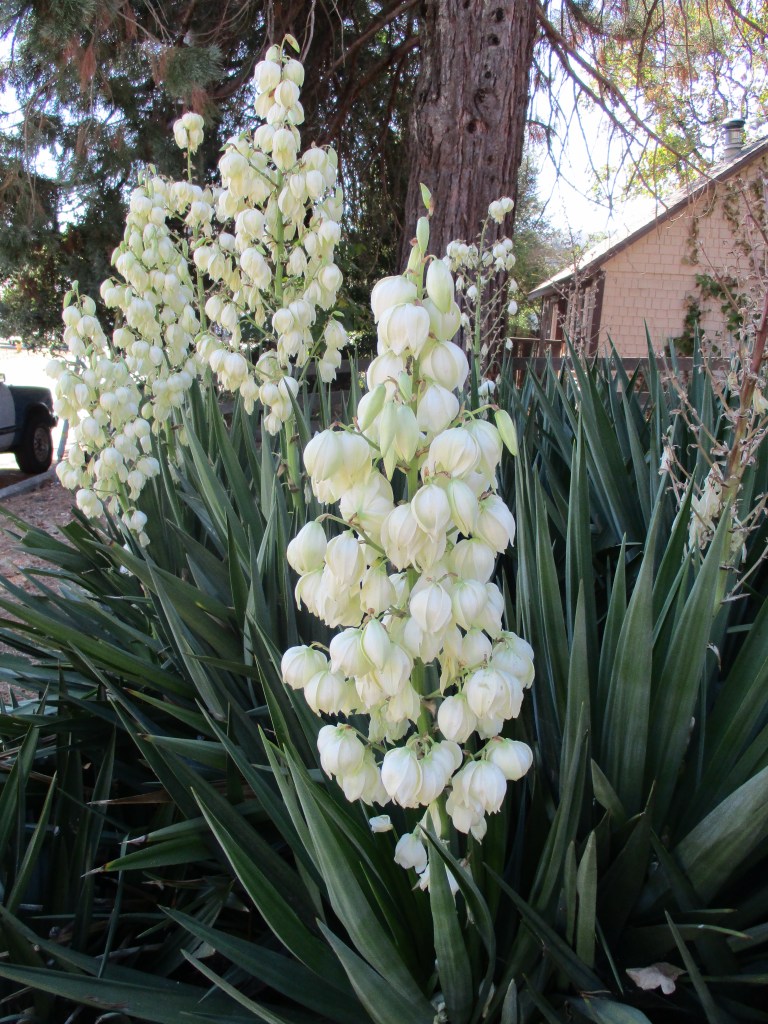
Floral stems of lily of the Nile, New Zealand flax, and some species of Yucca are striking even after bloom. After deadheading, they can become flowerless dried flowers. Fruiting structures are no problem to remove. If within reach, some palms may provide distinctive bloom trusses. Floral design can be as imaginative as gardening and landscape design.
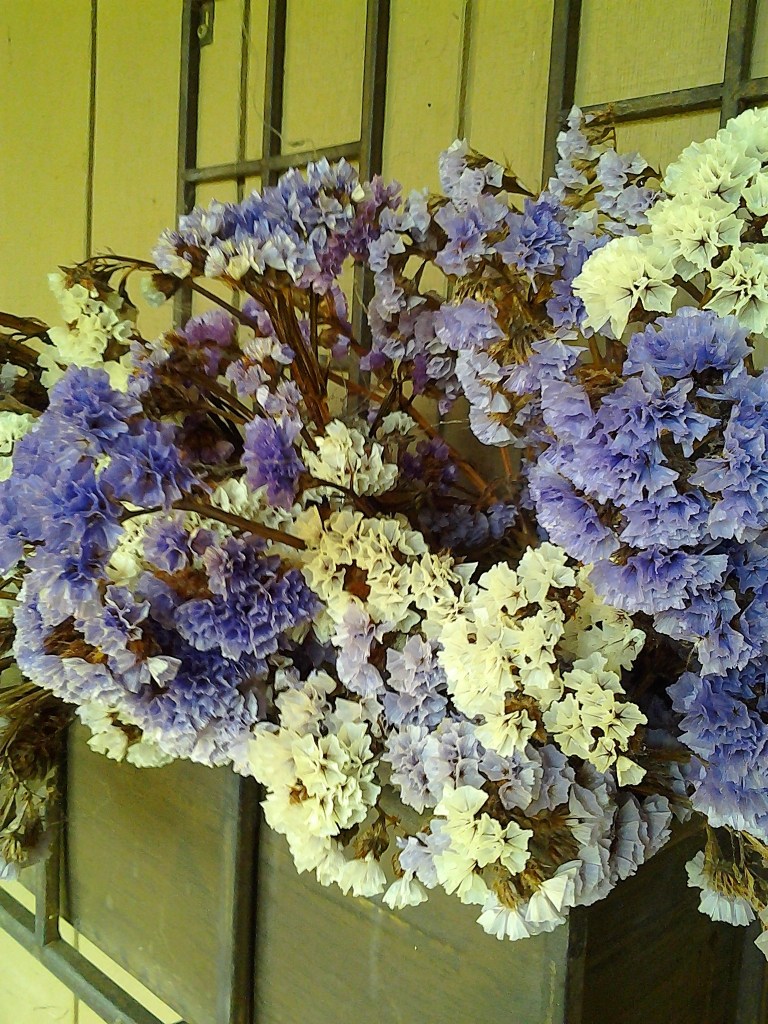
Statice is about as colorful dried as it is while fresh.
The papery flowers of annual statice, Limonium sinuatum, are so popular as seemingly synthetic dried flowers that many garden enthusiasts are surprised to find that they are happy to bloom naturally in home gardens. The clear shades of blue, purple, pink, orange, yellow and white seem to be dyed. The one or two foot tall flower stems are outfitted with odd papery ‘wings’ that make the stems seem wider than they actually are. Deeply lobed basal foliage forms shallow rosettes. Mature plants are about one or two feet tall, and a foot or so wide. Bloom begins late in summer, and continues into autumn. Good sun exposure and good drainage are preferred. Seed can be sown directly, or young plants can be added to the garden early in spring.
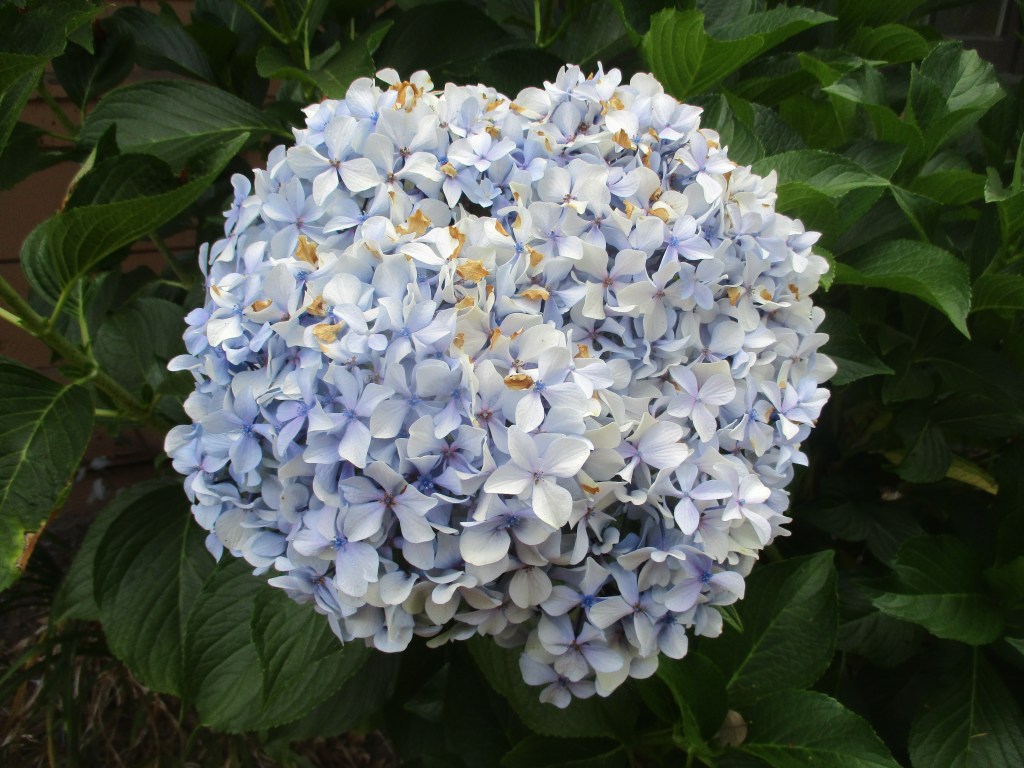
With proper processing, hydrangea bloom can be dried.
Statice, strawflower and globe thistle continue to bloom later than most other summer annuals, and hold their flowers longer. Even after bloom, the flowers are so stiff and ‘crispy’ that they remain intact and colorful until they succumb to exposure to weather. If cut and brought in from the weather soon enough, they will last as dried flowers at least until fresh flowers start to bloom in the garden next spring.
Strawflower and larger globe thistle tend to wilt and droop from the weight of the bulky flowers, so should be tied in small bunches and hung upside down to dry. Perennial statice (which has larger blooms than annual statice) tends to flop to the ground, but the stems often bend only at the base so that the rest of the stem length stays somewhat straight. Smaller globe thistle and annual statice often dry standing up while still out in the garden.
Yarrow and English lavender can be dried as well, but lose most of their color. Lavender dries naturally in the garden. Yarrow can likewise be allowed to dry in the garden, but probably keeps a bit more color if cut while still fresh and hung upside down. Because yarrow blooms are so wide, they should be hung individually or in small bundles. Queen Anne’s lace has even wider blooms that curl inward as they dry, so they really should be hung individually.
Old hydrangea flowers that are only beginning to fade can dry surprisingly well if cut and hung individually before they deteriorate too much or start to rot. Some varieties retain color better than others. Some fade almost completely to an appealing brown paper bag.
There are not many roses this time of year, but when they do bloom, even they can be cut and dried while beginning to unfurl. Only a few small and tightly budded roses can be dried when completely open. Because they droop right below the blooms, roses should be hung upside down to dry. Dark colored roses get very dark as they dry. White roses turn tan. Pink and yellow are probably the better colors.
Cat-tails and pampas grass flowers are big, bold and dated cut flowers. Yet, for situations where big flowers fit, they are just as practical now as they were in the 1970s. Because pampas grass flowers shed, and cat-tails can explode (to disperse their seed), they should be sprayed with hair spray or another fixative to keep them contained. Pampas grass foliage has dangerously serrate edges that can give nasty paper cuts, so should be handled carefully, and displayed out of the way.
They start out simply enough, as weirdly twisted bare stems in fancy floral arrangements. By the time the last flowers fade, the submerged parts of these bare stems develop roots and perhaps leaves. These now rooted cuttings then graduate into pots or gardens. Most curly willow, Salix matsudana ‘Tortuosa’, is therefore unplanned. It is rare from nurseries.
Mature trees should not get much taller than fifteen feet, with awkwardly irregular branch structure. Regular pruning and grooming eliminates congested and structurally deficient growth. Alternatively, pollarding or coppicing during winter dormancy promotes vigorous growth. Healthy trees can drop overburdened limbs, and might live for only twenty years.
Curly willow, which is also corkscrew willow, is popular more for distinctively curly stems than as a small deciduous shade tree. Specimens that provide such stems for cutting do not need to be very big. If cut and dried while dormant during winter, stems can not grow roots in water. Nor will they require plucking to remove their leaves, which are also curly.
Pussywillow is an odd cut flower. It is neither fragrant nor very colorful. It just gets cut and brought into the home because the distinctively fuzzy catkins are so interesting. They are appealing alone or mixed with other late winter flowers. The otherwise bares stems can get cut just as soon as the fuzz is beginning to become visible within the swelling buds. Bloom accelerates once the cut stems are brought into a warm home.
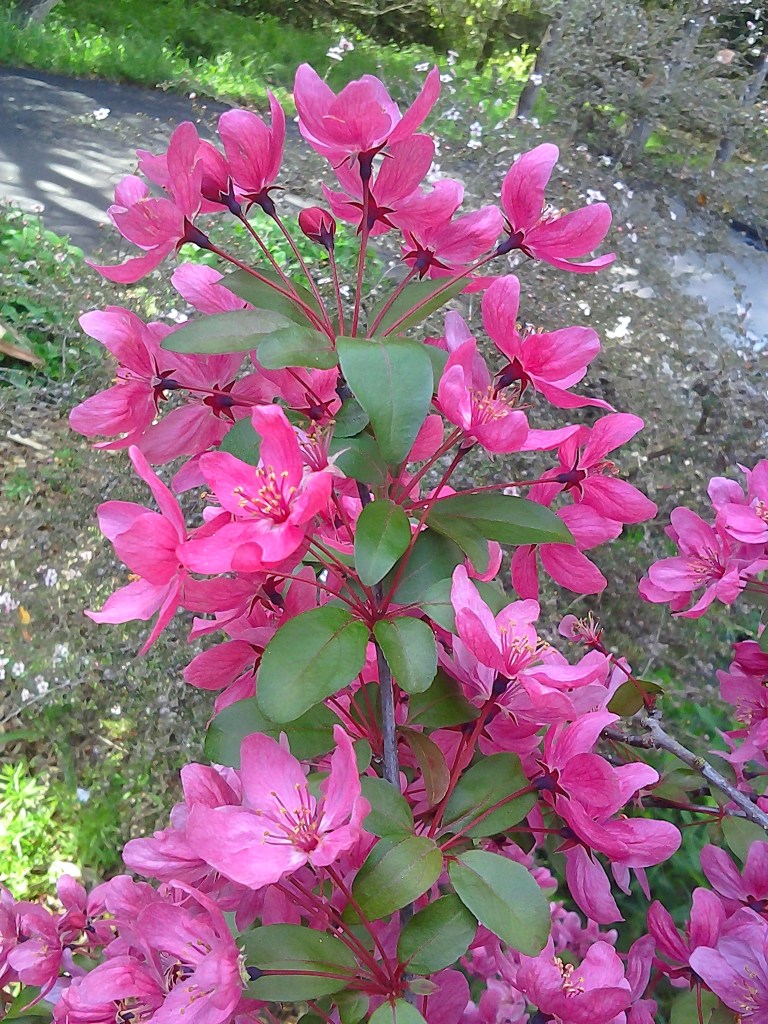
There are actually several other plants that can provide bare twigs that can be ‘forced’ into bloom in the home. ‘Forcing’ is simply the acceleration of bloom of such twigs by cutting them and bringing them from cool winter weather into warm interior ‘weather’. Flowering quince, flowering cherry and flowering (purple leaf) plum have likely finished bloom; but forsythia, hawthorn, flowering crabapple and many of the various fruit trees that have colorful bloom will be ready to be forced any time. Some daring people even force redbud, dogwood, witch hazel, lilac and star and saucer magnolias.
When the deciduous fruit trees that bloom well need to be pruned in winter, some people intentionally leave a few spare branches to be cut and forced later, just before bloom. These include almond, cherry, apricot, plum, prune, nectarine, peach, pear, apple and a few others. When stems get cut for forcing, they should be pruned out from the trees according to proper dormant pruning techniques, and can be trimmed up accordingly when brought into the home. Flowering (non-fruiting) trees should likewise be treated with respect when stems for forcing get pruned out.
Twigs to be forced should be cut just as the flowers are about to bloom, and preferably, as a few flowers are already blooming. They should be put in water immediately, and if possible, cut again with the cut ends submerged. Buds that will be submerged when the stems are fitted into a vase should be removed.
Once in a warm home, the rate of bloom will be accelerated, although everything blooms at a particular rate. Apple and pear bloom later than most, and can bloom slow enough to justify cutting stems while already blooming. As forced stems bloom, they can be quite messy, but the mess is probably worth it.
Statice is so popular as a cut flower that it should be more popular than it is in home gardens.
The papery flowers of annual statice, Limonium sinuatum, are so popular as seemingly synthetic dried flowers that many garden enthusiasts are surprised to find that they are happy to bloom naturally in home gardens. The clear shades of blue, purple, pink, orange, yellow and white seem to be dyed. The one or two foot tall flower stems are outfitted with odd papery ‘wings’ that make the stems seem wider than they actually are. Deeply lobed basal foliage forms shallow rosettes. Mature plants are about one or two feet tall, and a foot or so wide. Bloom begins late in summer, and continues into autumn. Good sun exposure and good drainage are preferred. Seed can be sown directly, or young plants can be added to the garden early in spring.
These flowers were cut weeks ago, and will look just as fresh months later.
Statice, strawflower and globe thistle continue to bloom later than most other summer annuals, and hold their flowers longer. Even after bloom, the flowers are so stiff and ‘crispy’ that they remain intact and colorful until they succumb to exposure to weather. If cut and brought in from the weather soon enough, they will last as dried flowers at least until fresh flowers start to bloom in the garden next spring.
Strawflower and larger globe thistle tend to wilt and droop from the weight of the bulky flowers, so should be tied in small bunches and hung upside down to dry. Perennial statice (which has larger blooms than annual statice) tends to flop to the ground, but the stems often bend only at the base so that the rest of the stem length stays somewhat straight. Smaller globe thistle and annual statice often dry standing up while still out in the garden.
Yarrow and English lavender can be dried as well, but lose most of their color. Lavender dries naturally in the garden. Yarrow can likewise be allowed to dry in the garden, but probably keeps a bit more color if cut while still fresh and hung upside down. Because yarrow blooms are so wide, they should be hung individually or in small bundles. Queen Anne’s lace has even wider blooms that curl inward as they dry, so they really should be hung individually.
Old hydrangea flowers that are only beginning to fade can dry surprisingly well if cut and hung individually before they deteriorate too much or start to rot. Some varieties retain color better than others. Some fade almost completely to an appealing brown paper bag.
There are not many roses this time of year, but when they do bloom, even they can be cut and dried while beginning to unfurl. Only a few small and tightly budded roses can be dried when completely open. Because they droop right below the blooms, roses should be hung upside down to dry. Dark colored roses get very dark as they dry. White roses turn tan. Pink and yellow are probably the better colors.
Cat-tails and pampas grass flowers are big, bold and dated cut flowers. Yet, for situations where big flowers fit, they are just as practical now as they were in the 1970s. Because pampas grass flowers shed, and cat-tails can explode (to disperse their seed), they should be sprayed with hair spray or another fixative to keep them contained. Pampas grass foliage has dangerously serrate edges that can give nasty paper cuts, so should be handled carefully, and displayed out of the way.
Mild autumns and arid summers keep chrysanthemums on a different schedule here than in most other regions. They can get planted in spring to grow through summer and bloom through autumn; but because they can take a bit of work, they are more often planted while blooming in autumn. Although commonly grown as autumn annuals, they are perennials that can regenerate next spring, grow through summer, and bloom even better the following autumn.
Centuries of development in Japan have produced more varieties of chrysanthemums than can be documented. There are really some weird types grown for cut flowers or by hobbyists. Garden varieties are mostly limited to simpler flowers that do not need much thinning or staking. Color ranges through all sorts of hues and shades of yellow, orange, red, pink and bronze, as well as a few purplish colors, cream and white. Many have yellow centers. The aromatic foliage is alluring to some, but objectionable to others.
Many of us who already grow sea lavender, Limonium perezii, might wonder why it is a topic for August. In the mildest spots, it gets more credit for blooming in winter while most other plants are dormant. Yet, it is actually classified as a summer blooming perennial because it blooms more reliably though summer in most places.
Bluish purple blooms stand more than two feet tall, just above coarse mounds of evergreen basal foliage that gets more than two feet wide. Each billowed bloom contains many tiny flowers. Larger blooms are too heavy to stand upright, so they lay down on the foliage. The weirdly wavy leaves are on such long petioles (leaf stalks) that they may lay down too.
Established plants do not need much attention or water. Faded bloom should be pruned away. It is not practical to remove all of the faded foliage. Every few years or so, old plants can be reinvigorated by getting divided. Newly divided rhizomes will need to be watered regularly until they disperse their roots. Sea foam statice likes full sun exposure.