Mrs. George Washington never grew Martha Washington geranium, Pelargonium X domesticum. It was hybridized in Europe from south African species after she passed away. Although classified as a hybrid species, it is actually a group of distinct hybrids. Most are related to the same pair of primary ancestors. A few other species mingled in the process though.
The largest cultivars do not get much taller than three feet. Some develop rather irregular form. A few grow upward only to fall over. Minor tip pruning can improve awkward form. Stems are woodier than those of common zonal geranium. Consequently, cuttings do not develop roots as efficiently. Old specimens are less likely to recover from major pruning.
Martha Washington geranium may not bloom quite as profusely as zonal geraniums. The flowers are more spectacular though. Floral color can include purple, lavender, pink, red, burgundy or white. Billowy flowers are bordered or blotched with alternate colors. A few flowers bloom together on rounded umbels. Evergreen foliage is light green and ruffly.
Elderberries grow efficiently from hardwood cuttings.
Seed is the most familiar source of much of the vegetation that inhabits home gardens. It is the origin of almost all vegetables and most annual flowers. Some seed grows directly into its gardens. Some grows in nurseries to become saleable young plants. Seed is not the only method of propagation though. Cuttings, division and layering are as productive.
Cuttings, as well as divisions and layers, are genetically identical to their single parents. Unlike seed, which are products of two parents, they lack potential for genetic variation. Division is the separation of stems with roots from perennials or clumping woody plants. Layering is the rooting of stems by partially burying them while attached to their parents.
Cuttings grow simply as pieces of stem within moist rooting medium such as potting soil. They initially lack roots and perhaps foliage. They develop new roots and foliage as they grow. Their medium must remain moist throughout the process. For many plants, rooting hormone accelerates root initiation. Some species can grow roots as they soak in water.
Hardwood cuttings are mostly from deciduous species as they defoliate for winter. Those from last winter are developing now. Evergreen hardwood cuttings retain some foliage through their winter dormancy. Softwood cuttings can be either deciduous or evergreen. They involve fresh new growth, so can begin as soon as such growth is mature enough.
The lower cuts of cuttings should be just below a node. Upper cuts should be just above a node. Terminal cuttings are tips of stems without upper cuts. Each cutting must include at least two good nodes. Some species may need cuttings to be several inches long in pots. Most grow better from small cuttings that fit into flats. Some can go directly into a garden. Cuttings should lack leaves below the level of their rooting medium.
Softwood cuttings generally require humidity to help compensate for their lack of roots. Most also appreciate partial shade. Evergreen hardwood cuttings appreciate the same as weather gets warmer and drier. Warmth from a heating mat below pots or flats might accelerate rooting. Many species are difficult or impossible to grow from cuttings though.
Wandering Jew, spider plant, various philodendron and jade plant were among the most popular houseplants of the 1970s. They are as easy to propagate as they are to grow, so were popular gifts for friends and neighbors. Jade plant, Crassula ovata, commonly grew too big to stay inside without pruning. It fortunately grows better than the others outdoors.
Jade plant does not grow fast, but can eventually get more than six feet tall, with densely rounded form. The succulent stems of such large specimens get quite plump, but remain rather fragile. The paired evergreen leaves are thickly succulent, and mostly a bit longer than two inches. Clusters of tiny pale pink or white flowers are not especially impressive.
At least one cultivar is variegated with irregular white stripes. Another is somewhat ruddy with relatively compact growth. Others exhibit tubular or curly leaves. Foliage can fade or develop narrow red edges in response to harsh exposure or heat. It is also susceptible to frost damage. Jade plant is mildly toxic, but also potentially appealing to dogs who chew.
The Seventh Rule of Six on Saturday suggests that verbiage regarding pictures should be reasonably limited. I prefer to limit mine to three hundred words, although I sometimes exceed this limit. I certainly would have exceeded this limit this week if I had explained, for example, why I want so many new flax lily, what we intend to do with another lemon gum, why I intentionally plant elderberry seedlings and promote better pollination while so many grow wild, what our options for yellow flag are, why a perfectly good apple tree remains canned and underappreciated, and what justified a pair of white bougainvilleas. Perhaps I should limit words within individual sentences as well as cumulative verbiage.
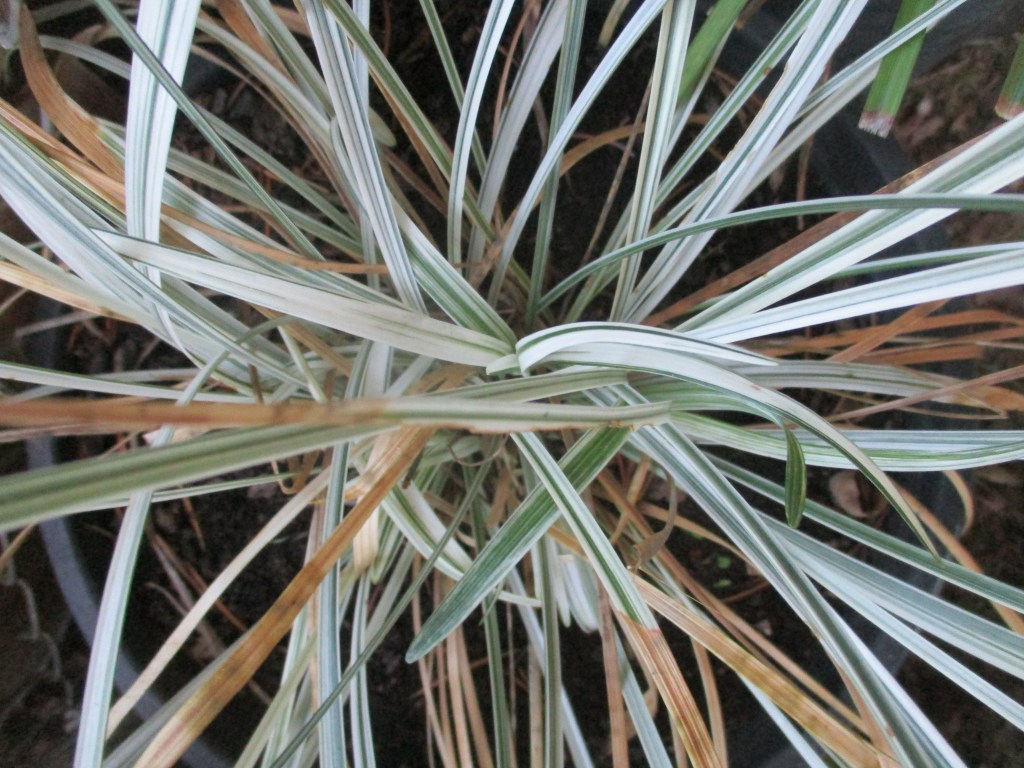
1. Dianella caerulea, flax lily has been a notably reliable perennial. I know nothing more about it. I am not even sure of its identity. Grooming scraps make good cuttings though.
2. Eucalyptus citriodora, lemon gum came back with me from the Los Angeles region. It has a bad reputation as a Eucalyptus. My colleague here and I are very fond of it though.
3. Sambucus caerulea, blue elderberry seedlings grow like weeds. I can them though, to later install them where I want them, and because they pollinate a bit better than clones.
4. Iris pseudacorus, yellow flag can be invasive within riparian situations. I really craved it though. A colleague here got it for me from a roadside ditch. Now what do I do with it?
5. Malus domestica, ‘Golden Delicious’ apple is not exactly my favorite. It lives here in a can though. Perhaps it will go live in a garden this winter, where it can make better fruit.
6. Bougainvillea ‘Barbara Karst’ came with a pair of white Bougainvillea ‘Mary Palmer’s Enchantment’ from the Los Angeles region. It is unplanned. It is such the classic though.
Seed are germinating; and cuttings are rooting. I try to finish my propagation before the end of winter. Some seed appreciate the last bit of chill to maintain their schedule. Some cuttings prefer to start their rooting process while still dormant, so that they are ready to grow by spring. The last and most important of these six pictures is irrelevant to cuttings and seed though. Only the names of those involved are relevant to horticulture; and half of that relevance is merely, although amusingly, coincidental. It will be interesting to see how many can answer the question presented with the last picture. It was difficult to get a reasonably clear picture, and after all the effort, the clarity may not help much.
1. Esperanza seed from Crazy Green Thumbs is finally germinating! Poinciana seed that came with them are still inactive. My rush to sow them prior to spring seems unfounded.
2. Poinciana seed of another kind and from another source is germinating though. Brent thought that I got royal poinciana seed. Rather than disappoint, I procured a few online.
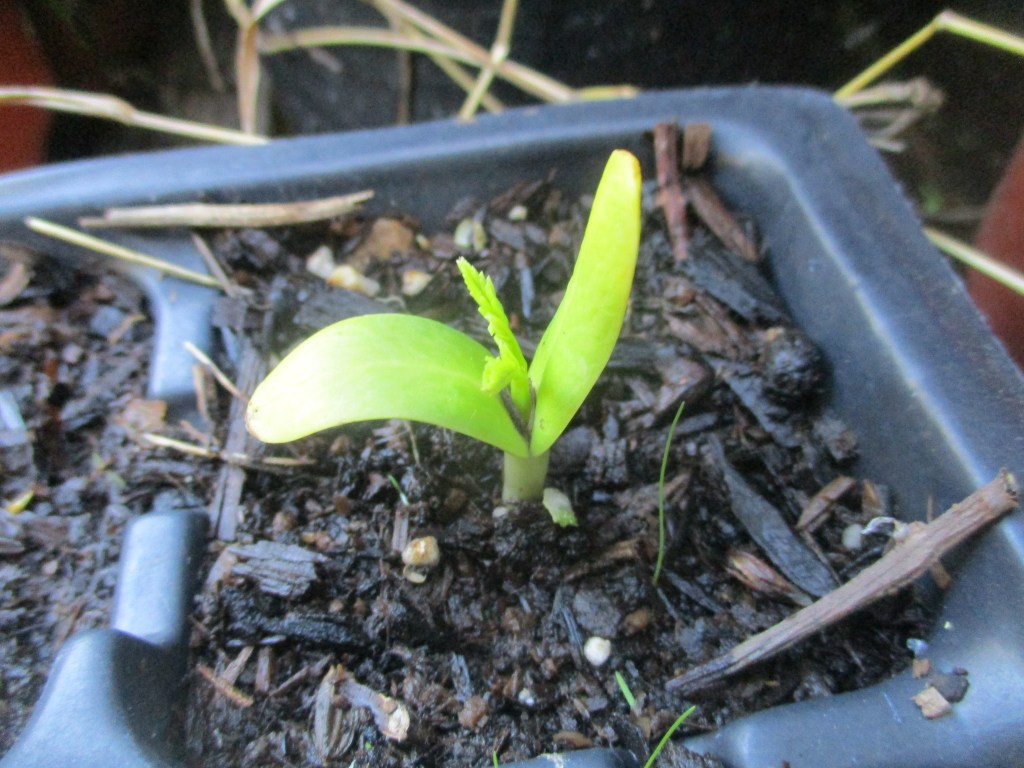
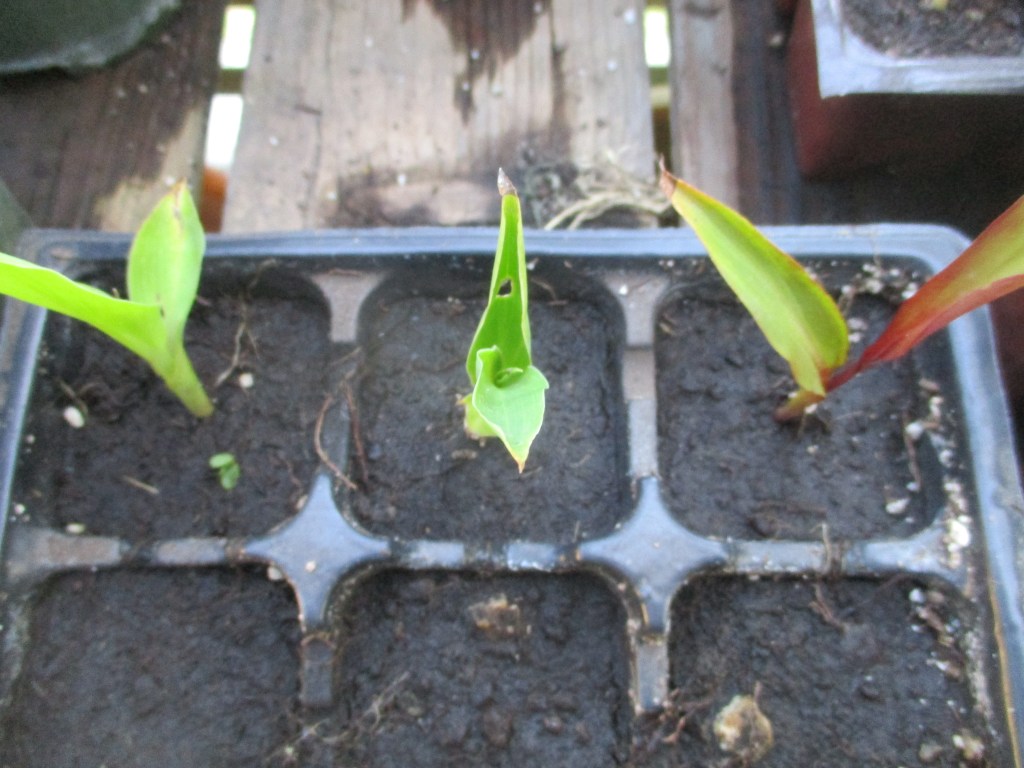
3. Canna seed germination is a surprise. These seed were discarded runts from pods that were still green when deadheaded. I saw them growing from the trash and canned them.
4. Red passion flower vine was a runt also. None of a few other cuttings that got plugged properly took root. This one was too dinky, so was left in its jar of water, where it rooted.
5. Angel’s trumpet cuttings are growing like the red passion flower cuttings should have. They were scraps from pruned out frost damage. Many appeared dead prior to plugging.
6. Lily and Rhody are nearly indistinguishable as they frolic. Their genders are opposite, and their faces are distinct, but they scamper too fast to discern. Can you identify them?
White blooming dragon wing begonia are still quite rare.
The modern hybrid of wax begonia and angel wing begonia, known as dragonwing begonia, wants to be out in the garden like wax begonia, but like angel wing begonia, needs to be sheltered from direct sun exposure in summer. This time of year, it also needs shelter from frost. It gets two or three feet high and wide, and makes quite an impressive display with abundant red or pink flowers against glossy foliage. A white blooming cultivar became available only recently. Pruning scraps are easy to root as cuttings.
With only one exception (#6), everything that I added to my downtown planter box was recycled from somewhere else. Almost all of that which I added came from the garden of the mother of a now deceased old friend, so has major history with me. The original cuttings rode around for more than a month on the dashboard of the old station wagon prior to getting plugged. Yet, I do not know many of their names. Only #5 inhabited the planter box before I got there. Nowadays, bits and pieces generated from occasional grooming of the planter box get recycled elsewhere. Many are shared with neighbors.
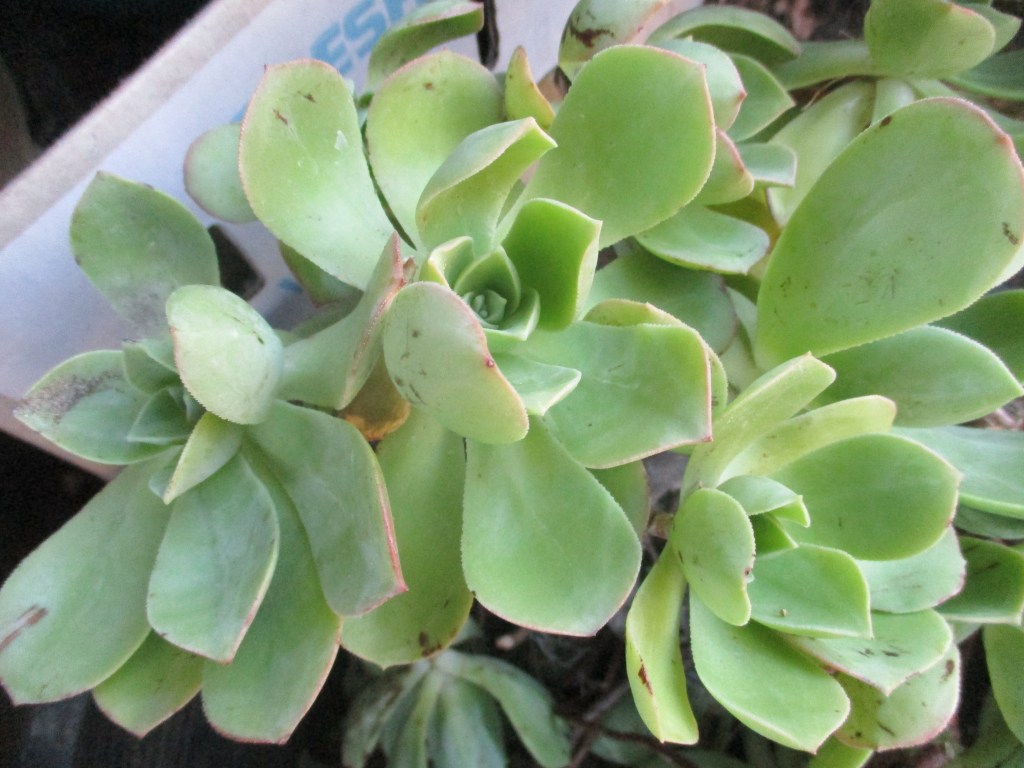
1. Tree houseleek grew almost as big as small tumbleweeds. Except for two Indian hawthorn trees that were installed when the planter boxes were built, they are the most prominent features.
2. Unknown succulent resembles tree houseleek, but stays much lower. A neighbor requested ‘Australia’ canna (#6) because this and tree houseleek produce so much pallid light green foliage.
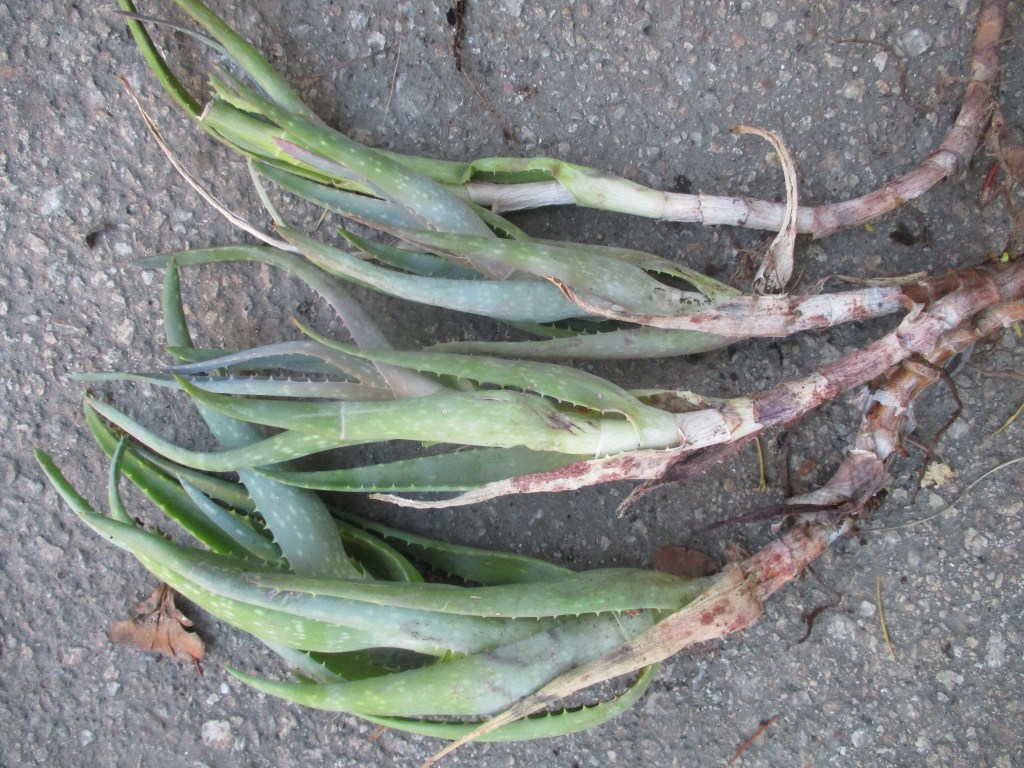
3. Unknown Aloe is more appealing in the planter box than these shriveled cuttings are. I think that it might be more appealing if it bloomed. After a few years, I have not seen a single flower.
4. Unknown bearded is not a good choice for a planter box downtown. It blooms only once annually, and the few flowers get picked. They are slightly grayish white, so are not even very pretty.
5. Variegated lily turf is one of the few plants that was already in the planter box when I go to it. Some of it reverted to unvariegated, and became even more invasive, and then more abundant.
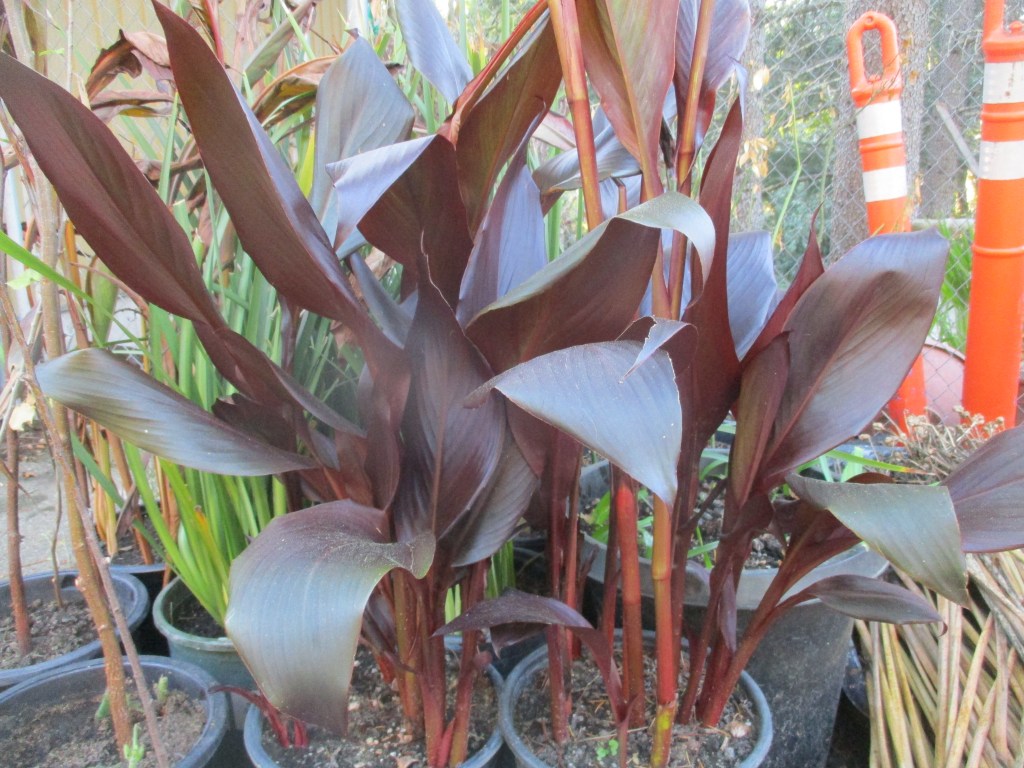
6. ‘Australia’ canna is the only item that I actually purchased for the planter box. I got it because a neighboring merchant expressed an appreciation for bronzed foliage. It does not disappoint!
This is the link for Six on Saturday, for anyone else who would like to participate:
Honeysuckle can layer naturally, and will most certainly layer if a portion of stem is simply buried or weighed down under a rock.
Where they grow wild in riparian environments, box elders, willows and cottonwoods are not as clumsy as they seem to be. As the rivers and creeks that they live so close to erode the soil around them, they often become destabilized and fall. Yet, this is actually part of their plan. If their original roots remain somewhat intact, the limbs and trunks develop new roots where they touch the ground. Eventually, these rooted limbs and trunks develop into new and separate trees.
In home gardens, a similar technique known as ‘layering’ can be employed to propagate one or a few copies of many other plants. Many sprawling vines and ground covers, such as ivy, honeysuckle, blue rug juniper and trailing rosemary, are likely to develop roots where their stems touch the ground anyway. Rooted stems need only to be found, dug and separated as new plants. Shrubbier plants need a bit more help.
Azalea, rhododendron, camellia, holly and just about any plant that has low stems that can be bent downward into the soil can be propagated by layering. Redwood, elm and magnolia do not always have limbs that reach the ground, but any that do would be pleased to cooperate as well. In fact, there are only a few woody plants that do not develop roots by layering, such as some pines and most eucalypti.
A layered stem only needs to be partly buried to develop roots. The tip should protrude from the soil a few inches. A short stem may barely protrude above the soil. A layered stem of a plant that develops adventitious roots very efficiently can be as long as a few feet. A very flexible stem can easily be held down by the weight of the soil that it gets buried with. A more rigid stem may need to be held down with a rock.
Before getting buried, the stem should be cut about a third of the way through to promote development of roots. The cut should be made on the underside so that it stays open when bend downward and buried. A bit or rooting hormone powder applied to the open wound accelerates the process. It works almost like taking a cutting, but without completely separating the cutting from the parent plant right away.
Once buried, a layered stem should be watered regularly until it gets dug while dormant (or mostly dormant) the following winter. By that time, the rooted stem can be dug and pruned from the parent plant, and then planted where desired. Because it takes a few months for enough roots to develop, layering should be done in spring.
Norway maple is aggressively invasive in the Pacific Northwest and the northeastern quadrant of America. It is no problem here though, and is actually rare. Schwedler maple is a cultivar of Norway maple that used to be more popular as a street tree in San Jose. I had been trying to grow copies for years. Besides propagating by cutting, I also tried grafting.
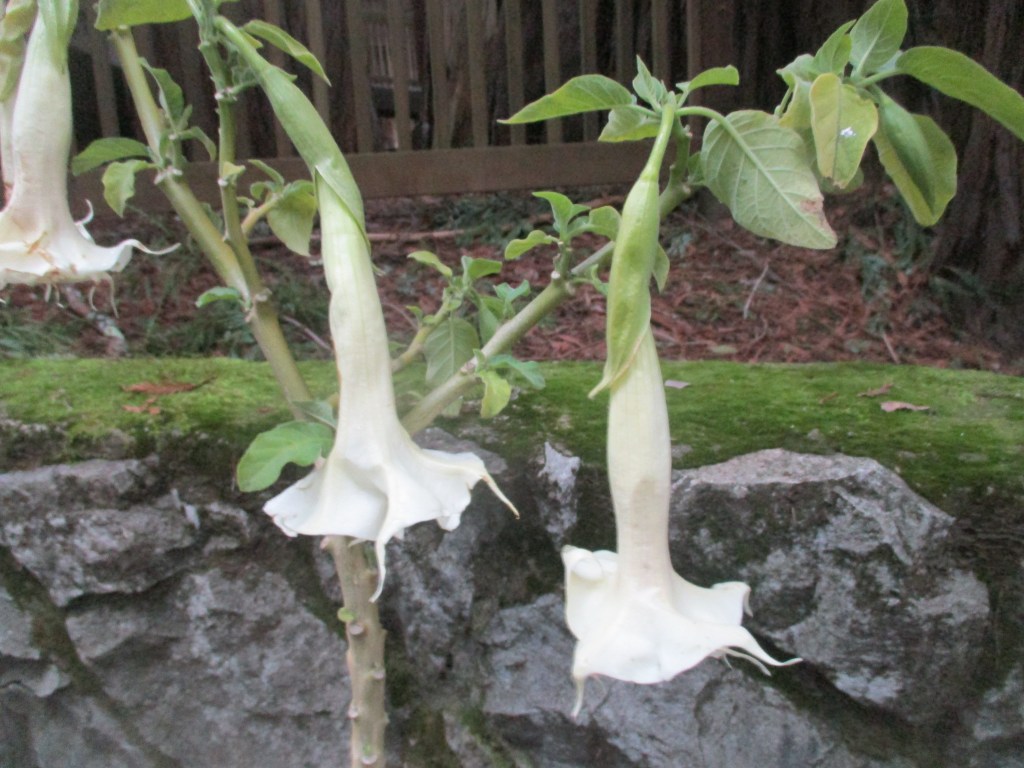
1. Double white angel’s trumpet is irrelevant to Schwedler maple. It belonged with the Six for last week, but with the addition of the picture of Rhody, did not fit. Omission of Rhody’s picture would have been unacceptable. The parent plant lives at the Santa Cruz Civic Auditorium. The piece in this picture is a pruning scrap that became more new cuttings. Bloom is very fragrant!
2. Scion wood looks like a bunch of bare twigs because that is precisely what it is. This is an important bunch of bare twigs for me. It is from an elderly tree that I met in the summer of 1976.
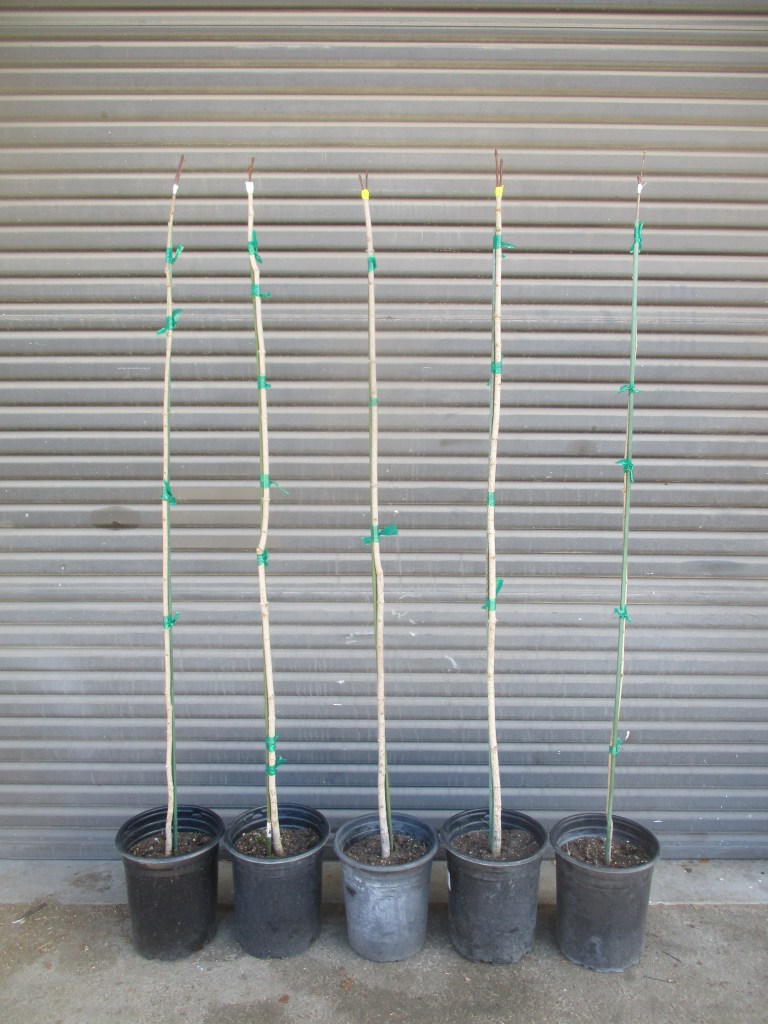
3. The usual suspects. Norway maple is notoriously invasive elsewhere. The few cultivars that live here are both rare and seemingly sterile. However, one noncultivar tree seeded these five.
4. High bud grafting is not my style, but was likely easier on the thinner portions of trunks five and a half feet up. Besides, the straight trunks were too perfect to waste. It will look silly later.
5. Cleft grafting was also an easier option to more typical budding. Besides, I do not trust budding with such fat buds and such thin bark. I could not find rubbers, so used elastic from masks.
6. Rhody is about as relevant to Schwedler maple as the double white angel’s trumpet. Nonetheless, he is always the main attraction of my Six on Saturday. He is as uncooperative as always.
This is the link for Six on Saturday, for anyone else who would like to participate:










 Tony Tomeo