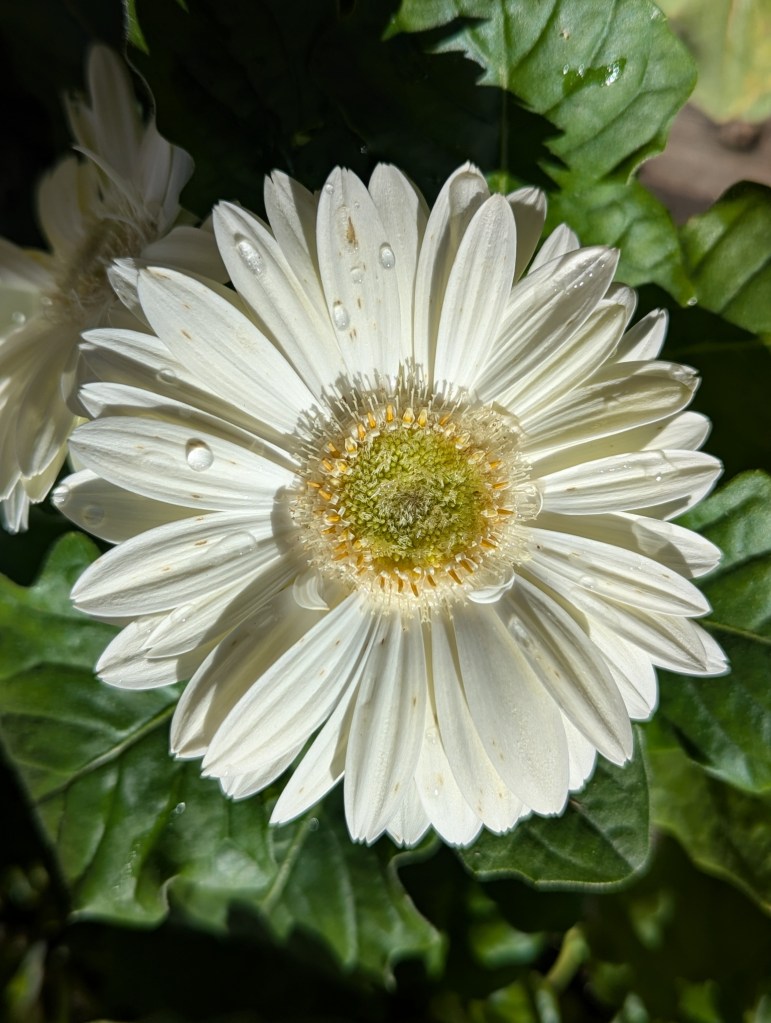
English Daisy

Common English daisy can infest lawns.

Like pampas grass, periwinkle and the ivies, English daisy, Bellis perennis, has a bad reputation as an aggressive weed. The primitive species with single white flowers with bright yellow centers is very difficult to eradicate once it becomes established in lawns. The first phase of bloom in early spring can be profuse enough to resemble thin patches of snow that appear as the weather gets warmer instead of colder.

Varieties that are sometimes found in nurseries are much better behaved and more colorful. Their red, pink or white flowers are typically double, and stand on stems about three inches high. Their rich green, inch and a half long leaves make six inch wide clumps that are compact enough to mix with other small perennials in borders, urns or large pots. Deadheading (removal of fading flowers) is a bit tedious for so many small flowers, but promotes continued bloom. English daisy is very easy to propagate by division.

Blue Marguerite

Not many flowers are as blue as blue marguerite is.

            Like all sorts of daisies, gazanias, ice plants and so many of the familiar flowers in the Compositae family, blue marguerite, Felicia amelloides, is endemic to South Africa. Their flowers are the colors of the flag of Sweden though, with clear blue petals around bright yellow centers. These inch wide or slightly wider flowers bloom on well groomed plants most of the time, except during cool weather. Plants that do not get dead headed (groomed of deteriorating flowers) take breaks between bloom phases. The simple inch long leaves seem to be glossy, but almost have the texture of a cat’s tongue.    

            Mature plants may be taller than a foot and broader than four feet. Their somewhat woody stems are not as substantial as they should be, so can break easily, leaving awkward holes in otherwise well rounded shrubs. Unfortunately, the healthiest plants may live for only a few years. Distressed plants actually last a bit longer. Aggressive pruning at the end of summer or just before spring can restore old deteriorating plants for a while.

            Blue marguerite likes well drained soil, good sun exposure and somewhat regular watering. It is most often used as a colorful and shapely perennial, but is colorful enough for pots and urns of mixed perennials or annuals.

Feverfew

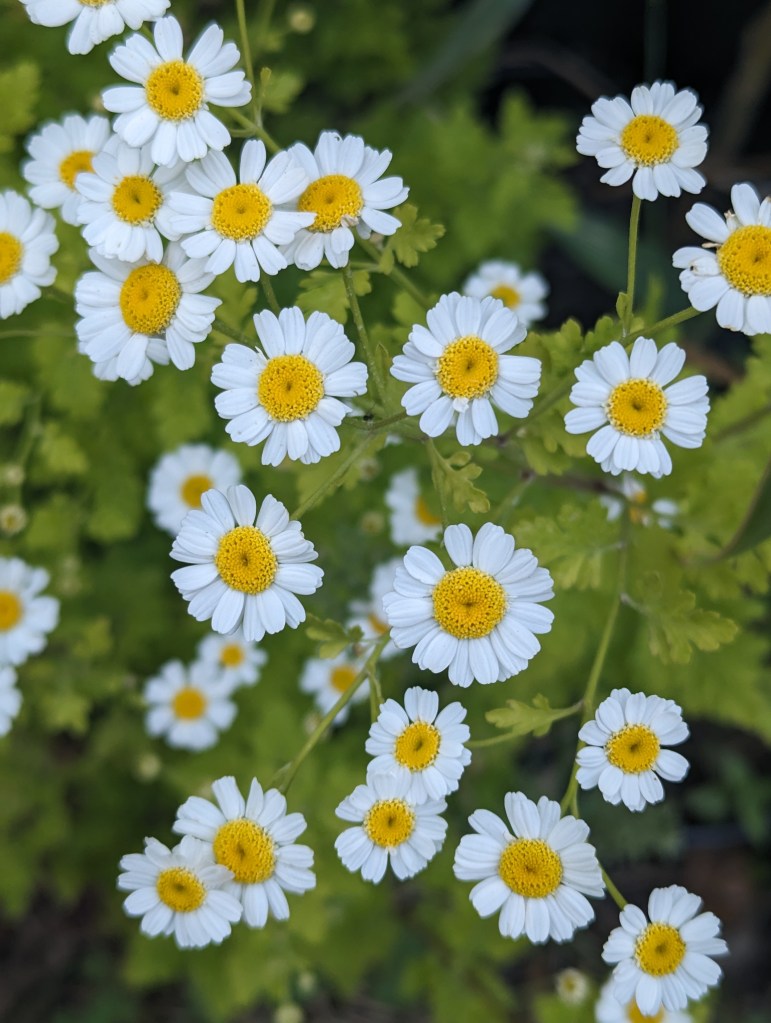
Feverfew blooms with many tiny daisies.

Historical herbal applications were the origin of its now silly name. Feverfew, Tanacetum parthenium, is a relative of chamomile. Its leaves are useful for herbal tea like floral buds of chamomile. Feverfew is delightfully aromatic, although some may disagree about how delightful it is. Some believe that it can repel unwanted insects, but may also repel bees.

Feverfew is likely more popular for its floral display than its aromatic foliage. Its abundant small composite blooms are very similar to those of chamomile. They are nearly as wide as three quarters of an inch. Their yellow centers are a bit flatter. Their ray florets (petals) are a bit wider. They bloom on open trusses that hover loosely above their basal foliage.

Feverfew has lime green foliage with a fine texture. It can stand almost two feet high with bloom standing a bit higher. It migrates slowly, but can slowly get where it should not be. Pruning scraps can root as cuttings. Feverfew prefers rich soil but does not need it. Good sun exposure and even watering are more important. ‘Aureum’ is bright greenish yellow.

Chrysanthemum paludosum

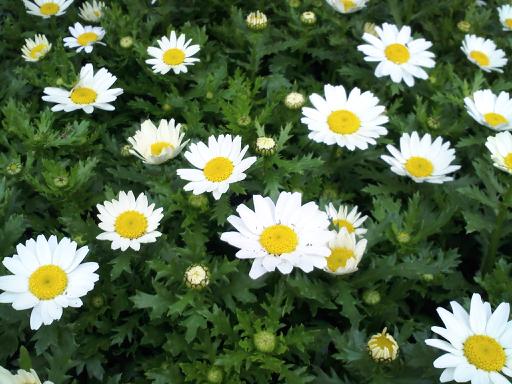
Chrysanthemum paludosum goes into the garden early here.

            In cooler climates, where winters are too harsh but summers are just right, Chrysanthemum paludosum is a warm season annual. Locally though, it gets planted about now like pansies, stock and Iceland poppies.  Chrysanthemum paludosum does just fine through late winter, and does even better as the weather gets warmer in spring. It can be replaced with real warm season annuals as weather eventually gets too warm and dry (lacking humidity) in summer. In cool and damp places, it can survive through summer. Chrysanthemum paludosum develops into six inch wide mounds of rich green and finely textured foliage adorned with small white daisy flowers with yellow centers.

Shasta Daisy

Shasta daisy is ideal for cutting.

Mount Shasta very rarely lacks its snow. Its summit is almost always white. Shasta daisy, Leucanthemum X superbum, strives for the same. Bright white bloom starts in spring and continues into autumn. Primary spring bloom is the most profuse. Sporadic bloom lingers between subsequent minor bloom phases. Only cooling autumn weather inhibits bloom.

Shasta daisy is a resilient perennial. It develops dense colonies of tough basal rhizomes to survive winter dormancy. From spring to autumn, upright blooming stems grow almost three feet high. Individual composite flowers are of classic daisy form with cheery yellow centers. They are excellent as cut flowers, with simple green foliage. Leaves are serrate.

Shasta daisy prefers systematic watering, but can survive with less. It tolerates only a bit of partial shade. Removal of floral stems after bloom or cutting should leave no tall stubs. Removal of all upright growth as it deteriorates into winter promotes tidier spring growth. During winter dormancy, Shasta daisy is very easy to propagate by division of rhizomes.

African Daisy

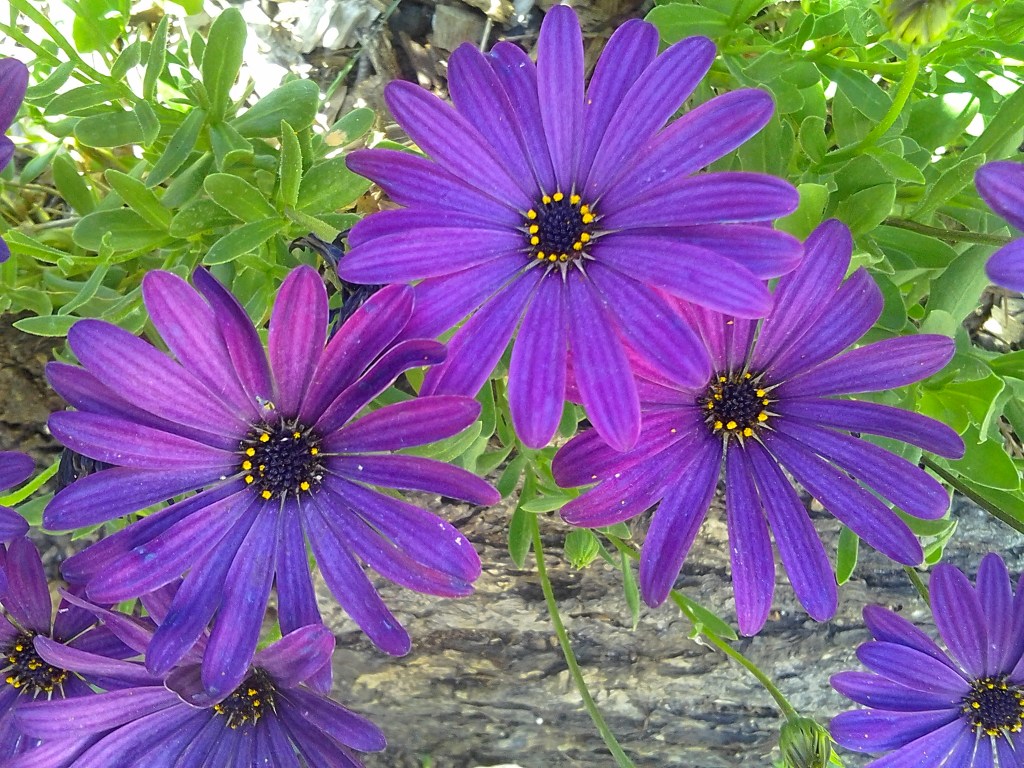
African daisy hybrids are generally sterile.

Old fashioned trailing African daisy was becoming too common by the time it succumbed to the Big Freeze just prior to Christmas of 1990. Shrubbier and more colorful cultivars of hybrids with similar species, particularly Osteospermum ecklonis, are now more popular. Such hybrids mostly lack species designation because their lineage is very complicated.

Mature specimens do not grow much wider than two feet, so do not migrate as efficiently as old fashioned trailing African daisy. Since they are hybrids, they do not produce viable seed either. However, if pressed into damp soil, peripheral stems generate roots to grow as new plants that extend the collective width. They also replace deteriorating old plants.

Sporadic bloom may be almost continuous between a few profuse phases, with the most profuse phase between winter and spring. Only the coolest and warmest weather inhibit bloom. It can be difficult to shear overgrown plants between phases without ruining a few flowers. Floral color is pastel hues of purple, lavender, red, pink, orange, yellow or white.

African Daisy

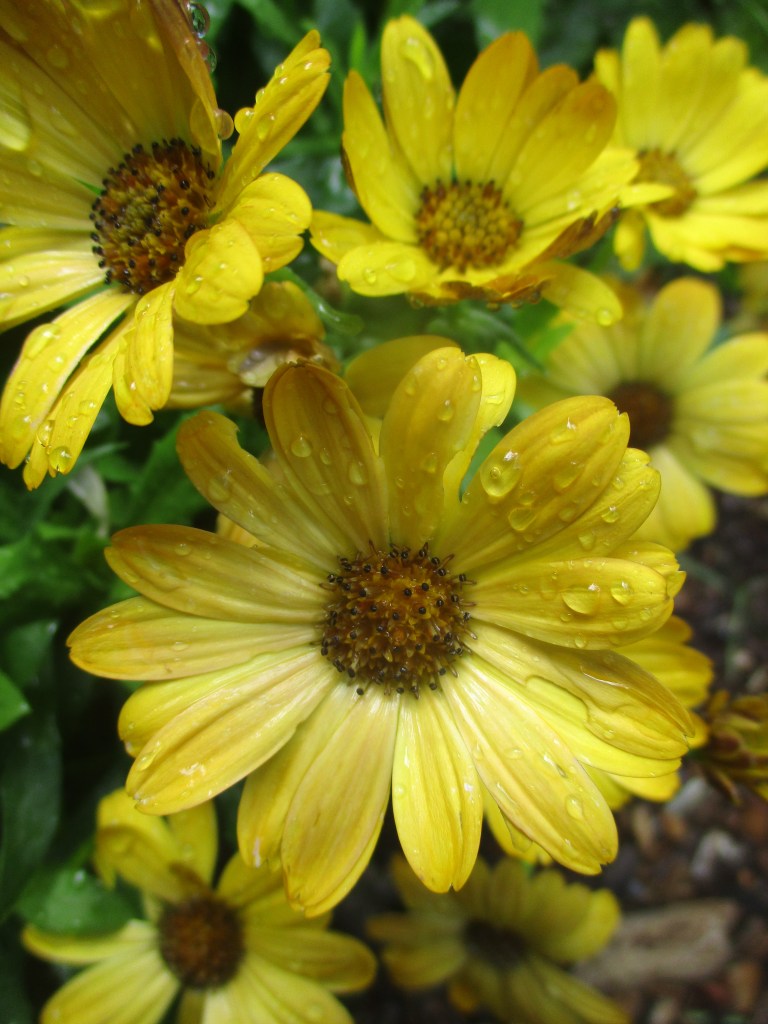
Modern African daisies are surprisingly colorful.

Only a few decades ago, the only familiar African daisies, Osteospermum spp., were the sprawling and often sparsely branched ‘freeway daisies’ with blue-eyed white or rarely light purple flowers. They made nice blooming ground cover that could be planted in drifts for a bit of color among the deep green of Algerian ivy on expansive freeway embankments.

Modern varieties are shrubbier perennials with more profuse bloom of white, cream, pink, purple, pale yellow or pale orange flowers, mostly with blue or purple centers. Some yellow flowers have yellow or cream centers. Some of the fancy types have spooned petals like some types of cosmos or chrysanthemums. After the primary bloom phase in spring, a few sporadic flowers may continue to bloom through summer until the secondary light bloom phase late in summer. However, the old fashioned ‘freeway daisy’ types do not always display a second bloom phase. Varieties with variegated foliage are still rather rare.

Even though African daisies can survive in inferior soil with minimal watering, they perform best with good soil and regular watering. Plants in containers can not disperse their roots like they want to, so are are more dependent on regular watering. Fertilizer prolongs bloom.

Gazania

Gazania is colorful until cool autumn weather.

The most familiar of the gazanias are the ‘trailing’ types commonly appreciated as ground cover. They are rather shallow, but dense enough to prevent most weeds from getting through. Their yellow or orange composite (daisy like) flowers bloom initially in spring, and then continue to bloom sporadically as long as the weather stays warm into autumn. Some trailing gazanias have interesting silvery foliage.

‘Clumping’ gazanias do not spread efficiently or thoroughly enough to be practical as ground cover over large areas, but bloom a bit more profusely with bigger flowers in shades of yellowish white, light yellow, bright yellow, orange, brownish orange and brownish red. The foliage gets a bit deeper to form irregular but dense low mounds. Clumping gazanias can be lined up as an informal border around blooming annuals or perennials, or incorporated individually into mixed urns or vertical gardens.

Gazanias are not too discriminating about soil quality or frequency of irrigation. They only need good sun exposure. Trailing gazanias are rather easy to propagate by cuttings made from scraps from pruning around the edges. Clumping gazanias do not get pruned as much, but are easy to propagate by division from dense clumps.

Santa Barbara Daisy

50729-c
Some of us know Santa Barbara daisy by the less appealing name of ‘fleabane’.

Santa Barbara was not exactly its first choice. Santa Barbara daisy, Erigeron karvinskianus, is not even native to California. It is actually from Central America. It just happens to do very well here, and can naturalize if conditions are right. It can be rather grungy through summer in the wild, but with a bit of watering, it can bloom nicely all year.

The thin stems can spread a few feet without getting more than a foot deep. If even shallower growth is preferred, older plants can be cut down or pulled up as they get replaced by their own offspring. The narrow leaves are quite tiny. The white or slightly pinkish flowers are not much bigger, less than half an inch wide, with prominent yellow centers.

Santa Barbara daisy is also known as Mexican fleabane, both because it is actually native to Mexico, and also because it is supposedly useful for repelling fleas. The problem with using it to repel fleas is that only its smoke is effective. There are probably other herbal alternatives that work just as well without being a fire hazard.