
The most familiar of the gazanias are the ‘trailing’ types commonly appreciated as ground cover. They are rather shallow, but dense enough to prevent most weeds from getting through. Their yellow or orange composite (daisy like) flowers bloom initially in spring, and then continue to bloom sporadically as long as the weather stays warm into autumn. Some trailing gazanias have interesting silvery foliage.
‘Clumping’ gazanias do not spread efficiently or thoroughly enough to be practical as ground cover over large areas, but bloom a bit more profusely with bigger flowers in shades of yellowish white, light yellow, bright yellow, orange, brownish orange and brownish red. The foliage gets a bit deeper to form irregular but dense low mounds. Clumping gazanias can be lined up as an informal border around blooming annuals or perennials, or incorporated individually into mixed urns or vertical gardens.
Gazanias are not too discriminating about soil quality or frequency of irrigation. They only need good sun exposure. Trailing gazanias are rather easy to propagate by cuttings made from scraps from pruning around the edges. Clumping gazanias do not get pruned as much, but are easy to propagate by division from dense clumps.


 A flower that is so prominent in American culture should have a more appealing name than black-eyed Susan. Even the Latin name, Rudbeckia hirta, sounds bad. Is Becky really so rude? Did she hirt Susan? Well, black-eyed Susan is good enough to be the state flower of Maryland, and is one of the most popular of flowers for prairie style gardens of the Midwest. After all, it naturally grows wild in every state east of Colorado. Here in the West, it is a light-duty perennial that is more often grown as an annual. As a cut flower, it can last more than a week.
 If you’re going to San Francisco, be sure to wear some flowers in your hair. In the 1960s and 1970s, such accessorizing with Paris daisy, Argyranthemum frutescens (which was at the time, Chrysanthemum frutescens), was a fad. The white flowers with yellow centers were about two or three inches wide. Modern cultivars have smaller flowers that might be light pink or pastel yellow.
 No, this is not a Paris daisy. It is a common euryops daisy, Euryops pectinatus. It is obviously related, but the flowers are bright yellow rather than clear white with yellow centers, and the foliage is darker green. It is more resilient, so became more common in landscapes as quickly as mow, blow and go ‘gardeners’ replaced real gardeners who actually know something of horticulture. There is certainly nothing wrong with it. It is just cliché.
 It seems like not so long ago when the only African daisy that was commonly available was the trailing African daisy that makes such a nice relaxed ground cover for small spaces. The simple white flowers have navy blue centers, and are occasionally joined by mutant light purple flowers. The cultivar that blooms only in light purple was not as popular. Things have certainly changed!
 Most blue flowers are blushed with purple to some degree. Except for lily of the Nile, true blue flowers are quite uncommon. Even with their yellow centers, the tiny daisy flowers of blue marguerite, Felicia amelloides, seem to be too blue to be real. They are almost expected to fade to lavender. Bloom may not be as full as it was a month ago, but continues as long as the weather is warm.
 There is some controversy about the identity of the flowers that Micky Mouse picks at the porch to present to Minnie Mouse when she answers the door. Some insist that they are Transvaal daisy, Gerbera hybrida. When they are not in black and white, the substantial daisy flowers are cartoon hues of yellow, orange, red, pink and white, sometimes with chocolatey brown or black centers.
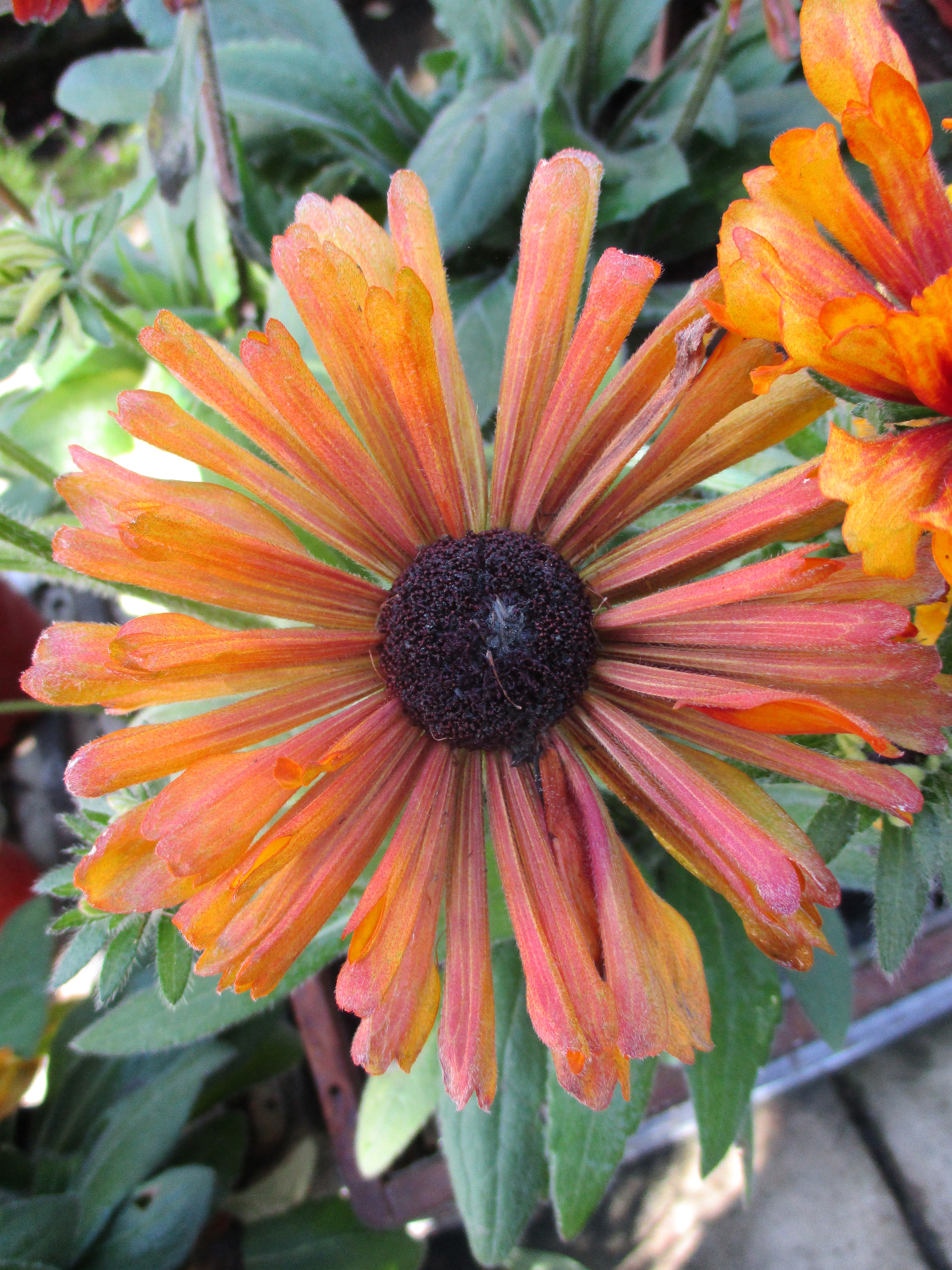 Is it coincidence that the Latin name of black-eyed Susan is Rudbeckia, or was Becky rude enough to give Susan her black eye? The dark center is something that all varieties have in common, and what distinguishes them from most of the related blanket flower varieties. The daisy flowers of black-eyed Susan are traditionally yellow. Modern varieties can be orange, reddish or bronzed.
