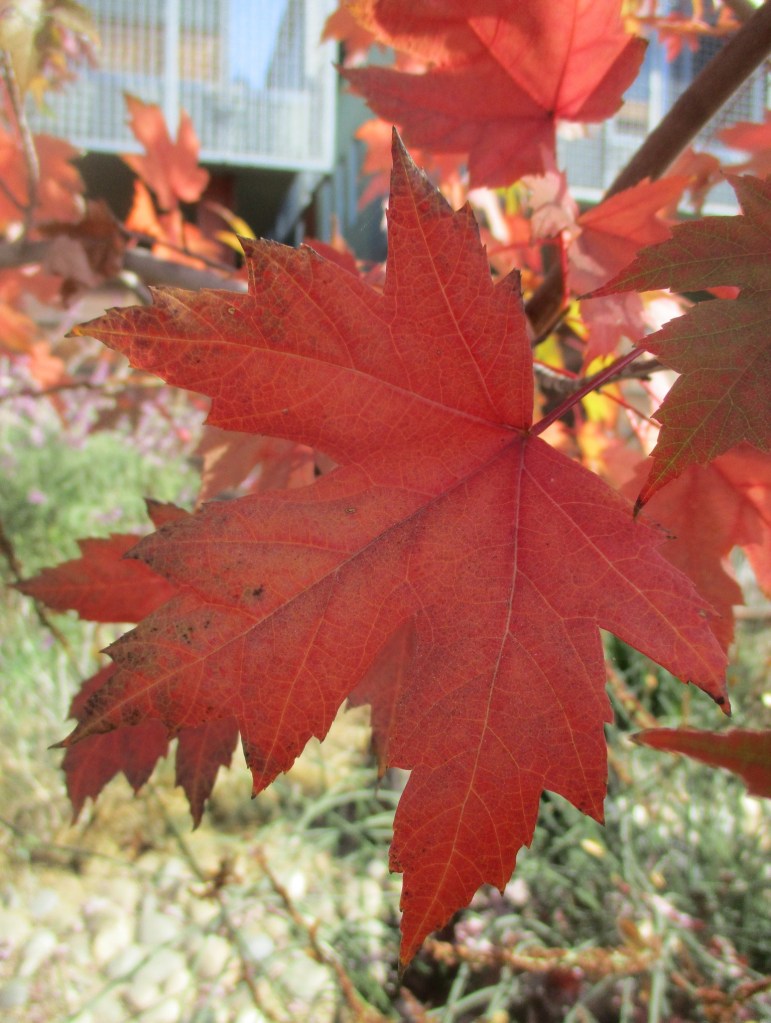
It combines the autumn foliar color of red maple with the lacier foliar form of silver maple. Freeman maple, Acer X freemanii, is a hybrid of the two. It occurs naturally where ranges of its parents overlap. However, most modern garden cultivars are products of intentional hybridization. Like silver maple, it does not need much chill to exhibit autumn foliar color.
Freeman maple inherits other attributes from both its parents. It combines rapid growth of silver maple with structural integrity of red maple. Although it gets bigger than red maple, it is not as imposing as silver maple. It develops high branches like silver maple, but also is symmetrical like red maple. Big roots are about as complaisant as those of red maple.
Mature Freeman maple trees can grow about forty feet tall and broad. Autumn foliar color is vivid orange and red, and lasts longer than that of red maple. Since Freeman maple is a hybrid, it is mostly sterile. It can not generate an annoying abundance of seed. Nor can it naturalize in favorable climates. It is an exemplary maple for mild climates such as this.
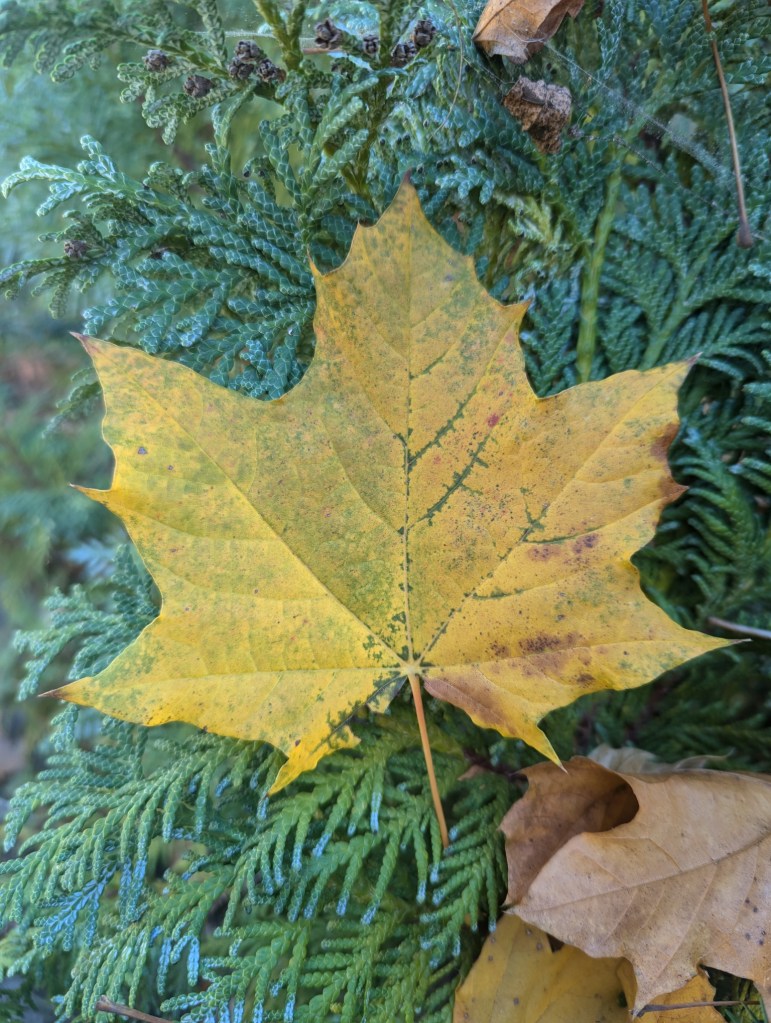
It is rare now, but Norway maple, Acer platanoides, was once common as a street tree. A few are prominent within neighborhoods that were developed in the 1950s and 1960s. It resembles the common London plane. In fact, its botanical name translates to ‘maple like a plane tree’. Unfortunately though, the roots are perhaps too aggressive with pavement.
Norway maple defoliates somewhat more efficiently than London plane tree. However, in spring, it refoliates significantly later. Otherwise, it is a splendid shade tree. A few modern cultivars exhibit bronzed foliage that yellows for autumn. One exhibits variegated foliage. Another has chartreuse foliage. ‘Schwedleri’ was once the most common bronze cultivar.
Very few Norway maples are taller than forty feet within the mild climates here. They can grow significantly larger in cooler climates, such as the Pacific Northwest. Their palmate leaves are about five to nine inches wide. New trees are rarely available from nurseries, so require special ordering. Norway maple is not overly discriminating in regard to soils. It prefers regular irrigation through summer warmth.
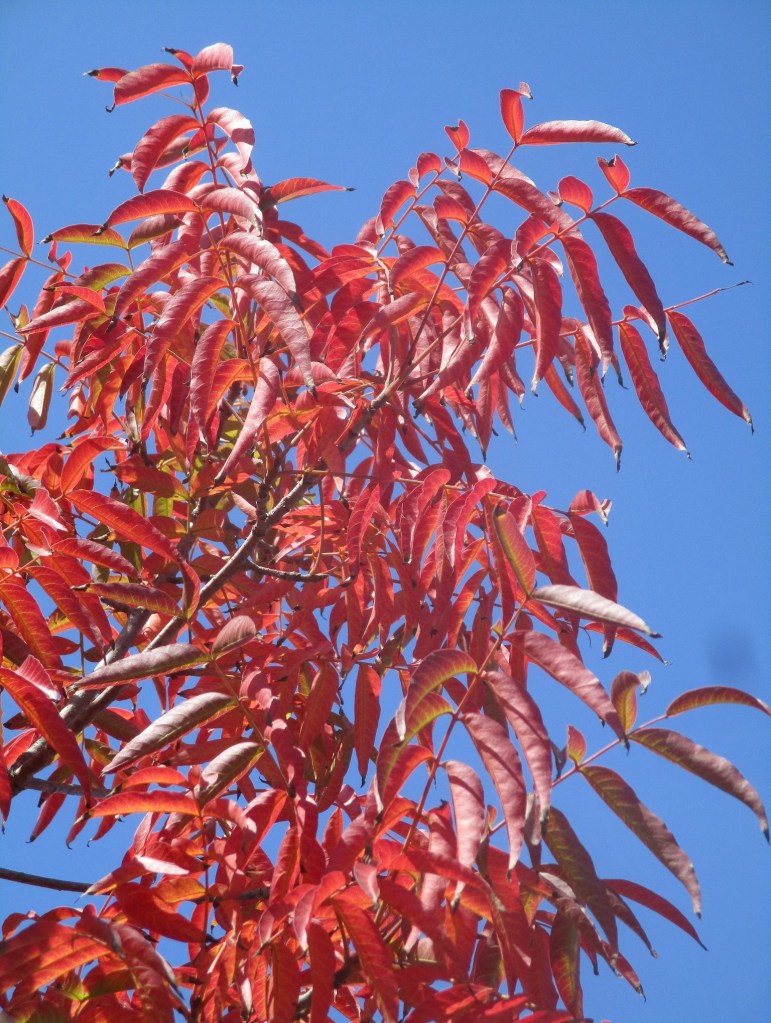
Chinese pistache, Pistacia chinensis, does not need too much chill to begin to turn color. In some climates, it is already yellowing. With cooler weather, it will develop fiery orange and red foliar color. Not only does it color reliably with mild weather, but it actually retains its color better. It could defoliate more efficiently within frostier, windier or rainier weather.
Chinese pistache grows about thirty feet tall and broad. Old trees can eventually grow to about forty feet tall. Some old trees are female, so can produce annoyingly abundant red berries. Modern trees should be fruitless male cultivars. Pinnately compound leaves are about nine inches long, with a dozen or so leaflets. Leaflets are two or three inches long.
Because of its resiliency, Chinese pistache is among the more popular shade trees here. Established trees do not need much irrigation and can likely survive with none. Frequent irrigation can promote shallow root dispersion, which can damage pavement. Otherwise, Chinese pistache is a good street tree. It merely needs pruning for clearance over roads, sidewalks and driveways.
Where it grows wild in the eastern half of North America, honey locust, Gleditsia triacanthos, may not seem like it would be such an appealing shade tree. It is too thorny and messy to make many friends. As it matures and grows nearly seventy feet tall and half as broad, the thorny stems stay overhead and out of the way. However, a larger canopy makes more messy and sometimes unsightly foot long seed pods.
Modern cultivars of the thornless form Gleditsia triacanthos inermis are friendlier and not so messy. Mature trees only grow about half as tall as wild trees. Their main problem is their buttressing roots, which can displace pavement, but stay tolerably low for lawns. Honey locust is actually a good shade tree for lawns (if minor buttressing is not a problem) because it makes just enough shade without getting too dark for a lawn or other shade tolerant plants below. Pods are rare.
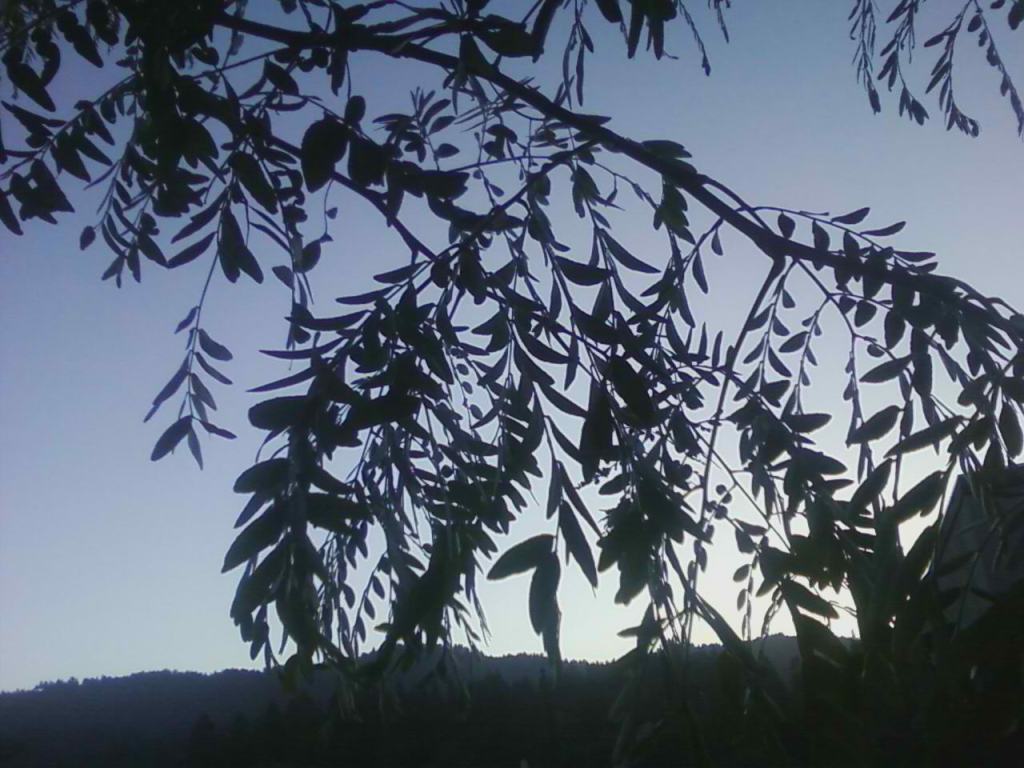
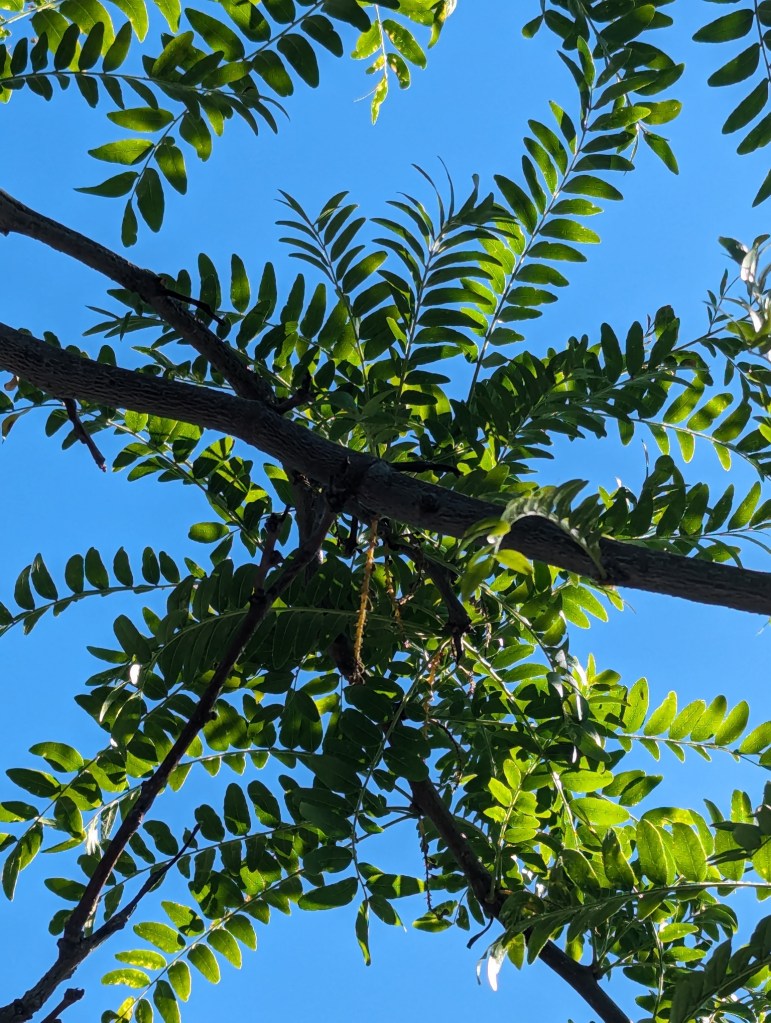
The big eight inch long leaves are bipinnately compound, which means that each leaf is divided into smaller leaflets, which are also divided into even smaller leaflets that are about half an inch long. Although individual leaves are actually quite large, the collective foliage is pleasantly delicate and lacy. This foliage turns yellow early in autumn and disintegrates as it falls, leaving minimal debris to rake. New foliage develops somewhat late in spring, along with inconspicuous flowers.
Trees are the most substantial components of a landscape.
Shady characters inhabit some of the best gardens. Actually, most of the best gardens have some sort of shade tree. There are so many to choose from for every sort of garden. Some stay small and compact enough to provide only a minimal shadow for a small atrium. Others are large enough to shade large areas of lawn.
Like every other plant in the garden, shade trees should be selected according to their appropriateness to particular applications. Favorite trees are of course welcome, but should be placed in appropriate locations where they will be less likely to cause problems later. For example, those of us who like silver maples should only plant them where they will not crowd other trees, and if there is sufficient area to accommodate them when mature. Southern magnolias are bold shade trees, but create too much mess for infrequently raked lawns, and create too much shade for many other plants around them.
Shade trees near to the home should be deciduous if possible. This means that they will drop their leaves to be not so shady when it would be good to get more sunlight through winter. Honey locust, red oak, Raywood ash, tulip tree and many varieties of maple (except Japanese maple) are some of the best. Silver maple gets a bit too large for small gardens, but is an elegant shade tree for large lawns. Japanese maple and smoke tree are small trees that fit nicely into an atrium or a small enclosed garden.
Evergreen trees also make good shade trees, but should be kept farther from the home if possible, in order to avoid shading too much through winter. Besides, most evergreen trees are messier than deciduous trees so are not so desirable over lawns, patios or roofs. Camphor tree and several of the well behaved eucalypti are delightful shade trees where their litter will not bother anyone. Mayten tree is a smaller tree for more confined areas. Strategically placed evergreen shade trees can also function to obscure unwanted views.
Every shade tree creates a specific flavor of shade. Honey locust makes just enough shade for summer weather without making the garden too dark for other plants and lawn grass. Silver maple is a bit shadier. The shade of redwood and Southern magnolia (when mature) though, is so dark that not many other plants want to get close to them.
Remember that appropriate shade trees may be in the garden for decades or even centuries. It is best to select them accordingly so there will be fewer problems in the future.
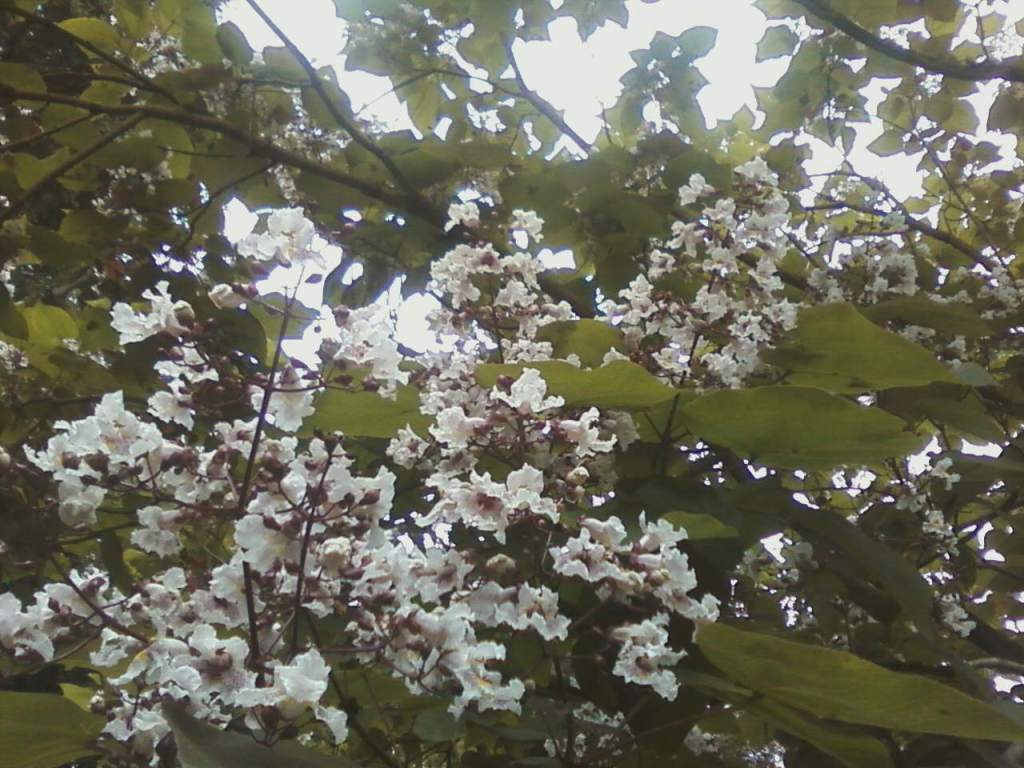
Those who know trees mostly agree that the more traditional catalpa, Catalpa speciosa, from the Midwest is the best catalpa, with soft leaves between half and a full foot long. In late spring or early summer, impressive upright trusses suspend an abundance of bright white, tubular flowers with yellow or tan stripes and spots at their centers. Individual flowers are as wide as two inches. Mature trees can be taller than forty feet and nearly as broad.
From the Southeast, Catalpa bignonioides, is a bit more proportionate to urban gardens though, since it only gets about seventy five percent as large, with leaves that are not much more than half as long. The flowers are also smaller, and not quite as bright white, but are more abundant than those of Catalpa speciosa are. The stripes and spots at their centers are slightly more colorful purplish brown and darker yellow.
Both catalpas can be messy as their flowers fall after bloom. Fortunately, the big leaves are easy to rake when they fall in autumn. Long seed capsules that look like big beans linger on bare trees through winter.
Catalpa speciosa is almost never seen in modern landscapes, and not exactly common even in older Victorian landscapes around downtown San Jose. A few remarkable specimens remain as street trees in older neighborhoods of Oakland, Burlingame and Palo Alto. Most young trees were not planted, but instead grew from seed from older trees that are now gone.
Catalpa bignonioides is actually quite rare locally. A few old but healthy specimens can be seen around downtown Felton, with a few younger trees that grew from seed around the edges of town. Trees in Golden Gate Park in San Francisco are not as happy because of cool and breezy summers and mild winters.
Not many arborists or horticulturists are fond of the unremarkable but very popular London plane tree, Platanus X acerifolia. It soon gets too large for many of the tight situations it gets planted in, more than thirty feet broad and more than forty feet tall. Although it is among the most common of street trees, it can produce aggressive buttressed roots that displace sidewalks and curbs. Fuzz (tomentum) from the leaves is irritating to the skin or if inhaled.
Older trees that were planted prior to the development of disease resistant varieties are very susceptible to anthracnose and mildew, and are likely to infect other susceptible plants. Infected trees often get their foliage late in spring (after earlier new foliage shrivels and falls), or defoliate by late summer. Otherwise, the slightly raspy eight inch wide leaves seem sickly as they turn grungy yellowish brown in autumn.
Landscapers use London plane trees too commonly merely because they are so reliable. They tolerate most soils, smog, severe exposure (such as reflected glare from pavement) and a bit too much watering. Modern varieties are not quite as susceptible to disease. ‘Yarwood’ has large rounded leaves that are resistant to mildew. ‘Bloodgood’ is less susceptible to anthracnose. ‘Columbia’ is less susceptible to both diseases.
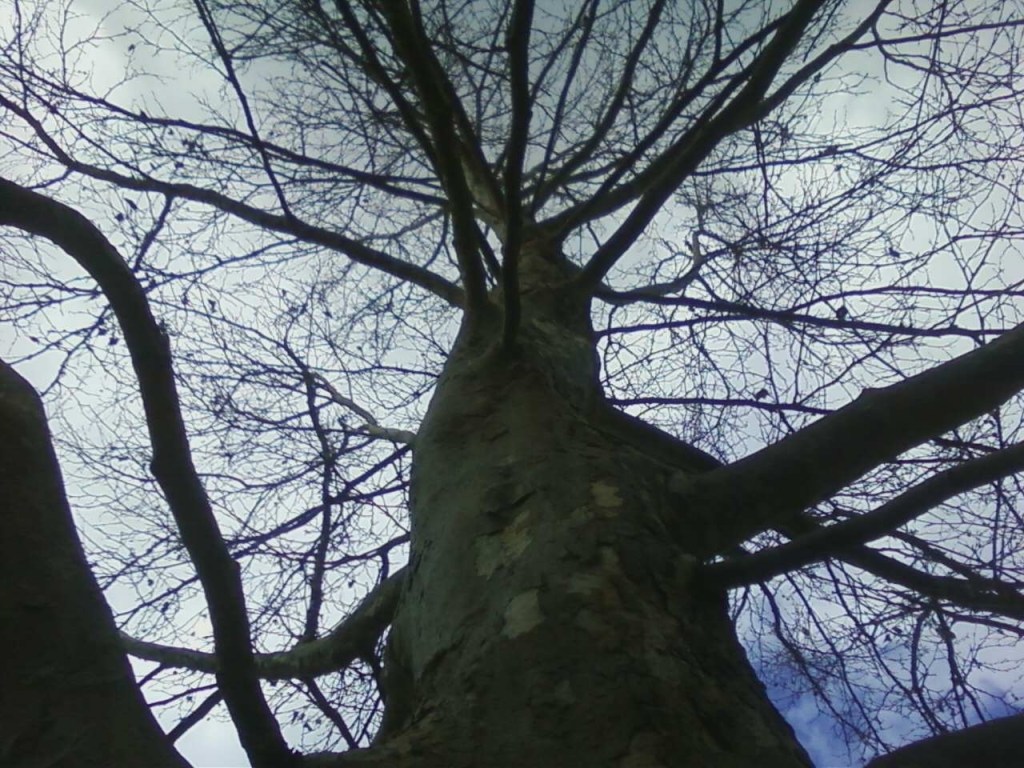
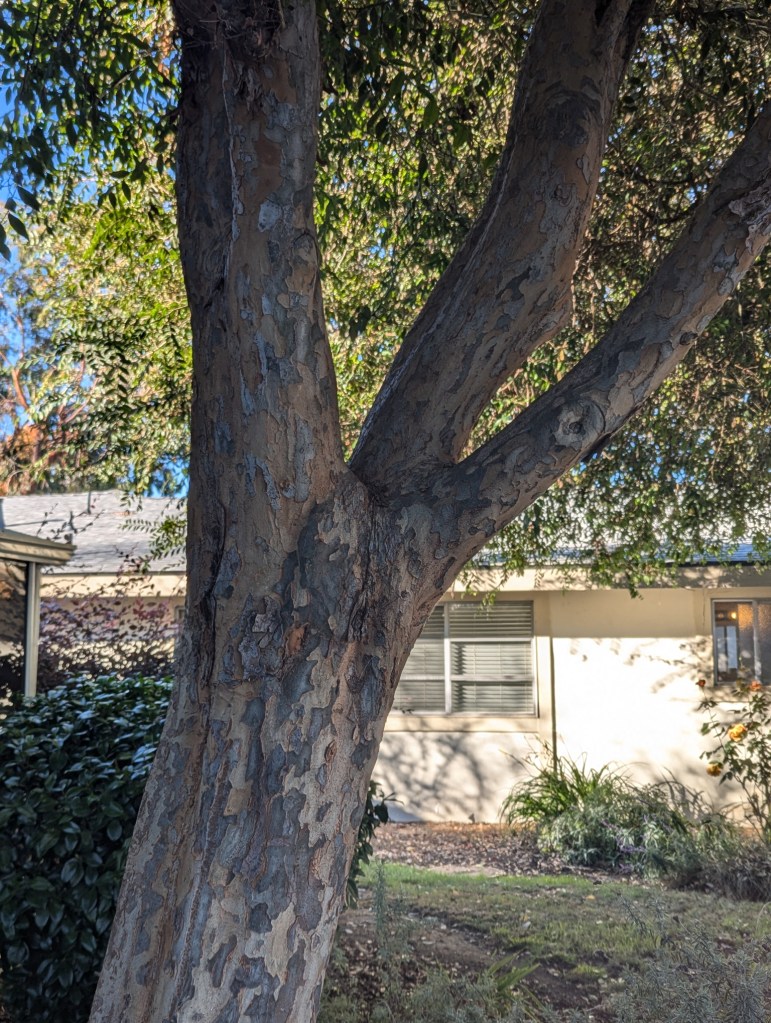
Large limbs and trunks with mottled gray and tan bark are rather sculptural while bare through winter. London plane happens to be conducive to annual pollarding, which makes the limbs even more sculpturally gnarly, and produces more vigorous growth with larger leaves that are less susceptible to disease.
Western cottonwood is better in the wild than within refined gardens.
The brilliantly clear yellow autumn color of Western cottonwood, Populus fremontii, is best in the higher elevations and inland areas of its extensive range, which spreads from the coast of California to the Rocky Mountains and as far south as Mexico. Although it thrives in local riparian areas, particularly Coyote Creek and Guadalupe River, mild temperatures in both summer and winter do not allow it to get as colorful as it does in Nevada. It is almost never planted intentionally, but has a sneaky way of sometimes growing from seed in well watered gardens.
The bad news is that Western cottonwood grows big, fast and aggressively. The shallow roots displace pavement, compete with other desirable plants and damage septic and drainage systems. Large trees produce an abundance of annoyingly fuzzy seeds that adhere to anything. After causing so much damage, Western cottonwoods survive only a few decades, leaving big deteriorating carcasses that need to be removed before collapsing. Consequently, Western cottonwood is really suitable only for large open areas or in the wild.
Mature trees can be more than fifty feet tall and more than half as broad. Their somewhat thick leaves are almost triangular, with paired angular lobes on the sides and blunt tips. ‘Nevada’ is a male cultivar that does not produce fuzzy seeds.
Dutch elm disease became a serious problem for American elms in the 1930s. However, it did not reach California until half a century or so later. Chinese elm, Ulmus parvifolia, is not very susceptible to the disease, but is a vector. In other words, it can survive infection to share it with other species of elm. Consequently, it became unavailable by the 1980s.
Some mature specimens of formerly common Chinese elm still inhabit older landscapes. Younger specimens in newer landscapes are mostly ‘Drake’ Chinese elm. They are a bit more upright, with more symmetrical form. More importantly, they are not vectors of Dutch elm disease. Other cultivars that are also resistant are rarely available at local nurseries.
Classic and formerly common Chinese elm can eventually grow more than fifty feet high. Some can grow thirty feet wide to shade an entire urban front lawn. Some cultivars might grow nearly as high, but are generally not quite as broad. Their blotchy gray and tan bark adorns curvaceous limbs. Their small deciduous leaves are not very colorful for autumn. They can be copious, messy and quite tedious to rake.
Within its native range, wild thorny honey locust, Gleditsia triacanthos, is a nasty tree! Its wicked thorns are typically as long as four inches but can be twice as long. Some branch into many thorns or thick clusters of thorns. Thickets of many trees can be impenetrable. Female trees produce a messy abundance of brown pods that are about half a foot long.
Fortunately, its cultivars are much more docile. Most are exclusively male, so produce no pods. Old fashioned cultivars that might produce pods as they mature are now rare. More importantly, cultivars are thornless. That is why their common name is now honey locust rather than thorny honey locust. They are as remarkably resilient as the simpler species.
Most cultivars of honey locust grow no taller or wider than fifty feet here. Some grow only half as tall. Some of the more popular cultivars are brightly yellowish green for spring. At least one is ruddy bronze for spring. The finely textured foliage provides dappled shade. Leaves are pinnately and bipinnately compound, and turn yellow for autumn defoliation. Individual leaflets are less than an inch long, so can be difficult to rake.
 Tony Tomeo