 Autumn is for more than planting. It is when most of the aggressive pruning gets stared. It might be the best time to work with compost and conditioning the soil. Bulbs get planted. Gutters get cleaned. Leaves get raked. Perennials get groomed. We might think of it as a time of slowing down after such a busy summer, but in many gardens, autumn is just as busy with seasonal chores.
Autumn is when many of the spring, and some of the early summer, blooming perennials get divided. That means that they get dug up, split into smaller parts, and then replanted. Because there will be more smaller plants after the process than there were bigger plants before the process, some should get planted over a larger area, in other parts of the landscape, or shared with friends.
Not all perennials need to be divided annually, and some may never need to be divided at all. Perennials that bloom in autumn or winter, such as Japanese anemone and bergenia, get divided in spring, since they will have plenty of time to recover from the process to bloom on schedule. Black-eyed Susan does not likely care if it gets crowded, but can get divided simply for propagation.
Lily-of-the-Nile should be divided if it gets too crowded to bloom well. Division allows more room for the individual shoots to grow and bloom as they should. However, because it takes a while for newly divided shoots to recover, they should only be divided every few years or so, and only if they happen to be getting crowded. African iris gets divided if overgrown plants are looking shabby.
It is not always necessary to dig entire plants. If dividing New Zealand flax just for propagation, it is easier to pry the desired number of side shoots from a mature clump, without digging the main part of the clump. Agave pups might be (very carefully) pried off of larger rosettes just to keep the main rosettes neat. Black-eyed Susan and other deciduous perennials get divided while bare.
 Mathematically, division is the opposite of multiplication. Horticulturally, they are the same. Digging and splitting overgrown perennials to propagate them is known as ‘division’ because it divides many rooted stems or rhizomes of one plant into many new plants. Division is a form of propagation; and propagation is commonly known as multiplication. So, we divide plants to multiply them.
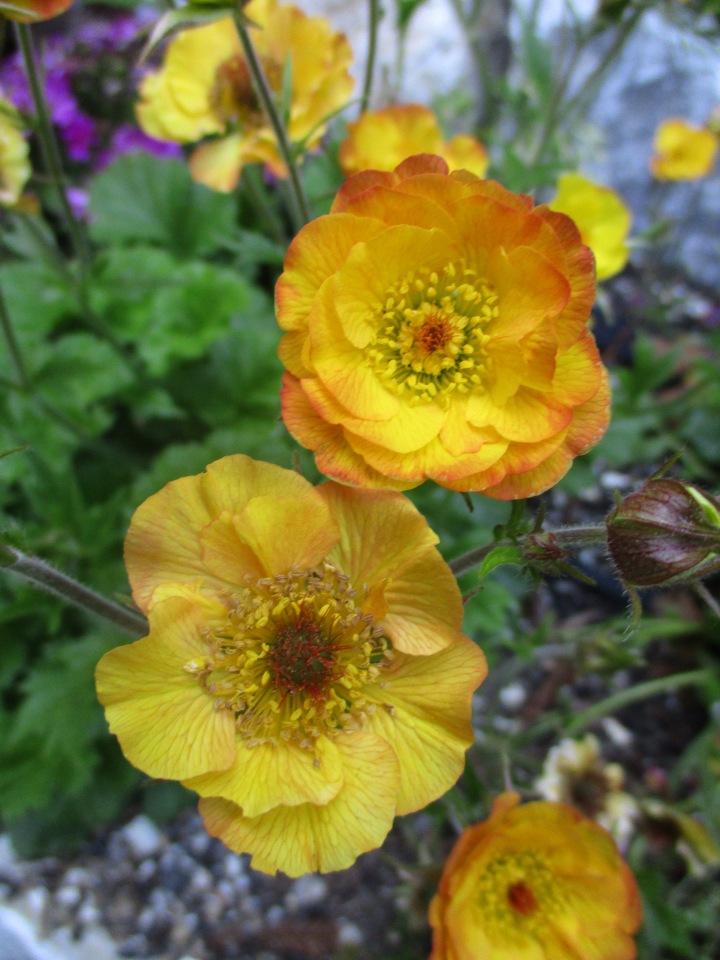 Wow, this is quite old school. Is it making a comeback? That would be nice. Avens, which is also known as Chilean avens, Geum quellyon, is an old fashioned perennial relative of the strawberry. Instead of producing fruit, it provides handsome yellow, red or coppery orange flowers that look something like small single, semi-double or double anemones, but can bloom through most of May.
 Along with all the bare root fruit trees, roses and cane berries, nurseries also stock bare root perennials like strawberries, asparagus, horseradish and rhubarb. They are so easy to plant while dormant. They recover from transplant through spring, and by summer, should be growing as if they had always been there. Although, if they had always been there, they might be crowded by now.
 Tony Tomeo