‘Borrowing’

This particular situation is both too compact and too shady for these items.

Yellow and purple ‘Karma’ iris did not work out so well. To be brief, Brent and I ‘borrowed’ rhizomes of pink bearded iris after their bloom, and prior to their removal and disposal, but they bloomed yellow and purple for the following spring. Apparently, we ‘borrowed’ the wrong rhizomes, and were victims of ‘karma’ that was appropriate for the manner in which we ‘borrowed’ them.

Of course, that experience has never dissuaded me from ‘borrowing’ what I want to grow in my own garden. I am a horticulturist. I can grow just about anything that will grow here from seed, cutting or other sources of propagation material. Some is from situations from which it must be removed anyway. Some is from greenwaste piles. Some is from seed or cuttings that I find while out and about. I purchase almost nothing from nurseries.

Much of what we grow for the landscapes at work is recycled from other landscapes at work. This particular portion of a landscape is in front of a residential staff cabin. The Australian tree fern and elephant ears were installed here by a former resident who no longer resides here. Unfortunately, this situation is both too confined and too shady for them. Not only do the leaves extend over the adjacent walkway and steps, but, in response to the shade, they also grow larger and therefore more obtrusive than they otherwise would be. Because it would be impractical for them to remain within this landscape, I am not at all hesitant about recycling them into other landscapes. I am merely waiting for cooler and rainier winter weather, when they will be more conducive to relocation. The elephant ears should be dormant. I know which landscape the fern will relocate to. The elephant ears may remain canned for propagation.

Bulbs For Next Spring

Hyacinth will not bloom for a few months, but goes into the garden about now.

Some of the most familiar flowers to bloom in the earliest of spring get planted now as bulbs. They sit and wait in the garden to finish their dormancy, perhaps get a bit of a chill through winter, and get an early start to their bloom cycles as soon as weather permits. Because winters are so mild here in the Santa Clara Valley, some do not even bother to wait for spring, but are instead happy to start bloom before winter ends.

Bulbs become available in nurseries when they can be planted. Those that are not available yet will become available when it is time to plant them for later spring or summer bloom. The first to become available are generally the first to bloom; although bearded iris seem to know when they want to bloom, regardless of when they get planted.

As long as they do not get stored too long or get planted too late, bulbs do not need to be planted immediately, and actually extend their performance if planted in phases. The earliest phases to get planted will bloom earliest. Phases of the same bulbs planted a few or many days later should bloom about the same amount of time later.

With proper planning, later phases bloom as earlier phases finish. For example, because crocus flowers do not last very long, different phases of bulbs can be planted only a few days or a week apart, so that more flowers start to bloom in time for earlier flowers to fade. Freesia flowers last a bit longer, so different phases can be planted two weeks or so apart.

Narcissus and daffodil bulbs are not so discriminating about how deeply they get planted, so various phases can be put in the same spots. As long as they do not get planted too deep, the earliest phases can be planted deep and covered with only a bit of soil, so that later phases can be planted above. If similarly covered with only a shallow bit of soil, later phases of the same bulbs can be stacked, as long as the last and shallowest phase still gets planted deep enough.

Not many bulbs are actually real bulbs. Most are corms, tubers, rhizomes or tuberous roots. They all do the same thing though; store resources through dormancy to sustain quick bloom as weather allows. Although many bloom reliably only once in their first season, some naturalize to bloom at about the same time each year. Tulips are capable of naturalizing, but rarely get enough chill in winter to bloom after their first season.

Anemone (windflower), hyacinth, lily, rananculus, tulip and small colorful callas are the less reliable of spring bulbs after their first year. Crocus, freesia, hymenocallis and harlequin flower can be more reliable if they get what they want. Grape hyacinth, narcissus, daffodil, watsonia, bearded iris and the old fashioned white callas are the most reliable of bulbs that get planted about now.

Early Spring Bulbs Start Now

Early spring bulbs appreciate winter chill.

Halloween seems to be an appropriate time to bury early spring bulbs in shallow graves. The season begins about now, and continues until about the end of the year. Installation of new bulbs might initially be ungratifying. There is nothing to show after their interment. Their spectacular bloom during late winter or early spring should more than compensate.

Freesia, narcissus, crocus, hyacinth and tulip are the most popular of early spring bulbs. So are anemone, ranunculus and several iris, although they may also be summer bulbs. Not all of such bulbs are actually bulbs. Several are corms, rhizomes, tubers or tuberous roots. Like bulbs, these store resources through dormancy to grow and bloom in season.

Early spring bulbs, unlike summer bulbs, prefer to be in their garden prior to winter. They enjoy rain and winter chill. Those that originate from nurseries are prechilled so that they bloom well regardless. After their first season though, some might not perform as reliably. Some bulbs can be slightly less than satisfied with winter chill within such mild climates.

However, a few types of early spring bulbs can naturalize. After their primary bloom, they produce new bulbs to replace the originals. Colonies of prolific bulbs eventually become crowded enough to inhibit bloom. Division of superfluous bulbs while dormant alleviates crowding. Also, it relinquishes a few bulbs for relocation. Freesia might be nicely prolific.

Early installation of early spring bulbs promotes early bloom. Obviously, later installation delays bloom. Therefore, installation in phases throughout the planting season prolongs bloom. For example, as one phase of daffodil finishes bloom, the subsequent phase can begin. This is effective only for their first season though. Bloom synchronizes afterwards.

Because winter weather is so mild locally, some early spring bulbs bloom a bit too early. Also because winter weather is so mild, premature bloom may not be a serious problem. Nonetheless, later installation may be preferable for some bulbs. Heavy rain may thrash tulip or freesia. Like phasing though, delaying bloom is only effective for the first season. Naturalized bulbs as they please.

Hydrangeas Perform Better With Proper Pruning

Pruning of one season affects bloom of another.

After decades of breeding, most modern cultivars of hydrangea are much more compact and a bit stockier than old fashioned hydrangeas that had long, limber stems that could bend downward from the weight of their own blooms. They stand up to proudly display their modern, vibrant color, even when their billowy blooms get heavy with rain. Yet, even with all their genetic improvements, they should still be pruned properly and annually to promote continued bloom. Without pruning, even modern cultivars can get floppy and lanky.

Because most hydrangeas bloom on stems that developed during the previous year, they should not be pruned too much while dormant through winter. Instead, solitary (generally unbranched) stems that grew from the base last year and bloomed this year should be pruned back to a pair of buds about a foot high as their blooms deteriorate. Even though some blooms continue to develop late into autumn, most are finishing about now. Therefore, pruning stems back while also removing spent blooms gets the pruning done early enough for the side buds to start to grow into secondary stems.

These secondary stems should not get pruned again, even when they go dormant through winter. They do not grow much before winter, but should be mature enough to bloom during the following spring. Thinning these branched stems through winter by cutting some of the smaller stems to the ground should produce fewer but significantly larger blooms, as well as prolong the blooming season. (However, many modern cultivars naturally bloom sporadically after their primary bloom phase until autumn anyway.)

New canes that develop from the ground to replace older branched stems may not bloom their first year, but can be left unpruned through winter to bloom early the next spring, which starts the process over again. Old stems should be cut to the ground after their third year (second bloom season). Leaving a few spent blooms on the plants long enough to dry (as dried flowers) should not interfere too much with proper pruning.

Dormant Pruning For Roses

Proper pruning during winter promotes the best roses during summer.

(This recycled article is eleven years old. Therefore, the event that it describes is no longer relevant.)

Just about anyone can plant roses in the garden, and care for them for at least the first year. Pruning them properly while they are dormant in winter in order to get them to perform satisfactorily every subsequent year is what most of us who grow roses have difficulty with. Like deciduous fruit trees, roses should not be planted and expected to perform with minimal attention. They certainly should not be pruned with hedge shears!

The once modern, but increasingly old-fashioned, hybrid T roses have traditionally been the most common victims of inadequate pruning, since they need such aggressive pruning every winter to prevent overgrowth that interferes with healthy cane growth and bloom. More modern cultivars (cultivated varieties) designed to resemble older roses, as well as reintroduced old fashioned roses are generally not so demanding, but likewise perform best with proper dormant pruning. There are slightly, and not so slightly, different ways to prune the different types of roses. Even the ‘low maintenance’ carpet roses should be pruned to some degree.

Fortunately for those of us who are just learning about roses, the first of several free rose pruning lessons in the San Jose Heritage Rose Garden began this morning, January 4. These hands-on lessons continue at 9:00 a.m. every Wednesday and Saturday until late February. Participants meet in the center of the Garden. The minimum age to attend is sixteen; but minors without parental supervision require a signed minor release form that can be obtained from the Guadalupe River Park Conservancy.

Participants should bring bypass shears, leather gloves, closed-toe shoes and preferably a water bottle. Those who lack shears or gloves can borrow what they need at the Garden. The Heritage Rose Garden is located on West Taylor Street near Walnut Street in San Jose. Parking can be found on Seymour, Taylor or Walnut Streets. More information can be obtained by email to Emily of the Guadalupe River Park Conservancy at emily@grpg.org or by telephoning 298 7657.

The Heritage Rose Garden is the most complete collection of old world roses, the ancestors of modern roses, in the world! Although it lacks modern cultivars, it exhibits a remarkably extensive variety of roses, with all sorts of growth habits. There really is no other garden where one can prune roses with the same basic techniques in so many different ways.

Incidentally, modern hybrid T roses derive their designation from the ‘T budding’ technique employed to attach the scion (upper blooming portion) to the understock (roots), not because the rose hips (fruiting structures) are used to make tea. However, all sorts of roses, including floribundas, polyanthas, grandifloras and all sorts of climbing roses, are budded by the same means; and many hybrid T roses are actually grown on their own roots and not budded onto understock at all. The designation of hybrid T seems somewhat out dated, but is still effective.

Defoliation And Dormancy Are Justifiable

Wind blows freely past defoliated stems.

Defoliation and dormancy begin early for quite a few species within desert and chaparral climates. California buckeye can defoliate during the driest summer weather, refoliate for autumn, and then defoliate again for winter. They do what they must to avoid desiccation within their arid climate. Many more species do what they must to survive through winter.

That is why so many plant species are deciduous while they are dormant through winter. They shed their foliage when it is more likely to be a liability than an asset. Like summer dormant plants, they respond to inevitable and potentially detrimental weather. Moreover, they respond to seasonal changes of sunlight as well. Plant species are very perceptive.

With few exceptions, deciduous plants are nonconiferous or broadleaf species. More are endemic to regions to the north and south of tropical regions than within tropical regions. They know that sunlight is less intense and daylength is shorter while the sun is at a low angle during winter. Their defoliation coincides with the least usefulness for their foliage.

Most deciduous plant species are also aware of the sort of weather that they are likely to encounter during winter. Cold and stormy weather with wind and rain or perhaps snow is probably familiar to them. They know that foliage is not only vulnerable to damage, but is also burdensome to associated stems. In colder climates, it can accumulate heavy snow.

Foliage is the source of almost all wind resistance within foliar canopies that suspend it. Such wind resistance causes wind to dislodge limbs or blow vegetation over, particularly while soil is moist from rain. Defoliation eliminates much of such risk prior to the windiest and therefore riskiest storms of winter. Bare stems are more aerodynamic than foliage is.

Defoliation seems to happen at the best time, immediately prior to wintry weather. It even increases warming sunlight exposure during the darkest and coolest season of the year. However, defoliation is also messy while the weather is unpleasant for those who go out to rake it away. Without prompt raking, it clogs drainage of rain while it is most important.

Dormant Pruning Enhances Fruit Production

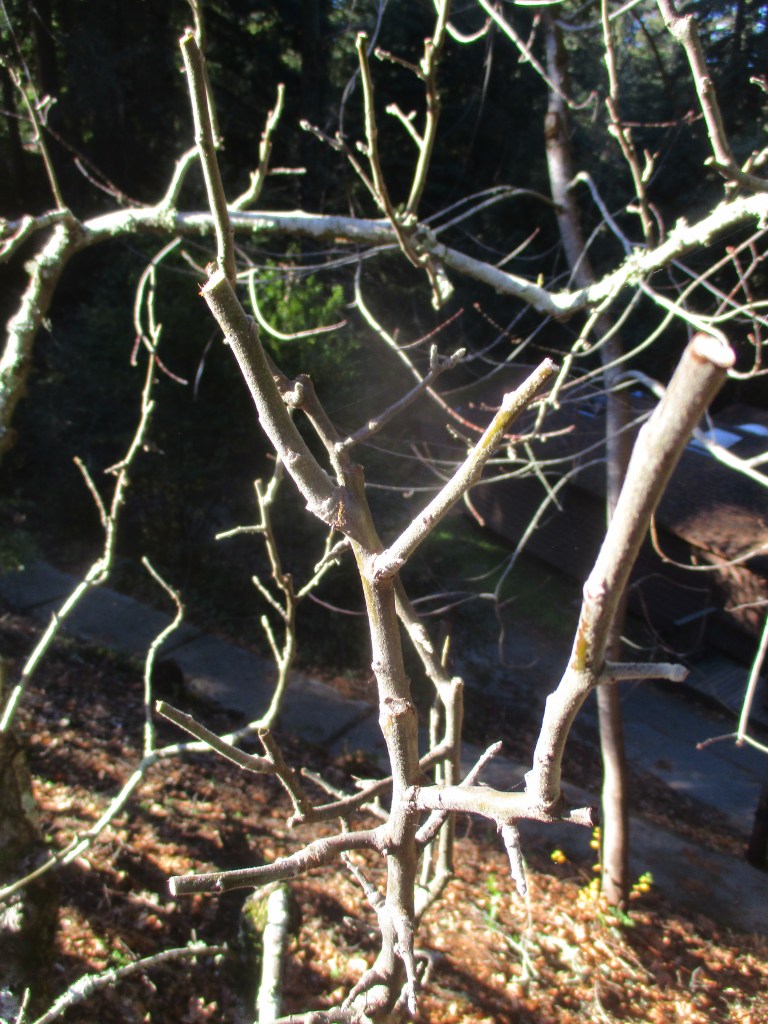
Dormant pruning may not be pretty.

Adding new fruit trees to a garden is reasonably easy. Maintaining them properly as they mature is more of a challenge. Centuries of extensive breeding to enhance production of such trees has also increased their reliance on horticultural intervention. Most deciduous fruit trees consequently need specialized dormant pruning during their winter dormancy.

Without adequate dormant pruning, most deciduous fruit trees are unable to support their unnaturally large and unnaturally abundant fruit. Dormant pruning actually enhances the size and quality of fruit. However, it also limits the weight of excessiveness, and confines it to sturdier branch structure. It concentrates resources into fewer fruit of superior quality.

Dormant pruning, or winter pruning, likewise concentrates resources into more docile but healthier vegetative growth. It eliminates or at least diminishes the 4 Ds, which are dead, diseased, damaged and disfigured growth. Confinement of potentially rampant stems not only improves structural integrity, but also limits wasteful production of unreachable fruit.

Almost all deciduous fruit trees, and most nut trees, require specialized dormant pruning. So do grapevines, kiwi vines, berry canes and roses. Evergreen fruit trees, such as citrus and avocados, are exempt for now though, since such pruning promotes new growth that is vulnerable to frost. Most of such trees do not require such aggressive pruning anyway.

Almonds, apricots, cherries, nectarines, peaches, plums, prunes and all their hybrids are stone fruits of the genus Prunus. Almonds are actually seeds, or stones, of leathery fruits that are merely hulls. Various stone fruits need various degrees of similar pruning. Heavy peaches need aggressive pruning. Lightweight cherries might need only minor trimming, or no pruning at all.

Apples, pears and quinces are pomme fruits that, like stone fruits, need various degrees of similar pruning that conforms to their distinct characteristics. Persimmons, mulberries, pomegranates and figs each need specific types of pruning as well. Familiarity with each of the dormant pruning techniques that each fruit tree in the garden requires is essential.

Bare-Root Stock Arrives For Winter

Bare roots might fail to impress.

Spring is overrated. It is obviously the best season for planting warm season vegetables and bedding plants. It is the most colorful season with more flowers in bloom. There is so much more to gardening though. Most plants prefer autumn planting. Some prefer winter planting. That is why this present bare-root season will be so relevant all through winter.

Dormancy is an advantage to stressful procedures such as planting. Spring bulbs prefer autumn or early winter planting while they are most dormant. For the same reason and to avoid late frost, summer bulbs prefer later winter planting. It should be no surprise that so many deciduous woody plants likewise prefer dormant planting during bare-root season.

Bare-root season is simply when bare-root stock becomes available for planting through winter. Unlike more familiar canned (potted) stock, bare-root stock lacks the medium that it grew in. Their roots are literally bare. Most bare-root stock awaits purchase at nurseries with its roots resting within damp sand. Roots of some are bagged within damp sawdust.

Bare-root stock is innately more practical than typical canned stock. It is significantly less expensive. It is much less cumbersome, and therefore easier to transport from nurseries. Planting is easier within much smaller planting holes. Formerly bare roots disperse new roots into their garden soils more efficiently than crowded formerly canned root systems.

Deciduous fruit trees and roses are the most popular of bare-root stock. Most of such fruit trees are stone fruits and pomme fruits. Stone fruits include almond, apricot, cherry, plum, prune, peach and nectarine, as well as their unusual hybrids. All stone fruits are species of the genus, Prunus. Pomme fruits include apple, pear, Asian pear and perhaps quince.

Fig, pomegranate and persimmon trees should also be available. So should grapevines, currants, gooseberries, blueberries and various cane berries. Strawberries, rhubarb and asparagus are perennials that are available bare-root. Except for almond, most nut trees, including English walnut, pecan, filbert or chestnut, may be available only by mail order. Most mail order catalogs are online now.

Getting an early start to winter pruning may have certain advantages

Without specialized pruning, fruit trees become sloppy and unable to sustain all of their fruit.

As long as it gets done well before buds begin to swell late in winter, the meticulous and specialized pruning that deciduous fruit trees and roses require during winter dormancy does not need to be done immediately. Here where the climate is so mild, some roses may still be blooming. The main advantage to getting an early start is that those of us who have many fruit trees and roses in need of pruning have more time to get them all done within the proper time.

If it helps to start pruning early, it is best to prune fruit trees and roses in the same order that they go dormant and defoliate. The ‘stone’ fruits (those of the genus Prunus, that have large pits known as ‘stones’), like apricots, cherries, nectarines and peaches typically defoliate earlier than the ‘pomme’ fruits, like apples, pears and quinces. Modern ‘carpet’ roses may not defoliate completely, so can be delayed until after all the bare roses get pruned, but may eventually need to get pruned while still partially foliated.

The specialized pruning that deciduous fruit trees and roses need is serious business. Those who do not know how to do it properly should learn about it before actually doing it. Improper pruning of fruit trees can inhibit production and damage the trees. Roses are not so easily damaged, but will get overgrown and not bloom as well if not pruned aggressively enough. (This sort of pruning will be a topic later in the season.)

Like fruit trees and roses, other trees and shrubs that need pruning prefer to be pruned while dormant through autumn and winter. Deciduous trees and shrubs are obviously dormant while bare, but realistically, are ready to be pruned when their foliage is no longer green.

Evergreen plants are not so obviously dormant, but will be as dormant as they get through winter. This would therefore be a good time to prune to eliminate pine limbs that are too low. If pruned a bit early, the pruning wounds will get weathered more through winter and consequently bleed less through spring.

Six on Saturday: Bad Timing

Autumn and winter are busy seasons here. They do not last long enough for all the work that must be done while particular plants are dormant. That is why pruning began early every autumn within the orchards that formerly occupied the Santa Clara Valley. Within the landscapes, scheduling in compliance with the seasons is complicated by factors that are not so seasonal, such as gophers, who eat whenever they want to. Major weeding of a new landscape is planned to begin next Wednesday because the weeds are so overgrown. Unfortunately, this does not coincide with the dormancy of plants that I would prefer to relocate from the same site. Furthermore, the achira is being uncooperative.

1. Hedychium gardnerianum, kahili ginger should not be disturbed so late in its season. Gophers do not care. I salvaged this cane with three buds and a root. It seems to survive.

2. Ceanothus papillosus, wartleaf ceanothus grew from seed within a new landscape that will get weeded next Wednesday. I pulled and canned them early to avoid wasting them.

3. Betula pendula, European white birch grew in the same landscape. Big seedlings were tagged and left until defoliation. These tiny seedlings in the front row were canned early.

4. Sambucus caerulea, blue elderberry was, as one might guess, in the same landscape. I could not bear to simply let it go with all of the other weeds. I pulled and canned it early.

5. Canna edulis, achira, like kahili ginger, should not be disturbed so close to dormancy. However, its busted can could not hold water. Although early, it moved into a larger can.

6. Canna edulis, achira really wanted out! If it did this to escape its can, do I really want to release it into the garden? Its new can will only contain it until dormancy this winter.

This is the link for Six on Saturday, for anyone else who would like to participate: https://thepropagatorblog.wordpress.com/2017/09/18/six-on-saturday-a-participant-guide/