 We really should be growing more of what grows well here. This is as relevant in other regions as it is in the Santa Clara Valley. Some regions have a lot more to choose from. There are always limitations too. Tropical plants do not survive the winters of New England. Apples and pears want more winter chill than they can get in San Diego.
In California, we do not have enough water to go around. Well, that is not completely true. Much of that misconception is political, which is none of my business. Much of it is that there are just too many people living here and sharing a limited resource. Much of it is that many of the too many people living here waste water on, among other things, gardening.
Many of the urban areas of California are in chaparral climates, which means that there is not much rain. Los Angeles and some other urban areas are full blown desert, which means that rain is quite minimal. My former neighborhood in the western Santa Clara Valley got about a foot of rainfall annually. It was considered to be chaparral. Trona, in the Mojave Desert, gets about four inches of rain annually.
However, few people in chaparral or desert regions landscape their homes accordingly. Some limit their ornamental plants to natives. Others limit their choices to plants from chaparral or desert climates, even if not native. Yet, most of us grow plants and lawns that really have no business in chaparrals or deserts, and we do so excessively.
Well, enough of that rant. There are many plants that really should be more popular here.
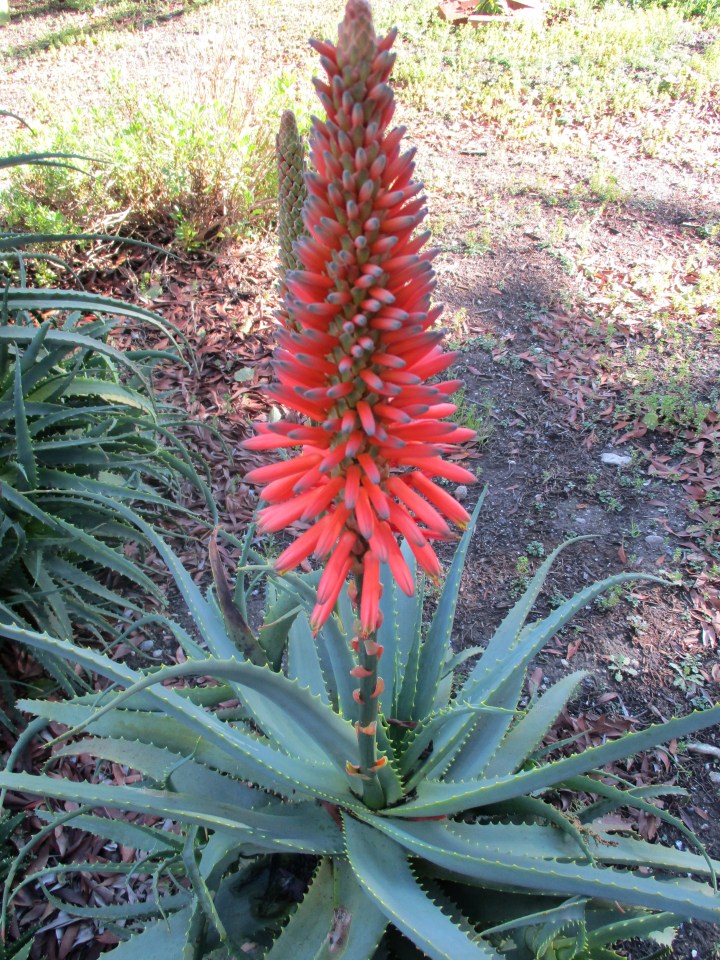
Aloes are a perfect example. Although many are from more tropical climates, most do not need to be watered too much. Some prefer minimal watering through summer. After winter rains, they produce fresh new succulent foliage in spring, and bloom reliably. Many have flashy orange or yellow flowers on striking vertical spikes. As plants grow, superfluous shoots can be separated and planted wherever more of the same plants are desired.
Smaller aloes are quite dense and mounding, with tight rosettes of stout leaves. Larger types with more open growth can get six feet tall. A few grow into small trees, with thick trunks that might be distended or buttressed at ground level. Leaves might have pronounced teeth along the margins, and most are spotted to some degree.
Everything about aloes is striking. They have prominent and colorful bloom. The distinctive succulent foliage is bold and unique. The larger aloes even have sculptural form.
Aloes are ideal for planters and pots because their roots are so complaisant and undemanding. They are rarely bothered by insects or disease. They are so easy to propagate that cuttings or pups can be acquired from friends or neighbors who are already growing them.
 Pictures are probably prettier than the real thing. Australian fuchsia, Correa pulchella, really does bloom with pendulous soft pink flowers through winter when not much else is blooming. However, the flowers are quite small, and the color is rather hazy. The real appeal of Australian fuchsia is that it is so undemanding, and once established, only needs watering a few times through summer.
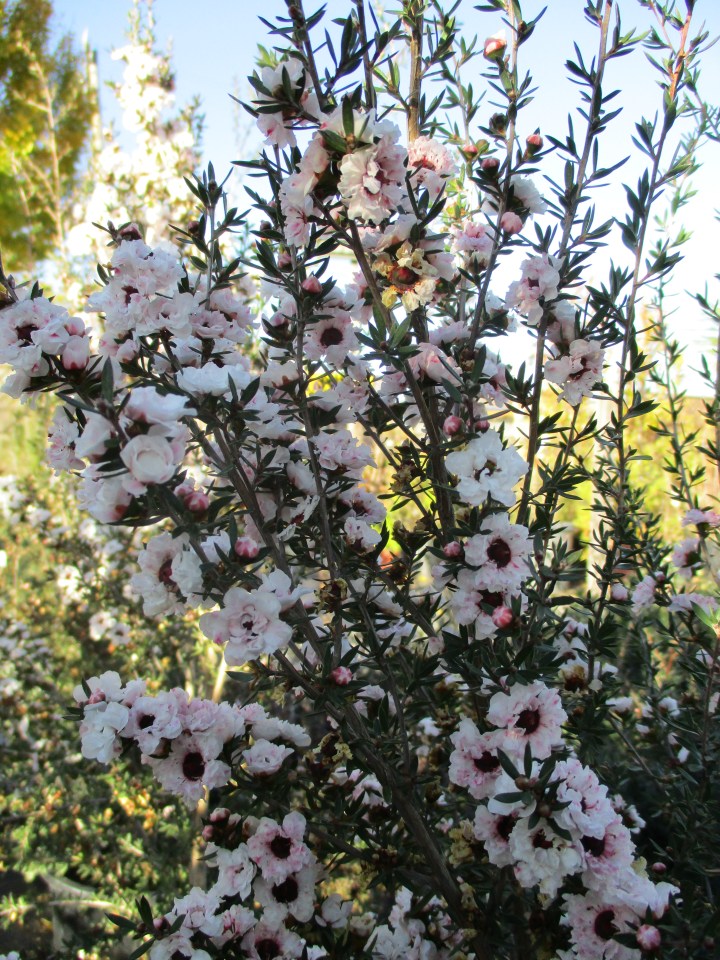 With such an odd variety of flowers blooming out of season, it should be no surprise that New Zealand tea tree, Leptospermum scoparium, decided to join the party. It starts blooming in phases in spring, and continues into autumn, so is not too terribly out of season. Besides, some varieties are known for spontaneous bloom phases at any time of year. Bloom can be pink, white or red.
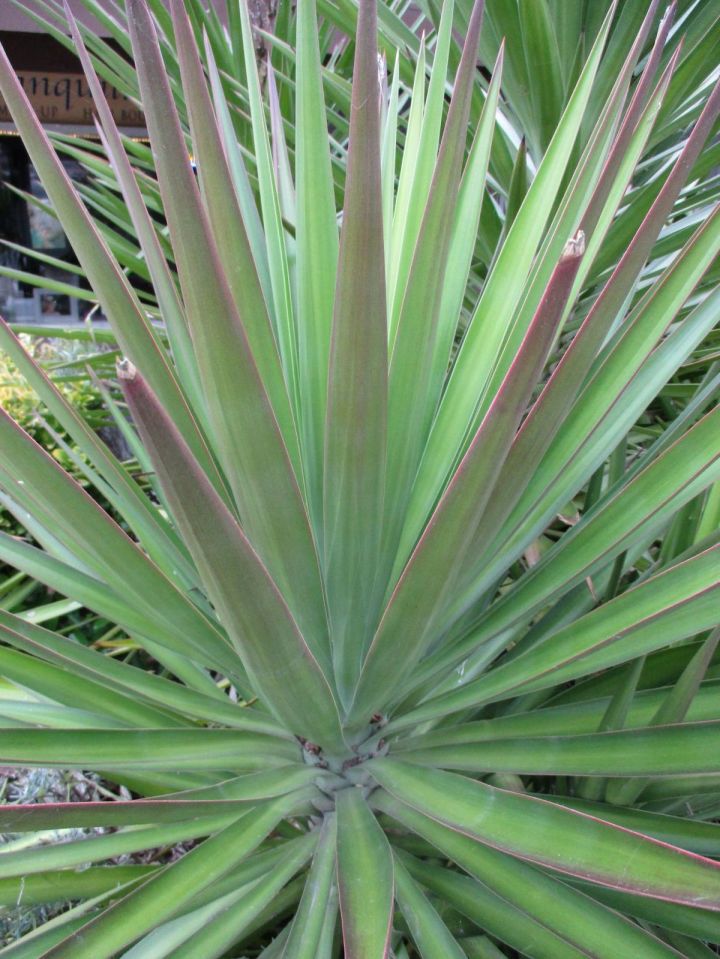 From a simple picture, Spanish bayonet, Yucca aloifolia, is indistinguishable from the common giant yucca. The narrow leaves are about two feet long, and flare upward and outward from terminal buds. Plump conical trusses of waxy white flowers with purplish highlights stand vertically just above the foliage. The main difference is that the leaves are more rigid than they appear to be, with nastily sharp terminal spines.
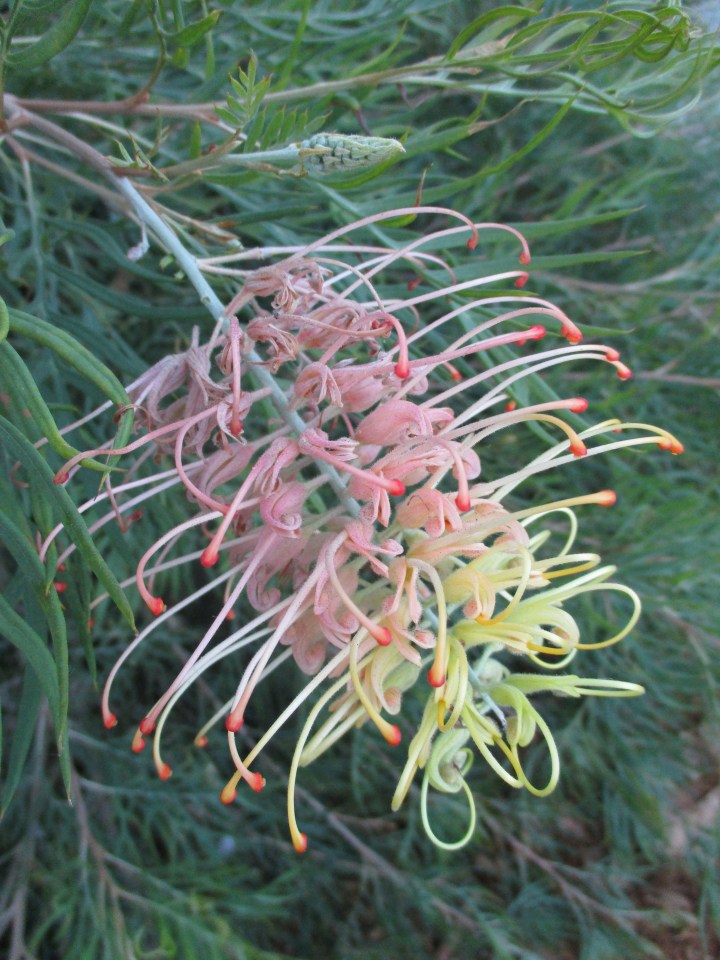 No one knows for certain who the parents were, so the hybrid Grevillea ‘Peaches and Cream’ lacks a species designation. (If it is important, the parent are most likely Grevillea banksii and Grevillea bipinnatifida.) It is an evergreen shrub that gets about four feet high and wide, with intricately lobed light green foliage. Individual leaves are about four inches long and two inches wide.
 Tony Tomeo