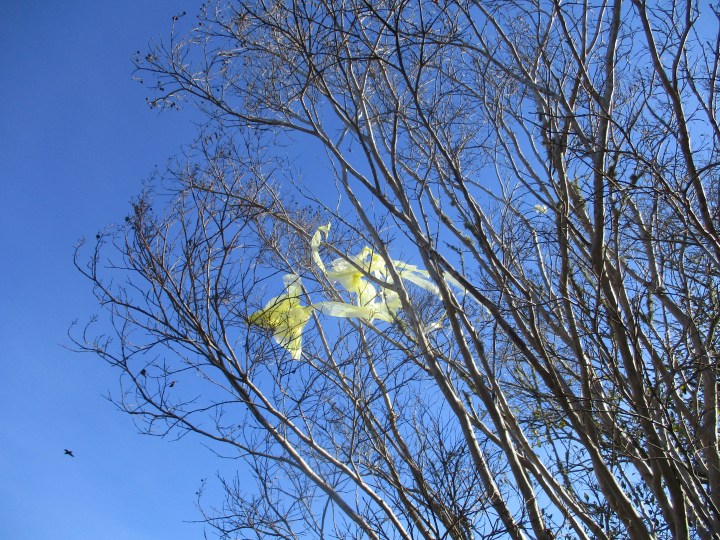
 Those of us who work in public landscapes find litter in the strangest of places. It gets everywhere. It is not necessarily put everywhere. It just has a sneaky way of getting everywhere. By nature, litter blows about and gets washed into creeks and rivers that flow out to the bays and oceans.
Of course, there is much more litter in public spaces with the most traffic, such as city parks, than there is out in remote places where fewer people go, such as hiking trails in state parks. People are not necessarily slobs, and most put their trash into the appropriate receptacles. There just happens to be more litter where people are because that is where most of the trash that becomes litter happens to originate. Most litter that accumulates on the sides of roadways was blown there from the open beds of pickups. Not much is discarded out there intentionally.
One of the projects where I work is designing trash receptacles that wildlife can not get into. Racoons, which some of us know as ‘trash pandas’, are notorious for distributing large volumes of trash into the forest. Squirrels tend to be a bit more selective in taking mostly biodegradable bits of discarded fruit, and by unwrapping their finds before taking them away. Crows are actually worse than squirrels because they will take larger bits of trash merely because they find it to be amusing. Once out of the receptacles designed to contain it, trash gets blown about by the wind. In fact, wind alone can blow trash out of some types of trash receptacles, such as those fancy cylindrical steel mesh receptacles that suspend trash bags within, like those that are so common downtown in many cities. Litter is naturally an unnatural consequence of modern civilized society.
Horridculture – Vandals
 It wasn’t even two days. The article about the ‘Illegal Planting’ of the Memorial Tree in Felton Covered Bridge Park posted at noon on Saturday, and then on Sunday night or early Monday morning, the Memorial Tree was vandalized. Fortunately, it is nothing serious. A small bag of trash was impaled onto the binding stake that is there to keep the trunk straight, which pushed the top of the small tree aside. It needed to be bound to a new stake anyway.
(I do not often condone the use of binding stakes, but this particular tree contends with considerable abuse that causes structural distortion. The article from noon last Saturday is https://tonytomeo.com/2018/09/22/illegally-planting/ .)
Was it done by the haters who snivel about the Memorial Tree just being there? Probably not. The timing is suspicious. The technique is consistent with their style. However, they have been behaving for quite a while, and have not yet posted pictures of the vandalism to blame those they dislike, as they typically do. They are predictably vain in regard to gloating about such ‘community’ activism, particularly if they can also blame their victims for any incidental damages. ( https://tonytomeo.com/2017/12/09/hate-destroys/ )
As annoying as it is, this particular vandalism was most likely executed by someone who just did not put much thought into how bothersome it would be. It might have been done because of the lack of receptacles in which to deposit trash. Perhaps the bag of trash was impaled onto the stake so that it would be easier to retrieve and dispose of when the trash receptacles were returned to the site. The option of dropping it onto the ground might have been been perceived to be more like littering.
Perhaps I am being too optimistic and too generous with excuses.
Horridculture – Needle Mania!
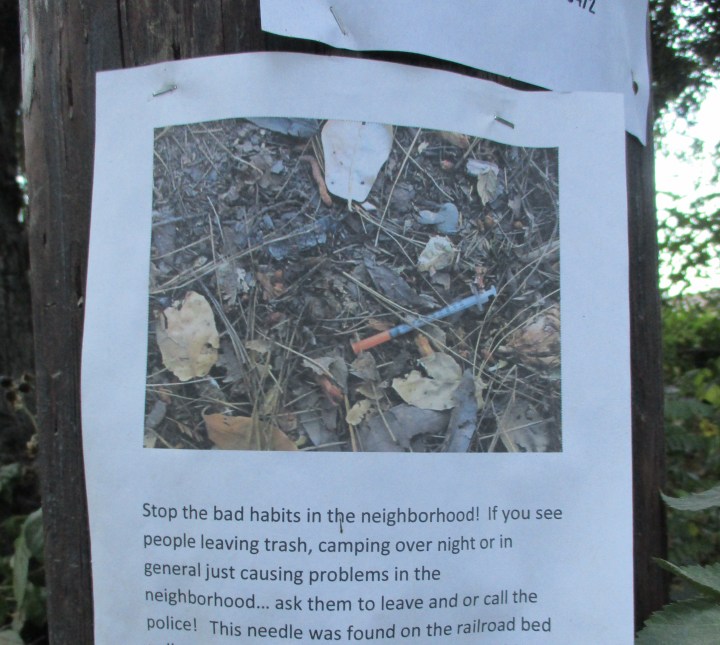 Throughout my career as a horticulturist, I have worked in more public landscapes than most. Some of these landscapes were in some of the most notorious neighborhoods of the San Francisco Bay Area and the Monterey Bay Area. Yes, I have found some rather strange items strewn about, including a few that necessitated telephone calls to local law enforcement. Yet, I have never once found a single used syringe.
Syringes are more commonly known as ‘needles’ by those who fear them. We are sometimes warned about them, particularly in areas where the sorts of people whom we are supposed to fear might have left them strewn about, whether or not these fearsome people actually use syringes. If found, such syringes are dangerous because they are used to inject illicit narcotics, and are consequently contaminated with the blood of those who use them. Such blood is always assumed to be infected with any variety of the communicable diseases that afflict all fearsome people, and is assumed to stay infectious for all eternity.
When I consider some of the situations that I have worked in, I believe that I am fortunate to have never found a syringe. On rare occasion, I have been presented with pouches and ‘sharps’ containment boxes containing syringes so that I can dispose of them properly. I actually expect to find a few at a site that I will be inspecting this next week or so, which will be a new experience for me. Caution is justified.
I know that syringes are out there, and that they are dangerous. So are rattlesnakes. I have seen and killed many rattlesnakes. They used to be quite common at the farm, and are still somewhat common at home. I know people who have been bitten by rattlesnakes, even though we all know to be careful out in regions where we expect them to be. Signs warning those who might not be familiar with rattlesnakes are posted in county and state parks inhabited by rattlesnakes. People are bitten by rattlesnakes much more commonly than people are accidentally pricked by used syringes. Accidental ‘needle pricks’ are actually extremely rare. For those unfortunate enough to experience such an injury, infection with any one of the communicable diseases that we all fear is very rare. Contrary to popular belief, infectious blood does not stay infections forever.
Needle Mania is really the most infectious affliction associated with used syringes. In a nearby Community, several people are so obsessed with discarded syringes that they have developed a ‘needle watch’ online, in order to monitor the number of syringes found, and the locations of where they were found. Some like to post pictures of the syringes that they find, sort of like trophies. Some people have found several syringes; which is quite commendable for those who live and work mostly inside. (I spent my entire career outside, but have never found a single syringe.) The numbers of syringes found is disturbing. So are the many pictures of syringes laying out in public spaces.
A few pictures are perplexing as well. One locally found syringe was pictured laying out neatly on a serpentinite outcropping. Another that was found in spring on the bank of the San Lorenzo River was laying on top of fallen autumn leaves of quaking aspen, Populus tremuloides. Neither serpentinite nor quaking aspen are endemic to this region.
A syringe was recently found in my neighborhood! As unfortunate and disturbing as this news was, it is not completely unexpected. Syringes can be discarded anywhere, and are probably likely to be discarded on isolated rural roads.
The neighbor who found the syringe believes that it is a problem that is serious enough to justify posting pictures of it all over the neighborhood! These pictures include a description of where the syringe was found, and instructions of what to do to curtail suspicious activity. They are everywhere! They were originally just stapled to trees, utility poles, mail boxes, fences, barns . . . and anything that a staple would stick into. Now that they have been out in the weather for a while, some are blowing about in the roadway and collecting in ditches. When they were first posted, a few were within view from every point on the road. More posters were added to replace those that blew away. These posters are now a prominent feature of our Community landscape.
I do not doubt that the discarded syringe is a problem for the Community. However, the pictures of it posted so prominently and abundantly throughout the neighborhood landscape are unsightly, trashy and unbecoming of such a safe and idyllic neighborhood.
Kenny
If you watch Southpark, you shouldn’t.
If you do anyway, you shouldn’t admit to it.
If you happen to know someone who watches Southpark, you might have heard indirectly about Kenny. He dies in every episode. Actually, he typically dies a few times in each episode, and typically does so violently. Experts claim that there are two episodes of Southpark in which Kenny does not die, but proof is all too conveniently scarce.
There is also an opossum named Kenny. Like Kenny of Southpark, Kenny the opossum dies in every episode.
Apparently, Kenny startled someone who was working too intently in the garden to notice his approach on top of a fence directly behind where this unnamed someone was working. This unnamed someone grabbed a stick and clobbered Kenny right across the backside. Although the blow was not terribly aggressive, and not intended to be harmful, Kenny surprisingly died violently in a fit of hissing, gnashing and flailing. After falling to the ground, he smelled as if he had been dead for quite a while.
The surprised unnamed assailant went to find a box to put Kenny’s remains into for a proper ‘burial’, but upon returning to the scene of the incident, could not find Kenny.
Others briefly observed Kenny frolicking about in the same garden later, but when the unnamed assailant came within view, Kenny again died in a violent fit of hissing, gnashing and flailing, accompanied by the aroma of well aged death. Again, the unnamed assailant was unable to locate Kenny’s remains after retuning with a box in which to put them.
After a few more similarly violent deaths, it became apparent that Kenny was merely playing possum, likely in response to being clobbered with a stick by the startled unnamed assailant during their primary encounter!
I apologize for the length of the video. My attempts to trim it compromised the quality of the imaging. The important part of the video is between ten and thirty seconds. This is not the real Kenny anyway, but merely a random opossum who happened to be frolicking in the garden.
I also apologize for posting this at noon rather than at midnight when I typically schedule my articles for the day. For midnight, I posted a short excerpt from an old article from the gardening column instead.
Horridculture – DEATH
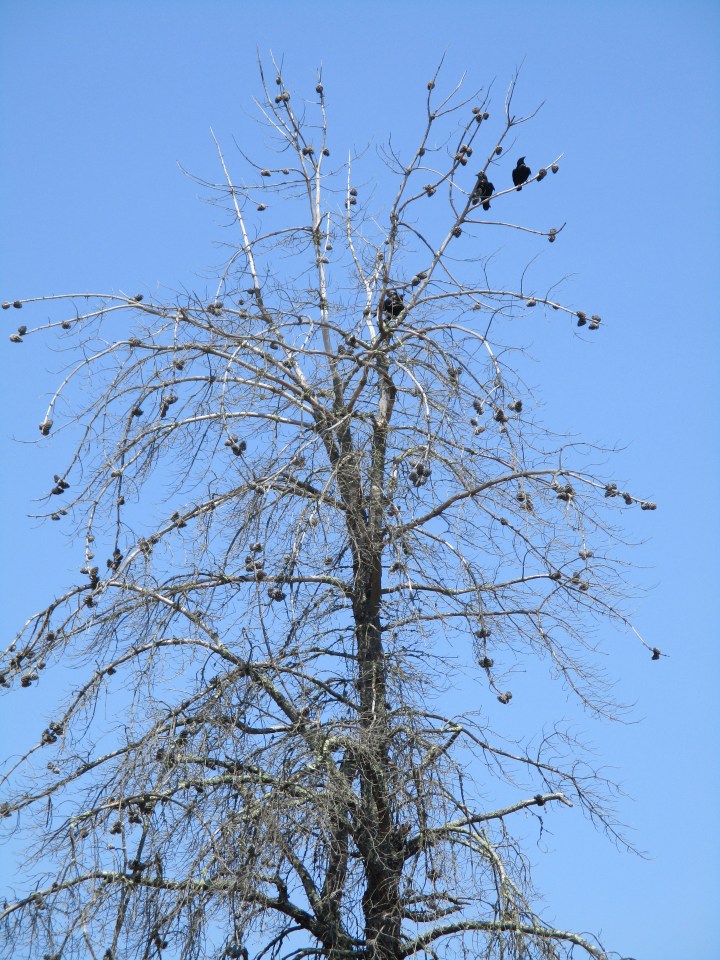 It is quite natural. Death, I mean. Every living thing does it at one time or another. Even the oldest bristlecone pines that live for thousands of years eventually do it. The Monterey pine in this picture did it quite efficiently. The three crows perched on top make it look extra dead. You know, not merely dead, but very dead. If this tree were in my own garden, I would be totally saddened by its death, but there is nothing that I could do about it.
The smaller dark objects suspended in the now dead limbs are pine cones. Monterey pine starts to produce pine cones at a young age, and of course, produces more with age and increasing size. As mature trees begin to deteriorate, they produce even more cones as they concentrate their resources into seed production for the next generation. This elderly tree knew that death was imminent. After all, death is natural.
Compared to other trees that are native to the neighborhood, such as valley oaks that live for centuries, and coastal redwoods that live for thousands of years, Monterey pines are ‘short-lived’. They live only a century or so, and may not live half that long in urban situations, particularly in more arid climates. They are endemic to the Monterey Peninsula, where they live within an ecosystem that, prior to urban development, naturally burned at least every century or so, before they got to be too old. In fact, their natural life cycle was directly relevant to how combustible the forests were, and how efficiently fires spread through them; but that is another topic.
The main concern here is that death is natural. The tree in this picture died a natural death. It can not be blamed on global warming, climate change, big industry, the President that we all seem to hate even though enough of us voted for him to become president, or my old car that, after almost half a century, is still not a hybrid. We can complain about death all we want, but we can never stop it.
Tent City
 In the autumn of 1989, small and temporary tent cities appeared in parks and other public spaces around the San Francisco Bay Area and the Monterey Bay Area, where many homes had been damaged or destroyed by the Loma Prieta Earthquake. They were necessary at the time, but were not intended to be permanent features of the landscapes. For a while, they were unpleasant reminders that some people could not go home until their homes were repaired or rebuilt.
In more recent history, ridiculously expensive real estate and rents have increased homelessness in the same regions. Even gainfully employed people are homeless because they can neither purchase nor rent a home, either because of expense or because of a lack of availability. Those who live in homes complain about the unsightliness and other problems associated with the homeless living in homeless encampments and small tent cities.
We get it. Tents are bad.
So then, what is this small tent city on one of the main roadways in town?
Good planning and bad planning.
First the good. Each of the shop spaces in the contemporary retail building behind this tent city needs its own water meter and valve manifold. Each of these meters and manifolds must be easily accessible. Because they are accessible, they are also exposed, so they need to be insulated so that they do not freeze during the very rare occasion (in our mild climate) that the weather gets cold enough to do so. This explains why the water meters are next to the sidewalks, and the upright valve manifolds behind them are covered with these billowed tents.
The bad? Good landscape design should have been considered with the location of these meters and manifolds. A water main line should have been routed so that this whole complex could have been constructed within a utility closet or shed, or even a small utility yard that could have been fenced in a less prominent location. If constructed inside a utility closet or shed, the insulating tents would not be necessary. Now that it is too late for that sort of planning, there is not even enough clearance from the sidewalk for hedging or low fencing to obscure the meters and manifolds without obstructing access. It really would not have taken much of a landscape modification to obscure the view of all this infrastructure, if only more space had been made available where it is needed.
Sadly, landscape design was not a priority on this building. Although the water meters and manifolds are completely exposed, shrubbery obscures window and more appealing features of the buildings, such as ornamental stonework. The view from inside many windows is of the unsightly backsides of pointlessly shorn shrubbery. Trees were crowded and planted directly in front of signs, even though there is plenty of frontage without signs where trees could have been planted. It is amazing what some landscape designers get away with.
Anti-‘Environmentalism’
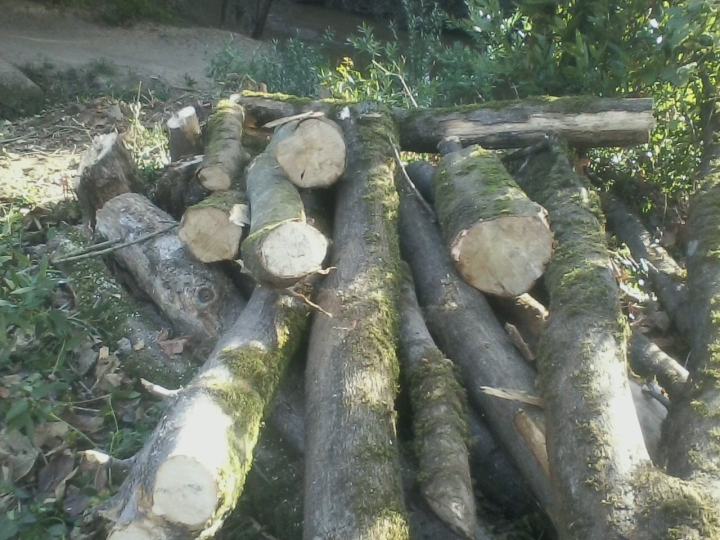 There will be no more updates after this last one for the dead box elders that had been leaning onto the historic Felton Covered Bridge. ( https://wordpress.com/read/blogs/135014809/posts/747 ) They are gone. A pile of logs and some debris are all that remain.
Because the area is a protected riparian zone, the remaining debris and logs may have been left there intentionally, as an important component to the ecosystem. Nearby dead trunks that will not reach the Bridge when they fall also remain, as well as many other larger dead box elders several yards upstream.
For now, the Felton Covered Bridge is reasonably safe from falling trees.
We can only hope it stays that way.
Environmentalism has a way of complicating things.
Environmentalism should be more concerned with prioritizing the natural ecosystem than preserving vegetation that is interfering with it. Much of the exotic (non-native) underbrush and even a few exotic trees should be eliminated to allow at least some of the displaced native vegetation to recover. Where necessary and appropriate, environmentalism must also make accommodations for safety within an innately hazardous natural setting that happens to be very accessible to the public. More of the dead box elders should be removed or at least cut down to reduce the risk of falling limbs to those visiting the adjacent Felton Covered Bridge Park.
Preservation of assets like the historic Felton Covered Bridge is also important. Trees that are likely to damage the bridge should not be salvaged merely because they are within the protected riparian zone. Because the Felton Covered Bridge is such a landmark for tourists, the view of the Bridge is an important asset as well. Vegetation that would obscure this view should therefore be managed, so that it does not eventually obscure the view as it regenerates within the area vacated by the now absent box elders. There is nothing unnatural about open spaces. Old photographs demonstrate how visible the Felton Covered Bridge had been in the past, and how the flood of 1982 eliminated much of the obscuring vegetation within the riparian zone in a very natural way.
In many situations, planting new trees to replace those that are now gone is actually more unnatural than natural. It certainly does not contribute to the efficiency of a natural ecosystem. The installation of new sycamores, coast lives oaks and bay trees adjacent to the nearby Graham Hill Road Bridge are superfluous to new tree seedlings that appeared naturally in the area vacated by fallen box elders. They were planted with soil amendment, fertilizer and a synthetic polymer gel to retain moisture, and then protected from deer with stakes and mesh cages. They require unnatural supplemental irrigation until they get established, and are so close to each other and other trees, that they will become an unnaturally crowded thicket as they mature. There is nothing natural about such installations!
Nor are such installations inexpensive! They require resources that could be more responsibly allocated to more practical projects.
Environmentalism is another one of those very important concepts that has been compromised by extremism.

 Tony Tomeo