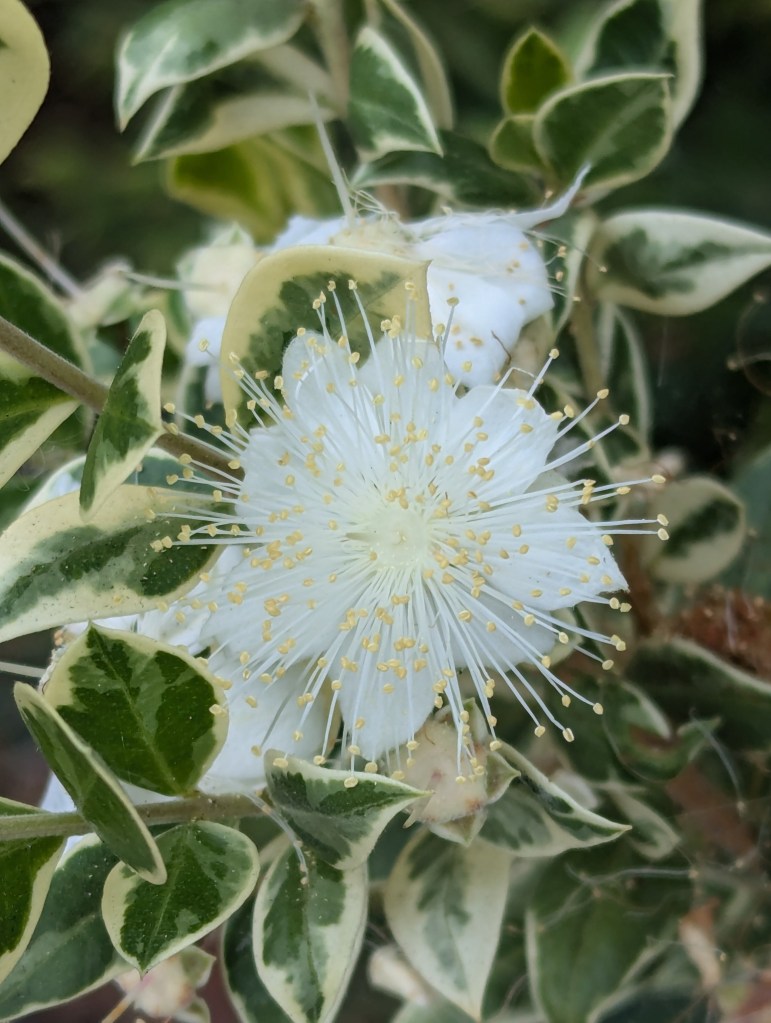
Old landscapes of the Victorian Era may still include myrtle, Myrtus communis. It is quite a survivor. It had been popular for centuries because of its resiliency. It is very conducive to the sort of formal hedging that was popular during that time. As formal hedges became old fashioned, so did myrtle. Yet, it is still more sustainable than more popular shrubbery.
Besides, myrtle is not limited to refined shorn hedges. It can just as efficiently become an unshorn and informal hedge or screen. It can grow as tall as fifteen feet, but rarely grows higher than first floor eaves. Without pruning, it typically grows about half as wide as it is high. Selective pruning rather than shearing limits its size without ruining its natural form.
Myrtle foliage is densely evergreen and pungently aromatic. Individual leaves are merely an inch or two long. Small white flowers with prominent stamens may not be very showy. Small and darkly bluish black berries are sparse. ‘Compacta’ grows only about three feet high and wide. ‘Compacta Variegata’ is slightly more compact and variegated with white.
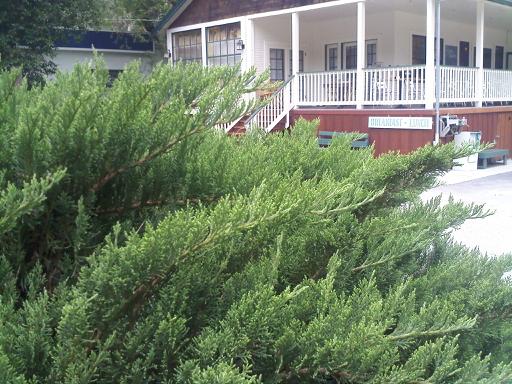
Shore juniper is a ground cover that can cascade splendidly.
Like so many other junipers, the old fashioned shore juniper, Juniperus conferta, is recovering from decades of a bad reputation. Through the 1950’s and 60’s, junipers had been so overly common and were so commonly planted where space was insufficient for their mature size that just about anyone who enjoys gardening now likely knows how irritating prickly juniper foliage can be, or how to remove overgrown junipers. I prefer to blame the icky tam junipers for this.
Now that they are actually regaining popularity, junipers seem to be commanding more respect; perhaps with the exception of tam junipers, which are just as useless now as they ever were. Junipers that grow into small trees are getting planted where they can be appreciated for their sculptural forms. Shrubby junipers are being employed as informal barriers where they do not need to be pruned for confinement. The shore juniper, like other low growing or creeping junipers, is a practical ground cover. Mature shore junipers spread about six feet wide without getting deeper than a foot. The finely textured bluish green foliage is actually a bit more bristly than it first appears, with small pine needle shaped leaves. The soft berries are lighter grayish blue to purplish black. ‘Emerald Sea’ has greener foliage that seems to be a bit more lax. ‘Blue Pacific’ has denser and more bluish foliage.
As much as I like junipers, even I have my limits. The tamarix juniper or tam, Juniperus sabina ‘Tamariscifolia’, is the juniper that gave junipers a bad name decades ago by being too common in too many of the wrong situations, and remains one of the most commonly planted junipers. What I do not like about it is that it is classified as a ‘ground cover’ juniper and can sprawl more than eight feet wide, but actually piles up more than two feet deep! However, I have noticed that it can be practical for certain situations as a ‘sprawling shrub’ instead.
Even without the foliar color or sculptural branch structure of other shrubby junipers, the dense dark green foliage and compact branch structure give the tam its own appeal and practicality. It can be shorn into low informal hedges as frequently as annually. It readily recovers its feathery texture if shorn as the weather starts to get warm in spring. All it wants is sunlight and infrequent but deep watering in summer.
Holly-leaf osmanthus resembles both English holly and Euonymus.
English holly happens to be one of my all time favorite plants, even though it rarely produces the abundant berries that are expected of hollies. Its deep rich green foliage is so glossy and distinctively textured. Because English holly does not mind partial shade, the variegated varieties can add a bit of color where it is too dark for most other plants to bloom. I really do not mind that it is so prickly.
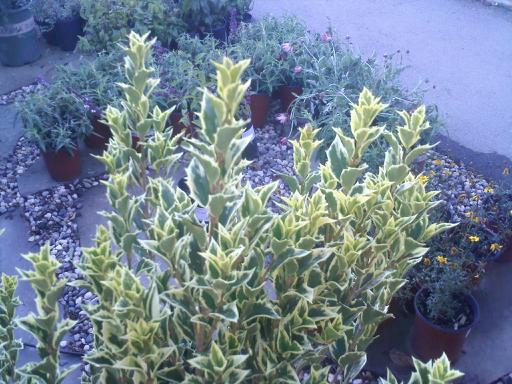
For those who do mind, the holly-leaf osmanthus, Osmanthus heterophyllus (or ilicifolius) is a worthy substitute for English holly that is just as happy with partial shade. The foliage is very similar in appearance, but a bit less glossy, and much less irritating. Holly-leaf osmanthus is sometimes mistaken for English holly, but can be distinguished by its opposite leaves. English holly has alternate leaf arrangement.
Mature holly-leaf osmanthus can get as large as English holly, but rarely does. It is more often less than 10 feet tall and wide, and is somewhat more adaptable to shearing into hedges. ‘Variegatus’, the most popular variety with pale white leaf margins, grows a bit slower and stays more compact, and actually looks better in partial shade than out where it is too exposed. Holly-leaf osmanthus flowers that bloom about now are not much to look at, but produce a delicate fragrance if the weather gets warm.
Coniferous evergreens are popular Christmas decor.
Christmas trees are extreme cut foliage. They grow on farms like cut foliage that florists use, but are entire trees! Although most fit under household ceilings, some within public venues are famously grand. Nonetheless, they are ultimately as disposable as any other cut foliage. Eventually, after their Christmas season, they become common greenwaste.
Other cut foliage is also popular as home decor through the Christmas season. Much of it is from the same sorts of coniferous trees that become Christmas trees. Almost all of it is evergreen, since deciduous vegetation is already defoliating. A few deciduous stems with colorful bark, such as red twig dogwood, are nice too. So are colorful winter berries.
Cut foliage is more practical as wintry decor within climates with cooler winter weather. Not much blooms during such weather. However, because of this same wintry weather, people prefer to be inside. While inside, they appreciate the color, texture, and perhaps aroma of cut foliage. Locally, such foliar decor for winter is more traditional than practical.
Actually, the most traditional cut foliage of Christmas is uncommon within local gardens. Scraps from the lowest branches of Christmas trees are a good source of minor bits of it. Premade wreaths and garland include a few types that are otherwise unobtainable here. Improvisation is necessary to create wreaths and garlands from locally available foliage.
Only a few of the few blue spruce that live here grow large enough to share many stems. Their best foliar growth is also their most important structural growth. Removal of it might cause minor disfigurement. Other spruce, as well as various fir, are very rare within home gardens. So is Eastern white pine, although a few other pines are notably common here.
Atlas cedar, Deodar cedar, various cypress and various juniper are also rather common. A few sorts of holly are uncommon but not rare, but they produce only a few berries here. Holly olive may be more common, and resembles English holly, but produces no berries. Southern magnolia is a strikingly untraditional cut foliage, but becomes fragile as it dries.
Maple foliage only seems to be messy because it all falls at once.
(Horridculture will resume on Friday.)
Contrary to popular belief, most deciduous trees, those that drop all their leaves in autumn, are not as messy as most evergreen trees. There are of course a few exception; such as cacti that lack foliage completely, or Italian cypress that drop their finely textured foliage straight down within a very narrow drip-zone, where it decomposes and disappears unnoticed. Very few leaves fall from a big silver maple through winter, spring and summer, so that almost all of the raking is done when almost all the leaves get shed in autumn. However, a big Southern magnolia generally drops leaves throughout the year, so that raking is always necessary.
The problem is that when deciduous trees get to be messy, they are very messy. Also, they get to be messy at the worst time of year, when their leaves mix with rain to clog drains and gutters. Unraked leaves become hazardously slippery when they get wet and start to decompose. It is amazing how something that can be so appealingly colorful through autumn can so quickly become such a nuisance.
Leaves of deciduous trees somehow seem to be better for composting than those of some of the evergreen trees. Anyone with a Southern magnolia knows how slow the foliage is to decompose. Foliage of camphor, bay, carob and various eucalyptus certainly decompose slower than various maple, ash, poplar and birch. Many of us outfitted with green waste bins or curbside collection of green waste prefer to recycle the less desirable evergreen foliage, and compost primarily deciduous foliage. Those of us who do not compost but need to rake under large or many deciduous trees may fill bins for several weeks, or leave very big piles of leaves at the curb.
Small leaves, such as those of most elms, or finely textured compound leaves, such as those of silk tree, jacaranda or locust, may not need to be raked if they fall onto lower shrubbery or ground cover. Small leaves or the small leaflets of disintegrating compound leaves simply sift through the lower plant material to decompose below. However, large elms may produce such an abundance of foliage that some may need to be removed. Maple and other large leaves are not so easy to ignore. They can shade lawns, ground cover or bedding plants, so need to be raked as they fall.
(This is an old article from 2011, so much of the information within is no longer relevant.)
The sixteen acres of gardens of Filoli are spectacular and horticulturally compelling throughout the year. However, the weather through winter, although more pleasant than other places in the world, is not always quite so compelling or conducive to garden tours. At Filoli though, this is not a problem. More than six hundred volunteers and the Filoli staff merely bring the outdoors indoors, by selecting materials from the garden to adorn the interior of the 36,000 square foot Filoli residence for ‘The Wise Old Owl’, the annual fund raising Holiday Traditions Boutique.
While perusing The Wise Old Owl merchandise, guests can enjoy how so much more than flowers can be brought in from the garden to deck out the home. Bare stems, gnarly limbs, evergreen foliage, pine cones, bark and all sorts of bits and pieces of the autumn and winter garden demonstrate the potential for alternatives to traditional cut flowers that we may not even recognize as useful materials in our own gardens. Of course, there will be no shortage of the less abundant flowers that bloom through the season and decoration that are not out of the garden, as well as live music to enhance the display. Regardless of horticultural interest or boutique merchandise, the grand residence at Filoli is worth visiting even on the least eventful day of the year.
There are too many events within the Event to describe here. Guests can visit http://www.filoli.org to plan ahead and make reservations for buffet lunches and evening bistro dining, as well as an elegant Saturday Evening Dinner Party with dancing in the Ballroom. Children six to twelve years of age can enjoy a Children’s Tea on the finale of The Wise Old Owl on December 3.
The Wise Old Owl begins in only a few days on November 25, and continues through December 3. The hours of operation and admission are variable relative to the various events throughout the main Event. Reservations for specific events can be arranged and more information can be found online
Tickets can be purchased online, by fax or by telephoning Filoli weekdays between 9:00 a.m. and 4:00 p.m. At 650 – 364 8300 X 508. Order forms for fax transactions can be downloaded from the website and sent to 650 – 503 2090. Admission is limited; and tickets get exhausted somewhat early. Tickets are neither refundable nor exchangeable. Filoli is located at 86 Canada Road in Woodside (94062).
Autumn foliar color eventually gets messy. Actually, any deciduous foliage can become messy during its autumn defoliation. Color is not a prerequisite. Some deciduous foliage remains green through the process. Furthermore, some evergreen foliage contributes to the mess. A few evergreen species shed a bit more as the weather becomes more wintry.
Contrary to popular belief, deciduous vegetation is neater than evergreen vegetation. It only seems to be messier because it defoliates completely at once. Also, such complete defoliation exposes bare stems. Evergreen vegetation sheds slower throughout the year. As it replaces old foliage with new, it sheds more in seasonal phases, but incompletely.
Deciduous leaves also seem to be messier because they are generally bigger. They do not disintegrate into landscapes as efficiently as tiny evergreen leaves do. They require raking from lawns, as well as groundcover that can absorb smaller leaves. So, they fall most abundantly, and dissipate least efficiently. That is why defoliation is so very messy.
Defoliation of deciduous foliage occurs at both the best and worst time of year. It allows more warming sunlight into homes and gardens while the weather is cooling. It leaves deciduous trees more resilient to eventual windy wintry weather. However, it gets messy while the weather begins to get less conducive to gardening. Summer is about finished.
It truly is ironic. Rain and wind will eventually dislodge the last deciduous foliage during winter. Rain is also why this same foliar debris must not clog eavestroughs and gutters. Yet, it is why removal of such debris can be such an unpleasant chore. Removal of foliar debris from hardscapes is also important. It stains and gets slippery if dampened by rain.
While defoliation decreases shade above, it can increase shade below. Accumulation of foliar debris can detrimentally overwhelm turf and groundcover. Some large leaves can do the same on top of dense shrubbery. Fungal pathogens proliferate within the dark and stagnant dampness below such debris. Shade from such debris inhibits photosynthesis.
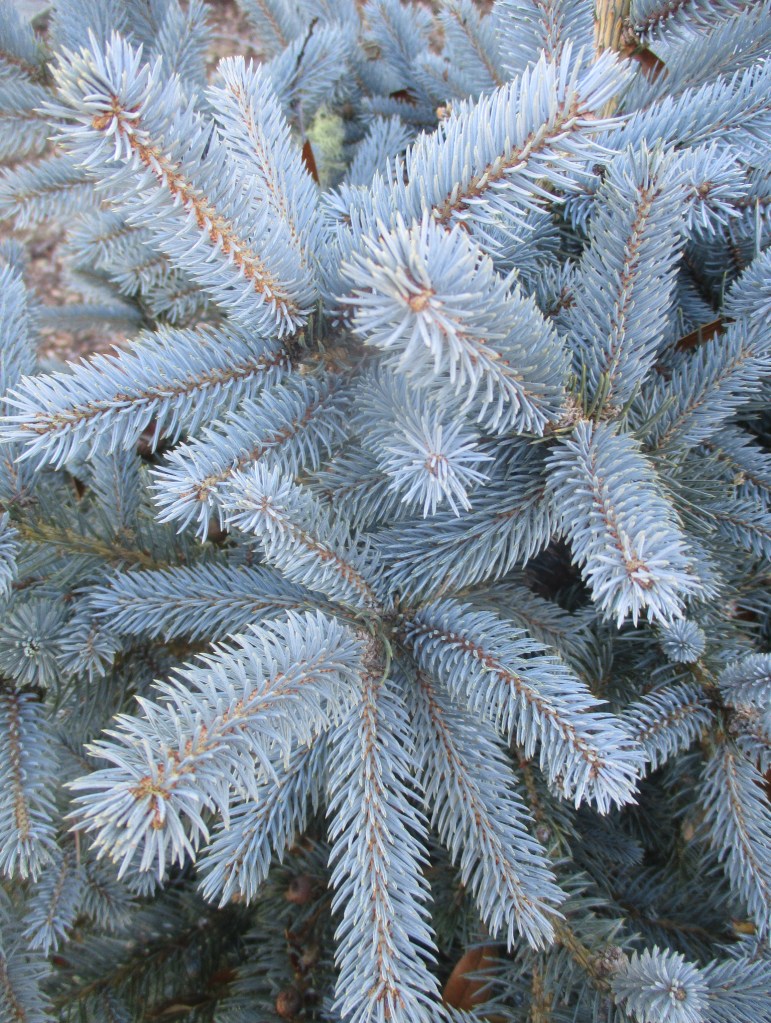
Most trees behave very differently in cultivation than in the wild. Colorado blue spruce, Picea pungens, is naturally a grand tree. It slowly but surely grows almost a hundred feet tall in the Rocky Mountains. Locally, if not competing with taller trees, it rarely gets as tall as thirty feet. Mild winter weather does not stimulate much more than necessary growth.
Furthermore, most home garden Colorado blue spruce are densely compact cultivars. Most are plumply conical. A few are quite rounded or globular. They function more as big shrubbery than trees. They are less conducive to major pruning than shrubbery though. Removal of low limbs for clearance compromises their strict but naturally elegant form.
Foliar color is as appealing as form and foliar texture. Obviously, Colorado blue spruce should be blue. Some are a bit more silvery or grayish. Trees that grow from seed tend to be greener and a bit less dense than cultivars. Such seedlings are sometimes available online. The stiff and prickly needles of Colorado blue spruce are only about an inch long.
This weird Euphorbia is one of the few small evergreen trees that drops no foliage.
Contrary to popular belief, most deciduous trees, those that drop all their leaves in autumn, are not as messy as most evergreen trees. There are of course a few exception; such as cacti that lack foliage completely, or Italian cypress that drop their finely textured foliage straight down within a very narrow drip-zone, where it decomposes and disappears unnoticed. Very few leaves fall from a big silver maple through winter, spring and summer, so that almost all of the raking is done when almost all the leaves get shed in autumn. However, a big Southern magnolia generally drops leaves throughout the year, so that raking is always necessary.
The problem is that when deciduous trees get to be messy, they are very messy. Also, they get to be messy at the worst time of year, when their leaves mix with rain to clog drains and gutters. Unraked leaves become hazardously slippery when they get wet and start to decompose. It is amazing how something that can be so appealingly colorful through autumn can so quickly become such a nuisance.
Leaves of deciduous trees somehow seem to be better for composting than those of some of the evergreen trees. Anyone with a Southern magnolia knows how slow the foliage is to decompose. Foliage of camphor, bay, carob and various eucalyptus certainly decompose slower than various maple, ash, poplar and birch. Many of us outfitted with green waste bins or curbside collection of green waste prefer to recycle the less desirable evergreen foliage, and compost primarily deciduous foliage. Those of us who do not compost but need to rake under large or many deciduous trees may fill bins for several weeks, or leave very big piles of leaves at the curb.
Small leaves, such as those of most elms, or finely textured compound leaves, such as those of silk tree, jacaranda or locust, may not need to be raked if they fall onto lower shrubbery or ground cover. Small leaves or the small leaflets of disintegrating compound leaves simply sift through the lower plant material to decompose below. However, large elms may produce such an abundance of foliage that some may need to be removed. Maple and other large leaves are not so easy to ignore. They can shade lawns, ground cover or bedding plants, so need to be raked as they fall.