 All around town, there are Italian stone pines, Canary Island pines, Monterey pines and Aleppo pines that are much too big for the home gardens that they live in. Some are too close to pavement or foundations. Others are under utility cables. Many are shading or crowding out other more desirable plants. What most have in common is that they started out as living Christmas trees.
Because they seem to be so cute and innocent when they are decorated in a small pot, living Christmas trees very often get planted where they really do not belong. Not much consideration is given to their true potential. Pines are innately difficult to contain, and can not easily be pruned back for confinement once they get growing in a space that is not spacious enough for them.
Living Christmas trees simply are not often the horticulturally responsible option for Christmas trees that we would like to believe that they are. Very few end up in good situations where they have room to grow. Planting them in the wild is not practical, since their roots are too confined to survive without watering. Because they are not native, they should not be planted in the wild anyway.
Contrary to popular belief, the most popular of the living Christmas trees do not do well in containers long enough to function as Christmas trees for more than just a few years. Some spruces and small pines can be happy in containers for many years, but can be demanding. If their roots get too disfigured, they are less likely to adapt to the landscape when they outgrow containment.
Ironically, cut Christmas trees are usually more practical than living Christmas trees. They may seem to be expensive, but they are less expensive than living Christmas trees of good quality (unless a living Christmas tree functions for a few years.) Even though they are bigger, cut Christmas trees are not as heavy and unwieldy as the big tubs of soil needed to sustain living trees.
Cut Christmas trees are not harvested from forests, but are grown on farms like any other horticultural commodity. There should be no guilt associated with bringing one into the home. In the end, they can be composted or otherwise recycled like green-waste. There is no long term commitment, and no need to provide accommodations for an eventually humongous tree in the garden.
Those who insist on procuring a living Christmas tree should choose responsibly, and be ready to accommodate a growing young tree. Although not big enough to be real Christmas trees, dwarf Alberta spruce like those in the picture above are sometimes decorated as a small live Christmas tree. They happen to be conducive to confinement in proportionate pots. One in the ground, they grow like strictly conical shrubs that do not get big enough to cause problems.
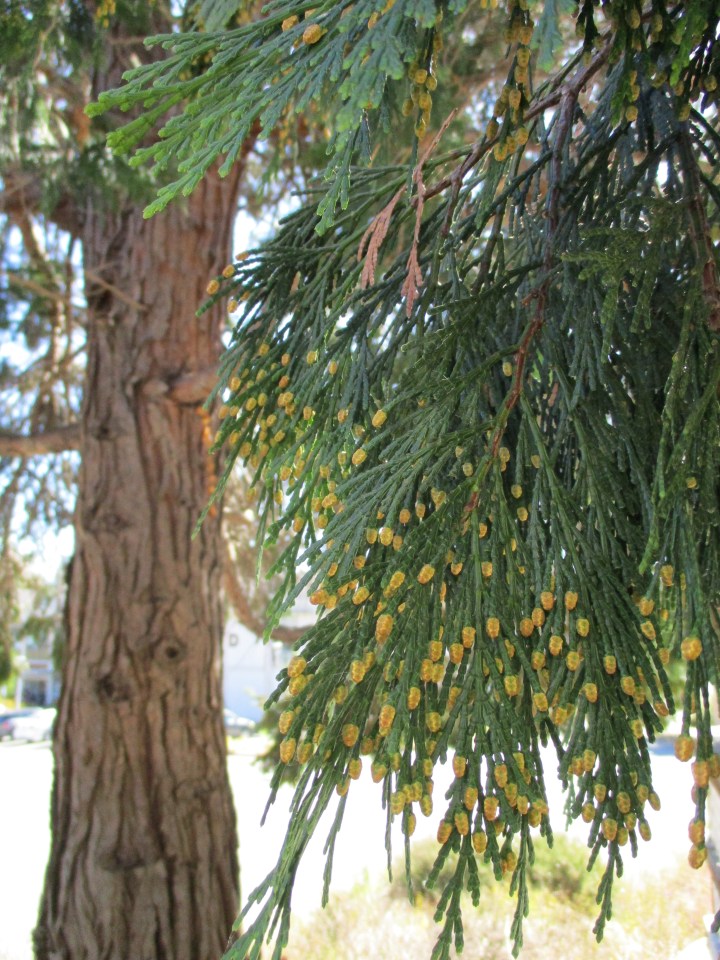 Calocedrus decurrens. Incense cedar. The first tree that I ever planted was a small incense cedar, like the tree in the picture here. Of course, it was not this big when I planted it.
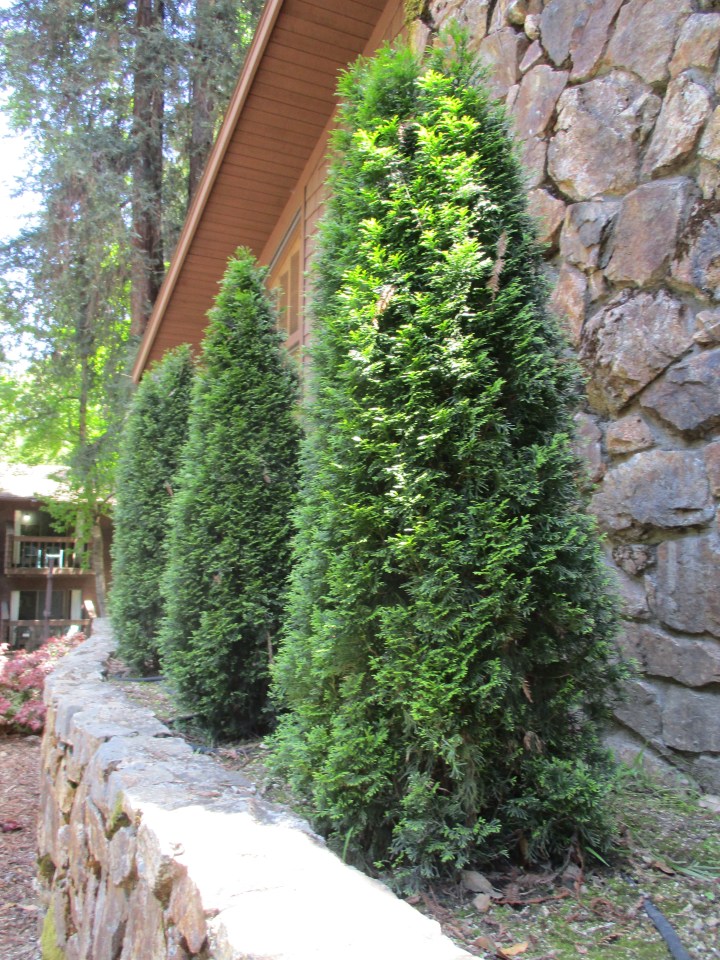 We all know what autumn is for. Planting, of course. Yes, it is a recurring theme; but there are so many different things to plant. Dormant bulbs need to get into the ground before cool and rainy winter weather. Deciduous plants that should be planted while dormant prefer an early start if planted as soon as they defoliate in autumn. Believe it or not, most evergreen plants are no different.
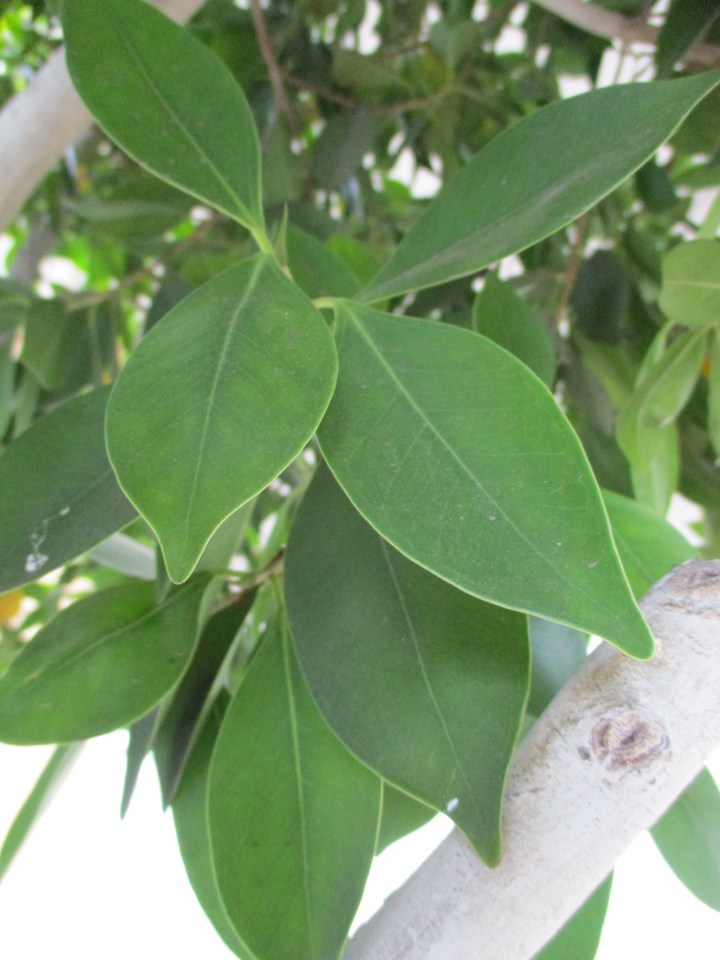 It is hard to believe that such a delightfully robust and luxuriant tree like the Indian laurel,
 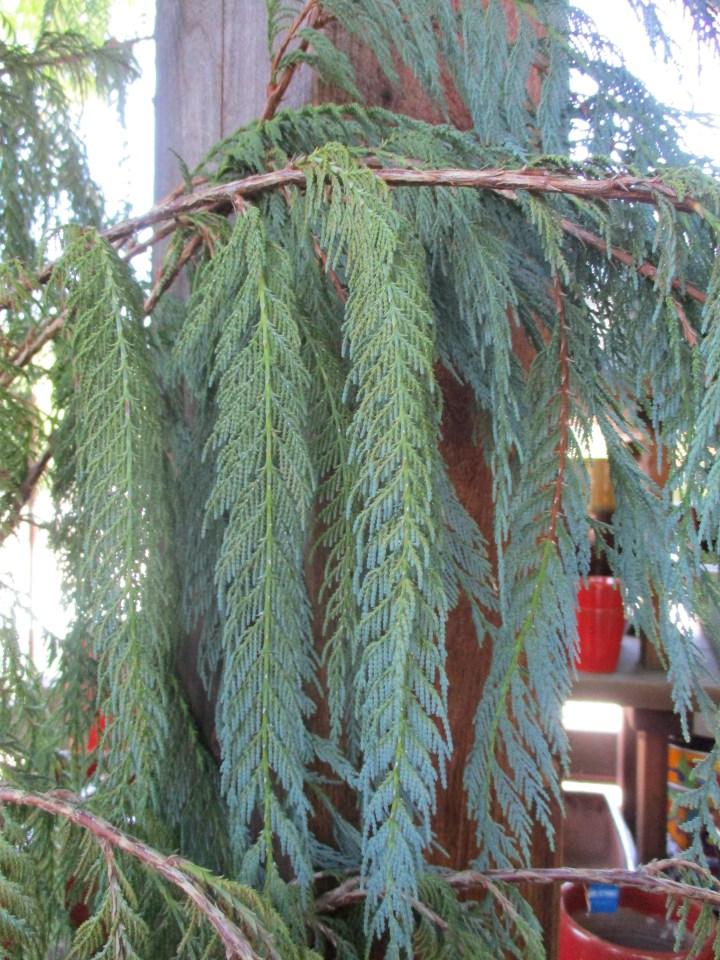 Plants are usually well suited to the climates that they are native to. Glaucous (slightly reflective grayish) foliage is more common in harsh climates where darker green foliage might get cooked by the sun. Pendulous growth is more common among plants that want to shed heavy snow efficiently. Kashmir cypress, Cupressus cashmeriana, has both, but is from a tropical monsoonal climate.
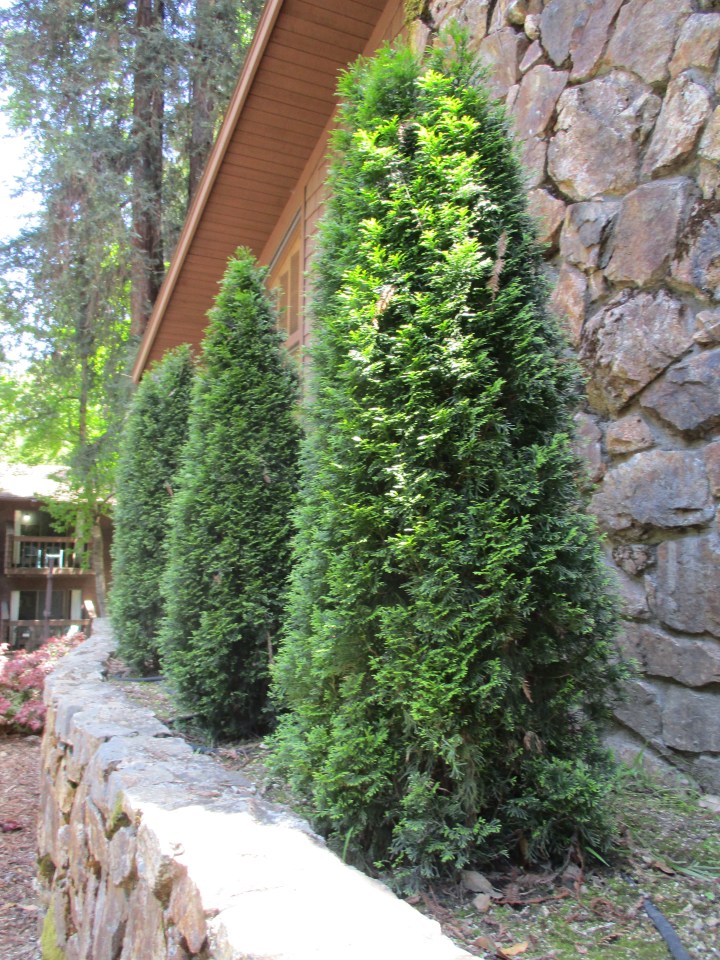 The many cultivars of arborvitaes of home gardening have been so extensively bred and selected that only the foliar texture resembles that of their ancestors. ‘Emerald Green’ which is also known by its Danish name ‘Smaragd’, is a cultivar of arborvitae that was developed from the white cedar, Thuja occidentalis,which grows wild from Minnesota to New Brunswick, as a forty foot tall tree!
 Relative to other pines and evergreens that are commonly grown as living Christmas trees, the uncommon and even rare Austrian pine, Pinus nigra, would be a better option. If it gets planted too close to the home, as Christmas trees often do, it does not get big enough to cause major problems. Although much bigger in the wild, local trees may take decades to reach second story eaves.
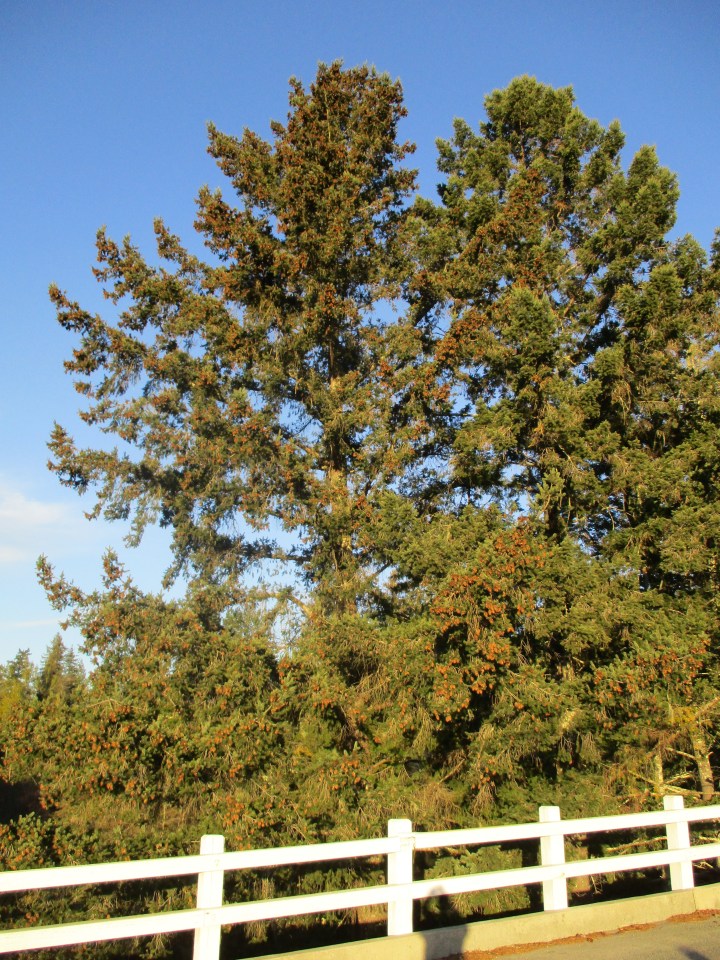 Even those of us who live nowhere near its natural range live closer to Douglas fir, Pseudotsuga menziesii, than we realize. Most of our homes are constructed from Douglas fir lumber. Although very uncommon in landscaped gardens, Douglas fir is the most popular Christmas tree here. Trees introduced for timber have naturalized in parts of Europe, Argentina, Chile and New Zealand.
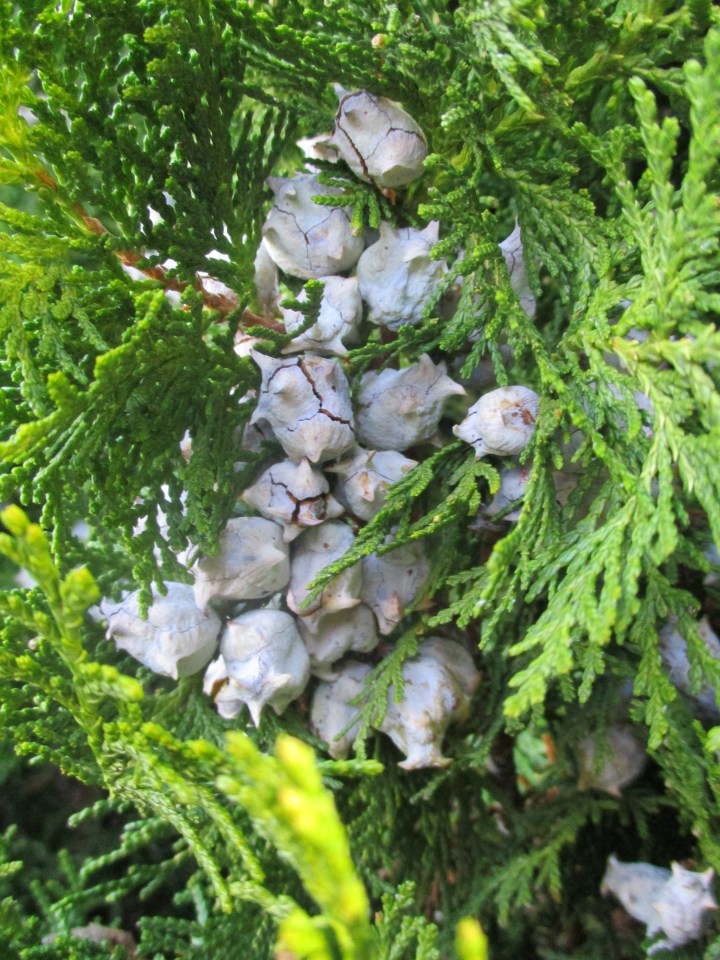 These pale blue . . . whatever they are, were just too cool to pass up without a picture. Technically, they are the ‘cones’ of dwarf golden arborvitae, Platycladus orientalis (formerly Thuja orientalis) ‘Aurea Nana’. They do not look much like cones. They are only about three quarters of an inch long, and are rarely as profuse as they are here. They are less appealing as they dry and turn brown.
 Tony Tomeo