Analysis

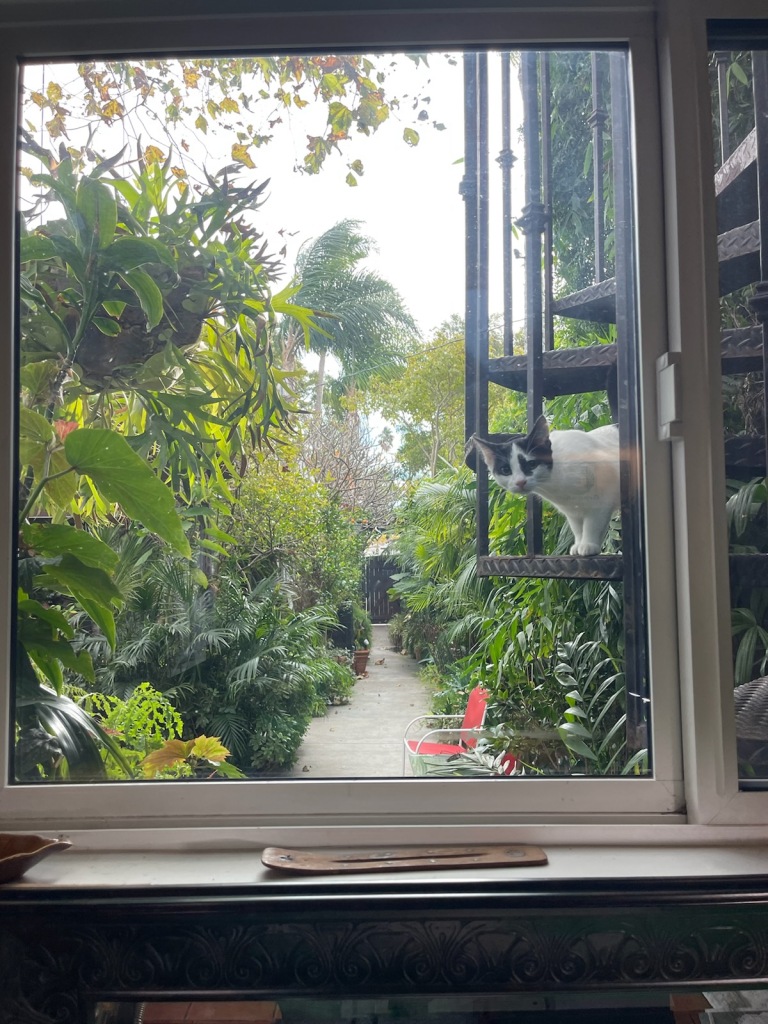
There is so much more to this picture than the kitty.

As Brent mentioned when he sent me this picture, which was included with my ‘Six on Saturday’ post earlier this morning, “There’s a lot going on in the picture.”

Slightly above the exact center of the picture, to the left of the tip of the kitty’s right ear, a Mexican fan palm peeks through a small void in the vegetation. It is at the curb of a home on the west side of the next street to the east. It is what Brent would have taken a picture of if he had zoomed in as intended. It leans to the right and south, as tall Mexican fan palms do there in response the the Santa Ana Winds.

The foliage of the queen palm above and to the left demonstrates that the Santa Ana Winds were blowing when the picture was taken.

The trunk that extends upward through another smaller void in the vegetation below the queen palm foliage is of another Mexican fan palm at the curb in front of Brent’s Jungalow. It is in alignment with the other Mexican fan palm to the east. Its canopy is obscured by that of the queen palm.

The foliage above and to the right of the primary Mexican fan palm, but below and to the right of the queen palm, is pink trumpet tree, which blooms spectacularly bright pink for spring.

The defoliated thicket of stems below and to the left of the primary Mexican fan palm is a large plumeria, which Brent, while very young, acquired from an elderly neighbor. He got it at about the same age that I was when I acquired my Dalmatian iris and rhubarb. More than a dozen other plumeria grow and bloom in a row that extends parallel to the walkway, in front of and behind the large specimen that is visible.

The somewhat yellowish foliage below and to the left of the plumeria is an impressively large Mexican lime that is somehow productive within all that shade.

The strange foliage that hangs outwardly from a dark central mass above and to the left of the Mexican lime, and left of the queen palm is a large colony of staghorn fern that is much closer to the window. Some sort of weird begonia foliage is below and to the left of it. California sycamore foliage is above it.

The top of a tall Indian laurel hedge is visible to the upper right of the picture. Some sort of odd dracaena and odd fern are visible to the lower left corner. Much but not all of the remaining vegetation is a mixture of understory palms, including various bamboo palms, Raphis palms and kentia palms. The spiral stairs lead to an upper deck, which has a splendid view of the rest of the garden that extends to the left, beyond the view of this picture. Finally, on the spiral stairs, is this kitty.

Six on Saturday: Unidentifiable

Only Australian tree fern is identifiable. Another is just, well, . . . weird.

1. Alocasia odora, taro was installed by a tenant, into a situation that was too dark for it. Now that the tenant is gone, and before another arrives, I brought it back to the nursery for reassignment. The holes in the leaves are from redwood twigs that fell from very high up. I can not identify its cultivar, and am not ever sure if it is an Alocasia or a Colocasia.

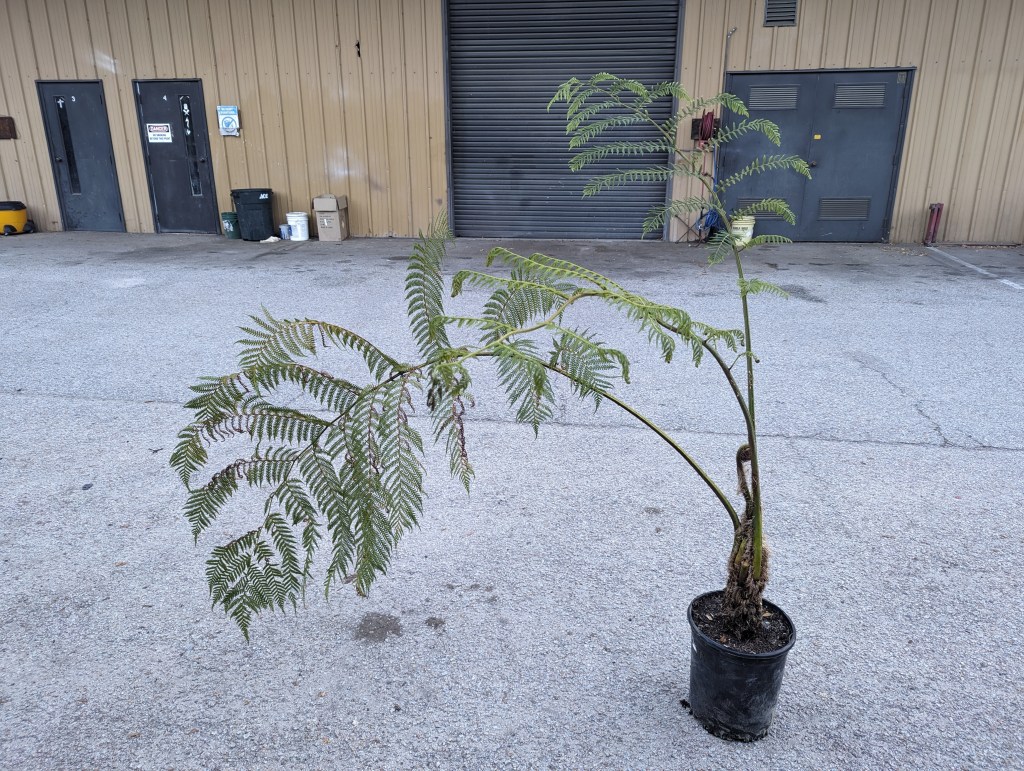
2. Sphaeropteris cooperi, Australian tree fern was next to the taro, so came here with it. Although otherwise healthy, its etiolated leaves were reaching towards limited sunlight.

3. Sphaeropteris cooperi, Australian tree fern that I tried to recycle from the garden of a former neighbor did not survive. It is a saddening loss. It was an excellent tall specimen.

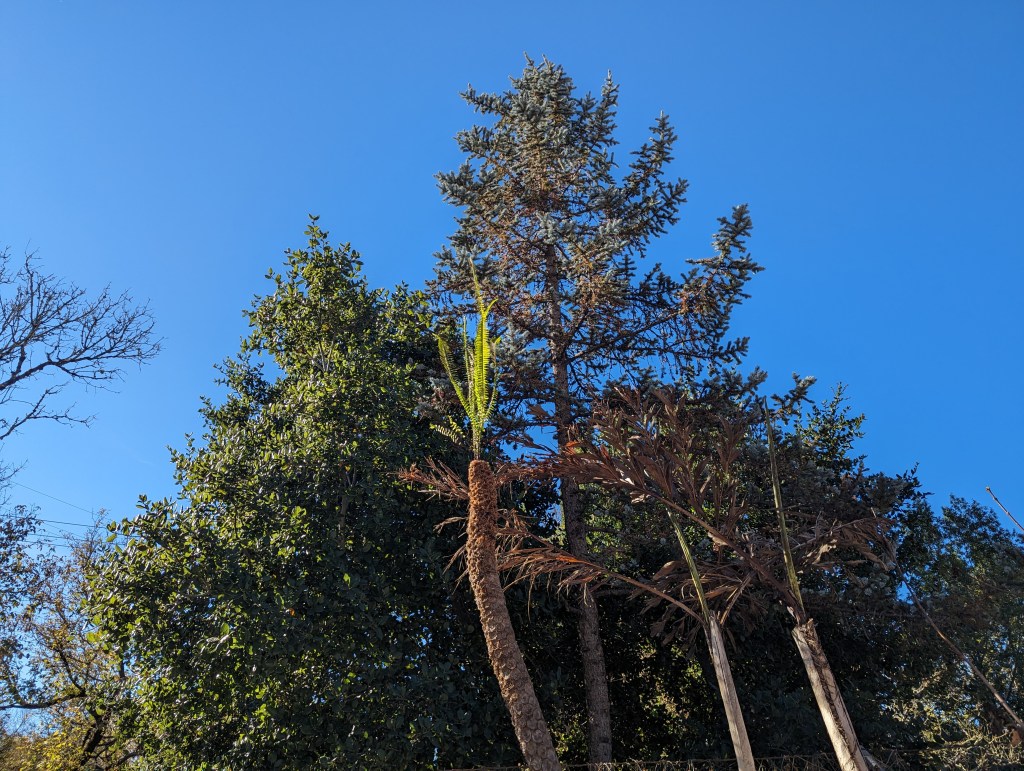
4. Nephrolepis cordifolia, sword fern might make good use of the trunk of this deceased Australian tree fern. Technically, the trunk is not actually a trunk at all; but is merely an accumulation of roots that extended downward through the decayed stem of the original fern. Perhaps the roots of this sword fern can do the same before the dead original roots deteriorate. It seems like a graft, but of course it is not. Nor is it a hybrid. It is just weird.

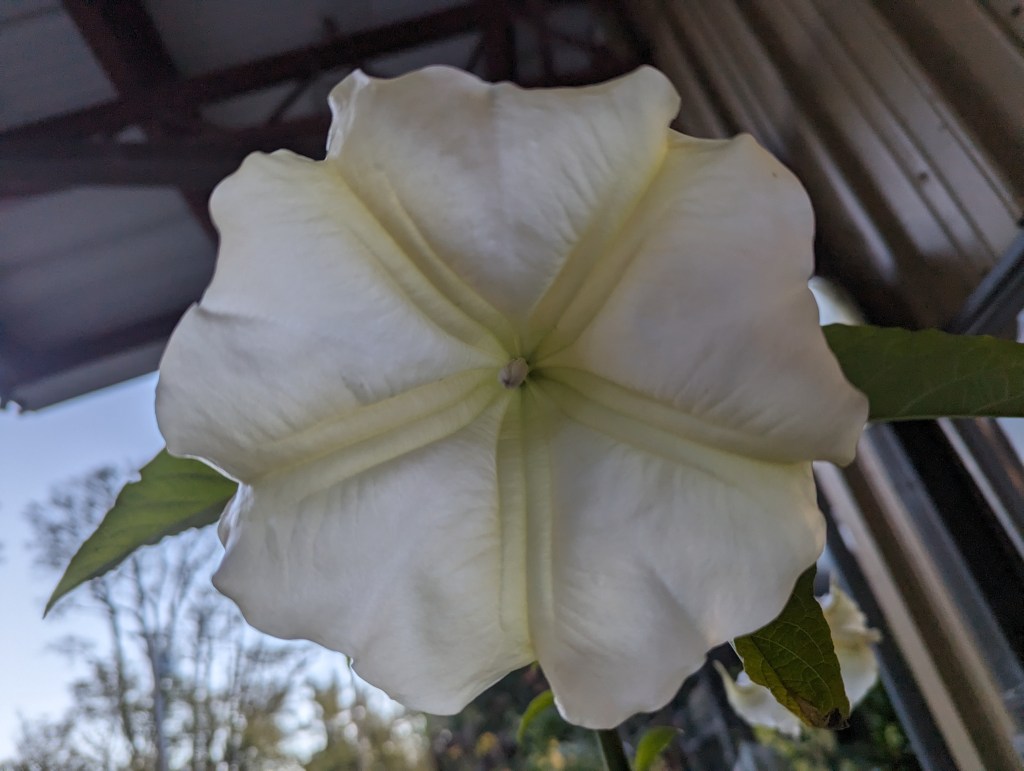
5. Brugmansia, angel’s trumpet of an unidentified cultivar is blooming for the first time. It has been with me for a few years, but dies back each winter. Before it recovers enough to bloom, it dies back again. I got it as a twig from a greenwaste recycle pile in San Jose.

6. Brugmansia, angel’s trumpet should be pastel orange. I took the original twig because I assumed that it was of a specimen that bloomed pastel orange. Does this look orange?!

This is the link for Six on Saturday, for anyone else who would like to participate: https://thepropagatorblog.wordpress.com/2017/09/18/six-on-saturday-a-participant-guide/

Fern Foliage Is Softly Bold

Ferns provide distinctive and bold foliage.

Ferns are foliar perennials. They provide neither floral color nor fragrance. They provide neither fruits nor vegetables. With few exceptions, they provide no shade. The very few that are deciduous are not impressively colorful for autumn here. Ferns can not grow as hedges. Nor can they become lawns. They exclusively provide distinctive fern foliage.

They do so splendidly! Most produce the sort of distinctively lacy fern foliage that ferns are famous for. Some exhibit even more finely textured and airy foliage. A few exhibit a relatively coarse foliar texture. Almost all ferns are rich and deep green. Some are lighter or slightly yellowish green. A rare few are silvery gray, or display an intricate silver lining.

Almost all ferns that are popular within home gardens are evergreen. Most benefit from occasional grooming to remove deteriorating old foliage. Some produce new growth on top as old growth lies down below. Several grow most lushly after removal of all foliage prior to their growing season. A few deciduous types of fern defoliate for their dormancy.

Ferns do not develop stems or trunks like most other vegetation does. They sprawl over the ground with rhizomes, which are fleshy stems. Rhizomes grow only in length, but not in diameter. Tree ferns grow upward as their rhizomes deteriorate below. Roots that grow through the deteriorating rhizomes form what seems to be trunks. Fern roots are fibrous.

Leaves of ferns are fronds. Such fronds of most ferns divide into pinnae, which are like smaller leaflets. Pinnae of some ferns divide into even smaller pinnae. Rachi are central stalks that suspend the pinnae within individual fronds. Ferns reproduce by spores, so lack flowers. Most ferns propagate efficiently by division of preferably dormant rhizomes.

Because of their fibrous root systems, ferns are complaisant to confinement within pots. Most ferns are naturally understory vegetation, so are innately tolerant of partial shade. Ferns that tolerate aridity as well as shade and confinement are delightful houseplants. Most ferns are very tolerant of relocation, although some must replace foliage to adapt.

Sword Fern

00304
Sword fern looks like Boston fern.

This is not the native Western sword fern of forested and riparian regions here on the West Coast. This sword fern, Nephrolepis cordifolia, is native to Northeastern Australia, Southeastern Asia and Hawaii. It is naturalized in many regions beyond its natural range, and is considered an invasive exotic species in some regions. Its resiliency and reliability are appreciated in local gardens.

If it resembles the popular houseplant, Boston fern, it is because this sword fern is of the same genus. It just happens to prefer to be out in a garden rather than inside a home. Much or even most of the light green foliage stands more upright, rather than cascading from pots or elevated planters. Foliage of mature plants can get almost three feet high, with an even broader horizontal reach.

In fact, sword fern is notorious for sneaking around the garden and spreading wider than just a few feet. It is not particularly aggressive about. It creeps slowly but steadily until someone eventually notices that it has gotten a bit too prolific. Their abundant runners are wiry and strangely hairy, and produce small round tubers. Foliage can be yellowish if not watered enough in sunny situations.

Delta Maidenhair Fern

90904Some of us might remember Delta maidenhair fern, Adiantum raddianum, as a houseplant that was popular for terrariums in the 1970s and into the 1980s. Although quite happy in terrariums, it eventually gets big enough to crowd other plants in such tight spaces. It prefers to be potted on a porch, or in a regularly watered and sheltered spot in the garden. It tolerates quite a bit of shade.

Regular watering is important to keeping the foliage well hydrated, particularly among potted plants that are unable to disperse their roots into surrounding soil. The stolons bellow the foliage are not so sensitive, so can regenerate new foliage if partly desiccated old foliage needs to be cut back. They want good rich soil or potting media, and appreciate occasional application of fertilizer.

Individual fronds (leaves) have the potential to get as long as a foot, and half as wide, although they are mostly significantly smaller, and might be only half as long. Each frond is intricately divided into many small leaflets that are almost triangular, except that their out edges are curved and scalloped. Foliage is lighter green than that of most other ferns. Rachi (leafstalks) are black and thin.

Ferns Are Delightful Without Bloom

90904thumbMany of the most popular plants are expected to bloom to add color and fragrance to the garden. Many others are grown to produce fruit or vegetables. Some are appreciated for their foliar color in autumn. Big trees are grown for shade. Turf grasses are grown as lawn. Evergreen shrubbery makes hedges. It seems that all plants perform particular tasks in the gardens which they inhabit.

Ferns only need to provide rich foliage. They do so very efficiently, with remarkably stylish and distinctive textures, and deep green color. Most ferns are evergreen, so only need to be groomed of their old foliage as it gets replaced by new foliage. Most of the few deciduous ferns are bare only briefly during their respective dormant seasons. Some can grow wild without any grooming at all.

Many ferns are famously tolerant of partial shade that is too dark for many other types of plants. Many are tolerant of confinement, so are happy in pots, planters and small atriums, or under stairs. Some ferns that are tolerant of both shade and confinement are popular as houseplants. Those that get too big or their situations are generally easy to dig and relocate, or divide into more plants.

There are only two species of tree fern that are common here; the Australian tree fern, and the New Zealand tree fern. Australian tree fern is taller with leaner trunks. Tasmanian tree fern is short and stout. These and more rare tree ferns are the only ferns that leave the ground as they develop ‘trunks’ of tightly bundled fibrous roots dispersed through the decayed remains of their rhizomes.

Their rhizomes are just their thick herbaceous stems. Those of tree ferns do not branch into more than a single terminal bud, so can not be divided. Rhizomes of most other ferns split into clumps of a few or many individual budded rhizomes, which can be divided if they get too crowded. Leaves that grow from the rhizomes are known as fronds. The fronds of almost all ferns are divided into smaller leaflets known as pinnae, which are suspended by leafstalks known as rachi.

Holly Fern

60601This is one of those perennials that has mixed reviews. Although relatively tough once established, holly fern, Cyrtomium falcatum, is susceptible to rot and fungal leaf-spot. It likes to be watered somewhat regularly, but rots if the soil is constantly saturated. Leaf-spot is not as dangerous as it looks, but can be unsightly. Too much fertilizer (to correct the damage) can burn the foliage too.

Individual fronds might get as long as a foot and a half, with half a dozen to a dozen pairs glossy and irregularly toothed pinnae. Foliar texture (remotely) resemble that of some types of holly. Because they disperse their roots so efficiently, mature specimens do not like to be transplanted. Small plants can grow as houseplants for years, but eventually want to get out into the garden. Holly fern likes a bit of shade, and will tolerate rather dark shade.

Ferns Are Shady But Cool

P90309+++++It could be either an asset or a liability. With few exceptions, ferns do not want to be too exposed to direct sunlight or wind, especially during warm and dry weather. However, as long as they get just enough filtered light, they can be quite happy in sheltered spots that are a bit too shady for other plants. Most like to be watered regularly, and perhaps lightly fertilized in spring and summer.

They provide neither floral color nor fragrance. They lack interesting branch structure and bark. Since they reproduce by spores, they do not even produce any fruit, either edible or ornamental. For those who do not know them any better, they might seem to be rather boring. Yet, those of us who grow them know how handsome their lush, finely textured and uniquely patterned foliage is.

Of the popularly grown ferns, only two develop ‘trunks’, (which are actually just clustered wiry roots growing downward through rotting stems). Two others are ‘epiphytes’ that naturally cling to trees or exposed stone, but in home gardens, are more popularly grown on wooden plaques. Most other ferns are terrestrial understory perennials that naturally live in the partial shade of larger plants.

Although mostly confined to the ground, some ferns can get quite large. Individual leaves, which are known as ‘fronds’, can get several feet long. Even before it develops a trunk, Australian tree fern produces huge fronds that can shade an atrium. Other ferns with smaller leaves can spread very efficiently, and can even become invasive. Fortunately, most ferns are relatively complaisant.

The two popular epiphytic stag-horn ferns have weirdly lobed but otherwise undivided fronds. Leaves of the odd bird’s-nest fern is neither divided nor lobed. Otherwise, fern fronds are intricately divided into small leaflets known as ‘pinnae’. These pinnae are neatly arranged on opposite sides of leafstalks known as ‘rachi’. Some ferns have silvery variegation, but most are rich dark green.

Ferns innately do well in pots. Boston, maidenhair, rabbit’s foot, holly and bird’s-nest ferns are actually excellent houseplants. However, Australian tree fern and a few others shed irritating fuzz that would be a problem in the home. Most of the popular ferns are evergreen. Many consume their own deteriorating foliage by covering it with new foliage. Some ferns need occasional grooming.

Where The Green Ferns Grow

80829thumbThe list of what ferns will not do is more noteworthy than the list of what they will do. They do not bloom with colorful or fragrant flowers. The do not produce fruit. Very few turn color in autumn, and their color is generally nothing to brag about. Most ferns will not maintain their appeal through drought, or if neglected too long. Nor will they tolerate heat and wind, especially in full sun exposure.

Yet ferns are still popular for what they ‘will’ do. They provide remarkably distinctive and stylish foliage. They survive in spots that are too shady or perhaps too damp for other plants. Ferns will be quite happy in pots or planters, and some are happy to grow as houseplants. Ferns somehow avoid getting eaten by deer. If a fern gets tasted by a deer who does not know better, it will survive.

All ferns are perennial. Most are evergreen. Their foliage arches upward and outward from the terminal buds of stout rhizomes. Some ferns develop dense foliar rosettes. A few develop trunks by growing vertically instead of horizontally, and dispersing roots downward through their own decomposing fibrous rhizomes. Many ferns will get quite broad. Many are quite delicate and diminutive.

Ferns may not require too much maintenance, but the little bit of maintenance they require is somewhat important to keep them looking tidy. Old foliage should be pruned away as it is replaced by new foliage. This may be as simple as pruning away all old foliage just after new foliage develops early in spring. For some ferns, small batches of old foliage might get removed through the year.

The foliage of ferns is comprised of leaves known as ‘fronds’. With few exceptions, the fronds of ferns are intricately lobed or divided into smaller leaflets known as ‘pinnae’. (‘Pinna’ is singular for pinnae.) These pinnae are arranged on opposite sides of fibrous leafstalks known as ‘rachi’. (‘Rachis’ is singular for rachi.) Rachi are quite fibrous and tough, so should be cut close to the ground with pruning shears when they get groomed, rather than plucked.