 It could be either an asset or a liability. With few exceptions, ferns do not want to be too exposed to direct sunlight or wind, especially during warm and dry weather. However, as long as they get just enough filtered light, they can be quite happy in sheltered spots that are a bit too shady for other plants. Most like to be watered regularly, and perhaps lightly fertilized in spring and summer.
They provide neither floral color nor fragrance. They lack interesting branch structure and bark. Since they reproduce by spores, they do not even produce any fruit, either edible or ornamental. For those who do not know them any better, they might seem to be rather boring. Yet, those of us who grow them know how handsome their lush, finely textured and uniquely patterned foliage is.
Of the popularly grown ferns, only two develop ‘trunks’, (which are actually just clustered wiry roots growing downward through rotting stems). Two others are ‘epiphytes’ that naturally cling to trees or exposed stone, but in home gardens, are more popularly grown on wooden plaques. Most other ferns are terrestrial understory perennials that naturally live in the partial shade of larger plants.
Although mostly confined to the ground, some ferns can get quite large. Individual leaves, which are known as ‘fronds’, can get several feet long. Even before it develops a trunk, Australian tree fern produces huge fronds that can shade an atrium. Other ferns with smaller leaves can spread very efficiently, and can even become invasive. Fortunately, most ferns are relatively complaisant.
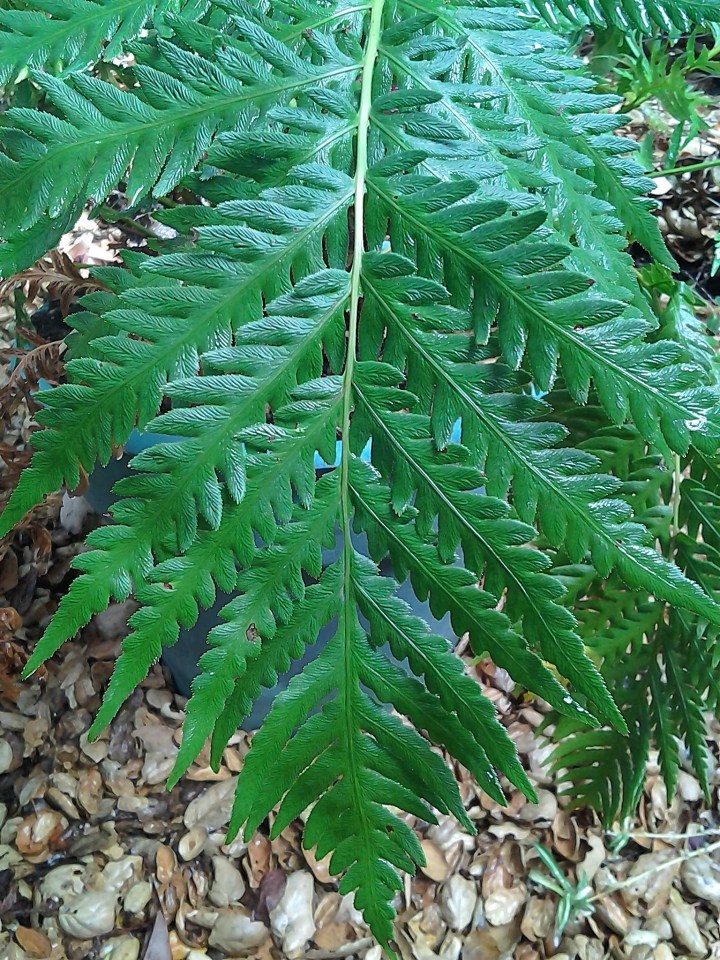
The two popular epiphytic stag-horn ferns have weirdly lobed but otherwise undivided fronds. Leaves of the odd bird’s-nest fern is neither divided nor lobed. Otherwise, fern fronds are intricately divided into small leaflets known as ‘pinnae’. These pinnae are neatly arranged on opposite sides of leafstalks known as ‘rachi’. Some ferns have silvery variegation, but most are rich dark green.
Ferns innately do well in pots. Boston, maidenhair, rabbit’s foot, holly and bird’s-nest ferns are actually excellent houseplants. However, Australian tree fern and a few others shed irritating fuzz that would be a problem in the home. Most of the popular ferns are evergreen. Many consume their own deteriorating foliage by covering it with new foliage. Some ferns need occasional grooming.
 Ferns tends to be . . . well, ‘ferny’, with divided or intricately lobed foliage. Staghorn ferns and bird’s-nest ferns are the more familiar of the rare exceptions. Staghorn ferns have two types of simple undivided fronds, and both types lack rachi. Bird’s-nest ferns have weirdly simple fronds that, although equipped with prominent rachi, lack any distinctive division or lobes that make ferns ‘ferny’.
 The list of what ferns will not do is more noteworthy than the list of what they will do. They do not bloom with colorful or fragrant flowers. The do not produce fruit. Very few turn color in autumn, and their color is generally nothing to brag about. Most ferns will not maintain their appeal through drought, or if neglected too long. Nor will they tolerate heat and wind, especially in full sun exposure.
 Staghorn ferns are epiphytes. They cling to tree trunks, rocks or whatever they happen to grab onto. They can root into decayed wood if it is porous enough, but they are satisfied to just cling to the exterior. They do not need soil. They sort of make their own soil by collecting debris that falls from the canopies of trees above. In the jungles where they live, they get all the water they need from rain. They often live in the crotches of branches because that is where they happen to land. (The epiphyte I wrote about earlier was just a palm that landed in the wrong place, but is not really an epiphyte.
  Tony Tomeo