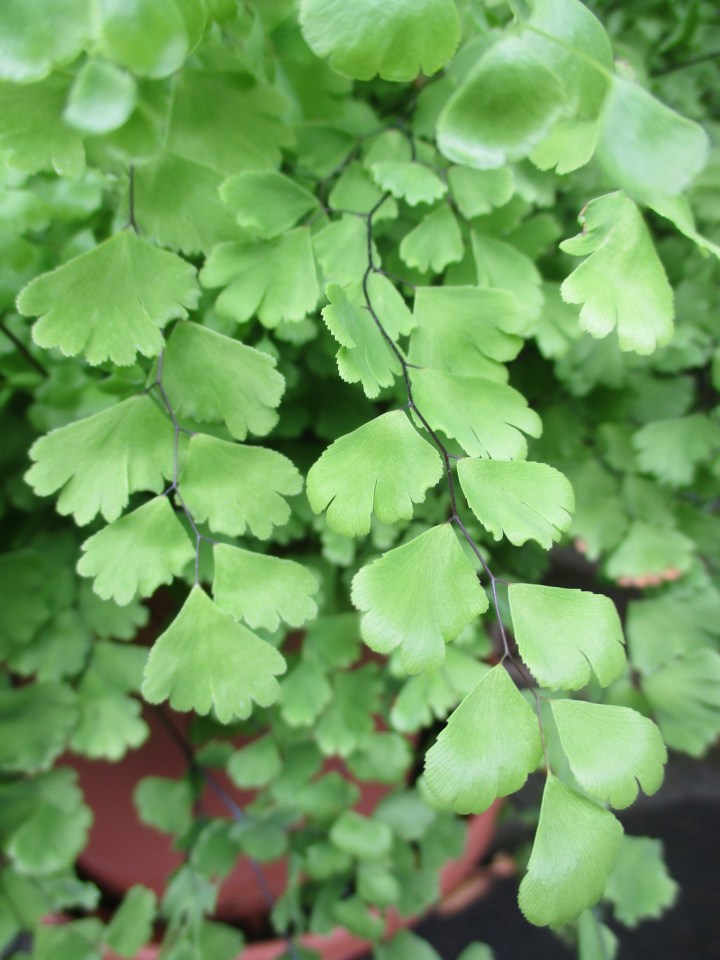
 Some of us might remember Delta maidenhair fern, Adiantum raddianum, as a houseplant that was popular for terrariums in the 1970s and into the 1980s. Although quite happy in terrariums, it eventually gets big enough to crowd other plants in such tight spaces. It prefers to be potted on a porch, or in a regularly watered and sheltered spot in the garden. It tolerates quite a bit of shade.
Regular watering is important to keeping the foliage well hydrated, particularly among potted plants that are unable to disperse their roots into surrounding soil. The stolons bellow the foliage are not so sensitive, so can regenerate new foliage if partly desiccated old foliage needs to be cut back. They want good rich soil or potting media, and appreciate occasional application of fertilizer.
Individual fronds (leaves) have the potential to get as long as a foot, and half as wide, although they are mostly significantly smaller, and might be only half as long. Each frond is intricately divided into many small leaflets that are almost triangular, except that their out edges are curved and scalloped. Foliage is lighter green than that of most other ferns. Rachi (leafstalks) are black and thin.
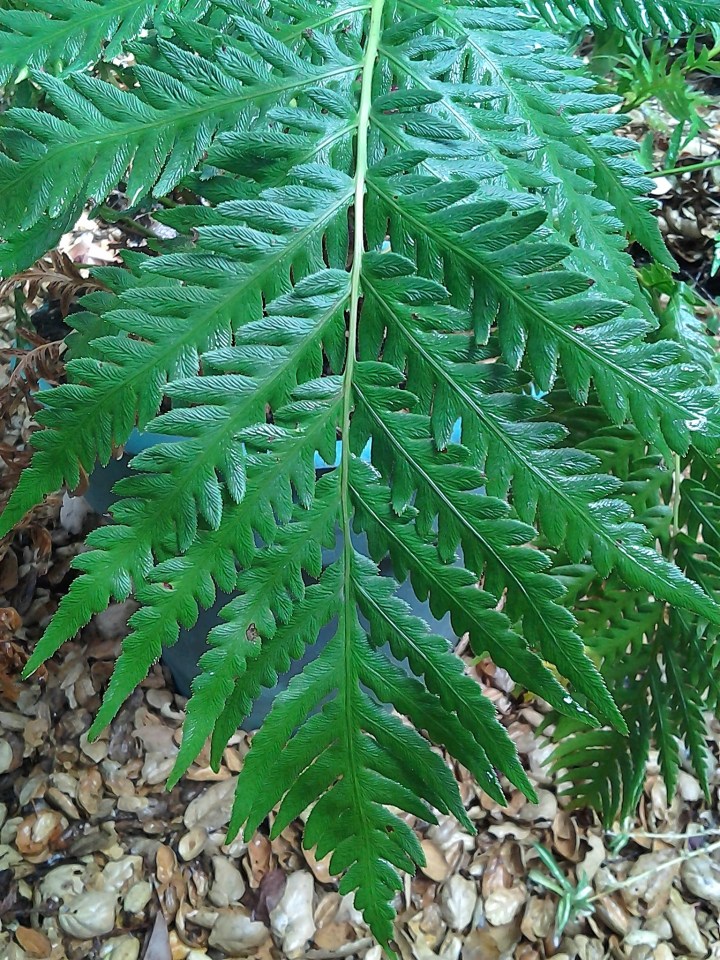 Many of the most popular plants are expected to bloom to add color and fragrance to the garden. Many others are grown to produce fruit or vegetables. Some are appreciated for their foliar color in autumn. Big trees are grown for shade. Turf grasses are grown as lawn. Evergreen shrubbery makes hedges. It seems that all plants perform particular tasks in the gardens which they inhabit.
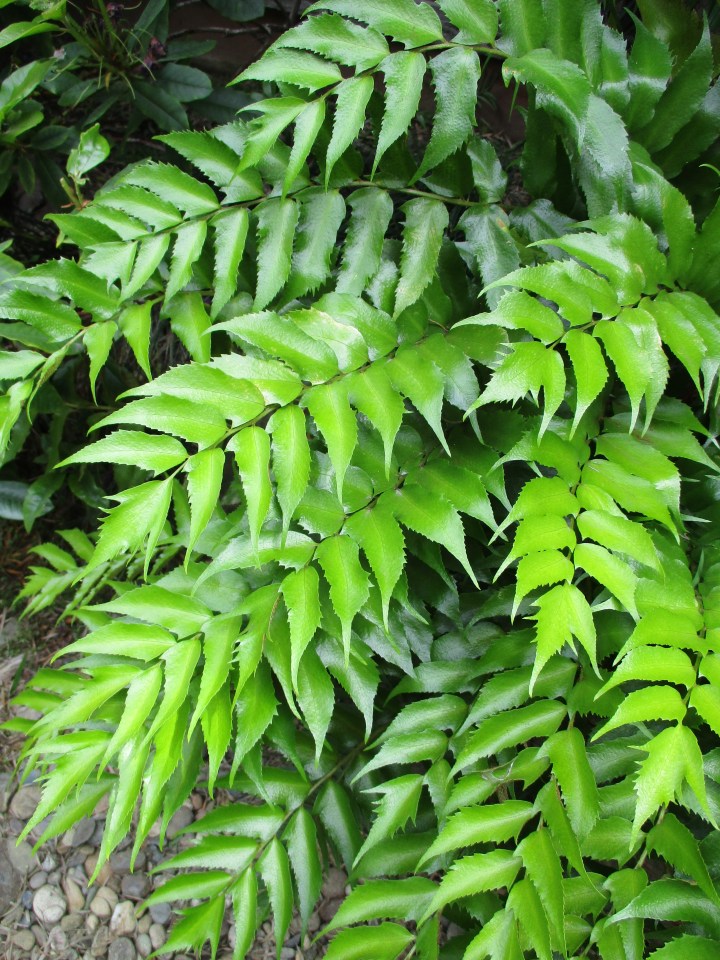 This is one of those perennials that has mixed reviews. Although relatively tough once established, holly fern, Cyrtomium falcatum, is susceptible to rot and fungal leaf-spot. It likes to be watered somewhat regularly, but rots if the soil is constantly saturated. Leaf-spot is not as dangerous as it looks, but can be unsightly. Too much fertilizer (to correct the damage) can burn the foliage too.
 It could be either an asset or a liability. With few exceptions, ferns do not want to be too exposed to direct sunlight or wind, especially during warm and dry weather. However, as long as they get just enough filtered light, they can be quite happy in sheltered spots that are a bit too shady for other plants. Most like to be watered regularly, and perhaps lightly fertilized in spring and summer.
 Ferns tends to be . . . well, ‘ferny’, with divided or intricately lobed foliage. Staghorn ferns and bird’s-nest ferns are the more familiar of the rare exceptions. Staghorn ferns have two types of simple undivided fronds, and both types lack rachi. Bird’s-nest ferns have weirdly simple fronds that, although equipped with prominent rachi, lack any distinctive division or lobes that make ferns ‘ferny’.
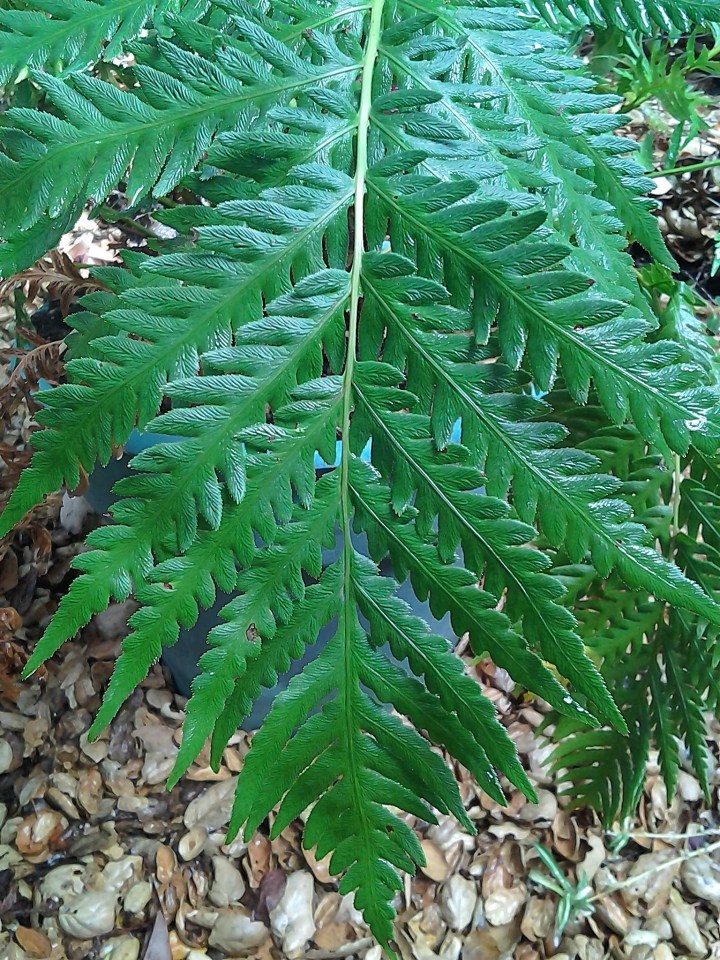 The list of what ferns will not do is more noteworthy than the list of what they will do. They do not bloom with colorful or fragrant flowers. The do not produce fruit. Very few turn color in autumn, and their color is generally nothing to brag about. Most ferns will not maintain their appeal through drought, or if neglected too long. Nor will they tolerate heat and wind, especially in full sun exposure.
 Staghorn ferns are epiphytes. They cling to tree trunks, rocks or whatever they happen to grab onto. They can root into decayed wood if it is porous enough, but they are satisfied to just cling to the exterior. They do not need soil. They sort of make their own soil by collecting debris that falls from the canopies of trees above. In the jungles where they live, they get all the water they need from rain. They often live in the crotches of branches because that is where they happen to land. (The epiphyte I wrote about earlier was just a palm that landed in the wrong place, but is not really an epiphyte.
