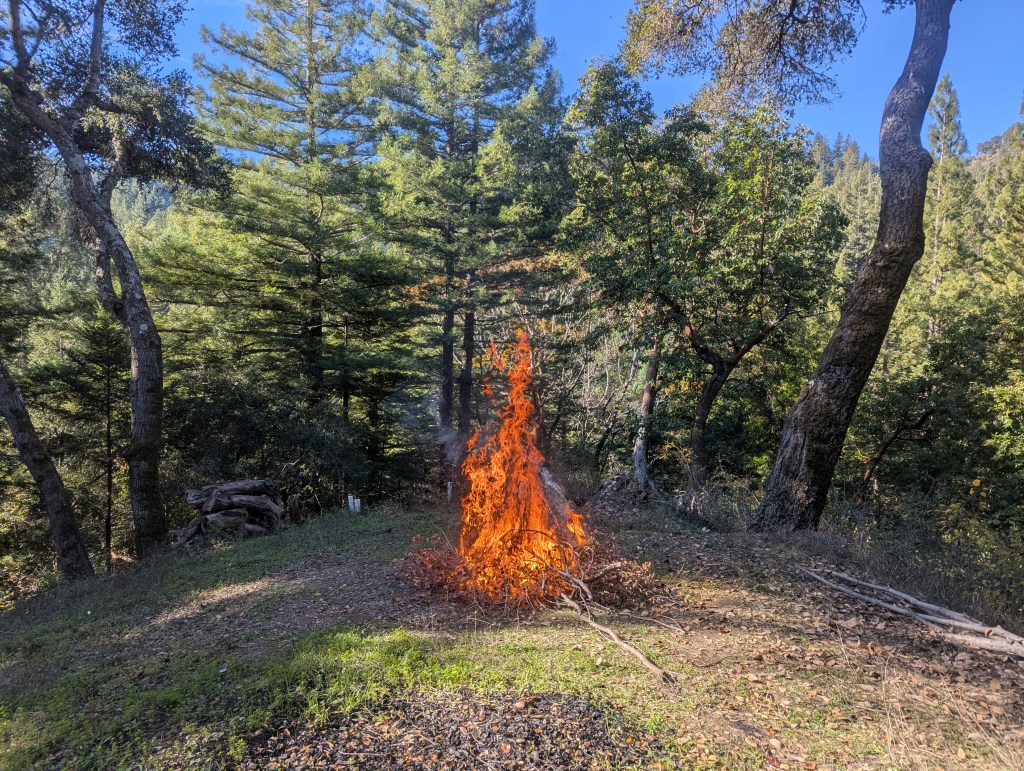
Monday was the first day of burn season, which continues from December 1 until April 30. On designated burn days within burn season, we can burn green waste that would otherwise make our properties more combustible during fire season, which is generally the opposite of burn season. The designation of burn days is determined by multiple meteorological factors, such as temperature, humidity, wind, atmospheric pressure and air quality. It is also limited by the moisture content of the forest, so can be delayed until after the first soaking rain storms. So, not only was Monday the first day of burn season, it was also the first designated burn day within burn season. I took the opportunity to burn some of the green waste that has been accumulating since the previous burn season. It was tedious but gratifying. A chipper would have been faster, but that is something that I lack here. Besides, a chipper can not go where some of the green waste remains. It is so far down steep hillsides that I may try to burn it where it is, rather than drag it up to where this primary burn pile was. There is a lot of green waste!
Fire season can begin as early as May and continue as late as November. It is defined by the rainy season. It is a long season because the rainy season is not. Summer is naturally warm and arid. Native vegetation is consequently desiccated. It is no coincidence. Fire is unfortunately a natural component of the ecosystems here, and native vegetation knows it. Many exotic species also react to the meteorological influences that affect fire season. Some are from similar chaparral ecosystems. However, some are from other ecosystems that are likely less adapted to fire. Perhaps their native ecosystems are less relevant than associated meteorological influences, which is what they are actually reacting to. A forty percent chance of rain on Monday morning is the first chance of rain in a long time.
1. Sequoia sempervirens, coastal redwood is always messy and gets even messier when a breeze dislodges foliage which got desiccated by arid warmth. It is a bad combination.
2. Adiantum capillus–veneris, maidenhair fern also reacted to arid warmth. In the wild, foliar desiccation through summer is normal. It is not so normal in irrigated landscapes.
3. Musa acuminata X balbisiana ‘Blue Java’ banana would enjoy sustained warmth with more humidity. While humidity is inadequate, wind more easily shreds its flimsy foliage.
4. Musa acuminata ‘Kokopo’ or ‘Patupi’ banana is more sheltered from breezes and more generously irrigated, so can exhibit guttation overnight and into the cool early morning.
5. Amaryllis belladonna, naked lady is generating seed as it typically does by now. Seed is very perishable, but grows in soil that is damp from the first rain that ends fire season.
6. Solidago rugosa ‘Fireworks’ goldenrod is only fiery by name. It was a gift from Tangly Cottage Gardening. It is the only bloom I will brag about today, and our first goldenrod!
Gardening involves weeds. Gardening outside of refined gardens involves more weeds. A few of such weeds are native species which grow where they are undesirable. Most of the most aggressive are naturalized exotic species. Collectively, they are an unpleasant consequence of unmanageable external biodiversity. They necessitate weed abatement.
Weed abatement is a standard procedure within refined gardens. Most know it simply as weeding. Ideally, it is harmless to desirable vegetation. It may be a relatively simple task where desirable vegetation excludes weeds. Also, weeds are less abundant where they lack sources of seed to regenerate. Timely weeding should eliminate much of their seed.
Unfortunately, no garden is isolated from external influences. Weed seed sneaks in from uncultivated spaces, adjacent gardens or beyond. Suburban and rural gardens might be close to wildlands or forests. Many of such weed seed sources are beyond the control of their victims. Some are merely easy to ignore because they are out of view or not in use.
For some unused or unseen areas, weed whacking can be more practical than weeding. It entails cutting undesirable vegetation almost to grade with a motorized weed whacker. Manual weed whackers, although rare, are not extinct. Weed whackers are not selective. They can sever desirable annuals or perennials that mingle with undesirable vegetation.
The primary advantage of weed whacking is that it is fast and efficient. With good timing, it eliminates bloom or developing seed prior to dispersion of seed. Diminishment of seed inhibits subsequent proliferation, and is much safer for pets. Foxtail seed are notoriously hazardous. Besides, overgrown weed vegetation becomes a fire hazard as it desiccates.
Viable basal stems and roots that remain after weed whacking are not much of an asset. Many types of perennial and biennial weeds regenerate from such growth. However, to a very minor degree, such vegetation may contribute to healthy biodiversity. It may sustain some beneficial insects and soil microorganisms. Also, it can inhibit surface soil erosion.
The Jungalow, as I wrote six years ago, is Brent’s home and associated gardens. It is an overgrown mess of lush foliage. I perceive it to be a frivolous waste of very limited space. Everyone else perceives it to be a phenomenally luxuriant urban oasis.
The house next door is more my style. It is a compact and simple home with simple bisymmetric architecture and an even simpler landscape. If Brent had not installed a symmetrical pair of tipu trees at the curb, a symmetrical pair of Tolleson’s weeping junipers flanking the porch and a foundation planting of star jasmine, it would have no landscape at all. It might be my favorite house in the neighborhood. Brent hates it.
More specifically, he hates that it is right next door. He would prefer it to be a bit farther away, so that a home with a landscape that is more compatible with his could be next door instead.
Anyway, sadly, a back bedroom of the house next door that I am so fond of burned a few days ago. Fortunately, Brent was in his office behind his home when it happened. He noticed a red glow and heard a window break. When he investigated, he could see the fire and smoke through the hedge between the backyards, so called 911. A fire crew arrived within only a few minutes to extinguish the fire before it ruined more of the home.
Brent sent this brief and blurry video of the situation shortly after the fire was extinguished. It resembles a hasty video garden tour, but speeds past some of the more interesting features of the garden, including my homeless camp, before turning back to show smoke rising from the house next door. It is a saddening situation for the next door neighbor.
Burned trees are visible on ridge tops within the CZU Fire zone.
Rain is gratifying at the beginning of the rainy season. We all know that it has potential to become excessive later in the season, but we are not yet concerned with flooding or mudslides. After a typically long and dry summer, we enjoy it while we can. A storm that finished earlier yesterday was relatively minor, but was nonetheless the first significant storm of this new rainy season of 2023 and 2024. Only minor drizzle preceded it.
The beginning of the rainy season is also the end of the fire season. Forest fires become less likely as the forests become more saturated through the season. However, rain also sustains growth of vegetation that will become combustible during the following fire season, especially if the weather becomes unusually warm and arid by then. Unfortunately, this is the natural pattern of the climate here. Fire is a major component of local ecosystems.
Three years ago, the CZU Fire was the most destructive forest fire within documented history of this region. Larger fires likely occurred prior to documented history, but burned forests that expect to occasionally burn, without damage to unnatural infrastructure that did not exist at that time. Prehistoric fires were likely less common than modern fires, but involved much larger areas. They also likely burned faster and less violently. Modern forest fires involve more fuel because of regeneration of hardwood species after clear cut redwood harvesting a century ago. That is why so many coastal redwoods that survived several fires during their long lives succumbed to the CZU Fire.
Much of the marginal area of the CZU Fire is regenerating efficiently enough to eliminate evidence that it burned so recently. The scenery of areas that burned more severely remind us why we are grateful for the beginning of the rainy season.
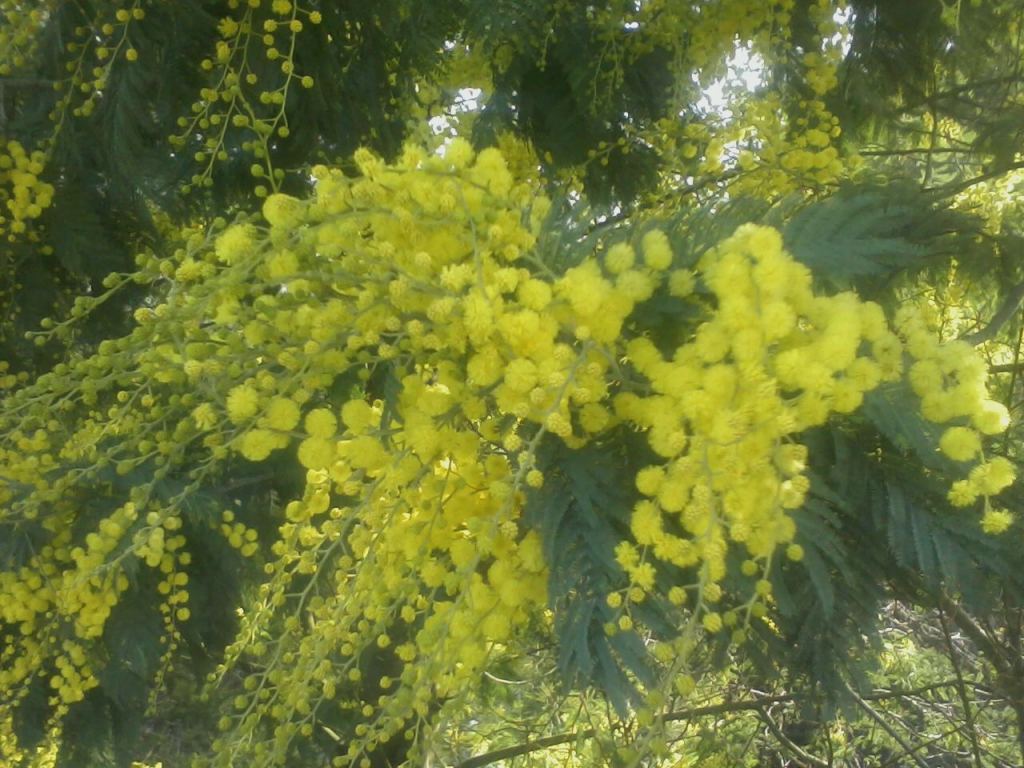
Silver wattle has a weird but effective means with which to clear space for its seedlings.
Why do forests seem to be so peaceful? Perhaps it is because most of what goes on there happens in slow motion . . . very slow motion. It is difficult to see how violent and competitive the various plants are to each other as they grow. Ironically, by bringing the serenity of a forest into our own gardens, we also bring in a certain degree of the natural violence that we are not so aware of.
Vines are some of the nastiest of plants in the forest. Only a few, like bougainvillea, manage to climb to considerable heights by simply leaning harmlessly onto taller trees for support. However, vines like the various ivies and creeping fig, grip tightly to the trunks of the trees that support them. Once such a vine reaches the top of a tree, it develops its own supportive trunk while simultaneously strangling and shading out the tree that supported it.
Some acacias and some willows have figured out how to take out some of their competition simply by clobbering them. For example, Acacia dealbata grows fast and big, but is innately unstable and does not live very long. Old trees invariably fall onto other trees, which clears patches of forest for their own seedlings.
All sorts of cypress, pine and walnut, as well as many eucalypti control their competition by overwhelming seedlings of other plants with foliar debris that leaches herbicidal chemicals into the surrounding soil. Their own seedlings do not seem to mind much, so are able to germinate and grow where space allows.
Monterey cypress, Monterey pine, California fan palm and Mexican fan palm use an even nastier technique, by incinerating their competition during forest fires. They retain as much of their own foliar debris as possible, so that during a forest fire, they burn hot enough to kill other plants and their seeds. Their own seeds though, survive the fire in protective fruiting structures. Monterey pine cones merely get cooked in a fire, and then open to disperse their seed as they begin to cool after a fire.
Like it or not, most gardens include at least some plants that are not as peaceful as they seem to be. Some have the potential to be downright violent. That is why is is important to know how the various plants behave and what they are capable of.
For examples, although bougainvillea can be trained up into arbors and trellises, creeping fig should not be allowed to climb into trees or any structures that might get damaged by its griping and strangling habits. Beards of dead fronds should be pruned from fan palms that are close enough to structures to be hazardous if they burn. Knowing our plants and maintaining them accordingly will promote the sort of harmony that we all want in the garden.
Halloween is the Holiday that I loathe most, for several reasons. Nonetheless, pumpkins that are grown almost exclusively for Halloween, are one of the main crops of Half Moon Bay and the rest of coastal San Mateo County. One of my classmates at Cal Poly was Half Moon Bay Pumpkin Queen of 1985! I am actually rather fond of pumpkin. Where I lived in town, neighbors left pumpkins on my porch after Halloween. They were bright orange but mildly flavored Jack O’ lantern types, but were good enough for me to can enough to last until the next Halloween. Anyway, these six might have been more appropriate prior to last Halloween.
1. Screwball! Seriously, what is this? I did not grow this orange. I have no idea how it got impaled by all those screws. I just found it here. It resembles a character of ‘HellRaiser’.
2. Skeletal remains of trees that were burned by the CZU Fire, which I happened to write about on Halloween last year, were likely Douglas fir. They look like the Haunted Forest.
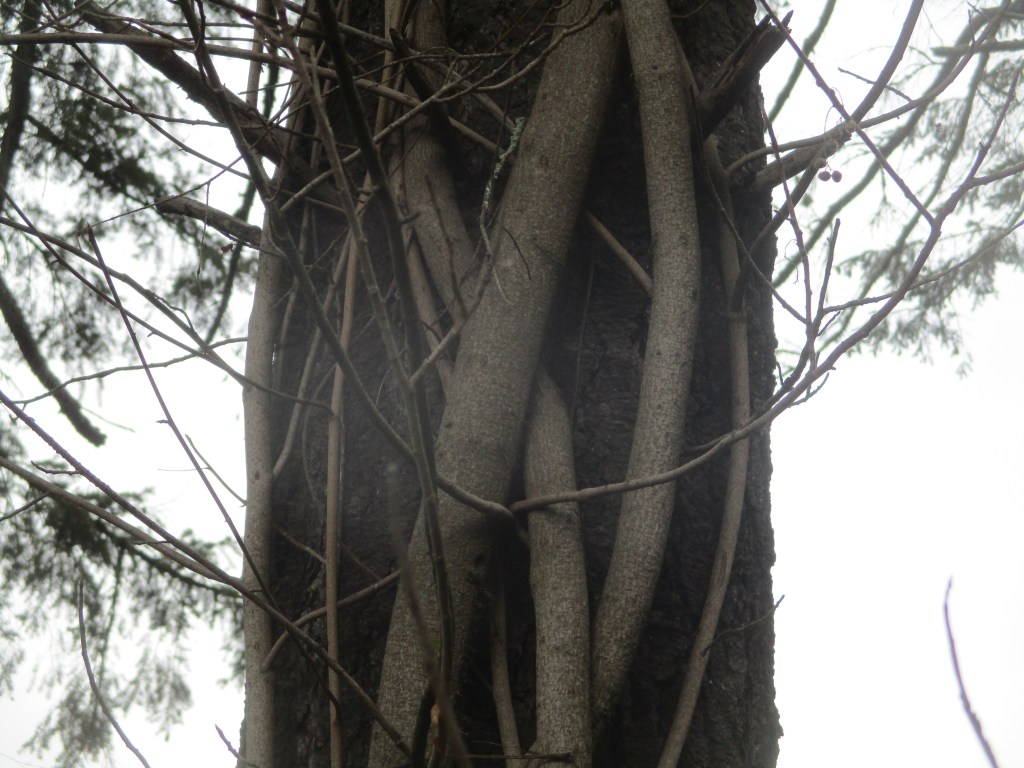
3. Poison oak is a nasty species in all regards. Not only are most people very allergic to it dermally, but it looks evil also! These vines look like they want to strangle their support.
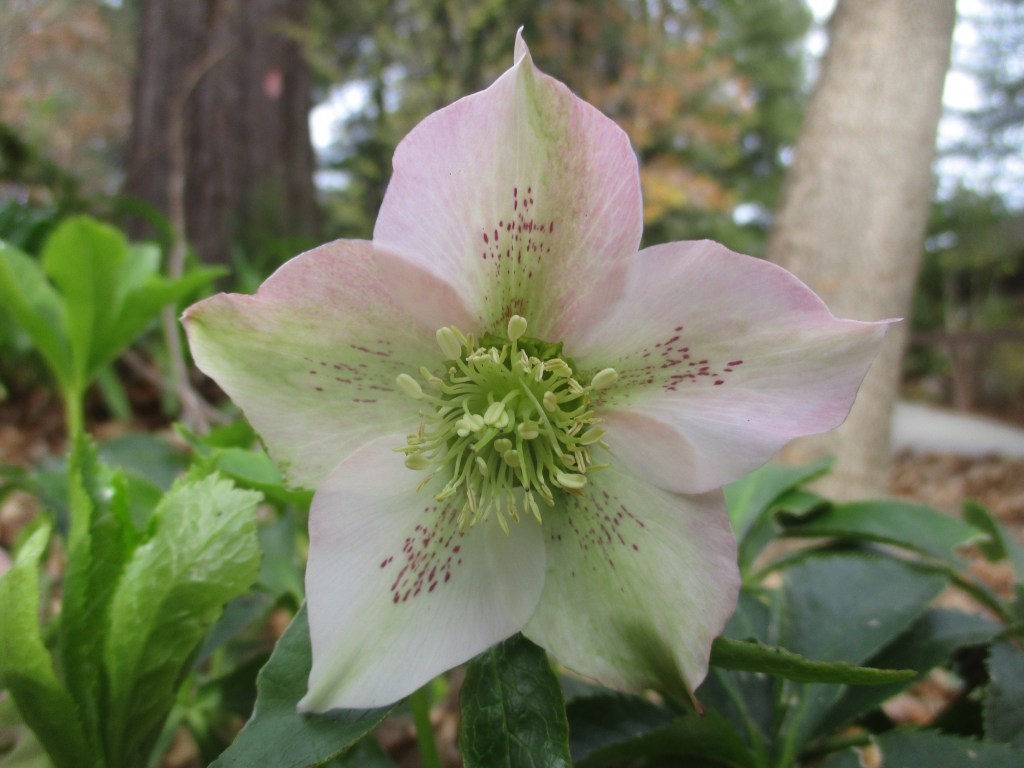
4. Hellebore does not perform well here. Perhaps it might perform better if it were bored in . . . someplace else. This is likely my favorite since it is white; but such a ghastly white.
5. Ignore the diminutive werewolf to the lower left, and the background flora too. Notice the bridge above instead, and the bright orange horticultural oddity in the middle below.
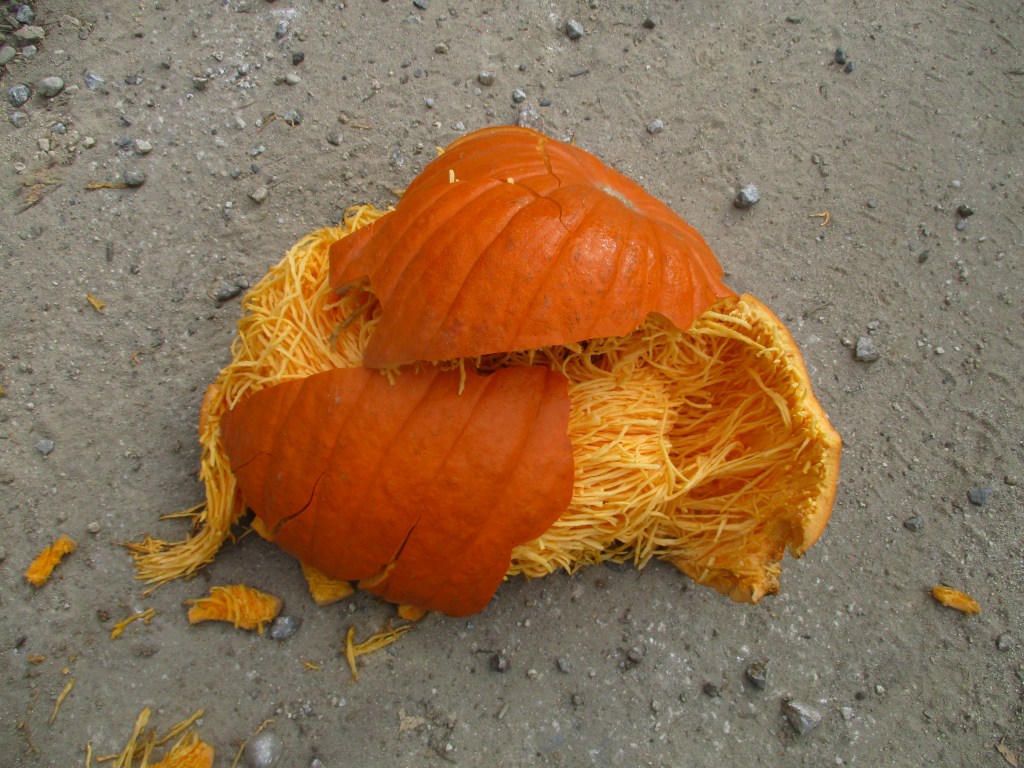
6. Pumpkins are squash. This one demonstrated that characteristic splendidly. Now that Halloween was a month and a half ago, most go to waste. At least this one had some fun.
This is the link for Six on Saturday, for anyone else who would like to participate:
Even as autumn weather cools, smoke rising from a simple old fashioned brick chimney is a rare sight nowadays. A smoking stovepipe is rarer. Modern building codes forbid the installation of new fireplaces or wood stoves within most municipalities here. Modern air quality ordinances severely limit the use of existing fireplaces and wood burning stoves.
Furthermore, existing fireplaces and wood stoves are neither as popular nor as common as they had been. After an earthquake, a faulty chimney is likely to justify removal rather than repair. An unused wood stove wastes too much space. Old orchards that generated inexpensive firewood as they relinquished their space to urban development are extinct.
There are a few advantages to these modern trends though. Modern homes consume so much less energy for heating than older homes because of efficient insulation. Insulation of older homes retains heat that fireplaces generate, so that less wood is needed. Almost every surviving chimney has a spark arrestor. Modern roof materials are noncombustible.
Nonetheless, vegetation that gets too near to a chimney that is in use can be hazardous. Even if clearance was adequate last winter, trees, vines and large shrubbery grew since then. It does not take long for such vegetation to overwhelm a chimney, or encroach a bit more than it should. It does not take too much vegetation to be hazardously combustible.
Clinging vines like English ivy and Boston ivy sometimes climb up and then over the top of a chimney. Although not especially combustible, they will burn directly over a fireplace or wood stove. Just like gutters do, vines can accumulate leaves that fall from deciduous trees to become more combustible. Birds or rodents can build combustible nests in them.
Evergreen trees and big shrubbery are similarly combustible over a chimney. Deciduous trees are generally not as hazardous. Conversely, cypress, pine, cedar, eucalyptus, large junipers, and ungroomed palms are very combustible. Eucalyptus foliage will burn while fresh, if it gets hot enough. The other trees tend to accumulate very combustible detritus.
“It’s not nice to fool Mother Nature.” That old margarine commercial was lame back in the 1970s, but the quote is so true. Inadvertent interference with the natural process of wildfires has unfortunately increased the combustibility of the flora of forests and wildlands throughout California. No one really meant to interfere with the process. It is just what happens when we need to protect our homes and properties from fire.
The longer the vegetation is deprived of fire, the more overgrown and combustible it becomes. If deprived of fire long enough, many plants start to succumb to insect infestation and disease, and they become more combustible as they deteriorate and die. To make matters worse, so many of the exotic (non-native) plants that have been introduced into California are just as combustible, and some are even more combustible than native flora!
Combustibility is certainly no accident on their part. It…
1. Ash regularly reminds us of how close the fire got. There is not as much as there was two weeks ago, but it still lingers in sheltered spots and on sticky foliage. At least no new ash is falling.
2. Smog also lingered early in the week. The sun looked like one of the moons of Tatooine. I worked inside for the early part of the week. It was not a good time for working out in the garden.
3. Then, this happened. The entire sky was this color for a while. The air still tastes like smoke, and remains rather toxic. It is a bit hazier now. Regardless, it was easier to resume gardening.
4. The redwoods and firs on the ridge in the background behind the utility pole are just outside of the fire zone. Everything beyond them is within the fire zone. The forest does not look very different from how it looked prior to the fire. Only a few brown spots can be seen from here. The fire must have burned only underbrush in this region. I know it was much worse elsewhere.
5. Horticulture is SERIOUS business here. (Actually, this is just parking for a cabin that happens to be named ‘Acorn’.) Vegetation management is a priority at cabins that are now residences for some who lost their homes to the CZU Lightning Complex Fires. The Conference Center has been closed because of the other ‘situation’ anyway. Firefighters stayed in some of the lodges.
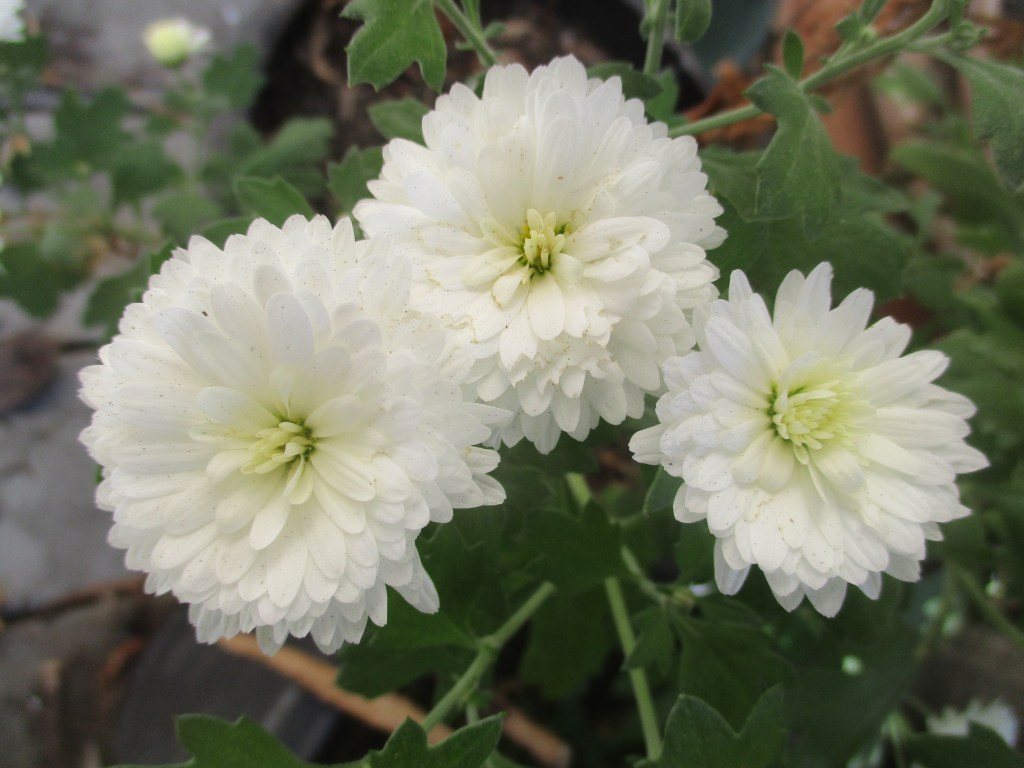
6. White chrysanthemums are in order. After, all this ‘should’ be a gardening blog. These bloomed on old plants that were left behind after a wedding in the chapel here more than a year ago.
This is the link for Six on Saturday, for anyone else who would like to participate:









 “It’s not nice to fool Mother Nature.” That old margarine commercial was lame back in the 1970s, but the quote is so true. Inadvertent interference with the natural process of wildfires has unfortunately increased the combustibility of the flora of forests and wildlands throughout California. No one really meant to interfere with the process. It is just what happens when we need to protect our homes and properties from fire.


 Tony Tomeo