Genesis 1: 11-12 describes the creation of all vegetation and the beginning of horticulture on the Third Day of Creation. Those must have been such happy times. Nowadays, it is getting to be more like the Book of Revelation! During this time of pestilence, while smoke obscures the sun, moon and stars, I have been contending with locusts. The premature defoliation of box elders that I mentioned last week (supposedly) might be associated with diminishment of sunlight by so much smoke.
1. Gloves which seem to have been worn for the Battle of Armageddon were my primary defense against the hellacious swarms of locusts that have been tormenting us for more than a year.

2. Thorns of black locust, Robinia pseudoacacia, are nasty! They are paired like the horns of Satan! The thorns are modified stipules, so are actually neither thorns nor spines, but ‘prickles’.

3. Swarms of locusts are more numerous this year because more mature locust trees were cut down last November, leaving more stumps and many more roots of the not quite so deceased.

4. Smoke and fog filled the sky with old fashioned smog before the sun rose on Wednesday. (‘Smog’ is an abbreviation of ‘smoke’ and ‘fog’.) Not much is from the CZU Lightning Complex Fire.

5. Smoke was so dark at noon that street lamps and this porch light came on. That is a big coast live oak in the middle, with a California buckeye to the left and a coastal redwood to the right.

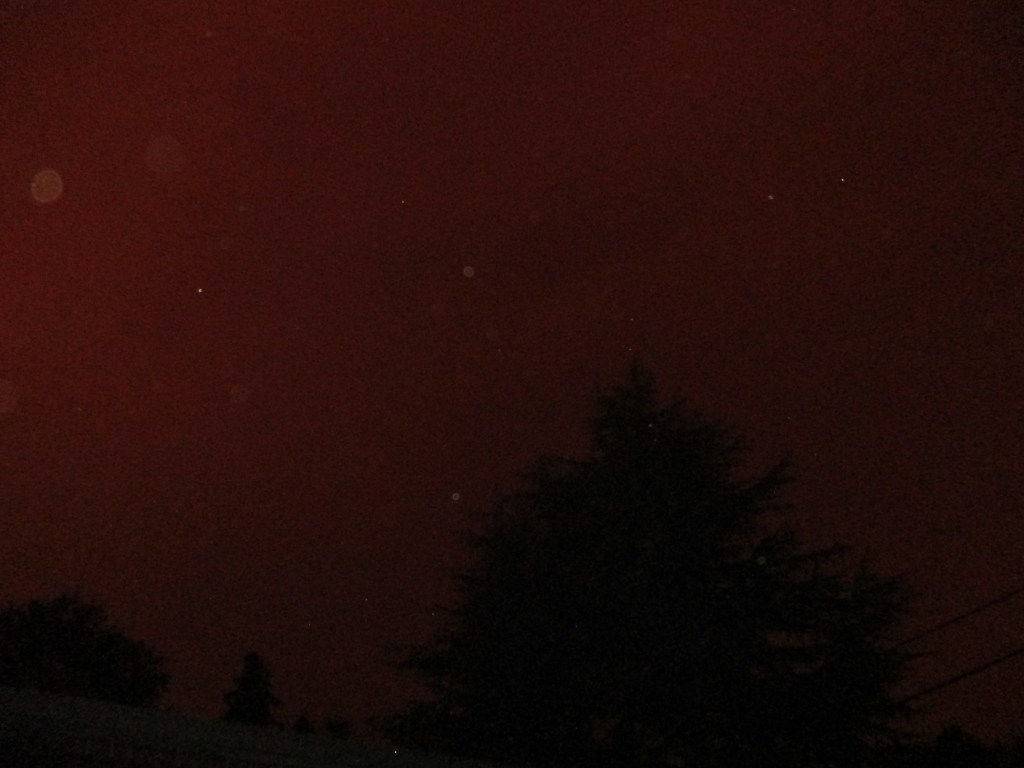
6. That was not the worst of it. It was so dark by 4:00 that I needed headlights to drive back. Those are deodar cedar to the right, a cottonwood to the left, and a coastal redwood in between.
This is the link for Six on Saturday, for anyone else who would like to participate:
https://thepropagatorblog.wordpress.com/2017/09/18/six-on-saturday-a-participant-guide/


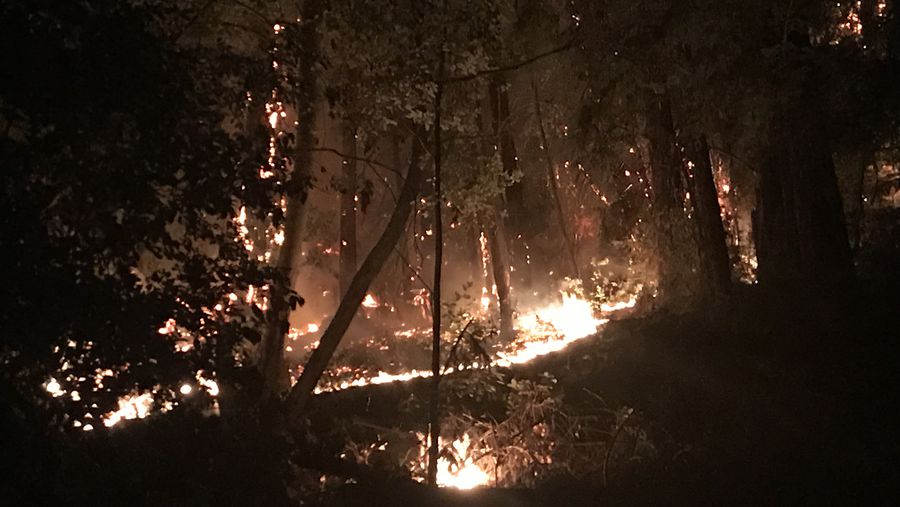
 Warnings were broadcast in local news for a few days prior. Because of the extreme potential for catastrophic forest fires, electrical service was to be disabled to our region, and large areas of California. Weather was predicted to be warm, windy and dry (with minimal humidity). Such conditions are exactly what cause fires to spread so explosively through the overgrown forests.
 Because redwoods live for centuries, their bark gets very thick. They do not shed their bark as they grow. Old giant redwoods in the Sierra Nevada have bark that is a few feet thick and thousands of years old. Their bark is thicker than the trunks of what most of us consider to be large trees! Even much younger coastal redwoods that have regenerated here since clear cut harvesting about a century ago have bark that is a few inches thick.
 Plants have very different priorities from those who enjoy growing them. The colors and fragrances of flowers that we find so appealing are really designed to guide pollinators. The appealingly aromatic foliage of scented geranium and other herbs is actually designed to repel hungry insects and animals. Many tasty fruits are designed for seed dispersion by animals who enjoy them too.
 For those who do not remember what ‘rain’ is, it is, it is those odd drops of water that fall so mysteriously from the sky in other regions. We get it here too, just very rarely, and almost exclusively within a limited season centered around winter. Rain tends to be affiliated with storms. The last storm moved through here last spring.




 Tony Tomeo