 Fire has always been a part of life in most of California. That is why almost all native flora benefits from it, and has developed an efficient system and schedule for not only living with it, but exploiting it.
Within a few years after a fire, the pioneer species are the first to regenerate. They are aggressive, but short lived. Some are annuals. Others are trees that grow fast and then die out as the slower growing but longer lived trees dominate. Some of the longer lived trees might have been there all along, since they have developed ways of surviving fire.
Big valley oaks and coast live oaks that live out in the open away from other forest trees can survive for centuries because the grasses around them burn off fast and relatively harmlessly. Giant redwoods and some pines survive by standing high above the more combustible fuel below. Coastal redwood survives for centuries by being less combustible than other species. Desert fan palms protect their single terminal buds inside their massive non combustible trunks, while their beards of old dead foliage burns hot enough to incinerate competing species. There are too many ingenious ways that plants survive fire and even use it to their advantage to write about; but the point is that they know what they are doing, and they know how to live with fire.
This system of ecology has been disrupted, but not just by people cutting down too many trees and starting too many fires. The problem now is that not enough trees are getting cut down, and fires are unable to burn that which relies on burning.
In this region, pioneer species and an unnatural mix of forest trees moved in where the redwoods were harvested. This makes what had been less combustible redwood forest more combustible than it naturally is. It will take centuries for the redwoods to reclaim their territory and crowd out more of the hardwood trees. Also, because the redwoods regenerate with many trunks from each individual trunk that was harvested, even the redwoods are more crowded and combustible than they would naturally be. While they are still relatively young, their foliar canopies are low and intermingled with the other more combustible trees. It is certainly not possible to cut down enough trees to repair the damage, but protecting too many of the wrong trees and outlawing selective harvest of second growth redwood only promotes combustibility of the local forests.
Other forests, whether formerly harvested or not, experience similar problems. Because they are not burning as frequently as they used to, they are not being regularly purged and restored, but are instead becoming more crowded and combustible than they would naturally be. Diseases and pathogens are proliferating in the geriatric vegetation, and vegetation that succumbs provide more fuel, which also enhances combustibility.
Although there are many (MANY) more fires that are started by human activity now than there ever was naturally, such fires can not burn the vast areas that naturally occurring fires had naturally burned. There are just too many of us living and working here. Forests that are deprived of fire continue to proliferate more combustible biomass. Again, there is no remedy to this. Fires must be controlled and confined as much as possible.
Paradise is gone now. It burned on Thursday. Our region more than two hundred miles to the south is gray with abundant smoke from the Camp Fire that continues to burn there. Two other major fires burn in Ventura and Los Angeles Counties, more than three hundred miles to the south of here. Paradise Park just to the south of here was protected from the much smaller Rincon Fire that filled the Valley with harsh smoke for days after it was contained. Sadly, for this region, this is all part of nature.
I do not remember on what days these pictures were taken. The first picture at the top was taken toward the sunrise, just prior to sunrise. The second picture above was taken later after noon, probably on the same day. The two pictures below were taken in the evening, perhaps on the day after. 
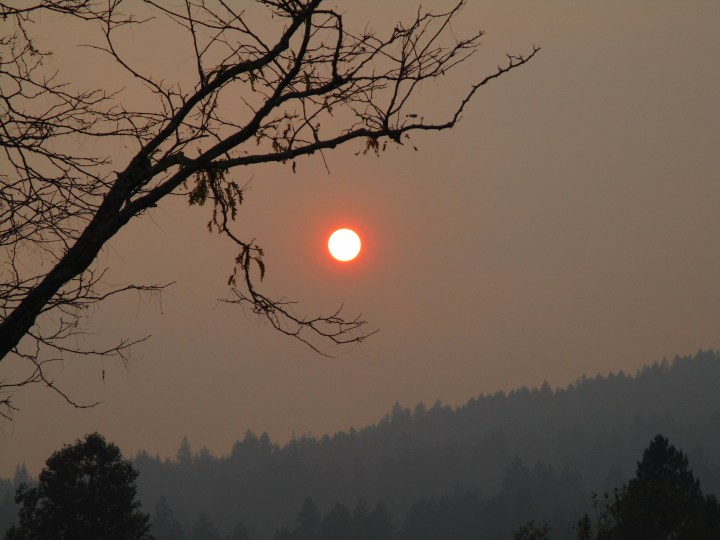
 The response to the brief article that I wrote about the smoke from a small and localized wildfire on Sunday is not easy to dismiss. The original article is at
  What a surprise. There was none when I went in to use the computer as the sun came up into a clear blue sky this morning. When I came outside just a few hours later, it was everywhere. It was so thick and so aromatic that it was obviously very close, but it did not smell like it was in the ponderosa pines around Scott’s Valley where I happened to be at the time. Once I got on the road back to Felton, I could see that besides the monochromatic ambient smoke that obscured the surrounding hills, a prominent and much thicker brown cloud of smoke hovered low over the San Lorenzo Valley. The smoke was even thicker in Felton, and obscures the range to the west where Bonny Doon is. As I write this in Felton Covered Bridge Park, ash is falling onto the computer screen.
 “It’s not nice to fool Mother Nature.” That old margarine commercial was lame back in the 1970s, but the quote is so true. Inadvertent interference with the natural process of wildfires has unfortunately increased the combustibility of the flora of forests and wildlands throughout California. No one really meant to interfere with the process. It is just what happens when we need to protect our homes and properties from fire.
 Tony Tomeo