A Few Favorite Cut Flowers

Try unconventional cut flowers if you can.

Flowers add such variety of color and fragrance to the garden that it is no wonder that they are so popularly cut and brought from the garden into the home. Even though larger quantities of flowers can be purchased from markets or florists without depleting those blooming in the garden, growing our own can be so much more rewarding. We may not be able to grow all the varieties of flowers that commercial growers can grow in greenhouses or other climates, but we can grow many other varieties of flowers that commercial flower growers do not provide.

Many flowers can be grown specifically for cutting, like vegetables are grown to be harvested. Some, like cosmos and daisies, can be grown in such abundance in mass plantings that it is easy to cut a few without anyone missing them. Other flowers, like roses and New Zealand tea tree, are merely by-products of plants that also function as shrubs, vines, trees and even ground covers.

Peruvian lilies are some of the best cut flowers, not only because they last so long after getting cut, but also because they bloom so much through such a long season that there are usually enough flowers for the garden as well as the home. The taller and unfortunately rare types grown by commercial flower growers are better for cutting than the more common ‘garden varieties’ are.

Callas are likewise among the better prolific cut flowers, but only bloom white. The colored types are neither as prolific nor as reliable. Believe it or not, lily-of-the-Nile makes good cut flowers when they bloom white or blue in the middle of summer. They are just awkward because their blooms are so round.

Gladioli are good either as cut flowers or for color in the garden, but unless they are planted in large quantities, they are not prolific enough for both. Like vegetables, they can be planted in phases (in season) to prolong the bloom season. Unfortunately, they need to be planted annually because they do not often naturalize. Those that do naturalize will synchronize their bloom season after the first season.

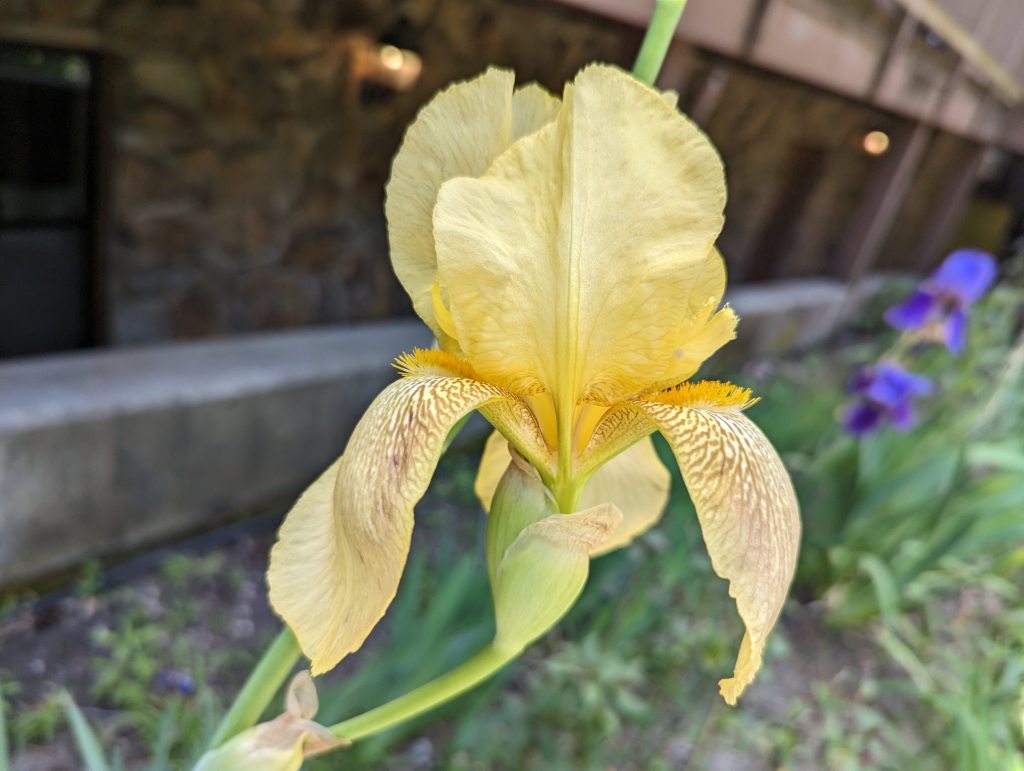
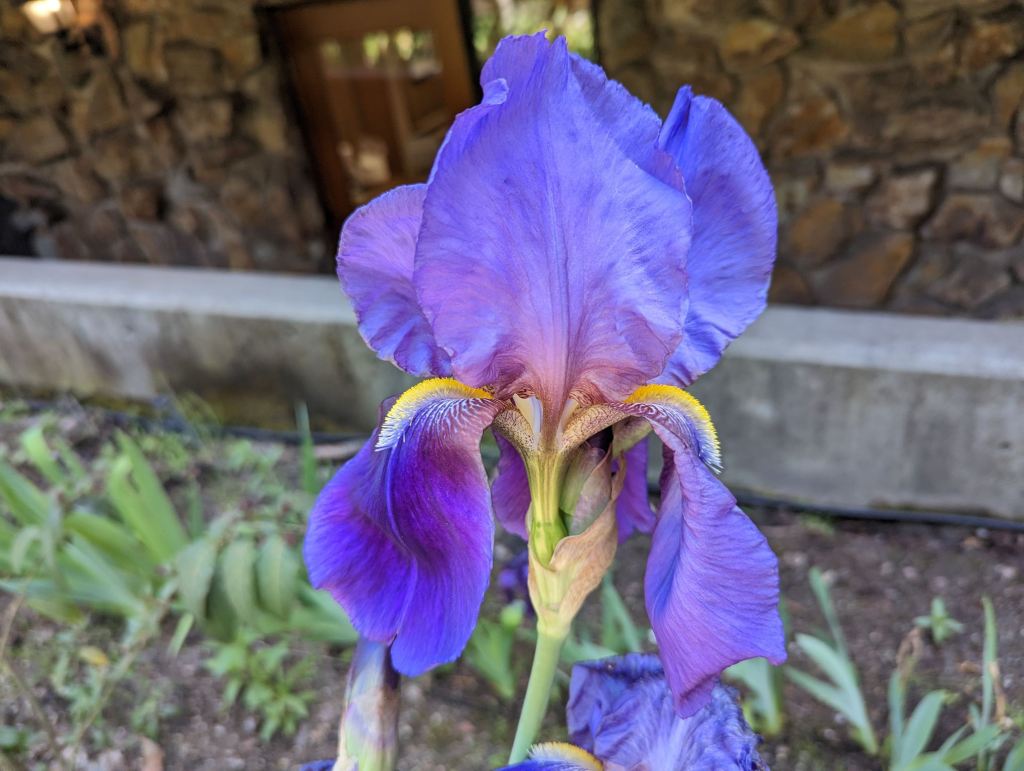
Several types of iris bloom more generously, and some are happy to naturalize, but only a few types are good cut flowers like Dutch iris are. Some bearded iris wilt within hours of getting cut.

Gazania

Gazania is colorful until cool autumn weather.

The most familiar of the gazanias are the ‘trailing’ types commonly appreciated as ground cover. They are rather shallow, but dense enough to prevent most weeds from getting through. Their yellow or orange composite (daisy like) flowers bloom initially in spring, and then continue to bloom sporadically as long as the weather stays warm into autumn. Some trailing gazanias have interesting silvery foliage.

‘Clumping’ gazanias do not spread efficiently or thoroughly enough to be practical as ground cover over large areas, but bloom a bit more profusely with bigger flowers in shades of yellowish white, light yellow, bright yellow, orange, brownish orange and brownish red. The foliage gets a bit deeper to form irregular but dense low mounds. Clumping gazanias can be lined up as an informal border around blooming annuals or perennials, or incorporated individually into mixed urns or vertical gardens.

Gazanias are not too discriminating about soil quality or frequency of irrigation. They only need good sun exposure. Trailing gazanias are rather easy to propagate by cuttings made from scraps from pruning around the edges. Clumping gazanias do not get pruned as much, but are easy to propagate by division from dense clumps.

FLORAL FRAGRANCE IN THE GARDEN

The most fragrant flowers are generally smaller and less colorful than less fragrant flowers. This angel’s trumpet is an exception.

Attracting pollinators is serious business for flowers that do not rely exclusively on wind for dispersion of their pollen. Many flowers attract pollinators with flashy color. Some reward their pollinators with sweet nectar. Many prefer to use fragrance. Most flowers use a combination of two or more of these tactics.

Fragrances are designed by the flowers that use them to appeal to the discriminating taste of specific pollinators. Most are sweet. Some are more perfumed. A few are even quite objectionable to people because they are tailored to flies. Fortunately, flowers with foul fragrances are rare in gardening.

The most fragrant flowers are often less abundant than flowers that rely on wind for dispersion of their pollen, or less colorful than flowers that rely on visual appeal to attract pollinators. Yet, the fragrant flowers of wisteria vines and lilacs are both profuse and colorful. The surprisingly big and fragrant flowers of ‘Charles Grimaldi’ angel’s trumpet are bright yellow.

Mock orange (Philadelphus spp.) conforms to the stereotype of fragrant flowers a little bit better, with somewhat small white flowers that are incredibly fragrant. The small pale pink flowers of daphne are even less impressive and nearly hidden among their foliage, even though their fragrance can not be ignored. The sweetly fragrant flowers of Japanese honeysuckle vines are abundant but not too colorful. Star jasmine vines likewise bloom fragrantly and abundantly, and their bright white flowers contrast better against their glossy green foliage.

Night blooming jasmine is not appealing enough for prominent placement, and is not even fragrant during the day, but will be unbelievably fragrant on warm summer nights. Just as fragrances appeal to specific pollinators, nocturnally fragrant flowers specifically appeal to insects or bats who are active at night.

Freesia, hyacinth, lily,narcissus and some types of iris are very fragrant as well as colorful now that they are blooming for early spring. It is unfortunate that their flowers do not last long, and that there are not any comparable flowers later in the year. The same annual sweet peas and stock that bloom about now can be planted again later for autumn bloom. Sweet peas are easiest to grow from seed. Stock is easiest to grow from cell packs, and since it is actually perennial, sheltered plants can survives through warm summer weather to bloom again in autumn. Annual sweet alyssum can bloom anytime while the weather is warm.

Camellia

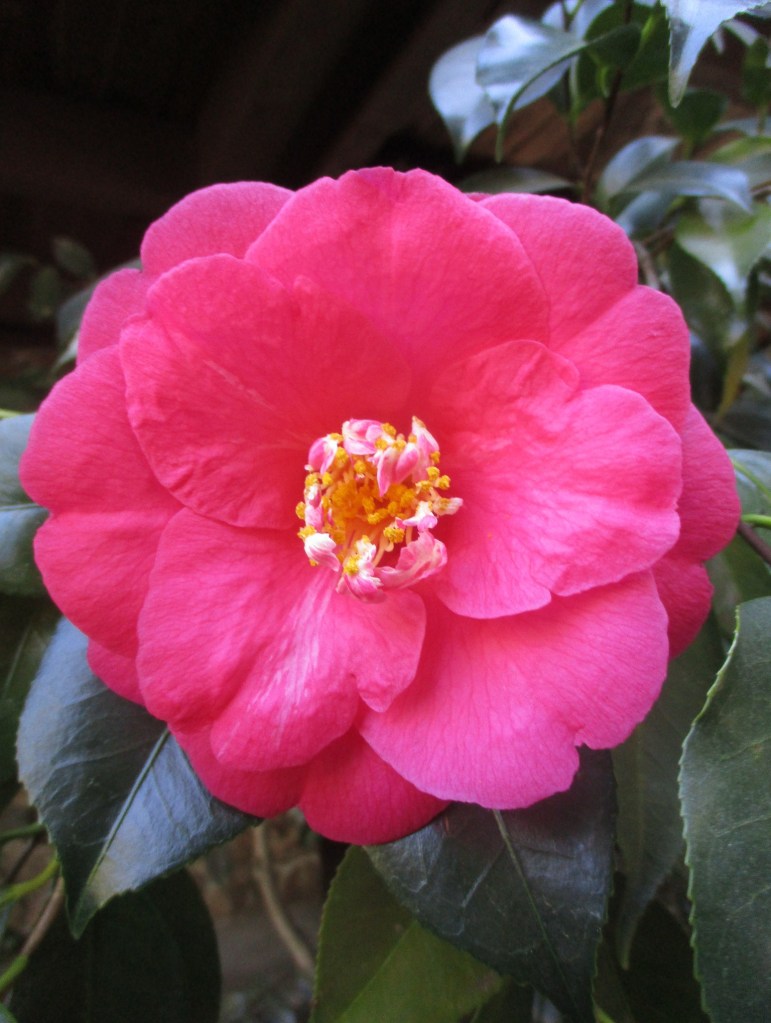
Many camellias have already finished bloom.

While other bloom might be lacking through late winter, camellia, Camellia japonica, can help compensate. Although generally not as profuse as spring and summer bloomers, its individual flowers display elegantly against luxuriantly glossy evergreen foliage. Lack of sturdy stems for cutting is no problem for a few flowers simply floating in a shallow bowl.

Centuries of breeding has produced more than two thousand cultivars of camellia. Floral form can be single, semi-double, double, formal double, paeony, anemone or rose, so is quite variable. Floral color ranges from pure white to deep red, with many hues of pink in between. Stripes, speckles, blotches or picotee margins are within the same color range. 

Camellia generally develops as nicely dense shrubbery that stays lower than the eaves. Some cultivars stay even lower. A few slowly mature as small and perhaps sparse trees. Individual flowers are about three inches wide. Some are smaller. A few are comparably bulky. Camellia sasanqua is a separate species with smaller but more abundant flowers.

Ranunculus

These potted ranunculus in a nursery are already blooming. Those planted while dormant last autumn may not have started yet.

If their dormant bulbs were planted back in October or November, ranunculus will soon be blooming. Those of us who missed the bulbs last autumn can already find blooming plants in nurseries. The bright yellow, orange, red, pink or white flowers are about three inches wide and seem to be outfitted with too many petals. They stand about a foot to a foot and a half tall, a few inches above the basal foliage that can get half a foot to a foot deep. The light green leaves resemble parsley, but are not as finely textured. Although perennial, ranunculus are most popularly grown as annuals because they tend to rot soon after bloom. They perform best with no more than a bit of shade, and rich but very well drained soil. They are more likely to survive as perennials if allowed to get rather dry as their foliage deteriorates after bloom.

Stock

Stock happens to excel at purpleness.

This is one of those annuals that could be a short term perennial if it gets the opportunity to do so. In most climates, stock, Matthiola incana, is a popular warm season annual that relinquishes its space to cool season annuals before it gets too worn in autumn. Locally, because it does not mind mild frost, it is more popular as a cool season annual for winter.  

Floral color ranges through both pale and rich pastels of purple, red, pink, yellow, cream and also pure white. Flowers may be single or double. In close proximity, bloom is richly fragrant. Foliage is light grayish green. Individual leaves are somewhat narrow. Removal of deteriorating floral stalks before they develop seed pods prolongs subsequent bloom.

Many garden varieties of stock stay relatively low and compact. Some may get no higher than a foot. Florist varieties that produce long stems for cutting might get as high as three feet. Overgrown plants get shabby after a primary season, but may regenerate from hard pruning. However, secondary growth is generally irregular and likely marginally reliable.

Tropical Hibiscus

This tropical hibiscus was found in Oklahoma, where it needs shelter from frost.

This humongous six inch wide tropical hibiscus, Hibiscus rosa-sinensis, looks like it might be from Hawaii or Florida, but was actually found in K and K Nursery and Landscape of Norman, just south of Oklahoma City, where winter nights are already seriously cold by our coastal California standards. It is happy to bloom so impressively only because it is in a greenhouse. Even here in our pleasantly mild climates, tropical hibiscus are happiest where sheltered above from frost, by eaves or evergreen shade trees that are high enough to also allow warming sunlight through. In the cooler spots, even sheltered plants occasionally get damaged by frost, and need some time to regenerate after winter.

Some of the classic tropical hibiscus that typically have smaller flowers can grow above single story eaves if not pruned down. Most modern varieties with larger or ruffly double flowers rarely reach the eaves, and many stay less than six feet tall even without pruning. The evergreen foliage has an appealing glossy sheen, which is an ideal backdrop for the red, pink, white, yellow or orange flowers.

Six on Saturday: WHITE

White is my favorite color! It always has been, long before it became a fad and a trendy coffee table book in the early 1990s. I do not care that it has become politically incorrect since then. Nor am I concerned with what Brent has to say about it. (He has not valued my opinion since 1986 anyway.) I realize that he is the famous landscape designer, and I am not, but I also know what I like in my own garden. I am quite pleased that there are so many white flowers at work, and even an exclusively white garden, at el Catedral de Santa Clara de Los Gatos!

1. Pelargonium X hortorum, the white zonal geranium at el Catedral de Santa Clara de Los Gatos, is blooming with smaller floral trusses because the weather is getting cooer through autumn.

2. Dianthus deltoides has the unappealing common name of ‘pink’, likely because most varieties bloom pink. Some bloom red. This is one of the best because it blooms so perfectly clear white.

3. Hydrangea macrophylla should be at el Catedral de Santa Clara de Los Gatos instead of the other ‘white’ hydrangeas that were relocated there last winter before deciding to bloom lavender.

4. Camellia sasanqua is blooming impressively well for the shade that it lives in. I do not remember the name of this cultivar. It might be a hybrid of Camellia sasanqua and Camellia japonica.

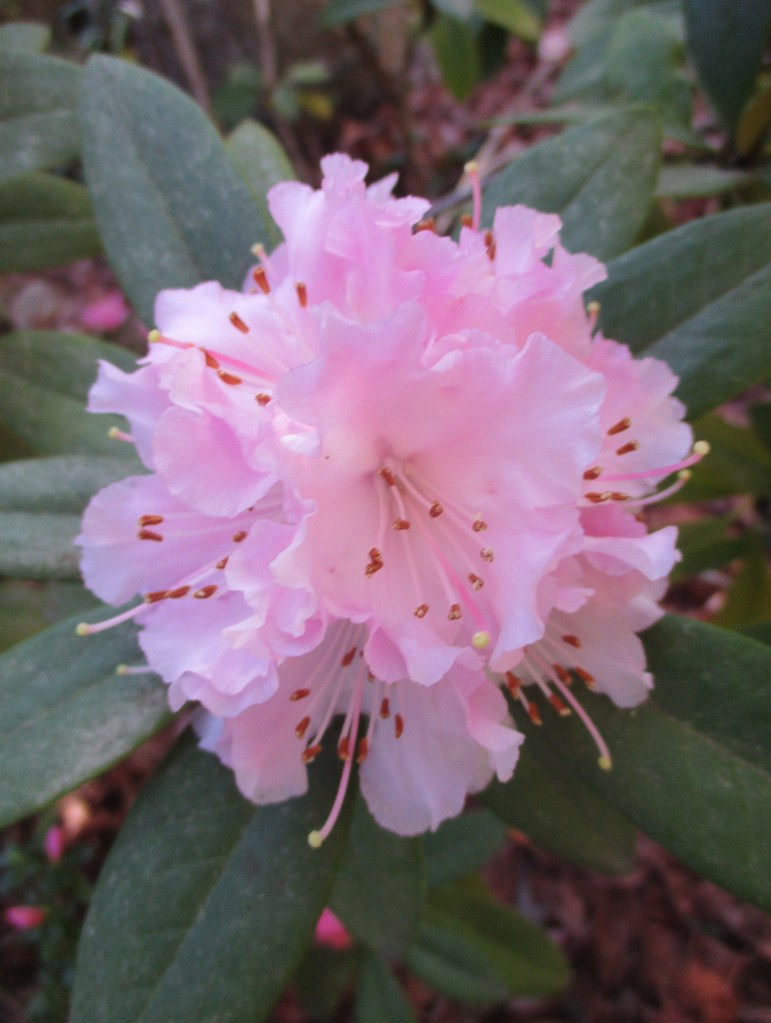
5. Rhododendron such as this are known as ‘azalea’. (There is no picture of Rhody.) This and ‘Coral Bells’ bloom about now, but not while the others bloom so abundantly at the end of winter.

6. Betula pendula is an old fashioned tree that still works well here. White trunks are striking among the dark green redwoods. We dig and can their seedlings to eventually replace aging trees.

This is the link for Six on Saturday, for anyone else who would like to participate:

Dried Floral Material Worth Recycling

Yucca bloom produces interesting floral stalks.

Gardens might be colorful throughout the year here. There is not much time between the latest of the autumn flowers and the earliest of the spring flowers. Winter flowers are glad to compensate for the lapse. Of course, there are plenty of flowers in spring and summer. Nonetheless, dried flowers are more popular now that there are fewer flowers for cutting.

The quantity of flowers blooming within a particular season might not be proportionate to the quantity of flowers available for cutting. Flowers that bloom through winter, even if as abundant as spring or summer flowers, do not develop as fast. Harvesting too many bird of Paradise flowers depletes the limited supply before something else can replace them.

Deciduous foliage that provides spectacular color through autumn is no substitute for cut flowers. Nor is the majority of colorful bark that becomes more prominent through winter. Some colorful berries can function like cut flowers, but only if there are plenty to spare in the garden. Conventional dried flowers that grew last summer may be useful about now.

For the venturesome and resourceful, unconventional dried flowers and other dried plant parts can also be fun. Such items, unlike statice, straw flower, lavender and other familiar dried flowers, might be byproducts of gardening. They might be derived from detritus that should otherwise go to compost or greenwaste. Some might even be products of weeds!

Pampas grass, both garden varieties and the invasively naturalized type, produces bold blooms that dry quite well. Because the leaves can cause such nasty paper cuts, flowers might be easier to harvest from a distance, with a pole pruner. Hair spray can contain the fuzz, so that it does not disperse indoors. Cat tails, if still intact, are compatible with them. 

Floral stems of lily of the Nile, New Zealand flax, and some species of Yucca are striking even after bloom. After deadheading, they can become flowerless dried flowers. Fruiting structures are no problem to remove. If within reach, some palms may provide distinctive bloom trusses. Floral design can be as imaginative as gardening and landscape design. 

Dried Flowers Last All Year

With proper processing, hydrangea bloom can be dried.

Statice, strawflower and globe thistle continue to bloom later than most other summer annuals, and hold their flowers longer. Even after bloom, the flowers are so stiff and ‘crispy’ that they remain intact and colorful until they succumb to exposure to weather. If cut and brought in from the weather soon enough, they will last as dried flowers at least until fresh flowers start to bloom in the garden next spring.

Strawflower and larger globe thistle tend to wilt and droop from the weight of the bulky flowers, so should be tied in small bunches and hung upside down to dry. Perennial statice (which has larger blooms than annual statice) tends to flop to the ground, but the stems often bend only at the base so that the rest of the stem length stays somewhat straight. Smaller globe thistle and annual statice often dry standing up while still out in the garden.

Yarrow and English lavender can be dried as well, but lose most of their color. Lavender dries naturally in the garden. Yarrow can likewise be allowed to dry in the garden, but probably keeps a bit more color if cut while still fresh and hung upside down. Because yarrow blooms are so wide, they should be hung individually or in small bundles. Queen Anne’s lace has even wider blooms that curl inward as they dry, so they really should be hung individually.

Old hydrangea flowers that are only beginning to fade can dry surprisingly well if cut and hung individually before they deteriorate too much or start to rot. Some varieties retain color better than others. Some fade almost completely to an appealing brown paper bag.

There are not many roses this time of year, but when they do bloom, even they can be cut and dried while beginning to unfurl. Only a few small and tightly budded roses can be dried when completely open. Because they droop right below the blooms, roses should be hung upside down to dry. Dark colored roses get very dark as they dry. White roses turn tan. Pink and yellow are probably the better colors.

Cat-tails and pampas grass flowers are big, bold and dated cut flowers. Yet, for situations where big flowers fit, they are just as practical now as they were in the 1970s. Because pampas grass flowers shed, and cat-tails can explode (to disperse their seed), they should be sprayed with hair spray or another fixative to keep them contained. Pampas grass foliage has dangerously serrate edges that can give nasty paper cuts, so should be handled carefully, and displayed out of the way.