 We may not get much foliar color in autumn here, but we get enough. Sweetgums do not need much cool weather to color well. They would probably have colored better and held their foliage a bit better if the weather got cooler faster, but we can not complain about what we got. Most of the crape myrtles are still completely green. Cottonwoods are defoliating, but without much color. Maples are rare here. The three best trees for color in autumn here are sweetgum, pistache and flowering pear. Of these, we happen to have several sweetgums here.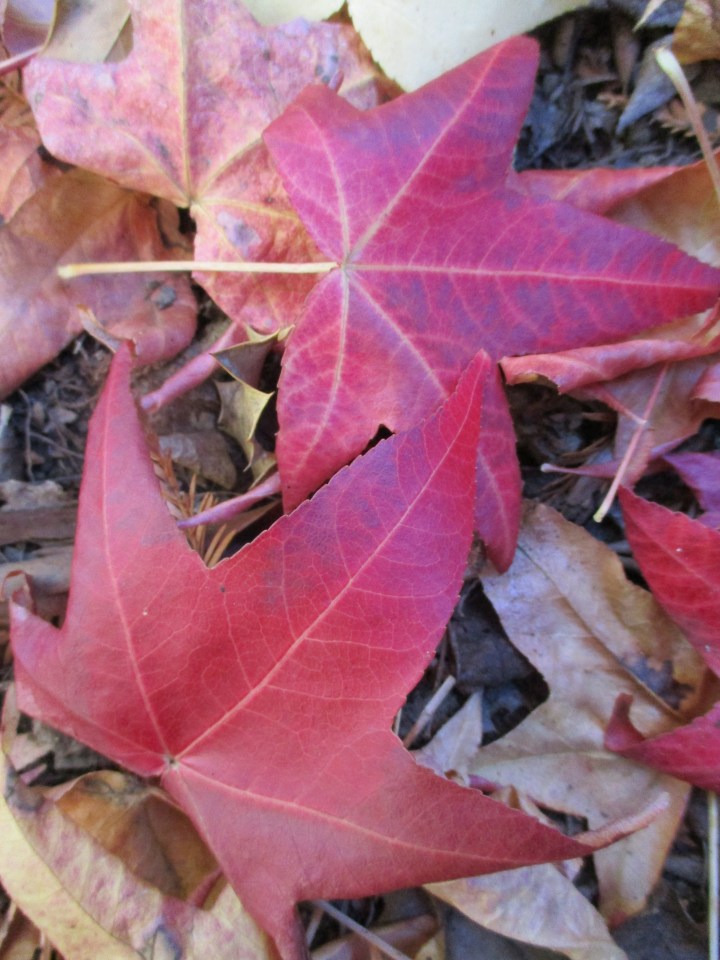
Sweetgum is not the sort of tree that I would recommend for home gardens. They are innately very likely to develop structural deficiency. By the time such problems are identified, they are difficult to correct without disfigurement. Aggressive roots are likely to displace pavement, and sometimes invade septic systems. Then there are all those nasty maces; those hard and prickly round seed pods that stick into lawns and make pavement dangerous to walk on. They are too abundant and heavy to rake away as easily as fallen leaves. There are not enough squirrels in the entire forest to take them all!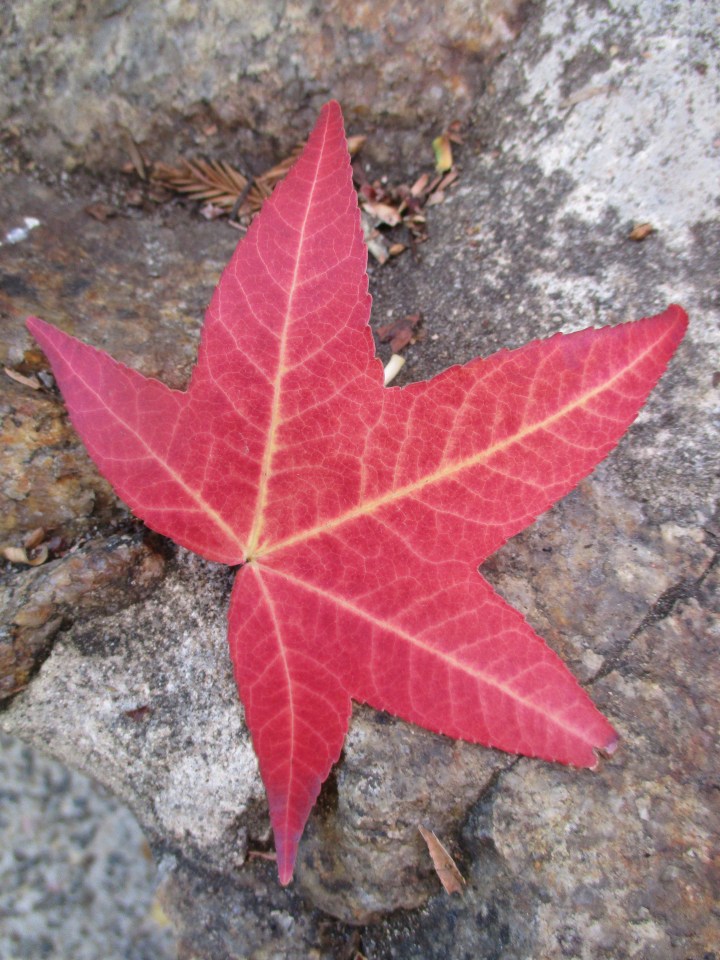
In some of our unrefined forested landscapes, where maces and falling limbs can fall into the forest without damaging anything, and roots can not reach concrete pavement, sweetgums can be allowed to go wild. (Unfortunately, most of ours happen to be near concrete within refined landscapes. That is another story.) Their tall and somewhat conical form happens to work very well with the native redwoods and Douglas firs, which provide the perfect rich green backdrop for their exquisite autumn color. Those of us who do not know better might mistake them for a native species. They look right at home here.
Heavenly Bamboo
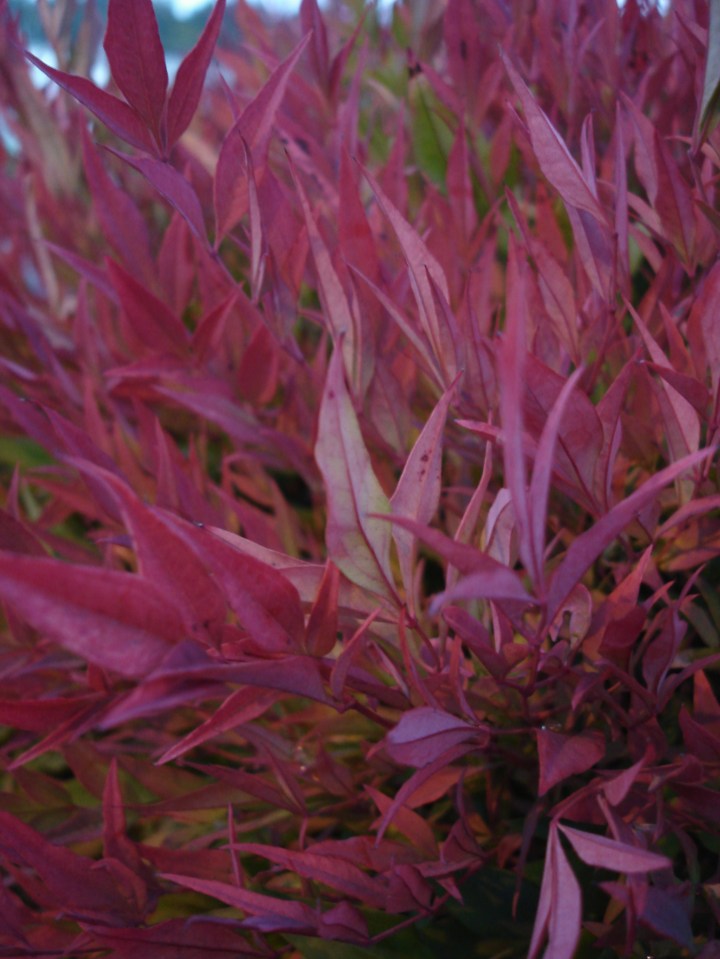 Good old-fashioned Heavenly bamboo, Nandina domestica, which can almost reach the eaves, can be difficult to obtain nowadays. More compact modern cultivars do not get much more than six feet tall, and some stay less than three feet tall. Foliage is airier in partial shade, but more colorful where more exposed.
As it begins to emerge in spring, new foliage is pinkish or reddish before greening. It slowly bronzes by autumn. Some cultivars turn ruddy or orangish, or even burgundy. Individual leaves are actually quite large, but are divided into many small, diamond shaped leaflets. Some cultivars have very narrow leaflets. Tiny white flowers bloom through summer. Bright red berries ripen through autumn.
Although unrelated, Heavenly bamboo grows like bamboo, with vertical canes developing from creeping rhizomes. Overgrown or deteriorating canes should be cut to the ground as they get replaced by newer canes. Otherwise, they become top-heavy and inhibit development of new canes. Foliage should not be shorn, since it is not much to look at without its naturally intricate texture.
Fall For Colors Of Fall
 Mild winter weather on the West Coast limits the choices for autumn color. So many of the trees, shrubs, vines and perennials that get so colorful where autumn weather is cooler do not get so colorful here. Mild weather also allows so many more evergreen plants and plants that do not get colorful in autumn to thrive here than in harsher climates. Consequently, the tougher and more colorful plants are not so common.
Fortunately for those who appreciate autumn color, there are a few choices that do not mind mild weather. The three most reliable trees for autumn color are sweetgum (liquidambar), Chinese pistache and flowering pear. All three turn yellow, orange and red. Maidenhair tree (gingko) is just as reliable, and turns bright yellow, but lacks orange and red. (‘Saratoga’ gingko turns pale yellow.)
If the weather is right, fruitless mulberry, tulip tree, black walnut and the various poplars display clear yellow foliage. Eastern redbud can do the same, but is a small tree. Smoke tree and crape myrtle are large shrubbery or small trees that can get as colorful with yellow, orange and red as Chinese pistache does. Japanese maples have the potential to turn yellow or even orange, but more often turn dingy brown.
Grapevines and wisteria are vines that can be somewhat colorful if they hold their foliage long enough to get noticed. Boston ivy, which is actually more closely related to grapevines than to ivy, is the most colorful of the vines in autumn. Unfortunately, it can be too destructive to paint, wood and whatever else it grabs hold of to be practical for home gardens. It works nicely on indestructible concrete walls.
Heavenly bamboo, which seems to have appealing but distinct foliar color for every season, turns richer shades of reddish bronze through autumn. Some cultivars turn rich brown. Others become more purplish red or burgundy. Unlike other autumn foliage that sooner or later falls through winter, heavenly bamboo is evergreen, so hold its color until it get replaced by another color in spring. Unfortunately, there are not many other evergreens that turn color in such mild weather.
Leaves Are Starting To Fall
 Autumn is slow in getting here. Yes, as of last Sunday, it is now autumn. The date is determined by the equinox, so is the same for everyone in the Northern Hemisphere, and is the same for the arrival of spring in the Southern Hemisphere. It just takes a bit longer for autumn weather to develop in the mild climate here. Nights are cooler. Shorter days are not as warm as they had been.
Even without the pretty foliar color that cooling weather prompts in other regions, deciduous foliage is already beginning to fall. Poplars, willows and some other trees that a naturally endemic to riparian environments are the first to start. Some are actually developing a slight bit of color, mostly soft yellow. More colorful foliage needs cooler weather, so will develop as weather gets cooler.
Sooner or later, falling leaves will need to be raked from lawns and groundcover. Trees that drop their leaves for a long time through autumn and into winter necessitate more frequent raking, even if their leaves do not accumulate enough to do much damage. Trees that drop their leaves within a shorter season can quickly drop enough to shade out turf or groundcover, or cause them to rot.
Because fallen leaves can stain hardscape surfaces, they should be raked efficiently from pavement and decking as well. Those of us who do not mind the staining, or even appreciate its rustic patina, might leave some of the fallen foliage out for a while, but should not leave it out long enough to promote rot in decking. Some leaves cause staining quite quickly, especially if wet from rain.
If leaves need to be raked from the garden and pavement, they probably need to be cleaned from roof gutters and anywhere else they accumulate on roofs. Just like raking, the clearing of fallen leaves from gutters and roofs is scheduled around the timing of the falling leaves, although it is not nearly as frequent. It may even be unnecessary if trees are too far from roofs for their leaves to fall or be blown onto them. Leaves that stay in gutters too long eventually decompose and clog downspouts.
Early Autumn Color Might Disappoint
 It might seem like autumn color is a bit early this year. In the wild, where there is no irrigation, native box elders, and maybe some of the cottonwoods and sycamores, are already yellowing. The box elders are already dropping some of their foliage. However, this is not caused by an early chill. It is caused by late warmth after an otherwise mild summer, and might inhibit better color later.
It is still impossible to say for certain. There are so many variables that affect autumn color, such as temperature, humidity and daylength. Some of the plants that develop color late, like flowering pear trees in irrigated landscapes, might not be bothered too much by the same variables that are troubling wild box elders now. Where autumn weather is so mild, color is unpredictable anyway.
Sudden cool weather after mild weather late in summer would have been better for autumn color. (Warmth through the middle of summer is no problem.) Foliage lingers best if the weather stays cool without getting too cold. Wind and rain will eventually dislodge foliage. Sheltered sweetgums might hold their foliage until just before it gets replaced by new foliage late in the following winter.
The earliest trees to color, as well as those that are notoriously less reliable for color, are the most likely to be inhibited by the weather this year. Besides box elders, cottonwoods and sycamores, other marginally colorful trees like willows, walnuts, maples, elms, redbuds, smoke trees and deciduous oaks, may develop bland color. Mulberries and tulip trees, though early, are more reliable.
Sweetgums (which are also known as liquidambars) , flowering pears, Chinese pistaches and maidenhair trees (which are also known as gingkos) are the most reliable trees for color locally. Maidenhair trees turn remarkably bright yellow. The others can be various shades of bright yellow, orange, red or burgundy red, (although Chinese pistaches do not not often get burgundy color here). Crape myrtles have the potential for the same color range if conditions are right.
Leaves Are Starting To Fall
 Autumn color is different every year. Sometimes, early and sudden cool weather after a mild summer promotes good foliar color that lingers longer while relaxed trees slowly realize that they should probably start to defoliate. Sometimes, early wind and rain accelerate defoliation of otherwise good color. There are a few variables that trees must adapt their performance to.
Warm and arid weather two weeks ago started the process of defoliation suddenly and a maybe slightly early this year. Even before the weather gets cool, deciduous trees are already starting to shed the oldest of their foliage that they do not need in order to hold their youngest foliage a bit later into autumn. Evergreen trees do the same to limit desiccation.
Slightly breezy weather that was so pleasant after such heat was just enough to start dislodging deteriorating foliage. Now, leaves are already starting to fall before they develop much color. Redwoods and pines are likewise dropping browned needles. Fortunately, trees that are the most colorful in autumn tend to hold their foliage better until the weather gets cooler.
It is impossible to predict how colorful trees will be this autumn; although if storms are as healthy as predicted, the mild temperatures may inhibit color, while wind and rain dislodge colorful foliage. Regardless, it is already time to start raking falling leaves and needles. They can get messy, and when the rain starts, they can stain pavement and clog gutters.
When more foliage falls later in autumn, it will need to be raked from ground cover, surviving portions of lawn, and any other plants that collect it, so that it does not shade out the sunlight.
Bird’s-Nest Fern
 Ferns tends to be . . . well, ‘ferny’, with divided or intricately lobed foliage. Staghorn ferns and bird’s-nest ferns are the more familiar of the rare exceptions. Staghorn ferns have two types of simple undivided fronds, and both types lack rachi. Bird’s-nest ferns have weirdly simple fronds that, although equipped with prominent rachi, lack any distinctive division or lobes that make ferns ‘ferny’.
Asplenium nidus is the more familiar of the bird’s-nest ferns, although none of them are common. It is usually grown as a potted houseplant, and is sometimes grown in rich and well watered soil in sheltered atriums. In the wild, it typically grows as an epiphyte, attached to the trunks or limbs of trees, where it collects rain and organic debris that fall from above into its flaring smooth foliage.
Fronds of mature bird’s-nest fern are commonly about two feet long and four inches wide, and can be twice as long and wide in ideally warm, humid and sheltered situations. They are arranged in neat funnel shaped rosettes. Partial shade is best. Bright ambient light is not a problem, but keeps foliage lower and more dense. Direct sunlight can easily scorch foliage. Frost kills entire plants.
Where The Green Ferns Grow
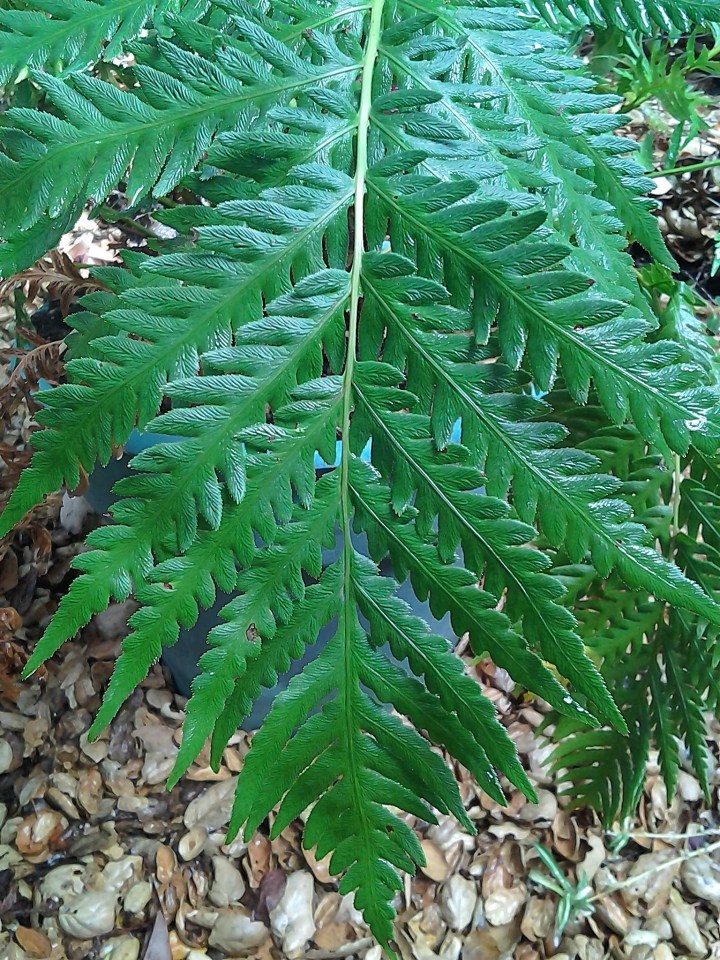 The list of what ferns will not do is more noteworthy than the list of what they will do. They do not bloom with colorful or fragrant flowers. The do not produce fruit. Very few turn color in autumn, and their color is generally nothing to brag about. Most ferns will not maintain their appeal through drought, or if neglected too long. Nor will they tolerate heat and wind, especially in full sun exposure.
Yet ferns are still popular for what they ‘will’ do. They provide remarkably distinctive and stylish foliage. They survive in spots that are too shady or perhaps too damp for other plants. Ferns will be quite happy in pots or planters, and some are happy to grow as houseplants. Ferns somehow avoid getting eaten by deer. If a fern gets tasted by a deer who does not know better, it will survive.
All ferns are perennial. Most are evergreen. Their foliage arches upward and outward from the terminal buds of stout rhizomes. Some ferns develop dense foliar rosettes. A few develop trunks by growing vertically instead of horizontally, and dispersing roots downward through their own decomposing fibrous rhizomes. Many ferns will get quite broad. Many are quite delicate and diminutive.
Ferns may not require too much maintenance, but the little bit of maintenance they require is somewhat important to keep them looking tidy. Old foliage should be pruned away as it is replaced by new foliage. This may be as simple as pruning away all old foliage just after new foliage develops early in spring. For some ferns, small batches of old foliage might get removed through the year.
The foliage of ferns is comprised of leaves known as ‘fronds’. With few exceptions, the fronds of ferns are intricately lobed or divided into smaller leaflets known as ‘pinnae’. (‘Pinna’ is singular for pinnae.) These pinnae are arranged on opposite sides of fibrous leafstalks known as ‘rachi’. (‘Rachis’ is singular for rachi.) Rachi are quite fibrous and tough, so should be cut close to the ground with pruning shears when they get groomed, rather than plucked.
Albino
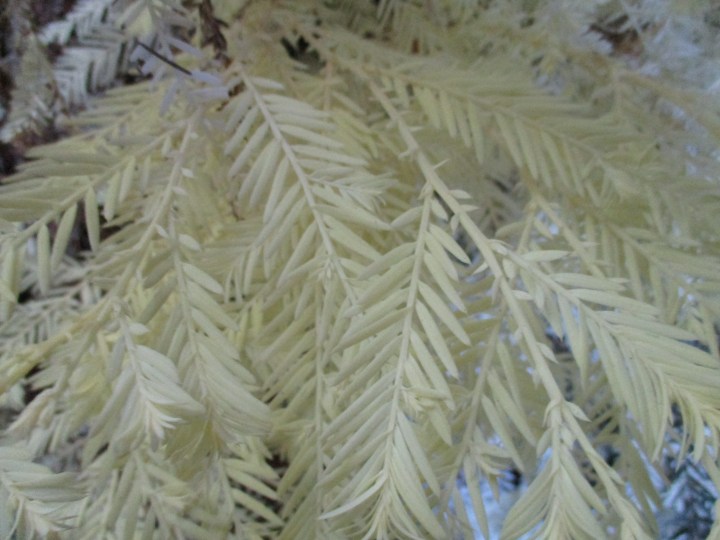 How Italian! Red, white and green! A coastal redwood with a white albino sport (mutant growth) amongst otherwise deep green foliage. Actually, it is very Californian. Coastal redwood is endemic to California with only a a few north of the border on the extreme southern coast of Oregon.
Such sports are quite rare. Back in the late 1970s, an article in World Magazine mentioned that only five of these albino ‘trees’ where known to exist. There were actually more, even back then, but others were not documented. (They were WithOut Papers – WOP.) The specimen in the picture is at a home that is about a century old, so it was known about for a very long time, although not documented.
Albino foliage is a lethal mutation. It lacks chlorophyll, so can not sustain itself. It only survives because it originates as basal watersprouts that remain attached to the original green trees that produce and then sustain it. Attempt to graft albino grown onto other green trees has been unsuccessful.
Albino growth looks pretty in pictures, and is provides striking (although very perishable) cut foliage that is even more striking with black flowers, but does not make such a nice tree. It stays shrubby at the base of the originating tree, without developing distinct trunks or substantial branches. It does not shed old foliage as efficiently as green growth does, so always looks grungy. To make matters worse, albino foliage is more sensitive to frost, so gets killed back every few years or so, and then is slow to shed the dead foliage and stems.
Coastal redwood is one of the most fascinating trees in the World. It is the tallest, and among the biggest and oldest. It is no wonder that it is the state tree of California.
Summer Weather Can Scorch Foliage
 Severe summer weather is something that we think that we do not need to contend with. It only rarely gets as unbearably hot here as it does elsewhere, and when it does, it usually gets breezy by evening, and somewhat cooler overnight. Aridity, or the lack of humidity, is another advantage, at least for us. The plants in our gardens are affected by warm weather very differently than we are.
Plants will tolerate significantly more warmth than we will, but only in conjunction with humidity. In our climate, we get one or the other, but not often both. In fact, humid warmth is so rare here, that when it happens, it causes spontaneous limb failure in trees that are not accustomed to it. Spontaneous limb failure occurs as vascular activity accelerated by warmth increases foliar weight, but humidity inhibits evapotranspiration (evaporation of moisture from foliar surfaces) that would decrease the weight.
The aridity and breezes that make warmth more comfortable for us accelerate evapotranspiration, which increases the need for moisture. Plants that lack adequate moisture wilt, and the foliage of some can get dehydrated or scorched. Wilted plants recover if watered soon enough. Dehydrated foliage is crispy and can not recover. Severe dehydration kills buds, stems and entire plants.
Scorch is quite different from dehydration. It happens as overly exposed foliage literally gets cooked by sunlight. It is similar to sun scald on formerly shaded bark that gets cooked by sunlight after being exposed by pruning or other means of removal of adjacent vegetation. Scorch is more likely on inner foliage that had been recently exposed by pruning, or foliage near reflective surfaces.
Foliage can not recover from scorch. Damage is permanent, and should not even be pruned away. Just like foliage damaged by frost, outer foliage damaged by scorch shelters the inner foliage. Removal of damaged foliage exposes foliage behind it to subsequent damage. Besides, scorch typically damages only parts of individual leaves, so that undamaged parts continue to function.

