Old fashioned New Zealand flax, Phormium tenax, is becoming increasingly uncommon. It is simply too big for compact modern gardens. Even without upright stems, its vertical and olive drab leaves can reach ten feet tall. They can flare outwardly as wide as fifteen feet. One cultivar is bronzed. Another is variegated. Both are somewhat more compact.
Most modern cultivars are either Phormium colensoi or hybrids of the two species. They are more compact and more colorful. ‘Jack Spratt’ grows only about a foot and a half tall, with chocolaty bronze foliage. ‘Yellow Wave’ gets about three or four feet tall with arching foliage with yellow stripes. Others are bronzed or striped with yellow, brown, red or pink.
New Zealand flax is remarkably resilient. The evergreen foliage is so very fibrous that it can be difficult to cut. Tough rhizomes that migrate where they are not wanted propagate easily by division. Some cultivars can revert by generating less colorful mutant growth. Since it is greener, such growth is more vigorous. It can overwhelm and displace more colorful foliage.
Of the few unrelated species of dusty miller, the most common here is Senecio cineraria. Like other dusty miller species, its foliage is remarkably silvery white. Its foliar tomentum can be so thick that it resembles fine felt. Individual leaves exhibit intricately deep lobes. They are about two to five inches long, but are smaller and simpler on upper floral stems.
Dusty miller blooms with floppy clusters of tiny but bright yellow daisy flowers. However, because the colorful foliage is more appealing, bloom might not be a priority. Removal of floral stems prior to bloom promotes denser and neater foliar texture. Within more severe climates, dusty miller is a warm season annual. It is a resilient shrubby perennial locally.
Mature specimens of dusty miller can get a bit taller than three feet with bloom. They are shorter with grooming and pruning to maintain compact form without bloom. If necessary, they are conducive to pruning to limit their height to about a foot and a half. This species tolerates a bit more partial shade than other dusty miller. Ideally, it prefers sunny warmth.
Floral color gets most of the attention within home gardens through spring. It should. It is the most copious and most colorful of color. Though, it is not the only color. A few species that provide floral color, and more that do not, provide colorful foliage. Similar to Olympic Medals, this foliage can be bronze, silver or gold, or variants of such. Some rivals bloom.
Colorful foliage is not the same as foliar color of deciduous foliage as it sheds in autumn. Much is evergreen. Most is most colorful while it grows through warming spring weather. Actually, most fades through summer, and some becomes simpler dark green by autumn. Afterward though, some deciduous colorful foliage also develops foliar color for autumn.
The most popular colorful foliage is variegated. This means it is partly green with stripes, margins, blotches, spots, patterns or blushes. The color range of such variegations is as variable as its pattern range. Some foliage is variegated with a few vividly distinct colors. New Zealand flax, coleus, croton and caladium are some of the more familiar examples.
Of all unvariegated colorful foliage, bronze foliage is the most variable. It includes foliage that is brown as well as reddish, purplish or perhaps dark orangish. Some emerges pink before developing a darker shade. New photinia foliage is reddish bronze only briefly as it matures as dark green. Purple leaf plum and smoke tree are famously purplish bronze.
Silver foliage is the most useful colorful foliage in the wild. At high elevations, where sun exposure is harshly intense, it is selectively reflective. It absorbs sufficient sunlight for its photosynthesis, but not enough to succumb to scald. It is how Arizona cypress and some agaves survive in the high desert. Such foliage may be gray, pallid blue or almost white.
Many species with gold foliage are the same as those with bronze foliage. New Zealand flax, smoke tree, barberry and elderberry can be either bronze or gold. Since gold foliage contains less chlorophyll than green foliage, it is a bit less vigorous. Unlike silver foliage, it serves no natural practical purpose. It survives in landscapes for visual appeal.
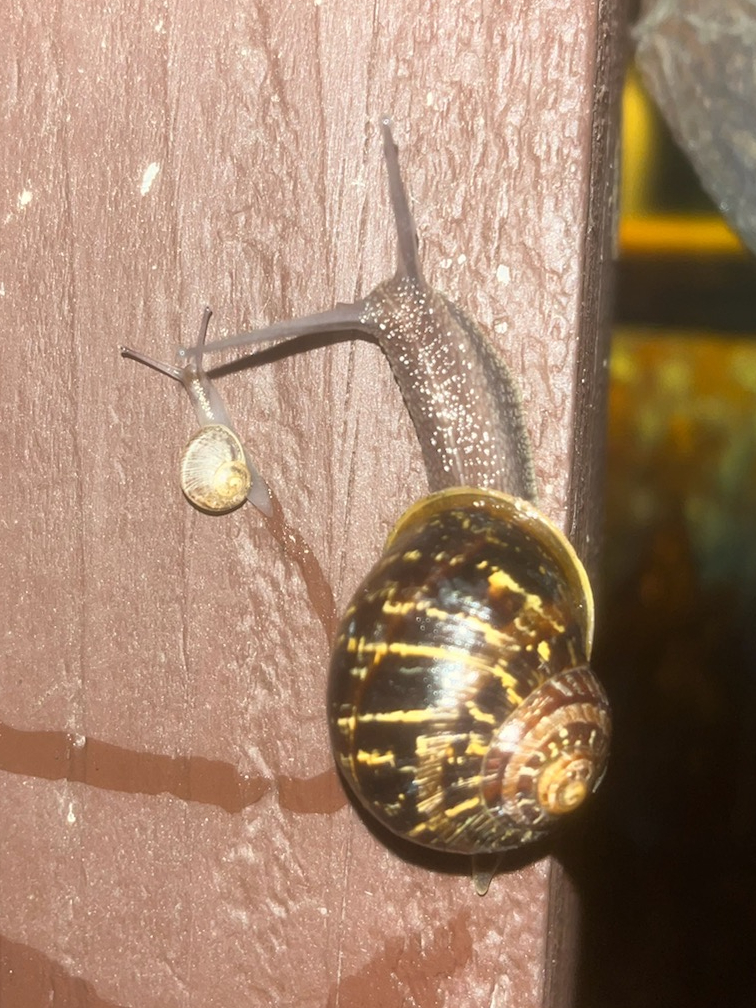
The problem with escargot that is too fresh is that it grazes – a lot! Snails, as well as slugs, lurk in our own gardens, waiting for nightfall, or sometimes not, to emerge and devour any tender plant parts that appeal to them. They tear apart large leaves and fresh flowers, and eat seedlings completely. They are particularly problematic this time of year, while the garden is still damp, but the weather is getting warmer, and especially since there is so much fresh new vegetation for them to eat.
The most effective means of controlling these troublesome mollusks is to eliminate their hiding places where they camp out during the day. This involves pulling large weeds and removing any debris that may be laying about the garden. Leave no stone unturned. Of course, this is not so easy in lush gardens with abundant or overgrown foliage, and features like large pots and statuary. In such situations, cunning and diligence are in order.
I have found bare copper wire wrapped around pots, planters and tree trunks to be an effective deterrent. Copper tape sold in nurseries and garden centers is probably better since it is wider. It can be self adhesive, or stapled to wooden containers or shelves. Snails can get past the copper though, on any plant parts than hang over where the snails can reach. Wire should be removed from tree trunks after ‘snail season’, or wrapped in a manner that accommodates for trunk expansion. For example, an ‘S’ shaped curve in the circling wire set flatly against a tree trunk provides enough slack for a bit of expansion.
It is also good to hunt snails as they come out after dark or before they go in for the morning. They are neither elusive nor fast. They are merely objectionable to handle. Laying a piece of cardboard or similar material out for them to hide under, and then surprising them during the day is a sneaky trick, but effective. Putting small puddles of beer out in shallow containers, such as saucers for potted plants, is more work, but not often as effective. It is sneakier though, since it entices the snails to stay out drinking until they die in the sunlight.
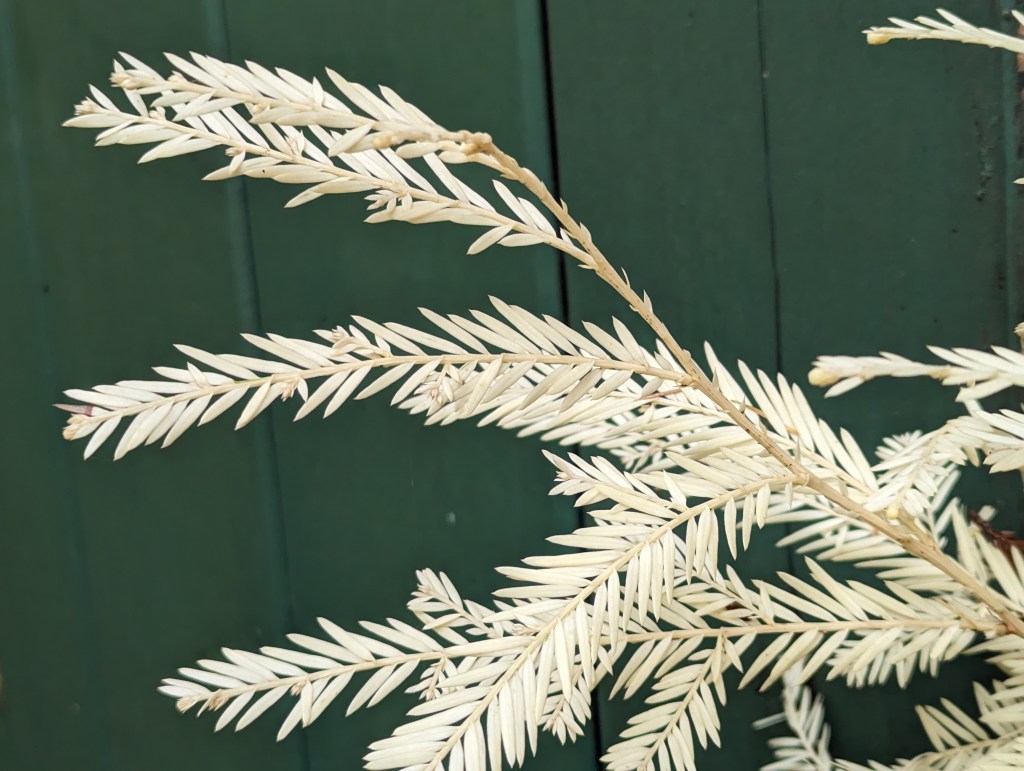
North Fourteenth Street is about as close as I have ever been to Italy; but amongst all the Green foliage here, I can find a bit of White albino Redwood foliage. It is a ‘sport’, which is a silly word for mutant growth. Because it lacks chlorophyll, and is consequently unable to photosynthesize, it is reliant on resources that it draws from the tree that generated it, which has a canopy of normal green foliage. Because of this reliance, copies of this mutant growth can not be grown as cuttings. Such cuttings simply could not sustain their own growth. I have made a few unsuccessful attempts to graft this mutant growth onto normal trees. The scions deteriorate before they can graft. I should try again. This foliage really is as strikingly white as it looks in pictures. I am certainly no expert on floral design, and I know that this foliage does not last for long once cut, but I suspect that it would look striking with black bearded iris or black hollyhock, or on a smaller scale, with black pansies or black petunias. Heck, it might likewise be striking with white flowers. In the early 1970s, albino redwoods, which are merely albino sports of normal redwoods, were considered to be very rare, with only a few documented specimens. Although they really are quite rare, many more have been documented since then, and many more, such as this specimen, remain undocumented. I wrote about this albino redwood foliage a few years ago, and was reminded of it by the wildlife photographer of Portraits of Wildflowers near Austin. Except for a few trees that are barely north of the border with Oregon, coastal redwood is exclusively native to the West Coast of California. It is the tallest tree in the World.
Both alocasias and colocasias are striking foliar plants. Alocasias generally develop big leaves that point upward. Colocasias generally develop even bigger leaves that hang downward. Alocasias are generally more colorful, perhaps with striking foliar patterns. Also, most tolerate more shade than colocasias. Of course, these are generalizations.
Asian taro, Alocasia odora, resembles colocasias as much as alocasias. Its big cordate leaves may point only slightly upward, and might sag downward. They can grow two feet long and a foot wide, on petioles as long as three feet. Collectively, foliage can get more than five feet tall. It is bright but monochromatic green, similar to that of Kermit the Frog.
Asian taro is only occasionally available from nurseries. Small plants are too delicate for nurseries to market too many of them for too long. Their dormant bulbs are more likely to become available with summer bulbs. They can be wider than three inches! They grow slowly though, especially while weather is cool. Foliage may not appear for two months.
Mexican weeping bamboo is more appealing in abundance.
Like junipers, bamboos have gotten a bad reputation from only a few of their problematic specie. Many of the traditional running bamboos really are too aggressively invasive. However, there are many clumping bamboos that are much more adaptable to confined and refined garden areas. Even these complaisant bamboos remain uncommon though, both because of the unpopularity of bamboos, and because they are not so easily produced.
Mexican weeping bamboo, Otatea acuminata aztecorum, is certainly one of the more interesting of these clumping bamboos. Their limber inch and half wide stems are not nearly as rigid as those of most other bamboos are, and may bend down to the ground under the weight of their abundant and remarkably finely textured foliage. The four or five inch long leaves may be only an eighth of an inch wide. Both the stems and foliage move nicely in even slight breezes.
Established plants are somewhat resilient to neglect, but can get rather yellowish and will likely stay less than ten feet tall without regular watering. With regular watering and monthly application of nitrogen fertilizer, such as lawn fertilizer, during warm weather, they can get twice as tall. Old canes should be pruned to the ground as they begin to deteriorate. There should be plenty of fresh new stems to replace them.
It is no wonder that the many specie of horsetail have been around since the Carboniferous Age. They seem to be impossible to kill! Because they can be so invasive and persistent, they should be confined to planters or areas of the garden where they can be controlled. They should probably be kept away from thickly foliated areas where they can spread and mix with other plants unnoticed.
Even though they are among the oldest plant specie, they seem well suited to modern architecture. Besides, the narrow areas between modern residences, walkways and driveways are confining by nature. Many modern buildings are even outfitted with awkwardly narrow planter areas that could use plants that get three or four feet tall without spreading out laterally, just as Equisetum hyemale, the most common species of horsetail does. The partial shade and potentially bad drainage in these confined spaces is not a problem.
The hollow segmented stems are rich green with black or dark brown joints. Some specie of horsetail have symmetrical whorls of wiry stems radiating from their joints. Otherwise, no other foliage is evident. Small knobs on top of the stems produce rusty brown spores. The larger types of horsetail are more likely to become invasive. Equisetum scirpoides stays about half a foot tall and is relatively complaisant. I do not know the identity of the horsetail that I got this picture of; but it has unusually large spore ‘blooms’ and a more relaxed texture.
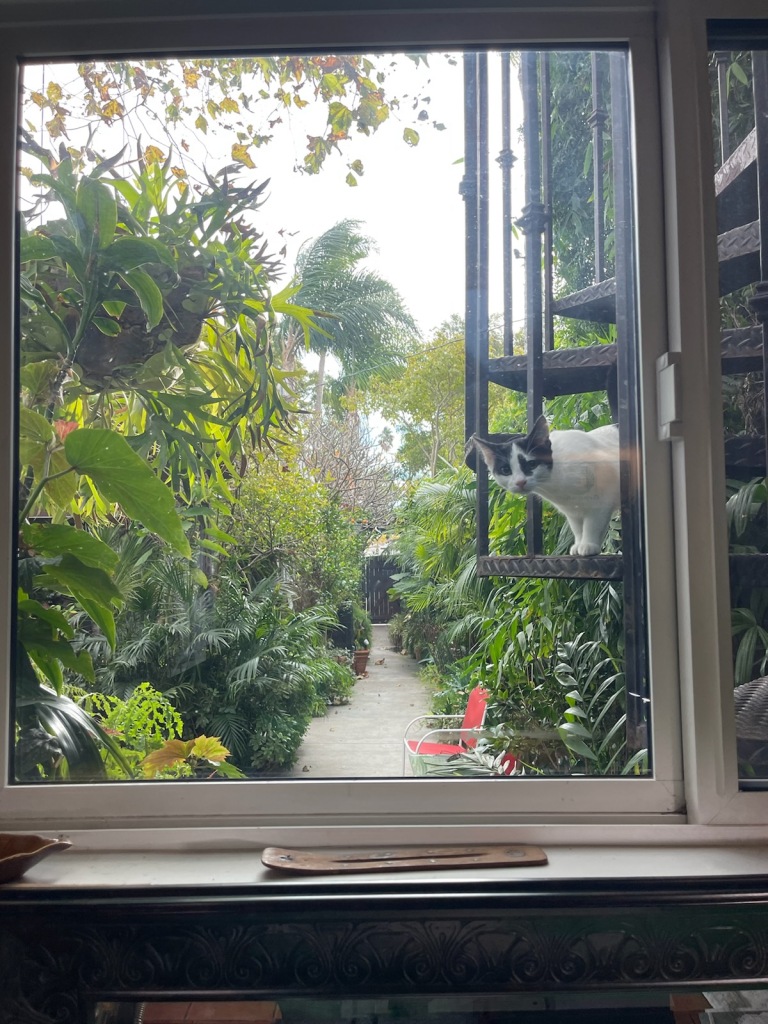
There is so much more to this picture than the kitty.
As Brent mentioned when he sent me this picture, which was included with my ‘Six on Saturday’ post earlier this morning, “There’s a lot going on in the picture.”
Slightly above the exact center of the picture, to the left of the tip of the kitty’s right ear, a Mexican fan palm peeks through a small void in the vegetation. It is at the curb of a home on the west side of the next street to the east. It is what Brent would have taken a picture of if he had zoomed in as intended. It leans to the right and south, as tall Mexican fan palms do there in response the the Santa Ana Winds.
The foliage of the queen palm above and to the left demonstrates that the Santa Ana Winds were blowing when the picture was taken.
The trunk that extends upward through another smaller void in the vegetation below the queen palm foliage is of another Mexican fan palm at the curb in front of Brent’s Jungalow. It is in alignment with the other Mexican fan palm to the east. Its canopy is obscured by that of the queen palm.
The foliage above and to the right of the primary Mexican fan palm, but below and to the right of the queen palm, is pink trumpet tree, which blooms spectacularly bright pink for spring.
The defoliated thicket of stems below and to the left of the primary Mexican fan palm is a large plumeria, which Brent, while very young, acquired from an elderly neighbor. He got it at about the same age that I was when I acquired my Dalmatian iris and rhubarb. More than a dozen other plumeria grow and bloom in a row that extends parallel to the walkway, in front of and behind the large specimen that is visible.
The somewhat yellowish foliage below and to the left of the plumeria is an impressively large Mexican lime that is somehow productive within all that shade.
The strange foliage that hangs outwardly from a dark central mass above and to the left of the Mexican lime, and left of the queen palm is a large colony of staghorn fern that is much closer to the window. Some sort of weird begonia foliage is below and to the left of it. California sycamore foliage is above it.
The top of a tall Indian laurel hedge is visible to the upper right of the picture. Some sort of odd dracaena and odd fern are visible to the lower left corner. Much but not all of the remaining vegetation is a mixture of understory palms, including various bamboo palms, Raphis palms and kentia palms. The spiral stairs lead to an upper deck, which has a splendid view of the rest of the garden that extends to the left, beyond the view of this picture. Finally, on the spiral stairs, is this kitty.
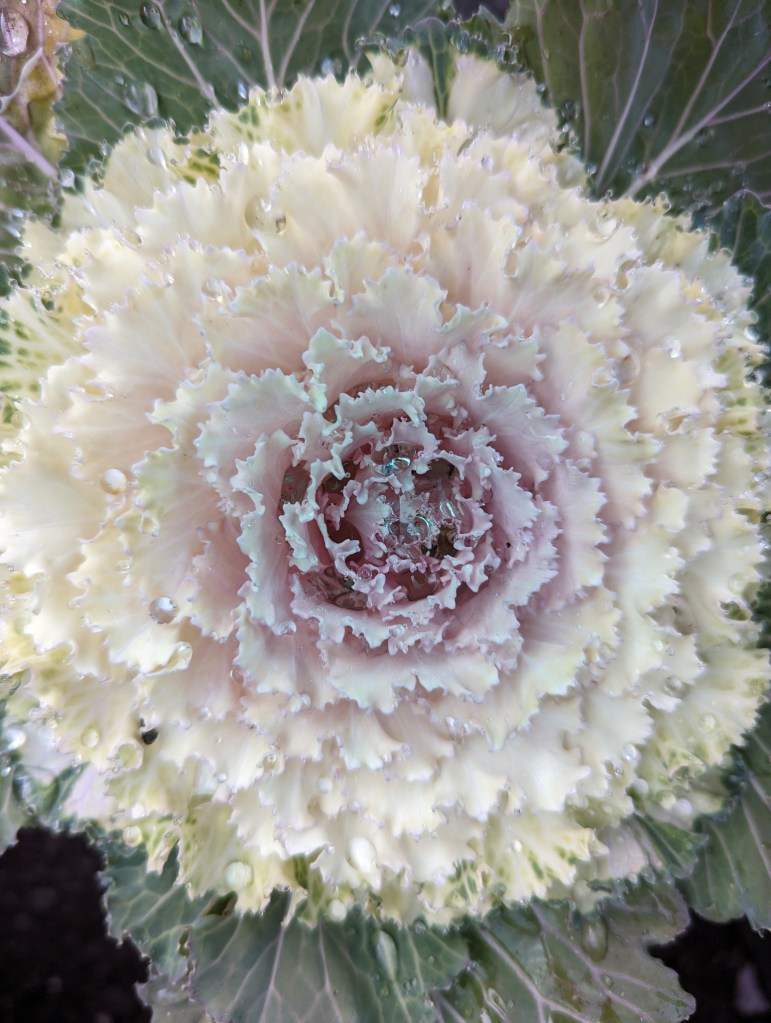
Flowering cherry trees are prettier but fruitless versions of their fruiting counterparts. So are flowering peach trees. It seems only fair that some vegetables could also be prettier than culinarily useful. Gourds are ornamental squash fruit that can qualify as vegetables. Ornamental kale, Brassica oleracea, is an actual vegetable that is primarily ornamental.
Ornamental kale is also known as flowering kale, or ornamental or flowering cabbage. It is more foliar than floral though. Its dense foliar rosettes unfurl like big ruffly roses. Some are very ruffly. Some are intricately lobed. Foliar color can be white, pink, red or purplish. Ornamental kale is as edible as culinary kale, but a bit more bitter. It is a splendid garni.
Like cool season annual flowers, ornamental kale performs between autumn and spring. It grows quite slowly though. Seed that starts in August grows into seedlings for October. Seedlings that start in October only begin to get colorful during November, a month later. Their seemingly floral but foliar display ironically ends as they actually bloom for spring.





 Tony Tomeo