Such silvery foliage contrasts exquisitely with bronze foliage.
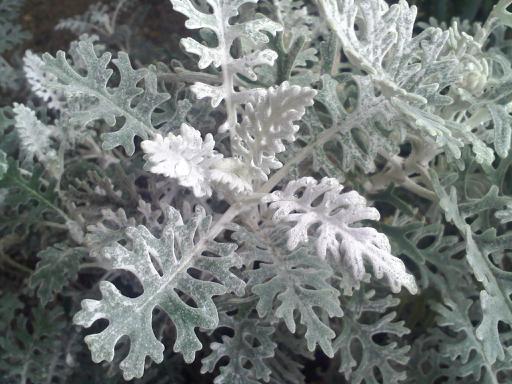
The relaxed trusses of small yellow composite (daisy-like) flowers of dusty miller, Senecio cineraria, can bloom at any time except when winter gets too cold. They are still blooming now. Yet, who cares? Dusty miller is grown more for its fuzzy white foliage than for bloom. It actually looks best and fluffier if occasionally shorn and pruned to remove blooming stems before they bloom. Individual leaves are intricately lobed. Mature plants get taller and wider than two feet. Dusty miller likes full sun exposure, good drainage and moderate water. Too much water causes rot and discoloration.
Gold dust plants actually prefers partial shade to full sun exposure.
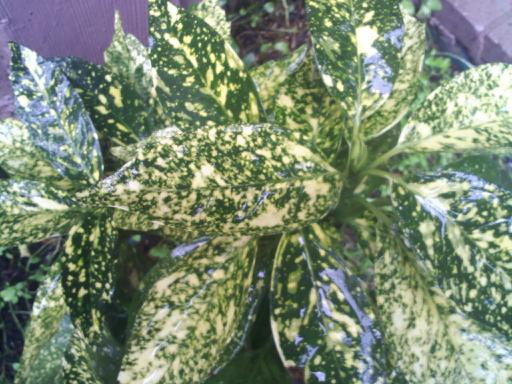
Like so many hollies, the gold dust plant, Aucuba japonica ‘Variegata’, is grown more for its glossy foliage than for flowers or berries. The tiny dark red flowers that bloom in the beginning of spring are barely visible. Clusters of bright red half inch wide berries that ripen in autumn and winter are almost never seen without a male pollinator. Yet, the three inch wide and three to five inch long leaves are colorful enough with their splattering of light yellow spots. Gold dust plant grows rather slowly to about six to eight feet tall and wide, and does better in partial shade. Foliage can get roasted if too exposed to sunlight.
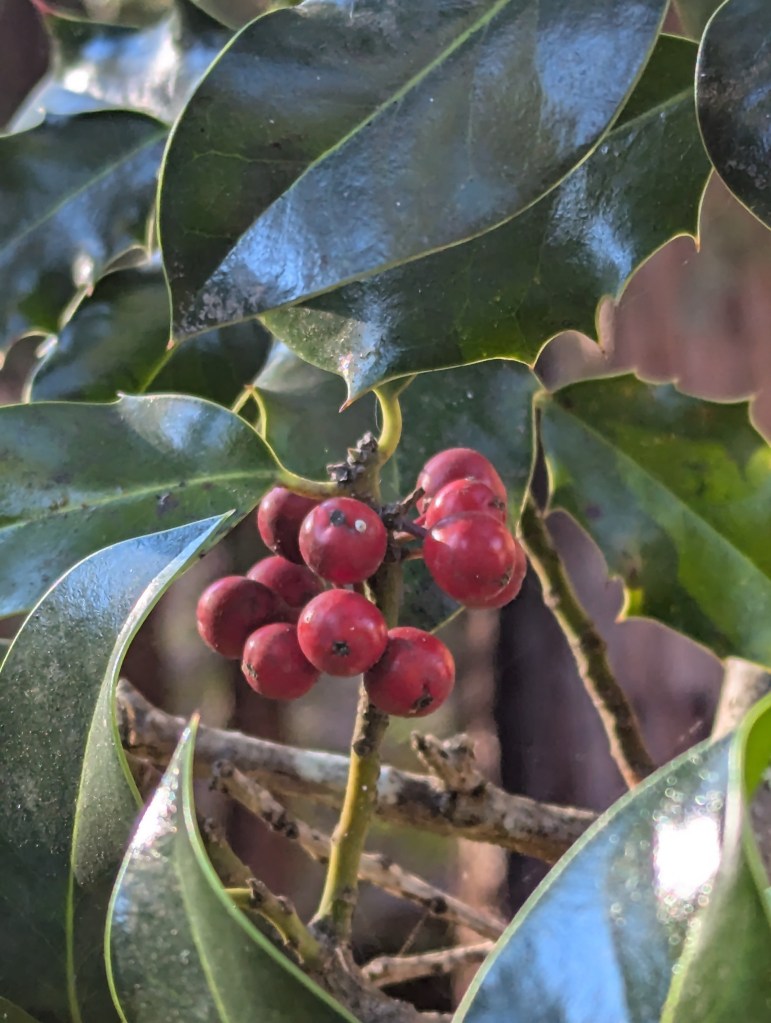
Hollies produced more bright red berries while they were more popular many years ago. Formal and perhaps lengthy hedges of exclusively female cultivars were common. A few or solitary male pollinators grew nearby, often as obscure small trees. Nowadays, males are oddly rare. Not many horticultural professionals are aware that hollies are dioecious.
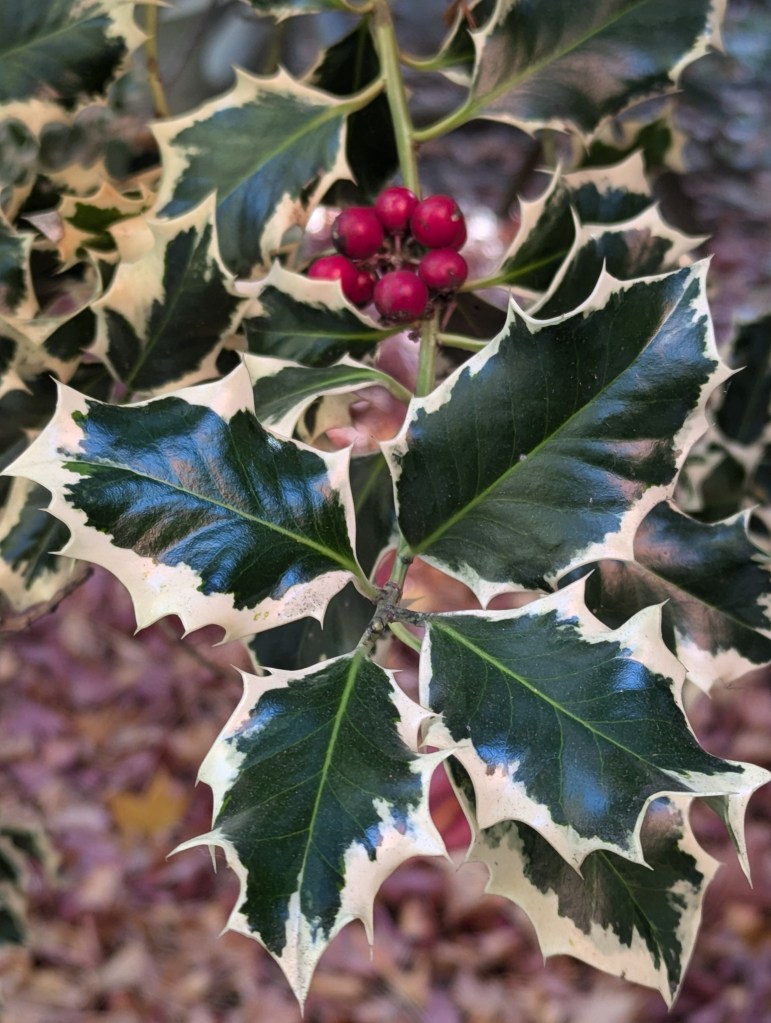
English holly, Ilex aquifolium, is both the most and least favorite holly. Some who grow it appreciate its distinctively intricate foliar texture. Others detest the unpleasant prickliness of the same foliar texture. No other holly is as spiny, although most are somewhat prickly. All hollies exhibit dark green foliar color, remarkably glossy foliar sheen and rigid foliage.
English holly can grow as a small tree with a dense canopy. With pruning, most stay less than ten feet tall. Cultivars with white or yellow variegation grow slower and stay smaller. Berries are common amongst naturalized colonies which naturally include both genders. Nurseries occasionally sell cultivars of both genders, potted together to mature together.
Winter bloom might be limited. Wintry berries, dried flowers and the remains of summery bloom can be more abundant. Evergreen foliage is as abundant as it always is. After all, it is evergreen. That is most likely why it is so popular for home decor through Christmas. It is the primary component of wreaths and garlands, and, technically, of Christmas trees.
Flowers are more scarce where winters are cooler. They are also more desirable indoors while the weather is too cool to be outdoors. Evergreen foliage effectively compensates. While flowers are less scarce here, the most traditional evergreen foliage is more scarce. It is simply less popular within home gardens locally. Also, less of it grows wild in forests.
Most cut evergreen foliage consequently grows on farms like certain popular cut flowers. Many of such farms are in the Pacific Northwest, where such foliage grows most readily. Many types of fir, spruce and pine that are popular for wreaths are naturally happy there. Western red cedar, which is the primary component of garland, is a native species there.
However, locally available cut evergreen foliage can be as delightful as traditional types. A few types are native species that grow wild beyond cultivated home gardens. More are exotic species within refined landscapes. Douglas fir is both traditional as well as native to many regions of California. A few native pines can substitute for more traditional types.
Redwood, cypress and juniper are likewise alternatives for traditional evergreen foliage. Some are natives or relatives of native species. Deodar and Atlas cedars resemble blue spruce. Arborvitae may substitute for Western red cedar, and is actually the same genus. English holly, although rare, and more rarely produces berries, is occasionally available.
Christmas trees are the ultimate form of cut foliage. Unlike other foliar decor, they almost exclusively grow on farms. Their cultivation is very impractical for refined home gardens. Collection of other cut foliage should not damage its source. Some may be from pruning scraps. Christmas trees, though, are much more than a few stems. They are entire trees, containing all their stems.
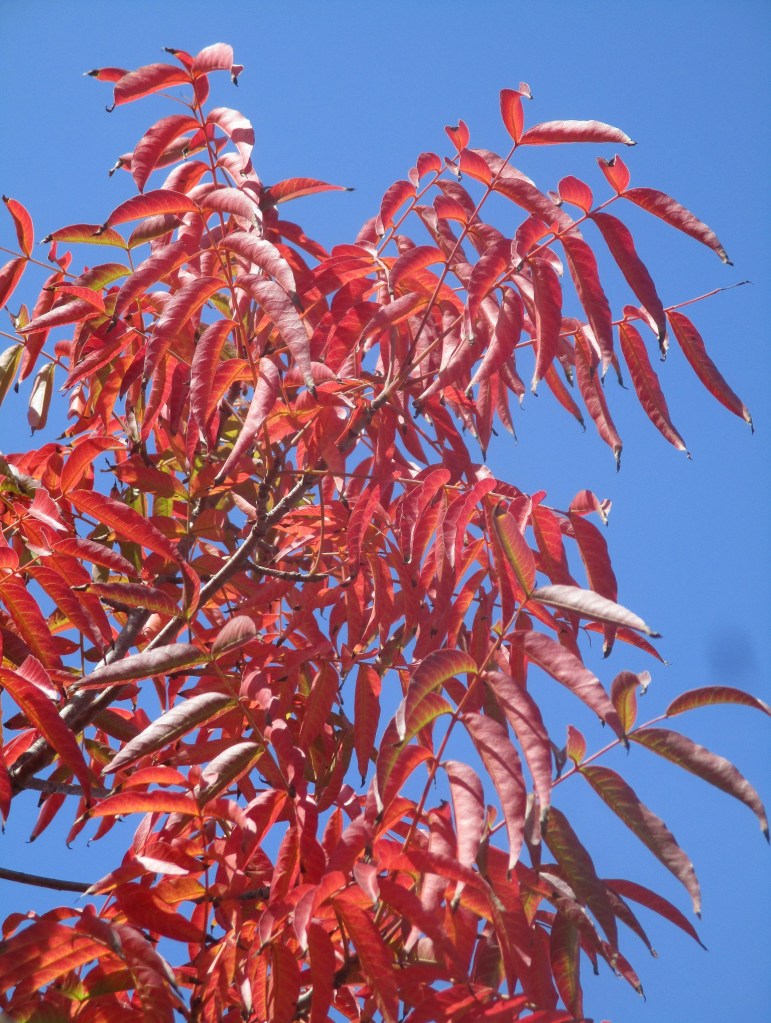
Pistache does not need much chill to develop exquisite foliar color.
Cooler climates may not have so much annual flower color to choose from at the end of summer, but have more autumn color from trees and a few shrubs and vines. The weather is of course different every year, so autumn color is never predictable. Just as some of the typically colorful trees may not be so spectacular every year, some of the more mundane trees may be surprisingly colorful if the weather is just so.
In milder climates, sweetgum (Liquidambar), flowering pear and Chinese pistache are generally the most reliable for the most color as the weather gets cooler. All three exhibit a good range of color, from clear yellow, through orange and bright red. Sometimes, particular colors are more prominent, or even exclusive. For example, Chinese pistache can be completely orange without yellow or red. Some cultivars of sweetgum specialize in particular color ranges. For example, ‘Burgundy’ turns dark red or purplish red without much yellow or orange.
In cooler climates, maples color well. Sugar maple is perhaps the most colorful, comparable even to sweetgum. Unfortunately, it does not hold onto its foliage as tightly, and soon looses it to slight wind or rain. Red maple colors just as reliably, but is more red and brown with less yellow and orange. Norway maple typically turns yellow or somewhat orange. Silver maple turns only dingy yellow, but gets big enough to make quite a show.
The best bright yellow is probably provided by maidenhair (Ginkgo biloba) tree. Birch, honey locust, tulip tree, fruitless mulberry, some willows and poplars can be comparable if the weather turns cool suddenly. Redbud, dogwood, hawthorn and flowering cherry are more subdued shades of yellow, but are grown more for their spring flowers anyway. Persimmon probably provides the best brightest orange foliage, followed by abundant and comparably bright orange fruit!
Some ash, some oaks, Chinese tallow tree, parrotia and dawn redwood all provide their own flavors of autumn color. Dawn redwood and pin oak actually turn simple brown, which some people think makes the trees look dead! Raywood ash turns a nice burgundy red or purplish. However, the old fashioned Modesto ash (which is a type of Arizona ash) turns as bright yellow as fruitless mulberry does. Not all crape myrtles have good fall color, but some are as colorful as sweetgum is. Various hazels, spiraeas and viburnums are colorful shrubbery in autumn. Wisteria vines, which are known more for their colorful spring flowers, turn yellow.
The primary problem with autumn foliar color is that it eventually becomes quite a mess. Premature shedding started the process even before much of the foliar color developed. Evergreen foliage can contribute to the mess, but most debris now is deciduous. Autumn is, obviously, its season for defoliation. Falling leaves merely do what is natural for them.
Falling leaves fall at different rates. Just as some fall prematurely, some might linger into winter. Also, some that usually linger into winter may fall earlier or later for some winters. Unusually cool, windy or rainy weather accelerates defoliation. However, defoliation can be slower with milder weather. Prolonged foliar color is pretty, but prolonged mess is not.
Besides falling at different rates, falling leaves are quite diverse. Big leaves of sycamore and fruitless mulberry are easy to rake away. Small and abundant leaves of Chinese elm require a bit more effort. They tend to sift between rake tines. Sycamore leaves disperse tomentum that is irritating and perhaps dangerous to inhale. Oak leaves stain pavement.
In a few relevant regards, falling leaves are quite convenient. Their absence allows more warming sunshine through as the weather cools. Not very long ago, they provided shade during summer warmth. Defoliation also allows wintery wind to blow more safely through deciduous trees. Otherwise, such trees would be more susceptible to damage from wind.
Falling leaves are also quite inconvenient. They clog eavestroughs and gutters precisely when they should not. As rainy weather begins for winter, it dislodges even more foliage. Also, it dampens foliar detritus so that it stains concrete and decking more than while dry. Raking detritus is most important while it is most unpleasant because of wintery weather.
Some coarse groundcover, such as Algerian ivy, can absorb smaller falling leaves. Most groundcover or turf is not so accommodating, though. Bigger leaves can overwhelm and shade them, as well as low or dense shrubbery. Slugs and, where they do not hibernate, snails can proliferate within this damp shade. So can fungal pathogens that tolerate chill.
Fall foliage is underappreciated here. It is not naturally prominent enough to suggest that it should be otherwise. Most native vegetation is evergreen. Most that is deciduous turns simple hues of yellow, without much orange or red. Some just gets shabby and brown as it defoliates with minor chill. Native vegetation does not represent total potential, though.
Contrary to common beliefs, local weather is not too mild for fall foliage to develop color. Only a few locally rare deciduous species need cooler weather for such color. Only a few deciduous species prematurely shed too much to develop their color for fall. Colorful fall foliage really could be more prominent within gardens than it is. It merely is not a priority.
Many home gardens here are within suburban or urban situations. Evergreen vegetation is therefore useful for privacy or to obscure undesirable views. Winter weather is not cold enough for evergreen shade to make it significantly colder. Some believe that deciduous vegetation is messier than evergreen vegetation. Some find it less appealing while bare.
Actually, evergreen foliage is generally more persistently messy than deciduous foliage. Although it sheds less abundantly, it does so more continuously through longer seasons. Some never stops shedding. Ultimately, the quantity of its detritus is at least comparable to that of deciduous foliage. Deciduous foliage sheds more profusely, but does so briefly.
Efficient shedding could be an incentive for deciduous vegetation. Sunnier conditions for winter could be another, whether or not it adds a bit of warmth. The color of fall foliage is obviously worthy of consideration also. Some types are more colorful than others. Some are more reliable than others. Ultimately, there is quite a bit of fall foliage to choose from.
Sweetgum, pistache and flowering pear develop the most exquisitely colorful fall foliage. Their color ranges from bright yellow, through orange, to deep red. Sweetgum is messier than the others, but only because it retains its fall foliage longer. Crape myrtle is smaller, but comparably colorful. Ginkgo is quite reliable for exceptionally brilliant yellow foliage, early in fall.
‘Siam Ruby’ banana started to display bronze foliar color before it seemed to revert to chartreuse.
Of the two dozen or so cultivars of banana here, ‘Siam Ruby’ is one of only two that are merely ornamental. It and ‘Zebrina’ produce fruit that is too seedy to be reasonably palatable. Both are instead grown more for their colorful foliage. ‘Siam Ruby’ develops bronze foliage with yellowish green spots. ‘Zebrina’ develops darker bronze or brown color mixed with more but darker green. Since their distinct foliar colors are their primary attributes, I was initially disappointed when ‘Siam Ruby’ seemed to revert to chartreuse green without any bronze foliar color. I was informed that it is typically chartreuse while very young or if shaded, but develops bronze foliar color as it matures with adequate sun exposure. However, I still suspect reversion because it started to display broad bands of bronze foliar color earlier, but became exclusively chartreuse green afterward. While inquiring about the potential for reversion with this particular cultivar, I learned that ‘Margarita’ originated as a reverted sport of ‘Siam Ruby’ with exclusively bright chartreuse foliage, just like the specimen of ‘Siam Ruby’ here that I suspect reverted. So, I may have indirectly acquired a fake copy of ‘Margarita’, which should contrast splendidly with the bronze foliage of both ‘Siam Ruby’ and ‘Zebrina’! The grower who sent the original pup of ‘Siam Ruby’ already sent a replacement. Now I want to see what the original pup does. If it recovers its bronze foliar color, there will be two copies of ‘Siam Ruby’ here. If it does not, I will consider it to be ‘Margarita’, which is still a rare cultivar. In a way, I sort of hope that it does not recover. A glitch such as this is a good excuse to try something that I would not try otherwise. Actually, we already have plans for it.
New foliage of ‘Siam Ruby’ banana is exclusively chartreuse green, without any bronze.
Indian summer is more typical here than not. As usual, the weather cooled somewhat as summer finished, and then warmed again. It is now autumn by date, but still seems to be summer by weather. This might confuse some vegetation, although some is familiar with this pattern. Some vegetation reacts by shedding foliage prematurely, prior to dormancy.
Prematurely shedding foliage is not the same as defoliation of deciduous species. Many of the species that exhibit such response to the weather are evergreen. More importantly, both evergreen and deciduous species do it prior to autumn dormancy. Also, they do not defoliate completely. There will be enough deciduous foliage for autumn foliar color later.
In the wild, prematurely shedding foliage is common among native California sycamore. It is a natural response to minor desiccation from any combination of aridity and warmth. It is as random as weather. Anthracnose is a foliar disease that might cause more severe defoliation earlier. Either type of shedding may be visually unappealing, but is harmless.
Actually, premature shedding foliage is common among many regionally native species. It helps them survive within chaparral climates. Although not a problem in the wild, it can be messy in or adjacent to refined landscapes. Both coastal redwood and coast live oak are notoriously messy. Yet, both species are evergreen and endemic to coastal climates.
Some exotic species from various climates can exhibit prematurely shedding foliage too. Species from other chaparral or desert climates are naturally proficient with the process. Species from less arid climates learn fast. It can be stressful for some of them. Daylength assures them that shedding is now safe. However, warmth that necessitates it might not.
Various species react variously to the various causes of premature shedding. That is too many variables. Simply, shedding is different every year because the weather is different every year. Eastern redbud and birchs that are exceptionally messy now may not be next year. Japanese maples happen to be shedding a bit less this year than they typically do.
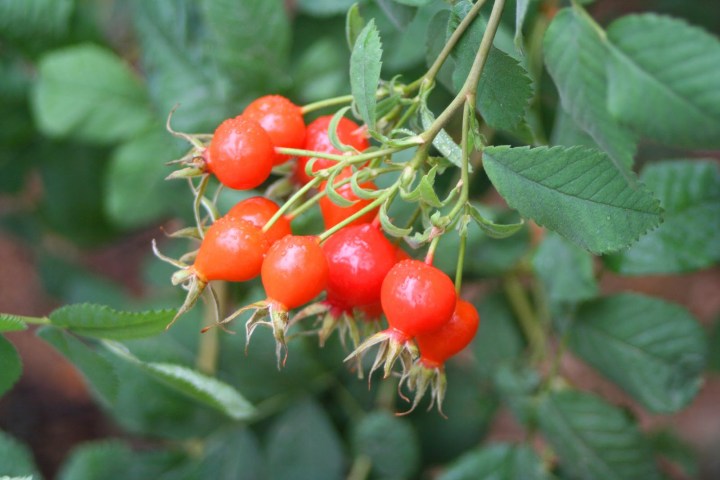
Rose hips are pretty fresh, and can alternatively be dried.
The problem with an abundance of bloom by lily-of-the-Nile over the summer is that all the spent blooms need to be plucked about now. Fortunately though, not all of the spent blooms need to go to compost or greenwaste. The stalks and floral trusses (the clusters of short flower stems on top of the stalks) can actually become interesting ‘dried flowers’, even though the real flowers are long gone.
Many years ago, my neighbor took many of the lily-of-the-Nile stalks that I plucked from my front yard, plucked off the seed capsules, and hung the empty stalks upside down until they dried and turned tan. Being the artistic sort, she added them to other dried flowers and foliage, and arranged them in a large vase (which I think is pronounced as ‘vahz’). Over the years, we found that we can actually let them dry in the garden if we first remove the seed capsules which would otherwise weigh them down and bend the stalks.
Since my artistic neighbor liked these lily-of-the-Nile flower stalks so much, I brought her other dried flower stalks to see how or if they could also be useful. We found that flower stalks from New Zealand flax were just as interesting and even more striking; and some types make rather tall stalks. The large seed capsules from Eucalyptus ficifolia function like modern substitutes for small pine cones.
There are many other plant parts that can be dried and used with dried flowers as well. Cut bird-of-Paradise leaves become sculpturally twisted as they dry. Petioles (leaf stalks) of windmill palm become simple but striking straight black sticks. While still green, the palm leaves can be cut with scissors into interesting shapes less than six inches wide (larger cutouts disfigure). Some native iris produce large seed capsules that split open as they dry, to reveal bright orange or red seeds within. Money plant is actually grown for its dried seedpods instead of for flowers of foliage.
Even bare stems can be added to dried flower arrangements. Both manzanita and madrone have gnarly stems that turn black or dark brown once cut. Fig has contrastingly thick and curving white or gray stems. Bamboo can be cut into sections of any desired length and stripped of foliage. Heavenly bamboo (Nandina spp.) has shorter canes with a corky texture. Realistically, there are no rules for what works well with dried flowers. Anything that looks good is worth trying once.
Straw flowers, statice (Including sea lavender), lavender, globe thistle and yarrow are some of the more traditional dried flowers. Cat-tails and pampas grass flowers can work as well in large arrangements as they did decades ago, but should be sprayed with hair spray to keep them from shedding. (Cat-tails can actually be very messy if they happen to explode.)
Although spray paint is much too synthetic for those of us who prefer dried flowers to look natural, it also works well to keep pampas grass flowers and cat-tails from shedding while adding serious color. Some people enjoy the potential for unnatural colors enough to spray paint other dried flowers and plant parts that do not need to be sprayed with a fixative.