What Is This?! III

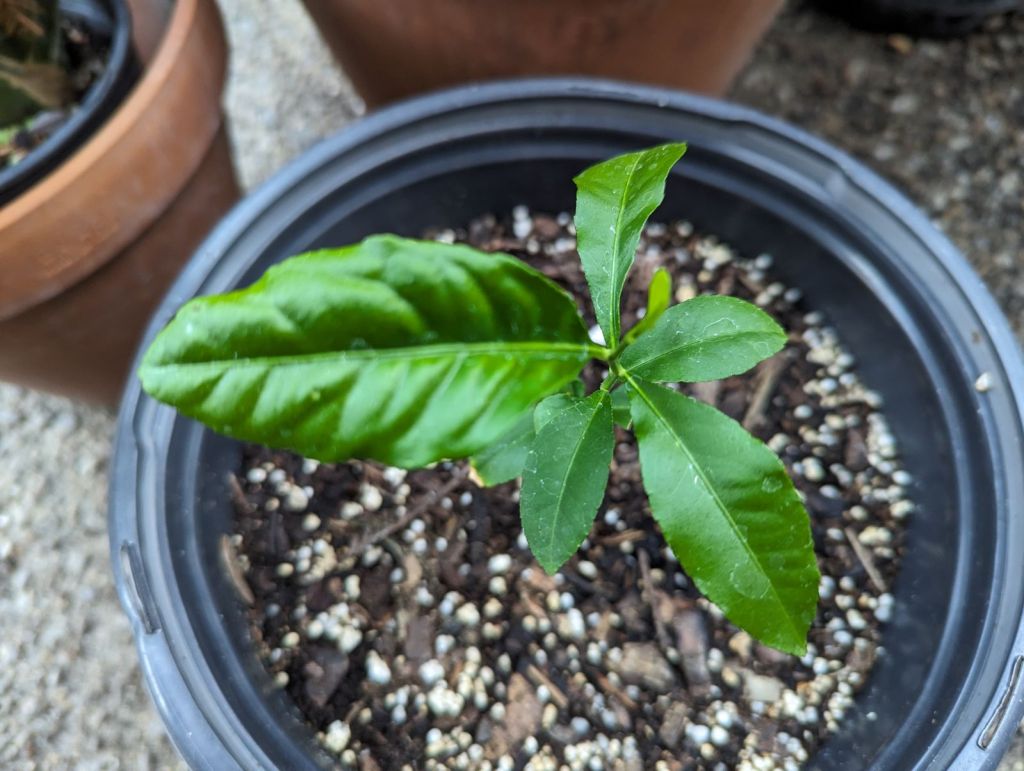
Could it be lychee?

Prior to the identification of Hibbertia scandens last week, another mystery arrived. I probably should have mentioned it earlier, but as with the previous mystery, I thought that I would have identified it before I felt compelled to mention it here. Unlike the previous mystery though, I did not recognize it as something that I had encountered in the past.

Someone with whom I work, who is not so horticulturally oriented, brought it from one of the homes that he was working at. It had been left by a former tenant. Initially, I thought that it was merely a can of otherwise unused media in which a common bay laurel seed had germinated. However, it is not a bay laurel seedling. Also, contrary to how it appears in the picture, it is remarkably centered within the can, as if intentionally plugged there.

Initially, I thought that it resembled coffee, Coffea arabica. However, coffee exhibits opposite leaf arrangement, and these leaves are alternately arranged. Besides, viable unroasted coffee seed is not exactly common. Now, I sort of suspect that it could be lychee, Litchi chinensis. Although uncommon, seeded lychee fruit are not as rare as unroasted coffee. Although their leaves are so closely paired among mature specimens that they seem to be oppositely arranged, they are technically alternately arranged, and more obviously so among juvenile growth. If this is lychee, it will not produce identifying bloom for a few years.

Realistically, immediate identification of this seedling is unimportant. I could have put less effort into discarding it than I put into writing about it. Therefore, I will merely give it what it needs until it grows enough for identification. I will not mind discarding it if I identify it as something that is useless. Otherwise, I can find it a home.

Jungle Update

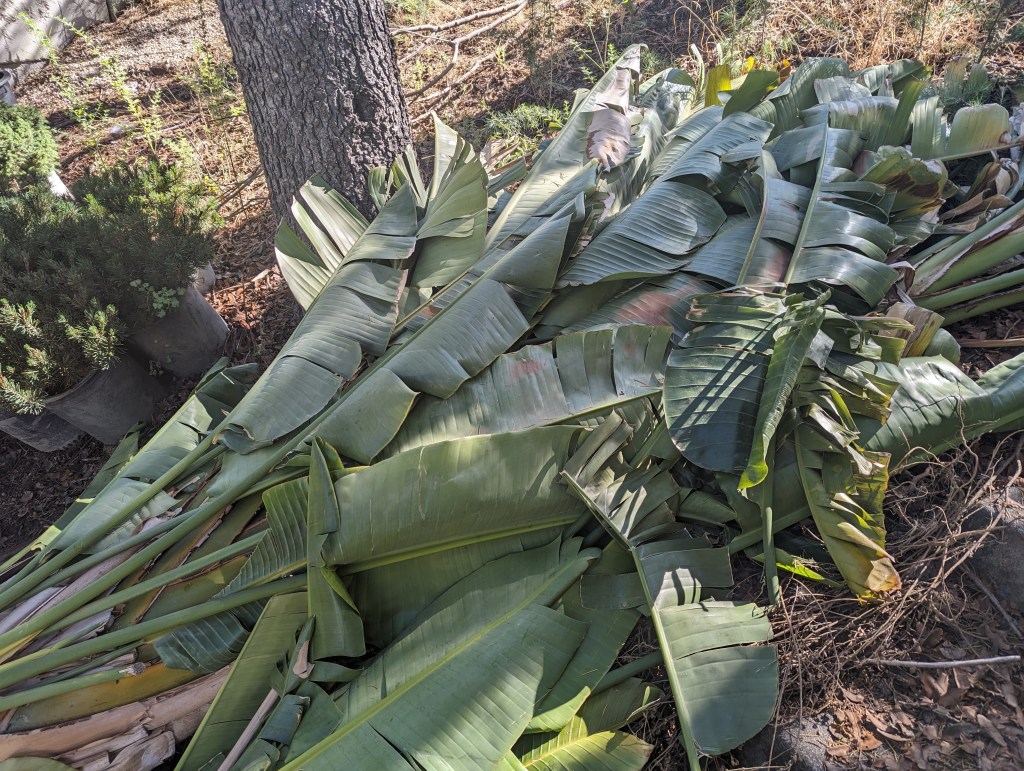
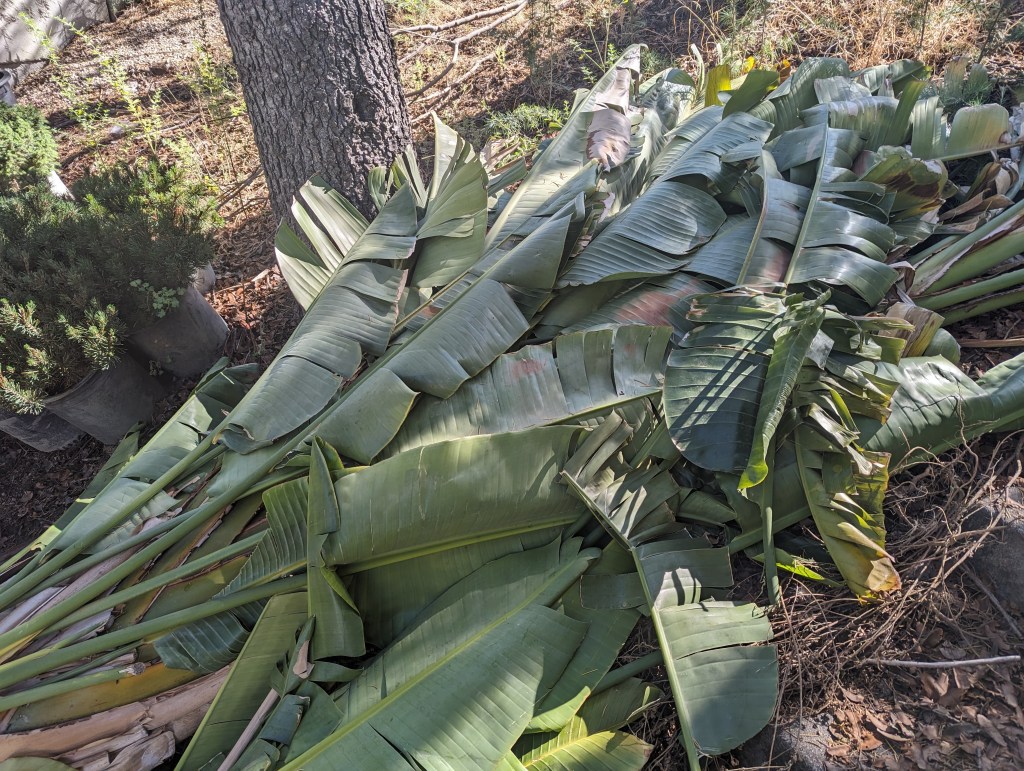
New foliage is already beginning to replace older foliage.

Strelitzia nicolai, giant bird of Paradise is growing! It is not much growth, but it is more than expected. The specimens were heeled in about a month ago to begin the slow process of recovery from division and relocation. Within the damp soil of their temporary situation, they should begin to develop rudimentary roots without actually dispersing them too remotely prior to another relocation to their more permanent landscape after the beginning of the rainy season of autumn. In other words, the roots should begin to grow, but not grow too much.

They can grow more when they get settled within their permanent situation. This is done in two separate processes because the specimens are easier to monitor and irrigate prior to rain within the confined space where they are heeled in. Besides, they would not be very appealing within their permanent landscapes until they begin to recover. Once they begin to recover, they should grow faster, so will not be too unappealing for too long, and even if they are, it will be through winter, when fewer people are here to notice.

Anyway, while they begin the process of recovery and development of rudimentary roots, foliar growth is expected to be minimal. It was expected to stagnate for at least a month or so, and then to slowly resume as the minimal foliage that was retained deteriorates. Like root growth, foliar growth should accelerate after final relocation.

Instead, foliar growth is already accelerating, perhaps as a response to removal of so much of the original foliage while foliage is necessary to sustain rudimentary root growth. Perhaps these specimens actually are as healthy and as vigorous as they seem to be. Although this fresh new foliar growth will be more vulnerable to frost through winter, it is nonetheless gratifyingly encouraging.

Six on Saturday: Welcome to the Jungle

Giant bird of Paradise, Strelitzia nicolai, is a grand perennial. It develops several trunks like those of palms, with lush leaves like those of bananas, and bold white flowers. Their bloom can be messy with its sticky and viscous nectar though. Brent and I refer to them as drooling seagulls. For this reason, these giant bird of Paradise needed to be removed. I was pleased to recycle them. They look pathetic now that most of their foliage has been pruned away to minimize evapotranspiration during their recovery. Most should begin to regenerate roots through summer, and then resume growth for next spring and summer.

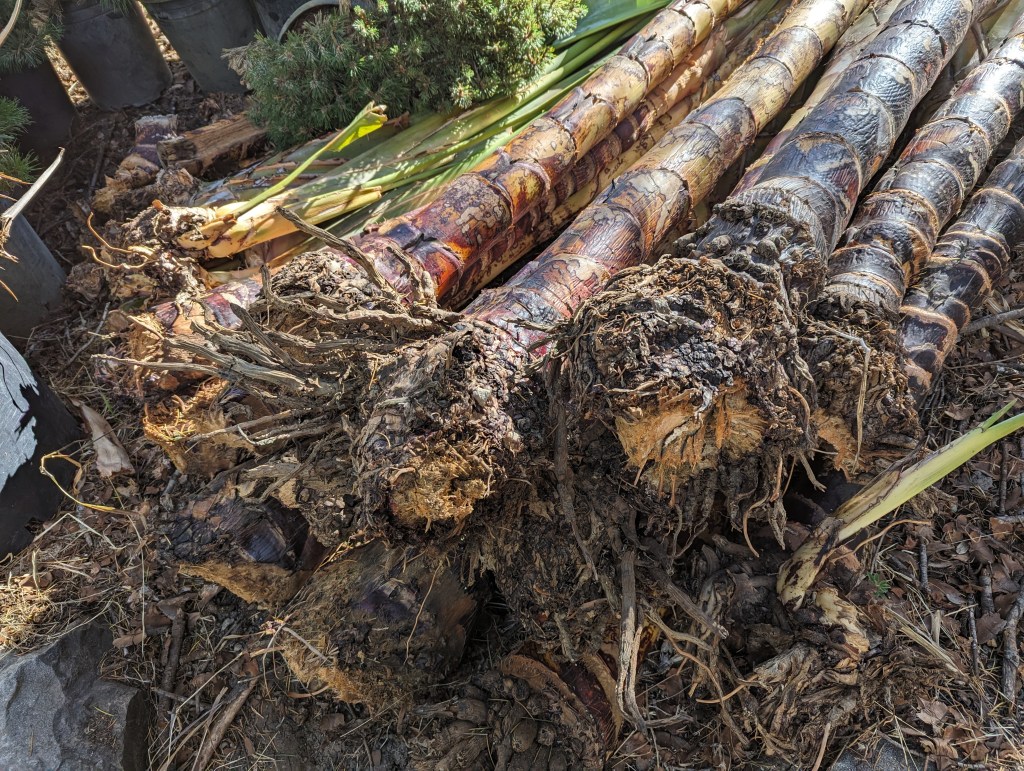
1. Giant bird of Paradise does not look so impressive laying on the ground. This is one of two piles of well foliated trunks that must be processed and heeled in until next autumn.

2. ‘A Flock of Seagulls’ demonstrates how abundantly these mature specimens bloomed. They are not just any seagulls, but are dead drooling seagulls. I will glean them for seed.

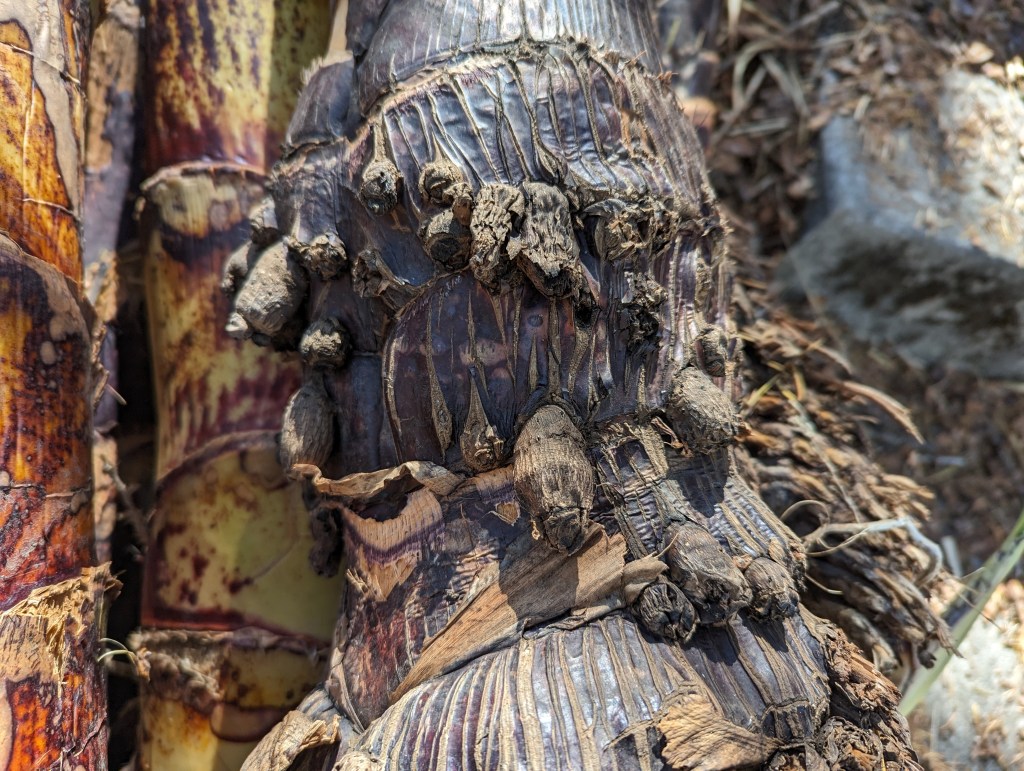
3. Husks make the trunks seem to be bigger than they are. They are the bases of petioles of leaves that were pruned off over the years. Trunks are leaner and tidier without them.

4. Severed roots are unimportant. They merely indicate that a portion of a subterranean rhizome remains attached to the base of a trunk. Trunks are neater without their husks.

5. Adventitious roots grow from portions of rhizome that remain attached to the bases of the trunks, and from the bases of trunks near the rhizomes. These roots are now buried.

6. Lineup shows that there are about a dozen significant trunks, a dozen shorter trunks, and half a dozen pups. They are heeled in here to begin rooting with frequent irrigation. They will be relocated to their permanent landscape after the rain starts during autumn.

This is the link for Six on Saturday, for anyone else who would like to participate: https://thepropagatorblog.wordpress.com/2017/09/18/six-on-saturday-a-participant-guide/

Giant Bird Of Paradise Migration

A Flock Of Seagulls

Giant bird of Paradise is not actually from Paradise, and if it were, it would not be the Paradise in Butte County that burned five years ago. This particular species, Strelitzia nicolai, is from South Africa, Mozambique, Botswana and Zimbabwe. These particular specimens are from none of these places though. They came from Morgan Hill. Nor are they actually birds, although they seem to be migratory like so many species of birds that migrate about the southwestern portion of Africa, and apparently Morgan Hill, but not Paradise. Oh, this is getting confusing.

Giant bird of Paradise, which is unrelated to Big Bird of Sesame Street, is a grand perennial that can get twenty feet tall. It resembles the more common bird of Paradise, but with tall trunks that resemble those of small palm trees. Also unlike the common bird of Paradise, their appeal is more foliar than floral. In other words, their primary attribute is their lush foliage, rather than their bloom. Actually, their bloom can be undesirable within some situations.

In fact, that is why these particular specimens needed to be removed. Their bloom was drooling messy nectar onto the pavement below. In horticultural slang, they are known as ‘drooling seagulls’ because of this habit, and also because their bulky white flowers look like seagulls peeking from the lush foliage, and of course, drooling while they do so.

Morgan, the old F250 who coincidentally is named after Morgan Hill, and I brought these giant bird of Paradise here, where they await processing. They are supposed to be left out of the ground for about two weeks anyway, so that they will be less susceptible to rot when planted and irrigated. After their processing, they will get heeled in here so that I can monitor them more directly as they begin their recovery. The best of them will migrate again to their permanent landscape after the rainy season starts. I should get better pictures of them and their processing for Six on Saturday.

China Doll

Most big China doll trees were formerly docile houseplants.

It is hard to believe that the original variety of the familiar China doll, Radermachera sinica, that grows so slowly to reach an eight foot high ceiling as a houseplant, can actually grow into a substantial fifty foot tall tree with a three foot wide trunk, where protected from frost. Modern varieties with more billowy foliage take even longer to reach the ceiling, and do not go much higher. The finely textured and very glossy foliage is bipinnately compound, which means that each of the half to two foot long leaves are divided into smaller leaflets, which are also divided into even smaller leaflets that are about an inch or so long. Trusses of tubular white flowers that resemble big catalpa flowers are almost never seen among houseplants or modern varieties, but are quite showy on big old trees.

Succulent Plants Exhibit Unique Foliage

Succulents provide unique texture and form.

All cacti are succulents. However, not all succulents are cacti. Actually, cacti are a very unique family. Their distinctive spines and thorns are very specialized leaves and stems. Such specialized leaves can not photosynthesize without green chlorophyll. Therefore, cacti rely on their succulent green trunks for photosynthesis. Their trunks work as foliage.

But of course, not all succulents are cacti. Other succulents have succulent leaves. Most also have succulent stems. Some, such as most agaves and some aloes, are spiny, but not like cacti are. They have real leaves that happen to be spiny. Yucca are supposedly succulent, likely because of their relation to agave. However, they lack succulent parts.

Furthermore, not all succulents are drought tolerant. Many are so only because they are naturally native to desert or chaparral climates. Many others are naturally native to less arid climates. Some that are native to tropical rainforests, like epiphyllum, crave regular watering. Many succulents thrive in harsh exposure. Some prefer a bit of cooling shade.

Succulents are generally very adaptable to container gardening. Ironically though, a few of the most familiar sorts are not as complaisant to containment. Several cacti and other desert species need more water while confined. They must compensate for their inability to disperse roots. However, frequent watering or even excessive rain might promote rot.

Agaves, including those of desert climates, happen to perform splendidly within big pots. In fact, some perform too splendidly. If they grow too big and heavy to move, they are as permanent as if in the ground. Their dangerously spiny foliage compounds the problem. Overgrown cacti are both very difficult to move, and likely to break apart in the process.

Fortunately, there are plenty of smaller, tamer and thornless succulents to choose from. They contribute a remarkable range of foliar form, texture and color to the garden. Some contribute colorful bloom. A few, such as aloes and agaves, produce sculptural bloom. Most succulents are naturally resistant to pathogens, and easy to propagate vegetatively. Rooted scraps are less expensive than nursery stock is.

Fern Foliage Is Softly Bold

Ferns provide distinctive and bold foliage.

Ferns are foliar perennials. They provide neither floral color nor fragrance. They provide neither fruits nor vegetables. With few exceptions, they provide no shade. The very few that are deciduous are not impressively colorful for autumn here. Ferns can not grow as hedges. Nor can they become lawns. They exclusively provide distinctive fern foliage.

They do so splendidly! Most produce the sort of distinctively lacy fern foliage that ferns are famous for. Some exhibit even more finely textured and airy foliage. A few exhibit a relatively coarse foliar texture. Almost all ferns are rich and deep green. Some are lighter or slightly yellowish green. A rare few are silvery gray, or display an intricate silver lining.

Almost all ferns that are popular within home gardens are evergreen. Most benefit from occasional grooming to remove deteriorating old foliage. Some produce new growth on top as old growth lies down below. Several grow most lushly after removal of all foliage prior to their growing season. A few deciduous types of fern defoliate for their dormancy.

Ferns do not develop stems or trunks like most other vegetation does. They sprawl over the ground with rhizomes, which are fleshy stems. Rhizomes grow only in length, but not in diameter. Tree ferns grow upward as their rhizomes deteriorate below. Roots that grow through the deteriorating rhizomes form what seems to be trunks. Fern roots are fibrous.

Leaves of ferns are fronds. Such fronds of most ferns divide into pinnae, which are like smaller leaflets. Pinnae of some ferns divide into even smaller pinnae. Rachi are central stalks that suspend the pinnae within individual fronds. Ferns reproduce by spores, so lack flowers. Most ferns propagate efficiently by division of preferably dormant rhizomes.

Because of their fibrous root systems, ferns are complaisant to confinement within pots. Most ferns are naturally understory vegetation, so are innately tolerant of partial shade. Ferns that tolerate aridity as well as shade and confinement are delightful houseplants. Most ferns are very tolerant of relocation, although some must replace foliage to adapt.

Six on Saturday: Like Totally!

Val culture developed within the Santa Clara Valley prior to its assimilation into the San Fernando Valley. I totally know how to use “like” in a sentence, and can do so repeatedly if I like. These Six are not about Val culture during the 1980s though. They are just a few items that are sort of like each other, and five items that I like. Eventually, I will like the item that I do not yet like. Totally!

1. Sambucus nigra ‘Black Lace’ is an ornamental cultivar of European elderberry. As the name implies, it has darkly bronzed and intricately lobed foliage. All but two of the herd of cuttings that I plugged rooted. I wanted a few, but got forty-eight. I was not at all fond of this cultivar or even this species when I met it a few years ago, but I now sort of like it.

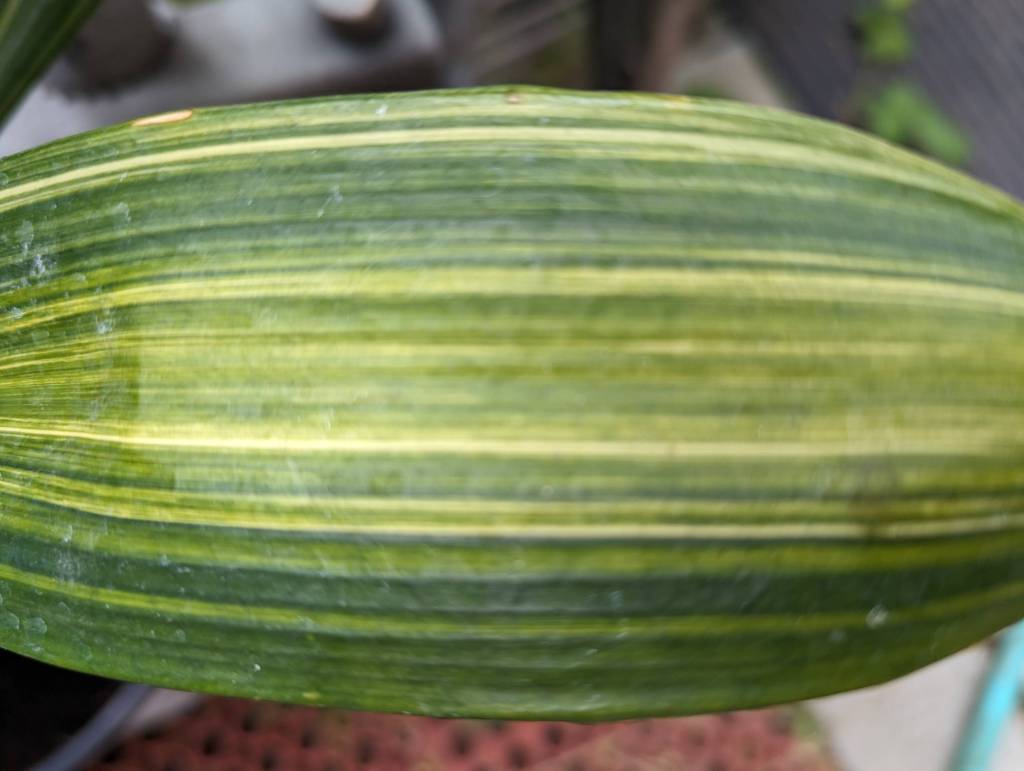
2. Clivia miniata, Kaffir lily lacks bloom now, but like ‘Black Lace’ European elderberry, provides colorfully ornamental foliage. It is variegated with these narrow yellow stripes. I believe it blooms orange. I do not know what cultivar it is. It came from Brent’s garden.

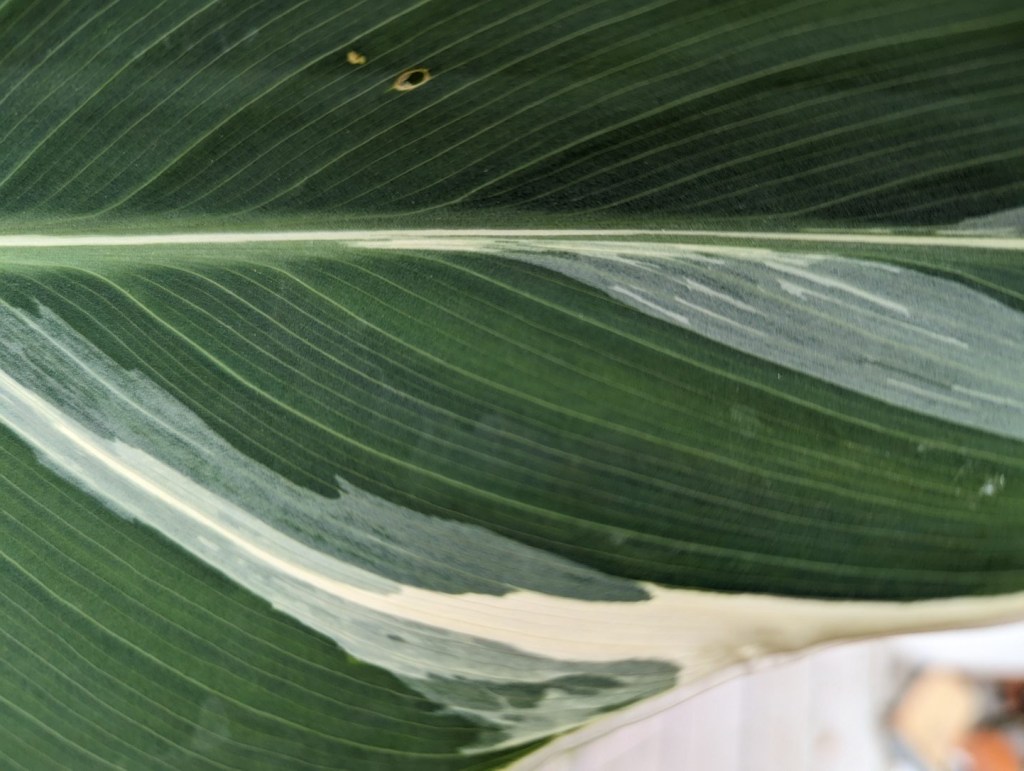
3. Canna ‘Stuttgart’, like the Cymbidium and the other two Canna, lacks a species name. Like 1, 2 and 4, it provides colorful foliage. Like 4 and 5, it is a Canna. It has a lot to like. Most importantly, it came from Tangly Cottage Gardening, and is approved by Skooter!!

4. Canna ‘Australia’ might be described like ‘Stuttgart’ Canna above, but is not approved by Skooter. Its colorful foliage is darkly bronzed, but this specimen is striped with green.

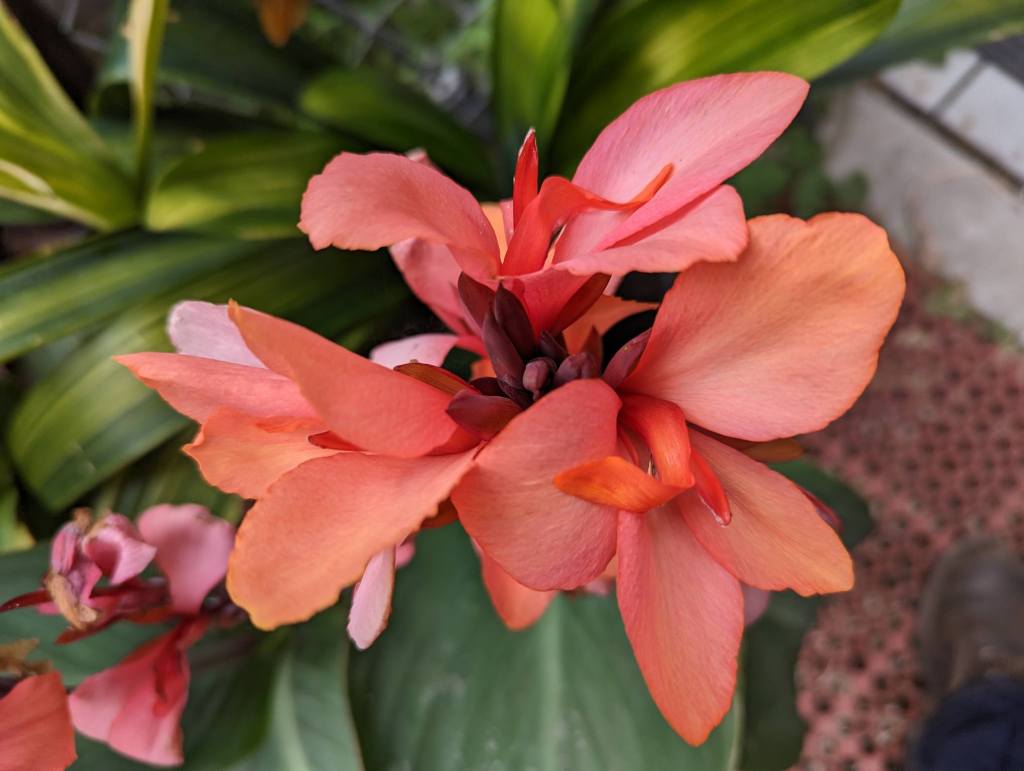
5. Canna ‘Cannova Mango’, like 3 and 4, is a Canna, but that is about its only similarity. I do not like it much because it is a modern cultivar, and it blooms with this weird color.

6. Cymbidium orchid, like 3, 4 and 5, lacks a species name. I like it because I have grown it since the early 1990s. Bloom began in March, but is only now beginning to deteriorate.

This is the link for Six on Saturday, for anyone else who would like to participate: https://thepropagatorblog.wordpress.com/2017/09/18/six-on-saturday-a-participant-guide/

Ornamental Foliage Augments Spring Color

Variegation contrasts nicely with darker foliage.

Spring bloom is the most colorful color in the garden here. It is not the only color though. Some deciduous foliage will provide color at the opposite end of the year. Bark can add a bit of color, particularly while deciduous trees defoliate for winter. So can colorful fruit. Furthermore, ornamental foliage, both deciduous and evergreen, can contribute color.

Ornamental foliage is not the same as deciduous foliage that is colorful only for autumn. The distinction is that it is colorful from the beginning. Generally, it is most colorful while fresh during spring. If both deciduous and colorful for autumn, it changes from one color scheme to another. If evergreen, it may remain more or less colorful throughout the year.

Ornamental foliage of this sort displays various colors and patterns. Variant colors might be yellow, orange, red, purple, blue, pink, bronze, white or gray. They can be variegation such as stripes, margins, blotches, spots, patterns or blushes. Alternatively, they can be monochromatic. Most fade to some degree during the warm and dry weather of summer.

The colors of ornamental foliage are not as vibrant as floral color. They are not intended to attract pollinators. In fact, most of such color serves no practical purpose. Blue, gray or white foliage mostly originates from high altitudes or harsh desert climates. It reflects a bit of excessive sunlight to avert scorch. Most other ornamental foliage is mere mutation.

In the wild, such mutant foliage is generally a disadvantage. White portions of variegated leaves contain less chlorophyll. Consequently, they can not photosynthesize as much as green portions. Such foliage only perpetuates unnaturally within cultivation because it is appealing. Some mutant ornamental foliage can revert to more vigorous greener growth.

Ornamental foliage can be annual, perennial or woody. New Zealand flax, canna, coleus and caladium are the most variably colorful. Coprosma and various pittosporum are a bit more limited. Euonymus, hosta and ivy display white or yellow variegation. Smoke tree, redbud and some maples are surprisingly diverse. Agave blue spruce and some junipers can contribute gray and blue. There are too many options to mention.

Variegated Foliage Adds Color And Brightens Shade

Variegation can be neatly symmetrical, or strikingly irregular like this.

With spider plant, croton, pothos, dracaena and the various ficus, variegated foliage seems to be very popular among house plants. Remember the wildly colorful variegations of coleus when it was a popular houseplant in the 1970’s? Variegation is most commonly white or some sort of yellow; yet can be just about any color.

In the landscape, variegated shade tolerant plants brighten shady spots even without bloom. Variegated acanthus, Japanese aralia, andromeda, hydrangea, aucuba and angels’ trumpet show up nicely, especially when they can contrast with the darker green of other plants; although andromeda and hydrangea do not bloom as well in darker shade. Variegated periwinkle and English ivy are nice ground covers, (but potentially invasive).

Variegated trees, like tulip tree and certain maples, stay smaller than their unvariegated relatives, so can be proportionate to large atriums that could use their brighter foliage. Some of the variegated pittosporums likewise function like the unvariegated forms used for informal hedges, but work better in tighter spots.

Even if there is no need to brighten areas that are already sunny, variegated holly, lily-of-the-Nile, bougainvillea, pampas grass and silverberry add nice contrast where there is an abundance of rich green foliage. (However, some people who grow variegated pampas grass are not too impressed by it.) New Zealand flax presently happens to be one of the most popular variegated perennials, with many different personalities of color to choose from. Variegated varieties of several specie of agave and yucca are striking big perennials for the sunniest and even inhospitably hot spots, as long as they are kept at a safe distance. (Many have dangerous spines and teeth!)

Some variegated plants, particularly New Zealand flax, andromeda, Pittosporum tobira and the various maples, try to produce unvariegated mutant growth that grows faster and bigger, and overwhelms the desirable variegated parts. It is therefore important to watch for and prune out unvariegated growth as it appears. For New Zealand flax, this involves diligent digging and splitting to removed unvariegated shoots from the variegated parent plants.